

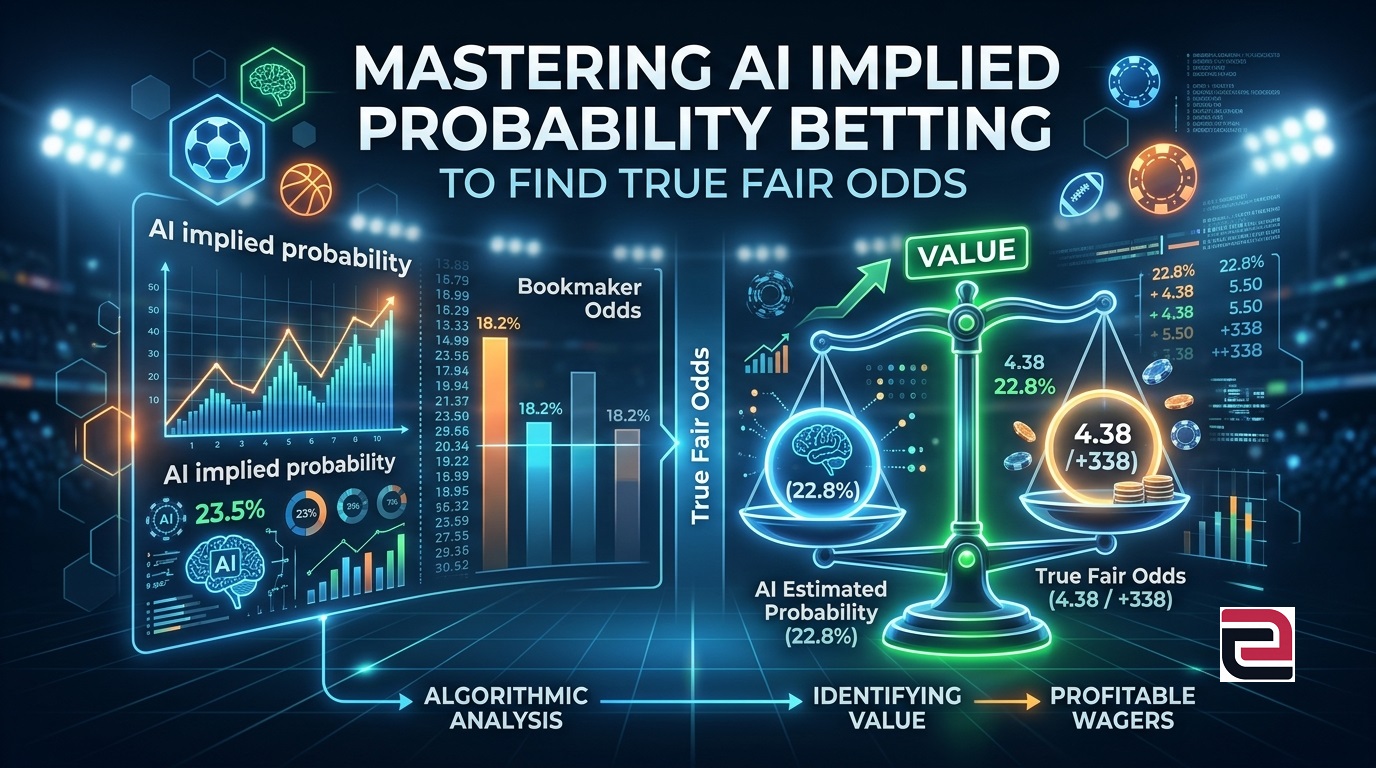
I treat implied probability in betting as the starting line, not the finish. That’s really the whole mindset shift. Most people stop at odds and think that’s the answer, but it’s not. Odds are just the surface layer. What actually matters is what those odds translate to in terms of real probability, and more importantly, whether that probability is accurate. Once you start thinking like that, everything changes.
So what I do is take sportsbook odds, convert them into probabilities, strip out the built in margin, and then compare that to what my own model thinks should happen. From there, it becomes less about guessing and more about making calculated decisions. The goal is simple. Find small edges, stay disciplined, and repeat the process over and over again.
Table Of Contents
- AI Implied Probability Betting: Building Calibrated Edges with Modern Models
- Foundational concepts for ai implied probability betting
- Modeling match outcomes with AI
- Finding edge vs the market
- Workflow, tools and ops
- Live timing and line movement
- Step-by-step: from line screen to placed bet
- Worked examples you can reuse
- Practical templates to operationalize
- Extra notes for ATS, props and multi-markets
- Common pitfalls and how to avoid them
- Quick-reference formulas and links
- Putting it all together the ATSwins way
- Conclusion
- Frequently Asked Questions (FAQs)
AI Implied Probability Betting: Building Calibrated Edges with Modern Models
Alright so let’s get into it. The whole idea behind implied probability betting with AI is not complicated, but it does require consistency. You are basically translating odds into probabilities, comparing them to your own numbers, and only betting when there is a real gap.
The problem is most people either skip steps or rush the process. They see a line, they feel like it’s wrong, and they bet. That’s not what we’re doing here. We’re building something repeatable.
Foundational concepts for ai implied probability betting
At the core of everything is implied probability. Odds are just a different way of expressing likelihood. Once you convert them into percentages, you can actually compare them to your own projections.
If your model says something has a 55 percent chance of happening, but the market implies only 50 percent, that gap is your edge. That’s where money is made. If your number is lower than the market, then you either fade it or just move on.
Everything you do should follow this structure. Convert odds, remove the vig, compare probabilities, calculate expected value, then decide if it’s worth betting.
The conversions themselves are something you should get comfortable with fast. American odds, decimal odds, fractional odds, they all just translate into probability in slightly different ways. Once you do it enough, you stop needing a calculator for most common lines.
Removing the vig is where a lot of people mess up. Sportsbooks build in their margin so the probabilities don’t add up to 100 percent. If you don’t remove that, you’re comparing your model to inflated numbers and your edge becomes fake. The easiest way is just proportional normalization. It’s quick and works well for most markets.
Calibration is another big one. You can have a model that picks winners better than random, but if the probabilities are off, your betting strategy falls apart. If your model says 70 percent and those bets only hit 60 percent, you’re overestimating confidence and risking too much.
Modeling match outcomes with AI
Now getting into the modeling side, the first thing is deciding what you’re actually predicting. You can go with simple win or loss, spread cover, totals, or even use market based probabilities as your labels. Each approach has its pros and cons.
Personally, I like mixing both depending on the market. Pure outcomes keep things clean, but using market derived probabilities can stabilize training, especially early on.
Features matter more than anything. You don’t need a crazy model if your inputs are solid. Start with team strength metrics like Elo or net rating, then layer in situational stuff like rest, travel, and injuries.
Injuries are huge. One player can completely shift a probability, especially in sports like the NBA or the NFL. Weather also matters more than people think, especially in football and baseball.
Then you have market context. Opening lines, line movement, and betting splits can tell you a lot about how the market is reacting. Platforms like ATSwins are useful here because they give you a clearer picture of where money is going and how lines are shifting.
This is also where sport specific modeling starts to matter more. For example, in baseball, pitcher performance can swing probabilities more than almost anything else on the field. If you have not already looked into it, the ATSwins article "How AI Predicts Pitcher Regression: A Simple How-To Guide" breaks down how to identify when a pitcher is likely to overperform or regress. That kind of edge feeds directly into probability modeling because it helps you avoid blindly trusting surface level stats like ERA and instead focus on what is actually sustainable.
When it comes to actually building models, keep it simple at first. Logistic regression, gradient boosting, even random forests can get you pretty far. The key is not complexity, it’s consistency and avoiding mistakes like data leakage.
Time based validation is something you cannot ignore. You should never train on future data. Always move forward in time, training on past games and validating on newer ones.
Evaluation should focus on probability accuracy, not just win rate. Metrics like Brier score and log loss tell you if your probabilities are actually meaningful.
After training, calibration is non negotiable. Platt scaling works well for smaller datasets, while isotonic regression is better when you have more data and need flexibility.
Finding edge vs the market
Once your model is producing probabilities, the next step is comparing them to the market.
You take the odds, convert them to implied probability, remove the vig, and then line them up against your model. The difference between the two is your edge.
But not every edge is worth betting. You need a threshold. In major markets, something like 2 to 3 percent might be enough. In smaller markets, you might need more because of higher vig and lower liquidity.
Expected value is where things get real. It tells you how much you expect to make per dollar over time. If EV is positive, the bet is theoretically profitable.
Then comes sizing. This is where a lot of people lose money even if they have a good model. The Kelly Criterion gives you a formula for optimal bet size, but going full Kelly is too aggressive for most people. Fractional Kelly, like a quarter Kelly, is way more practical.
You also need caps. No single bet should be too big. Even good bets lose sometimes, and variance is real.
Tracking closing line value is one of the best ways to know if you’re doing things right. If your bets consistently beat the closing line, you’re on the right track even if results are inconsistent short term.
Workflow, tools and ops
Your workflow should be boring in a good way. Consistent, repeatable, and documented.
Start by collecting lines from multiple books. Convert them to probabilities and remove the vig. Then update your model inputs like injuries and weather.
Score the slate, calculate edges, filter out weak plays, and then size your bets.
Tools wise, you don’t need anything crazy. Python with pandas and scikit learn is enough for most setups. Google Colab works fine if you don’t want to run things locally.
Version control is important. Keep track of your models, your data, and your results. Even a simple spreadsheet can work if you stay organized.
Monitoring drift is something people ignore. Markets change, teams change, and your model can become outdated. Keep an eye on performance metrics and recalibrate regularly.
Live timing and line movement
Timing matters a lot. Some edges show up early when lines open, others show up later when news breaks.
Pregame markets are usually more efficient, especially closer to game time. In game betting can offer bigger edges, but it also comes with more risk and requires faster reactions.
Sometimes the best move is to do nothing. If the edge disappears or the line moves too much, just skip it. There will always be another opportunity.
Placing bets in batches can help avoid moving the market against yourself. Especially if you’re betting into smaller books or lower liquidity markets.
Step-by-step: from line screen to placed bet
Every day should follow a similar routine. Pull the lines, update your data, run your model, and identify edges.
Once you find a potential bet, calculate EV and determine stake size. If it passes all your filters, place the bet.
After the games are done, review everything. Compare your numbers to closing lines, track results, and update your logs.
Worked examples you can reuse
Let’s say you see a team at plus money and your model gives them a higher probability than the market. You calculate EV and it’s positive. That’s a potential bet.
But then you look deeper. Is there injury news pending? Is the market moving? Are limits low? All of that matters.
Another example is totals. These are heavily influenced by pace and efficiency, but also by injuries. If a key player is questionable, you might split your bet or wait for confirmation.
Baseball is another good case. Starting pitchers and bullpen usage can shift probabilities a lot. If your edge is small, it might not be worth betting.
Practical templates to operationalize
Having a simple system helps a lot. Track each bet with details like odds, probability, edge, EV, and stake size.
Keep your feature data organized. Make sure everything is based on information available before the game starts.
Build a dashboard to track performance. Look at metrics like ROI, closing line value, and calibration.
Extra notes for ATS, props and multi-markets
Against the spread betting requires slightly different modeling. You’re predicting margin instead of just win or loss.
Player props can be softer markets, but they are also more volatile. News timing is everything.
Totals require attention to pace, efficiency, and external factors like weather.
Common pitfalls and how to avoid them
One of the biggest mistakes is data leakage. Using information that wouldn’t have been available at the time of the bet.
Overfitting is another issue. Just because a model works on past data doesn’t mean it will work going forward.
Ignoring limits and juice can also kill your edge. Even a good bet can become bad if the price isn’t right.
Calibration is often overlooked, but it’s critical for proper sizing.
Quick-reference formulas and links
You should always have the basic formulas in mind. Converting odds to probability, calculating expected value, and determining Kelly stake.
These are the foundation of everything.
Putting it all together the ATSwins way
When you combine all of this, you get a system that actually works. You use ATSwins to get market context like betting splits and trends, then layer your own model on top.
You convert odds into fair probabilities, compare them to your numbers, and only act when there’s a real edge.
You manage risk with proper sizing, track your performance, and continuously improve your model.
It’s not about hitting big wins. It’s about stacking small edges over time.
Conclusion
At the end of the day, smart betting is just math and discipline. You turn odds into probabilities, remove the vig, and compare them to your model.
If your number is better, you have an edge. If not, you move on.
You size your bets responsibly, track your results, and keep improving. Over time, those small edges add up.
That’s the whole game.
Frequently Asked Questions (FAQs)
AI implied probability betting is basically taking odds, turning them into percentages, and comparing them to your own predictions. If your prediction is better, you have value.
Converting odds is just math. American, decimal, and fractional all translate into probability in different ways.
Removing the vig is about normalizing those probabilities so they add up to 100 percent.
Once you do that, everything becomes clearer. You’re not guessing anymore. You’re making calculated decisions based on numbers.