

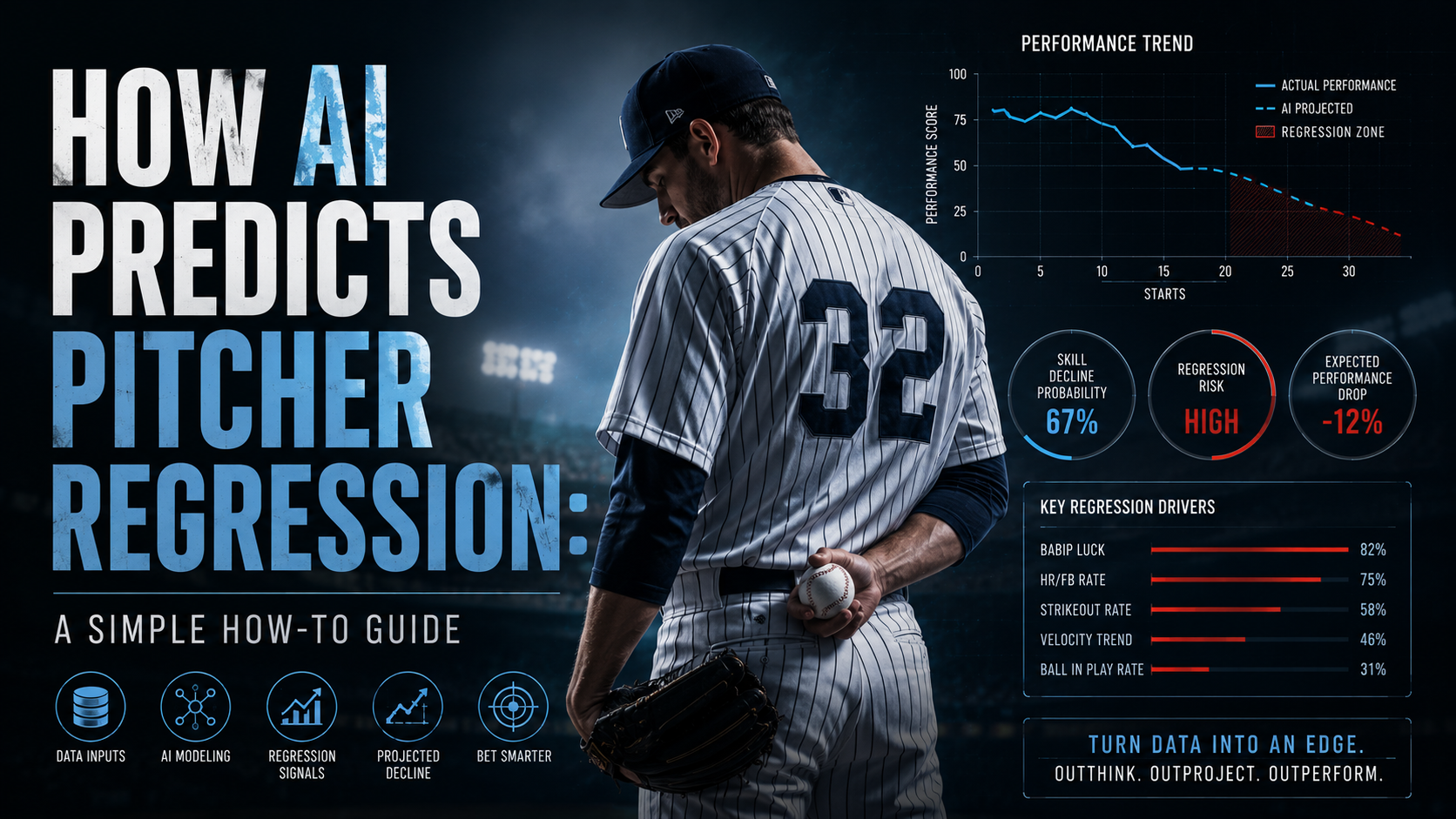
Pitcher regression sneaks up on traditional box scores, but it cannot hide from data-driven models. To gain an edge in sports betting, savvy analysts pair Statcast contact data with rolling trends, letting calibrated AI flag the difference between luck and genuine skill. By turning ERA-minus-xERA gaps, anomalous batting average on balls in play, and velocity drift into clear signals, bettors can make highly practical wagers before the first pitch is thrown.
Table Of Contents
- What Pitcher Regression Means and Why AI Flags It Fast
- Data Requirements and How to Properly Shape Your Inputs
- Modeling the Core Regression Framework
- Turning Predictive Signals Into Actionable Bets
- Limitations and Critical Model Gotchas
- Frequently Asked Questions (FAQs)
What Pitcher Regression Means and Why AI Flags It Fast
Regression in pitching is the inevitable pull back toward a pitcher’s true talent level after a stretch that looks unsustainable. It is not magic; it is math, environmental context, and the law of averages governing how batted balls land. Artificial intelligence catches these shifts faster because it monitors thousands of tiny signals simultaneously and compares them to historical baselines without emotional bias. When building models and making analytical calls for ATSwins, separating luck from skill is the primary objective.
Luck encompasses sequencing breaks, random flare hits, wind patterns, bloops that fall for hits, and missed borderline umpire calls. Conversely, skill involves pitch quality, command, deception, game planning, and physical health. AI parses which element is driving surface results by isolating noisy outcomes from stable skills. A pitcher with a brief run of extreme results will slide back toward their long-run baseline as the sample size grows. The trick is ensuring your baseline is properly estimated for the current season, which means adjusting for stadium dimensions, defensive efficiency, opponent strength, and the run-scoring environment.
Early-season samples and injury returns can easily mislead the public. AI stabilizes these metrics by blending career data with current form, keeping uncertainty parameters high when samples are small.
To spot regression early, models rely on several core telltales. The gap between a pitcher's actual ERA and expected indicators like xERA, xFIP, and SIERA is paramount. Large negative gaps indicate that worse results are coming unless the pitcher’s raw stuff or command has fundamentally improved. Large positive gaps suggest better results are on the horizon if bad luck dominated the previous stretch. Historical definitions and baseline formulas for these metrics are documented thoroughly on analytical platforms like FanGraphs and the Baseball Savant Statcast database.
Batting average on balls in play fluctuates wildly over short stretches. Anything far from league or career norms deserves a closer look, as a very low mark without a shift in contact profile usually regresses upward. Strand rate is another vital indicator. Anything pushing over an 80% strand rate for a starting pitcher is tough to sustain unless backed by elite strikeout metrics. Furthermore, home run per fly ball rate is highly volatile. If a pitcher's home run rate is under league norms with no corresponding drop in hard-hit percentage, a regression flag is raised.
Statcast metrics such as barrel percentage, hard-hit rate, and average exit velocity move much faster than surface ERA. If these metrics worsen while the ERA stays pristine, trouble is brewing. Pitch quality and shape must also be monitored, as sustained velocity dips of one mile per hour or more are highly actionable. Finally, environmental factors change run environments. Catcher framing shifts called strike edges, team defense impacts ball placement, and weather dynamics can turn marginal fly balls into home runs.
Data Requirements and How to Properly Shape Your Inputs
AI predicts pitcher regression effectively when the underlying data is clean, time-aware, and engineered around what truly matters. Building a usable system requires a systematic approach to data collection.
First, you must pull pitch-by-pitch Statcast data and game context. Baseball Savant provides pitch-by-pitch statistics featuring velocities, spin rates, movement profiles, and estimated weighted on-base average on contact. For league-wide leaderboards, team defense metrics, and park factors, analysts lean on FanGraphs to populate their databases. Public sources track umpire tendencies, allowing you to integrate edge called strike rates, while catcher framing values can be brought down to the game level. Weather variables like temperature and wind speed should be stored per game alongside travel metrics and rest days.
Second, rolling windows must be established to unlock true regression calls. Maintaining seven-day, 14-day, and 30-day windows helps capture current form signals, while a full-season window handles stabilization. For each window, compute core performance metrics, contact quality variables, and plate discipline statistics like called strikes plus whiffs percentage. Tracking pitch-mix changes and release point drift helps spot underlying fatigue.
Third, engineer distinct features that cleanly separate skill from noise. Called strikes plus whiffs percentage holds a strong tie to strikeout skill, meaning rolling shifts often precede ERA changes. Monitoring how often a pitcher locates on the shadow zone correlates heavily with low walk rates. Pitch-mix entropy measures unpredictability, where a higher score indicates a less predictable approach. Fatigue proxies, opponent rolling metrics, team defense ratings, and umpire tendencies should all be combined into a single running environment index.
Fourth, construct clear targets and labels for model training. To model regression risk, you need a target reflecting over-performance or under-performance. For each start, compute the difference between realized runs allowed and an expected baseline built from expected metrics. You can then track whether the next three starts move toward the blended baseline by a pre-defined margin, or predict the continuous change in ERA minus xERA over the next stretch of innings.
Modeling the Core Regression Framework
Turning advanced data features into a repeatable decision system requires a structured modeling workflow.
Begin with baseline estimation and shrinkage. Build a hierarchical baseline of true talent for each pitcher-season, starting with prior talent based on past performance regressed toward the league average. Pooling data across pitchers by role using Bayesian hierarchical models ensures that small samples do not cause the model to overreact.
Next, deploy gradient boosting algorithms like XGBoost or LightGBM to classify pitchers into regression categories. Boosting handles nonlinearities and complex feature interactions cleanly, making it perfect for tabular sports data. Stacking a calibrated logistic head on top of the model outputs turns raw machine learning scores into usable probabilities. Using isotonic regression or Platt scaling on a validation set improves probability accuracy, allowing you to track Brier scores and reliability curves.
To catch sudden performance drop-offs, hidden Markov models can tag starts as normal, drifting, or red-flagged. While a gradient boosting model might see a downhill slide too late if it only reviews aggregates, a regime-switching approach flags state changes earlier by analyzing sudden velocity and spin trends.
Strict time-series cross-validation is mandatory to protect your framework. Always utilize walk-forward cross-validation where you train up to a specific date and predict the next day's games. Never allow end-of-game facts, like late-inning weather shifts or post-game opponent statistics, to leak into the pre-game model. Backtest your system over multiple historical seasons to ensure it beats naive baselines consistently. Finally, use SHAP values to surface exactly why a pitcher’s regression probability spiked, offering clear explanations regarding velocity dips, defensive shifts, or impending weather changes.
Turning Predictive Signals Into Actionable Bets
Predictions are only useful when they tie directly to market wagers and strict risk controls. Putting regression calls to work for ATSwins requires a deliberate process.
Do not act blindly on raw probabilities. Pair the model's output with expected value calculations and uncertainty bands. Establish a clear tiering structure where a strong action requires a regression probability above 70% backed by multiple independent SHAP drivers. Smaller stakes should be applied to marginal leans, while highly uncertain profiles should be skipped entirely.
Always blend machine learning outputs with qualitative scouting. Reviewing brief video clips can quickly confirm mechanical flaws, arm slot adjustments, or visible fatigue. Cross-check pitch-tunnel proxies visually to ensure fastballs and sliders share a convincing path. It is also wise to check team beat reports for unannounced injuries or planned pitch count limitations.
Before placing a wager, adjust your expectations for opponent quality and defensive matchups. A prime negative regression candidate might survive a start if the upcoming opponent strikes out at an alarming rate or hits ground balls into an elite infield defense. Re-run your expected outcomes against the projected daily lineup rather than generic team averages. If the opponent rolls out a lineup that struggles against a pitcher's specific secondary weapon, scale down the wager size.
Timing the betting market is equally vital. When obvious flags like a major velocity drop appear, the betting public notices, and lines move early. If your edge depends on subtle inputs like framing changes or tunnel drift, value can often be found closer to first pitch once official lineups are posted. For player props, sportsbooks frequently lag on under bets for star players coming off a lucky stretch, providing an excellent window for action. Manage your bankroll using a fractional Kelly criterion or fixed low-percentage staking, and diversify your wagers across player props, first-five-inning totals, and individual team totals.
Limitations and Critical Model Gotchas
Respecting model limitations prevents severe bankroll depletion. Seasonal weather patterns are a major trap; early-season cold suppresses power, while midsummer heat supercharges it. If your rolling data windows straddle a major weather break, do not over-credit a pitcher's sudden spike in performance.
Injury lag poses another distinct risk. A pitcher returning from the injured list might display normal radar gun velocity but suffer from terrible command. If their walk rate or zone percentage whispers trouble, trust those indicators over raw speed. Be aware of league-wide rule enforcement windows as well, such as sudden crackdowns on sticky substances, which can permanently alter spin-to-velocity relationships.
Models must also contend with survivorship bias. Because pitchers only remain in a starting rotation if they perform well or play for a rebuilding franchise, training data can easily underrepresent massive blow-ups. Guard against this by using heavier historical priors and broader uncertainty bands during a player's first six to eight starts of the season.
When presenting these findings, always speak in terms of probabilities rather than certainties. If a system shows a coin-flip scenario, stating so openly preserves long-term analytical credibility. Never over-rely on a single isolated metric like xERA or called strikes plus whiffs percentage. The strongest, most profitable betting calls manifest when multiple independent lines of data converge on the exact same conclusion.
Frequently Asked Questions (FAQs)
What does “how AI predicts pitcher regression” really mean?
It means using models to spot when a pitcher’s results are likely to move back toward normal. In “how AI predicts pitcher regression,” we compare current ERA to skill-based metrics (xERA, xFIP, SIERA), then account for luck like high BABIP or wild LOB%. It’s not magic; it’s math & context, so you don’t chase small-sample noise.
Which stats matter most for how AI predicts pitcher regression?
Start with ERA minus xERA/xFIP/SIERA gaps, then check BABIP, LOB% above ~80%, and HR/FB swings. Add Statcast signals: barrels, hard-hit rate, exit velo, spin and velo drift. For “how AI predicts pitcher regression,” I also look at CSW%, zone%, O-Swing%, release-point drift, and pitch-mix changes. Together, they flag fragile performance.
How do I use how AI predicts pitcher regression without overreacting?
Anchor to rolling windows (7/14/30 days), then weigh longer samples more. If “how AI predicts pitcher regression” says risk is high but the pitcher just faced elite lineups, cool the take. Blend park and weather context, team defense, and rest days. Act in steps: scale bet size, not all-or-nothing. And re-check after each start—stuff changes.
Does park, weather, travel & catcher framing affect how AI predicts pitcher regression?
Yes. Run environments swing with park factors, wind, humidity, altitude, even day/night splits. Travel and short rest can sap velo. Catcher framing plus umpire zones shift strike probability, nudging walk and K rates. Any “how AI predicts pitcher regression” workflow should bake these in, or your risk reads might be off by a mile.
How does ATSwins.ai use how AI predicts pitcher regression in its MLB picks?
ATSwins.ai is an AI-powered sports prediction platform offering data-driven picks, player props, betting splits, and profit tracking across NFL, NBA, MLB, NHL, and NCAA. In MLB, we fold “how AI predicts pitcher regression” into our models by combining x-stats, Statcast quality-of-contact, and context (park, weather, defense) to surface edges. Free and paid plans give bettors simple insights and guides to act on, without the extra noise.