

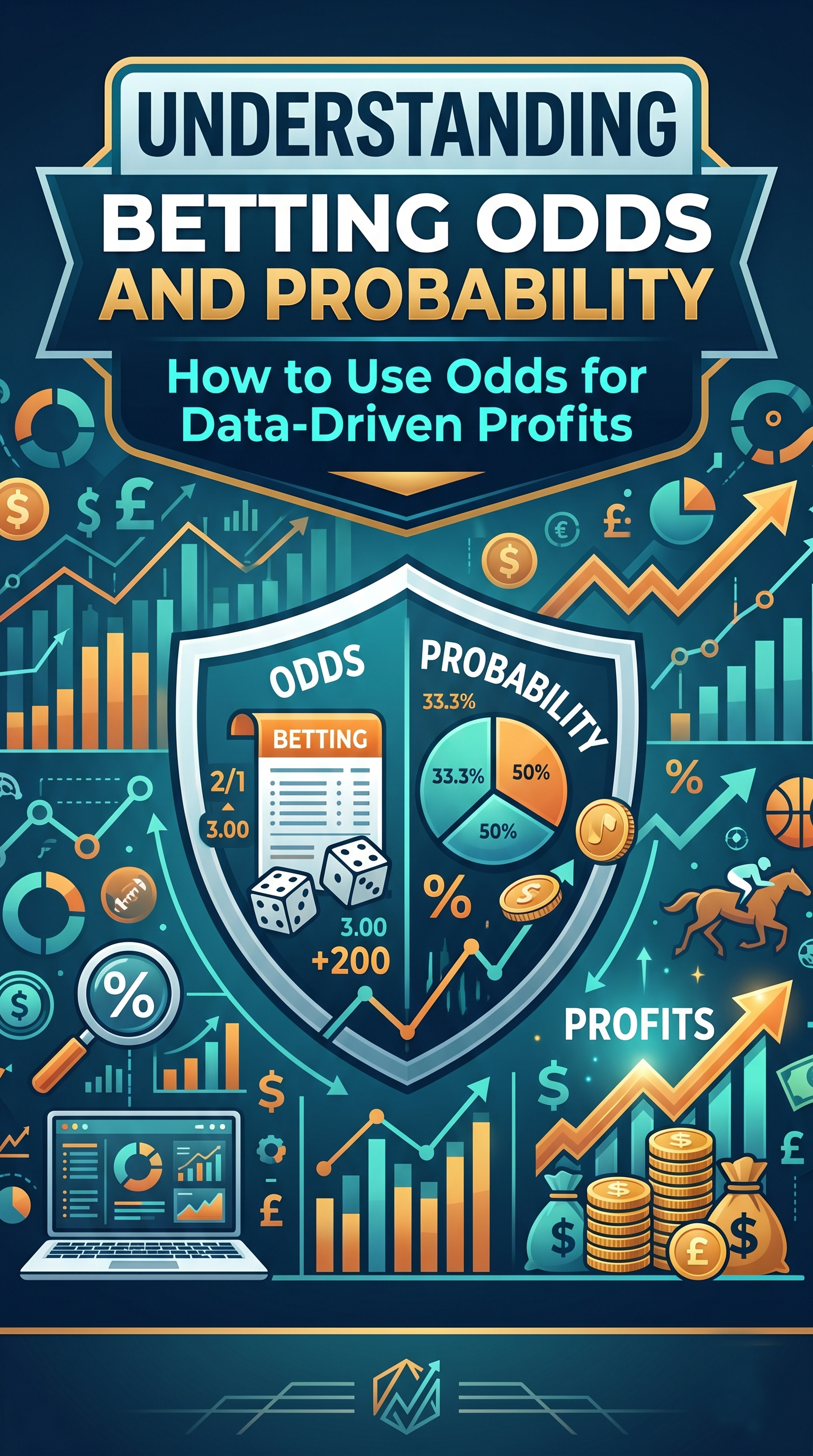
Sports betting makes sense when you turn odds into clear probabilities. As a professional analyst who builds AI models for pricing games, I will show you how to read American, decimal, and fractional odds, convert them to implied chance, spot value, and manage risk. We will keep it practical and data-driven, without hype, so you can bet smarter. Understanding the math behind the numbers is the biggest step you can take to move from guessing to analyzing. For those just starting out, expected value betting for beginners is the foundational concept that separates those who treat this as a hobby from those who approach it with a professional mindset.
Odds, Probability, and Edges: A Practical Playbook for Smarter Sports Betting
Odds formats and conversions
When you look at a sports book, the different formats can be confusing if you do not know how they translate to one another. American odds use a plus or minus sign to show the relationship between your stake and your profit. Positive odds, like plus 150, show the profit you would make on a 100 dollar stake. If you bet 100 dollars on plus 150 odds, you make 150 dollars in profit for a total return of 250 dollars. Negative odds, like minus 200, show how much you need to stake to make 100 dollars in profit. In this case, you would need to bet 200 dollars to earn 100 dollars in profit, bringing your total return to 300 dollars. Generally speaking, plus signs mean the team is the underdog, and minus signs mean they are the favorite.
Decimal odds are often favored by professional modelers because they are easier to use in calculations. They represent the total return for every 1 dollar you stake, including your original money. If you see odds of 2.50, a 100 dollar bet returns 250 dollars total, which is 150 dollars in profit. You can quickly calculate your total return by multiplying your stake by the decimal number. Fractional odds are more common in traditional markets like horse racing. They show your profit relative to your stake. Odds of 5 to 2 mean you make 5 dollars in profit for every 2 dollars you bet. To turn these into decimals, just divide the fraction and add 1.
The most important skill is converting these numbers into implied probability. This tells you exactly what percentage chance the betting market is assigning to a specific outcome. For decimal odds, the probability is 1 divided by the decimal. For fractional odds, it is the denominator divided by the sum of the numerator and the denominator. For American odds, the formula changes based on the sign. If the odds are positive, you take 100 and divide it by the odds plus 100. If the odds are negative, you take the absolute value of the odds and divide it by that same value plus 100. Doing this consistently allows you to compare different markets on an equal playing field.
If you ever need to go backward from probability to odds, the math is straightforward. If you have a percentage, you just reverse the formulas. For decimal, it is simply 1 divided by the percentage. For American odds, you use different formulas for underdogs and favorites. The key here is to keep these conversions in a spreadsheet. I personally keep all of my models in decimal format because it makes the math much cleaner. Just remember that the market odds include the house edge, which we call the vig. Before you call something a 50/50 game, you have to account for that margin.
Probability, edge, and pricing
Fair odds represent the true probability of an outcome without the house taking a cut. Sportsbooks intentionally build a margin into their lines. If you take the implied probabilities of every side in a matchup and add them together, the total will always be greater than 100 percent. This extra amount is the overround, or the juice, that the book collects. To find the fair probability, you need to normalize the numbers so that they sum to exactly 100 percent. This tells you what the odds should be if the book were not taking a commission.
Expected value is how you determine if a bet is worth making. To have sports betting expected value explained clearly, you just need to realize it is the average amount a bettor can expect to win or lose per bet placed on the same odds time after time. If you have a 100 dollar stake and decimal odds, your expected value is your probability of winning multiplied by your profit minus the probability of losing multiplied by your stake. A bet is profitable whenever this expected value is greater than zero. This happens when your calculated probability is higher than the break-even probability set by the market. You are not trying to predict the future perfectly. You are simply trying to price the risk better than the person on the other side of the counter.
Many people make the mistake of thinking that having an edge means they will win every time. That is not how it works. Even with a significant edge, you will deal with variance. You can easily go on long losing streaks even if your model is technically correct. You have to be mentally prepared for that. This is where you should use simulations to see what your bankroll might look like over thousands of games. It keeps you grounded and helps you avoid overreacting when things go south for a few days.
You should also watch out for correlated bets. If you bet on a team to win and also bet on their star player to score a certain amount of points, those things are usually linked. If the team plays well, the star player likely has a good game. Some bettors think they are getting double the value, but the sportsbooks are usually smart enough to account for this correlation in their pricing. Only bet on these if you are sure the market has underestimated the strength of that connection.
Modeling to estimate probabilities
To build a model, you need to start with a clear target. Are you trying to predict who wins, who covers the spread, or the total points in the game? Once you have that, you need to gather high-quality data. This includes box scores, player efficiency ratings, and situational factors like rest days or travel. I like to use rolling windows to capture current team form. It helps to keep a structured database of this information so you can run updates quickly.
When you are engineering features, try to think about what actually moves the needle. Possession counts, offensive efficiency, and opponent-adjusted ratings are much better than just looking at the final score of the last few games. If you are looking at football, look at red-zone efficiency. If it is baseball, look at bullpen fatigue. You want features that explain why a team is performing the way they are. Keep it simple at first. A model that you understand well is always better than a complex black box that you cannot explain.
I typically use logistic regression for my initial models because it is interpretable and fast. Once you have a handle on that, you can move toward gradient boosting if you need to capture more complex patterns. The goal is always to output a probability, not just a label. You need a number that you can compare to the book's price. After that, you must check your calibration. If you predict a 60 percent chance of winning, does your team actually win 60 percent of the time? If not, you need to adjust your model.
Tracking your closing line value is essential for long-term success. This is just a comparison between the price you got and the price the market closed at. If you consistently bet at prices that are better than the final closing line, you have a solid process. If you find yourself consistently getting worse prices, you need to figure out why. Keep a clean log of your bets, the rationale behind them, and the result. You can then review this later to see where your model was strong and where it was weak.
Bankroll and risk
Your bankroll management is the most important part of staying in the game. I generally suggest setting a unit size between 0.5 percent and 1 percent of your total bankroll. This keeps your risk controlled even when you have a bad run. Never bet more than you are comfortable losing in a single day. Discipline here is the difference between being a professional and being a gambler who is just waiting to hit zero.
The Kelly Criterion is a mathematical formula used to determine the optimal size of a bet. You calculate the net odds and your estimated probability to find a suggested percentage of your bankroll to wager. Most professionals use fractional Kelly, such as half or quarter Kelly, to be more conservative. This accounts for the fact that models are never perfect. It is better to leave some profit on the table than to bet so much that a standard deviation destroys your account.
Drawdowns are a mathematical reality of betting. Even a professional with a 55 percent win rate will have losing streaks. You need to simulate these scenarios so you are not surprised when they happen. If your simulations show that you have a high risk of ruin, you need to lower your stake size immediately. It is better to grow your bankroll slowly than to try to get rich in a month and end up with nothing.
Knowing when to pass is just as important as knowing when to bet. If your model does not show a clear edge, do not force the action. The market is very efficient, and there are plenty of games where there is simply no value to be found. If the situation feels too uncertain or the weather is making your model unreliable, stay on the sidelines. There is always another game tomorrow.
Applying odds and probability in markets
Moneyline bets are the most straightforward. You are just betting on the winner. The spread is more complicated because you are betting on the margin of victory. Totals involve predicting the combined score. Each market requires a different approach. For moneylines, look for teams that are undervalued by the public. For spreads, focus on the distribution of possible outcomes. For totals, look at things like pace of play and officiating tendencies.
If you want to turn a spread into a win probability, you can use a normal distribution. If you have an estimated mean and standard deviation for the point spread, you can calculate the odds that a team will cover. This is a very powerful technique for finding value in the market. You can build a simple calculator in a spreadsheet to do this for every game on the slate. It turns raw information into a specific betting number.
Live betting is where things get fast. You need a data feed that is extremely quick because if you are lagging, you are already losing to the house. Only attempt this if you have a pre-game model to anchor your thinking and a plan for how you will react to live events. Most people are better off sticking to pre-game markets where they have more time to think and verify their research.
Market signals like steam moves can tell you a lot. If multiple sharp books move the line in the same direction at the same time, it is usually because they have received significant information. You do not have to follow the steam blindly, but you should certainly respect it. It means your model might be missing something crucial. Always verify the reason for the move before you decide to change your position.
Step-by-step: working an example from odds to decision
Let us walk through a hypothetical NFL game. You see Team X at minus 2.5 with decimal odds of 1.91. First, you calculate the break-even probability, which is roughly 52 percent. This is the moment when you how to calculate expected value in sports betting by comparing your own derived win percentage against that market break-even point. Now, you run your model. It estimates the team has a 66 percent chance to cover. That is a massive difference. You check the news and see that the opponent's starting tackle is injured and the wind is going to be high. Everything lines up.
Next, you determine your stake. Using the Kelly Criterion with your edge, you might get a high percentage, but you should scale it down because of model uncertainty. You decide on a 2 percent stake. You record this in your log with all your assumptions about the weather and the injuries. If the news changes before kickoff, you have the data you need to decide whether you want to hedge or hold your position.
After the game, you update your results. Regardless of whether the bet won or lost, you check the closing line. If the market closed at minus 3, you know you got good value. This feedback loop is what makes you better over time. You are not betting on the outcome; you are betting on your ability to process the information correctly.
Common workflows across markets
For moneylines, your workflow should focus on team strength deltas. You want to see if your estimated win probability is significantly different from what the market is offering. For spreads, focus on key numbers. In the NFL, the number 3 is huge because so many games end with that margin. Be very careful when you are betting on or against that number.
Totals are often where the market is slowest to adjust. Weather can change the game, and the market often takes a while to react to it. If you have a way to quantify how wind or rain affects scoring, you can find a lot of value. Always look for correlation with the side of the bet. Sometimes the best way to play an under is by betting on the team you think will win by controlling the clock.
Player props are a different beast. You are looking at usage rates, minutes played, and matchup-specific defense. This is where individual knowledge of player roles pays off. If you notice a player is about to see an increase in minutes because of a rotation change, you can often find props that the market has not moved yet.
Mistakes I still see pros make (and try to avoid myself)
One of the biggest mistakes is overfitting to one season of data. Things change, players get traded, and coaching philosophies evolve. If your model is stuck on how teams played two years ago, it is going to fail. You also need to watch out for schedule density. A team that has played four games in five days is going to perform differently than one that is well-rested, no matter what their season average looks like.
Never treat closing line value as optional. If you are not beating the closing line, you are essentially gambling. You need to prove that you can identify value that the market eventually confirms. If you cannot do that, you need to go back to your research. Do not rely on your memory; it is biased. Keep your records, be honest with your data, and do not be afraid to admit when your model has failed.
Practical checklists
Before you place a bet, run through a quick list. Have you converted the odds? Is your model edge real after you remove the vig? Did you check the injury report one last time? Is the line available at multiple books? Have you set your stake based on your bankroll plan? If you can answer yes to these, you are doing it right.
After the game, do a post-bet check. What was the closing line? Did your model miss a rotation or a key injury? Was the variance within expected limits? Logging this information is the most important part of the process. It turns every bet into a learning opportunity, which is the only way to improve your model over the long term.
References and learning resources
If you want to get deeper into the math, start with resources like Khan Academy for probability and statistics. Investopedia is excellent for learning how implied probability works in various markets. For more specialized sports analysis, take a look at the Harvard Sports Analysis Collective. They provide great insights into how to build models for specific leagues. MIT also offers free online courses on probability that are very useful.
For those who want to see how this works in a live setting, you can check out the latest content and analysis on the ATSwins AI sports projections site. They offer a range of data-driven insights, player props, and betting splits across the major sports leagues. You can use this data as a starting point to feed into your own models. Testing your theories against real-time data is the best way to refine your strategy.
Conclusion
We have covered a lot of ground, but the core idea is simple. You need to turn odds into probabilities, price the game fairly, and only bet when your edge is clear. Convert your lines, check your edges, and never let your emotions override your staking plan. By using tools like the ones at ATSwins for projections, player props, and betting splits, you can get a better sense of where the market is moving. Start small, track everything, and stay consistent.
Frequently Asked Questions (FAQs)
What does how to read odds mean in sports betting?
Learning how to read odds is just understanding the price on a team’s chance to win. Odds come in three common formats which include American, decimal, and fractional. A quick way to get a feel for this is to look at the payout. Positive American odds of plus 150 mean you would profit 150 dollars on a 100 dollar stake. Negative American odds of minus 200 mean you must stake 200 dollars to profit 100 dollars. Decimal odds of 2.50 show the total payout per 1 dollar staked. Fractional odds like 5 to 2 show the profit relative to the stake. The key to reading odds is turning them into implied probability so you can compare them to your own analysis. Never mix up profit and payout, as decimal odds include your original stake while the others often focus on the profit.
How do I turn numbers into chances when I’m learning how to read odds?
To read odds as probabilities, you need to use specific conversion formulas. For decimal odds, the probability is 1 divided by the decimal. So, 2.50 becomes 1 divided by 2.50, which is 40 percent. For fractional odds, the probability is the denominator divided by the sum of the numerator and the denominator. So, 5 to 2 becomes 2 divided by 7, which is about 28.6 percent. For American odds, use the positive or negative formulas based on the sign. If the odds are positive, divide 100 by the odds plus 100. If the odds are negative, divide the odds by the odds plus 100. That is the core of reading odds; you convert them, compare them to your own number, and decide if the value is there.
In how to read odds, what’s the difference between moneyline, spread, and totals?
When you are learning how to read odds, you have to understand the market types. Moneyline is just picking the winner. The odds reflect the team’s chance to win the game straight up. The spread is a handicap where you are betting on the margin of victory. If Team A is minus 3.5 at minus 110, they need to win by 4 points or more for you to win the bet. The minus 110 signifies the break-even probability of about 52.4 percent. Totals, or over and under bets, are wagers on the combined score of both teams. Short minus prices represent small favorites, while large plus prices represent underdogs with lower win chances but higher potential profit.
How does ATSwins help with how to read odds and act on real edges?
If you want to move beyond just reading odds and start making informed decisions, ATSwins provides a suite of tools to help you along the way. ATSwins is an AI-powered sports prediction platform that offers data-driven picks, player props, betting splits, and profit tracking for all the major leagues. I use it as part of my daily workflow. I check the model leans and the betting splits to see if the market is moving against the public. I then convert the book’s odds into implied probability and compare that to the projections on the site. If my analysis suggests a 55 percent chance and the market only implies 50 percent, I have a potential edge. Using their tracking tools also helps me keep an accurate log of my performance.
What mistakes do people make when they’re figuring out how to read odds and probability?
The most common mistake is failing to account for the vig. When you read odds, you must remember the house margin is included. You have to remove that to find the fair odds. Another big mistake is ignoring the importance of bankroll management. Even if you have a perfect read on a game, betting too much will sink you over the long run. People also tend to overweight small samples; one or two games do not change a team’s true ability. Finally, many bettors do not keep a log. Without a log, you cannot track your progress or analyze your own biases. Keep the math simple, track your bets, and learn from every game you play.