

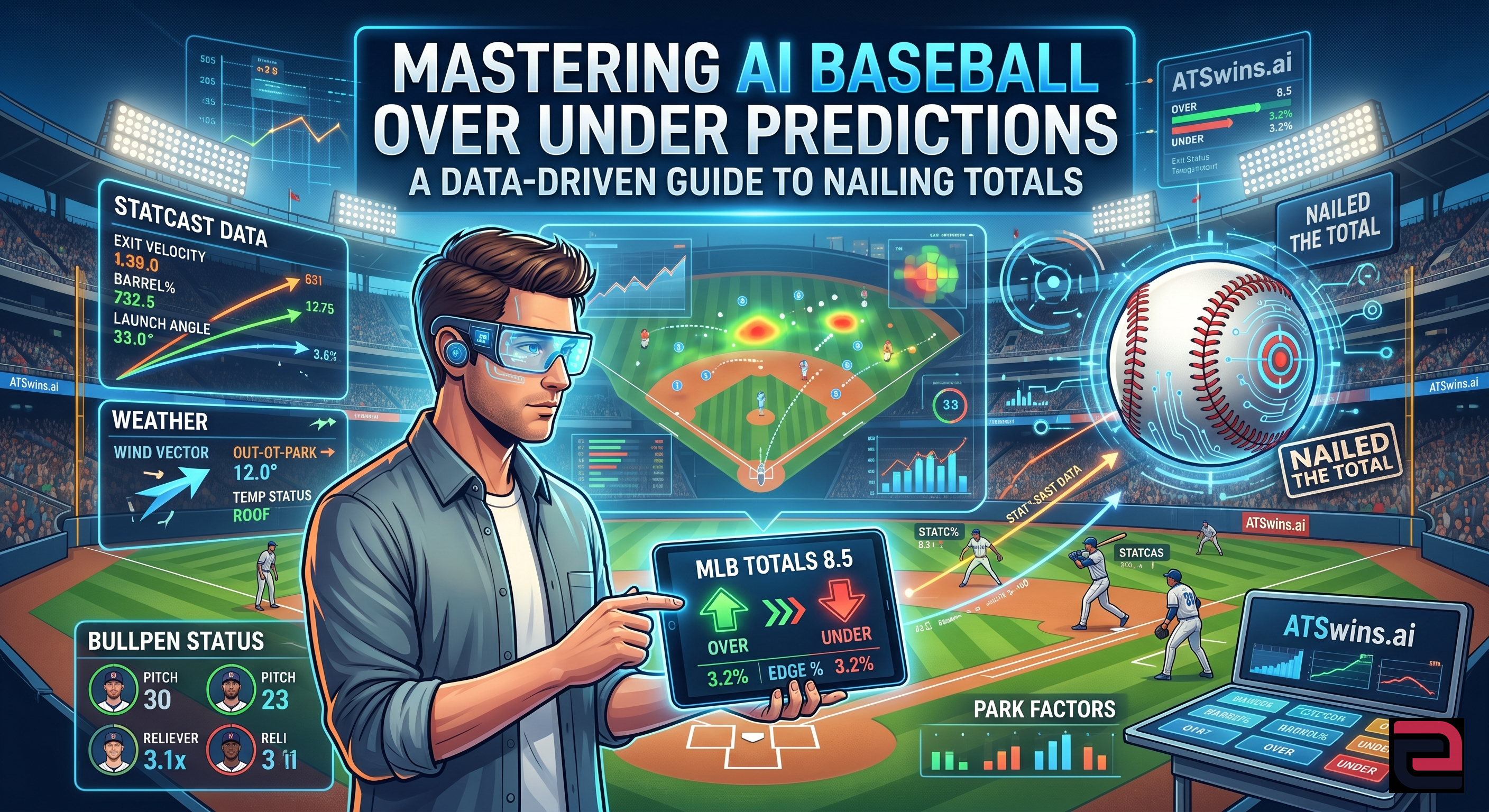
Listen, I am a sports analyst who basically lives in the data. I use AI to help price MLB totals because betting on baseball is just a massive probability puzzle. If you look at it the right way, it is less about guessing and more about building a system that blends Statcast quality, weather patterns, and the nitty-gritty of bullpen usage into actual, usable probabilities. When you sit down to frame the problem, you have to realize that a number on a board is just a suggestion. Your job is to predict the runs for each team individually and then merge those into a game total distribution. Once you have that, you convert the whole thing into probabilities for the Over and Under at the specific totals the books are offering. Then you turn those probabilities into fair prices and compare them against the market to see if you actually have an edge. It sounds like a lot, but if you treat it as a step-by-step process, it becomes way more manageable.
You need to think about your model outputs in terms of calibration rather than just being accurate. A model that nails the average error but completely misses the tail probabilities will absolutely wreck your bankroll because you are betting on the outcome of a game, not just the middle of the distribution. If you say the Over 8.5 should hit 56 percent of the time, then it needs to win at that clip in the long run. If it doesn't, your model is lying to you. Don't worry about being perfect. Worry about being right consistently. Focus on the main drivers like contact quality from Statcast, how the wind is blowing at the stadium, whether the roof is open, and how rested the bullpens are. I don't use web searches or random forums for this. I use primary MLB data because the noise in those other places won't help you price a tenth of a run correctly. By understanding the core mechanics of a sports market trading strategy, you can begin to treat your betting portfolio like a professional fund manager would, focusing on repeatable processes rather than singular, lucky outcomes.
Data sources, feature engineering, and targets
To actually build this thing, you need to pull from the right places. I lean heavily on Baseball Savant for Statcast and park context, FanGraphs for the deep-dive platoon splits, and Baseball-Reference for the roster stuff. Retrosheet is my go-to for historical validation. You want to build your features in layers so you don't get lost in the sauce. Start with the batters. Look at their rolling expected weighted on-base average on contact, their barrel rates, and their average exit velocity. Then look at the pitchers. For starters, focus on their pitch mix and movement, and for relievers, look at their leverage index and how much rest they have had lately.
The context features are where you make your real money. Umpire tendencies are huge, especially if they have a wide or tight zone. Weather is the biggest variable, and I am talking about temperature, humidity, and the wind vector relative to the field. Don't just look at a global park factor. Look at how a specific park plays for different types of batted balls. When you aggregate this all into a team run distribution, try to use a Bayesian approach to shrink your recent form data toward the long-term averages. This prevents you from overreacting to one weird series at Coors Field. You can model team runs as a continuous target, maybe using a Negative Binomial distribution to handle the fact that baseball runs are overdispersed. It works way better than a simple Poisson model.
Modeling and evaluation
When you get to the actual modeling, keep it relatively simple at the start. Gradient-boosted trees are fantastic because they handle non-linear relationships and interactions between things like weather and exit velocity without needing a PhD in math to set up. Random Forests are a decent sanity check, but they are a bit tougher to calibrate. If you really want to get into the weeds, you can layer in feed-forward neural networks once you have enough games under your belt, but don't rush that. The key here is to use hierarchical shrinkage to handle the small sample sizes you see with relievers or rookie call-ups.
Once you have your output, use isotonic regression or Platt scaling to calibrate those probabilities. Never trust the raw output of a machine learning model without running a calibration check on out-of-time data. You need to evaluate everything using metrics like Brier scores and log loss. If your calibration curve looks like a mess, you aren't ready to put real money on the line. Make sure you are splitting your data by time. Train on the first half of the season, validate on the next month, and then test on the month after that. It keeps your results honest and stops you from accidentally leaking information from the future into your training set.
From predictions to prices and edges
Once your model spits out a probability, you have to convert it into a price. If your model says the Over 8.5 is a 52 percent shot and the book is offering you plus 105, you have to calculate your expected value. If that value is positive and you have a high enough confidence in your calibration, that is when you pull the trigger. Always remember that you are fighting the house juice. At standard minus 110 odds, you need to be winning a significant chunk of your bets just to break even. This is why you need a decent margin of safety. If your edge is tiny, just skip the bet. There will be another game tomorrow.
Don't ignore the alternate markets, either. If you have a full distribution of team runs, you can price out alternate totals or team-specific totals. Sometimes the value isn't on the main number but on a total that is one or two runs away. Always shop for the best line. If you can get a 9.0 instead of an 8.5 for the same price, take it. Over the course of a whole season, those half-points are the difference between a winning model and one that just breaks even.
Backtesting, deployment, and monitoring
You have to act like a pro if you want to win like one. Use a walk-forward validation strategy that actually mimics how you would bet in real life. Keep a detailed ledger that records every bet you make, the timestamp, the line you took, your projected probability, and the closing line. If you aren't beating the closing line consistently, your model has a problem, or you are betting too late. Use fractional Kelly criteria for your stake sizes. This is a classic way to manage your bankroll without letting the variance destroy you. Never go all-in on one game. Cap your exposure per day.
Keep an eye on drift. Models decay, especially in baseball where players get injured or traded constantly. If your calibration starts to drift, you need to retrain. I like to do a weekly ablation test to see which features are actually helping and which ones are just noise. If a feature isn't adding value, cut it. Your model should be lean, mean, and stable. If you find yourself constantly overriding the model, maybe you need to fix the model instead of your manual process. Understanding why betting lines move is critical here, as it helps you distinguish between legitimate market shifts driven by new information and unnecessary noise that you should ignore.
Practical workflows with ATSwins
ATSwins is the platform I use to keep this whole thing organized. It is an AI-powered sports prediction platform that helps with everything from player props to profit tracking across the major leagues like the NFL, NBA, and of course, MLB. When I run my daily numbers, I compare my findings to the projections from ATSwins.ai. If we both see an edge on the same side, that is a green light. If we disagree, I go back and audit my work. Did I miss a late-breaking lineup change? Is there weather news I didn't account for?
It is also great for tracking my own performance. You can log your bets and see exactly where you are making money and where you are losing it. Maybe you are great at pricing total-run markets but terrible at 5-inning bets. That insight is gold. Their site also has some great content on early-season trends and bullpen strategy that can help you frame your own thinking as the season progresses. Using a tool like this lets me focus on the analysis rather than getting bogged down in the spreadsheet management.
Step-by-step: build a totals model that’s bet-ready
If you want to build this from scratch, follow this flow. First, ingest your daily data. You need to pull Statcast events, weather forecasts, and park factors every single morning. Verify those starting pitchers early and often. Next, engineer your features. Build your rolling averages for batters and pitchers, and make sure you have a way to quantify bullpen availability. Create your model rows, train your base models—I suggest a mix of Negative Binomial for the count and a gradient-boosted ensemble for the probability distribution—and then validate the hell out of it.
Once that is done, calibrate your outputs using isotonic regression. Create your betting rules. Define your minimum edge threshold and your Kelly fraction. Then, set up a simple MLOps pipeline. You want your model to automatically re-run as new lineups come out or as the weather forecast changes. If you do this properly, you will have a set of actionable bets ready for you by the time you sit down to look at the board. Learning how to spot bad betting lines becomes second nature once your pipeline is automated, as you can quickly isolate discrepancies between your fair-value calculations and the prices listed at the sportsbooks.
Feature and model patterns that consistently matter
Statcast is the absolute king. You cannot bet on totals in the modern era without accounting for exit velocity and launch angle. It tells you the truth about a batter’s power that a simple box score cannot. If a team is running out a lineup with a high barrel rate against a pitcher who gives up a lot of hard contact, that is a recipe for an Over. Conversely, weather is the ultimate wildcard. I have seen totals move by over a run just because the wind shifted from blowing in to blowing out.
Don't sleep on the bullpens. In the old days, we only worried about the starters, but now the bullpens are essentially half the game. If a team's top three relievers are all on the shelf because they pitched the last two nights, that changes the run expectancy for the late innings dramatically. You have to capture these small, meaningful details if you want to gain an edge over the books.
Bet timing and market microstructure
Timing is everything. Generally, you want to get your Overs in early before the public drives the line up. But for Unders, sometimes you wait until the lineups are released. If a star hitter gets a rest day, the line might move in your favor. Pay attention to key totals like 7, 8, and 9. These are "key numbers" in baseball, and they have higher push rates. This affects your implied probabilities on whole numbers compared to half-numbers. Always keep track of your closing line value. If you consistently bet a line and the closing line is significantly different, you are on the right path.
Edge protection: uncertainty and overrides
Life happens. A pitcher gets scratched, or a sudden storm rolls through. You need a system that handles this gracefully. If the model is based on a starter who is now off the board, you need to be able to re-price the game in minutes. If you have a situation where the variables are too uncertain, the best play is often to pass. Never feel pressured to bet on a game just because it is on the schedule. Protecting your bankroll is just as important as growing it. Sometimes the best bet is the one you didn't place.
Example: end-to-end on a single game
Imagine a Tuesday game. In the morning, the weather looks neutral, and the starting pitchers are confirmed. My model likes the Over at 8.5. By midday, I check the umpire assignment and see a guy who is known for a tight zone. My model automatically adjusts the run expectation downward. Then, right before the game, the lineups drop and I see the home team is resting their starting catcher. I re-run the numbers one last time. The edge has shrunk, but it is still there. I place the bet with a reduced stake because of the increased uncertainty, and then I log the result for my long-term analysis. That is how the professional workflow actually works.
Useful operating templates
I suggest you create a checklist for yourself. Mine is pretty simple. Before I confirm any bet, I ask: are the starters confirmed? Are the lineups out? Did I check the weather at the stadium one last time? Is the bullpen availability factored in? Is the edge higher than my 2.5 percent threshold? If the answer is yes to all of these, I bet. If I’m unsure, I skip. After the day is done, I review everything. I look at which total bands I hit on and which ones I missed. It helps me refine the model for the next day.
Tools and references that speed the work
You don't need a massive stack of software to get started. Python is the gold standard for this kind of work because of the libraries available for data manipulation and machine learning. Scikit-learn is your best friend for building the models. For the raw data, Baseball Savant and FanGraphs are the baseline. If you really want to get into the deep-dive statistics, take some time to learn about Bayesian inference. It really helps when you have to deal with those noisy, small-sample-size situations that baseball often throws at you.
Conclusion
At the end of the day, betting on MLB totals is about discipline. You aren't playing against the other bettors; you are playing against the house, which has more information and more money than you do. Your only way to win is to be more precise. Use your tools, trust your calibration, and respect the bankroll rules. If you can do those three things, you have a fighting chance. If you want to take your game to the next level, check out ATSwins.ai. Their platform is perfect for tracking these trends and keeping your betting process professional. ATSwins.ai is an AI-powered sports prediction platform offering data-driven picks, player props, betting splits, and profit tracking across the NFL, NBA, MLB, NHL, and NCAA. Their free and paid plans are great for anyone trying to make more informed decisions in the market.
Frequently Asked Questions (FAQs)
What are AI baseball over under predictions?
AI baseball over under predictions use machine learning to estimate the total runs scored in a game, then translate that into probabilities for the Over and the Under. In practice, I feed models with pitcher quality, lineup strength, Statcast batted-ball data, park effects, weather, and bullpen leverage. The output is a probability for each total line, which I compare to market prices to find value.
How do I use AI baseball over under predictions on game day?
Start with the model’s projected run distribution, then check the posted total and juice. Convert odds to implied probabilities and compare to your AI probabilities. Adjust for late info: confirmed lineups, wind changes, roof status, umpire assignment. Size your stake with simple bankroll rules. If the model shows a clear edge and late news doesn’t clash, you act. If signals conflict, pass. Discipline and timing matter more than hot takes.
Which factors matter most for AI baseball over under predictions?
The big levers are starting pitchers, including velocity trends, strikeout and walk rates, and pitch mix fit versus the opponent. Bullpens are also massive, specifically regarding rest days and high-leverage availability. You have to look at contact quality like average exit velocity and launch angle, along with park and weather factors like altitude and wind. Umpire tendencies also shift run expectancy a tick, which can be the difference between a win and a loss.
How does ATSwins help with AI baseball over under predictions?
ATSwins is an AI-powered sports prediction platform offering data-driven picks, player props, betting splits, and profit tracking across the NFL, NBA, MLB, NHL, and NCAA. I use ATSwins to align my AI baseball over under predictions with real-time betting splits, track closing line value, and audit performance by league and season. The platform’s dashboards make it easy to spot when my model disagrees with the market, then manage risk and bankroll in one place.
What are common mistakes with AI baseball over under predictions?
Common mistakes include trusting point estimates instead of probabilities, ignoring bullpen fatigue, and overreacting to tiny samples. Some people also miss late-breaking weather shifts or try to bet every single edge they see, which leads to losing money on high-juice bets. Keep it simple, verify your inputs, compare prices, manage your risk, and review your outcomes on a monthly basis.