

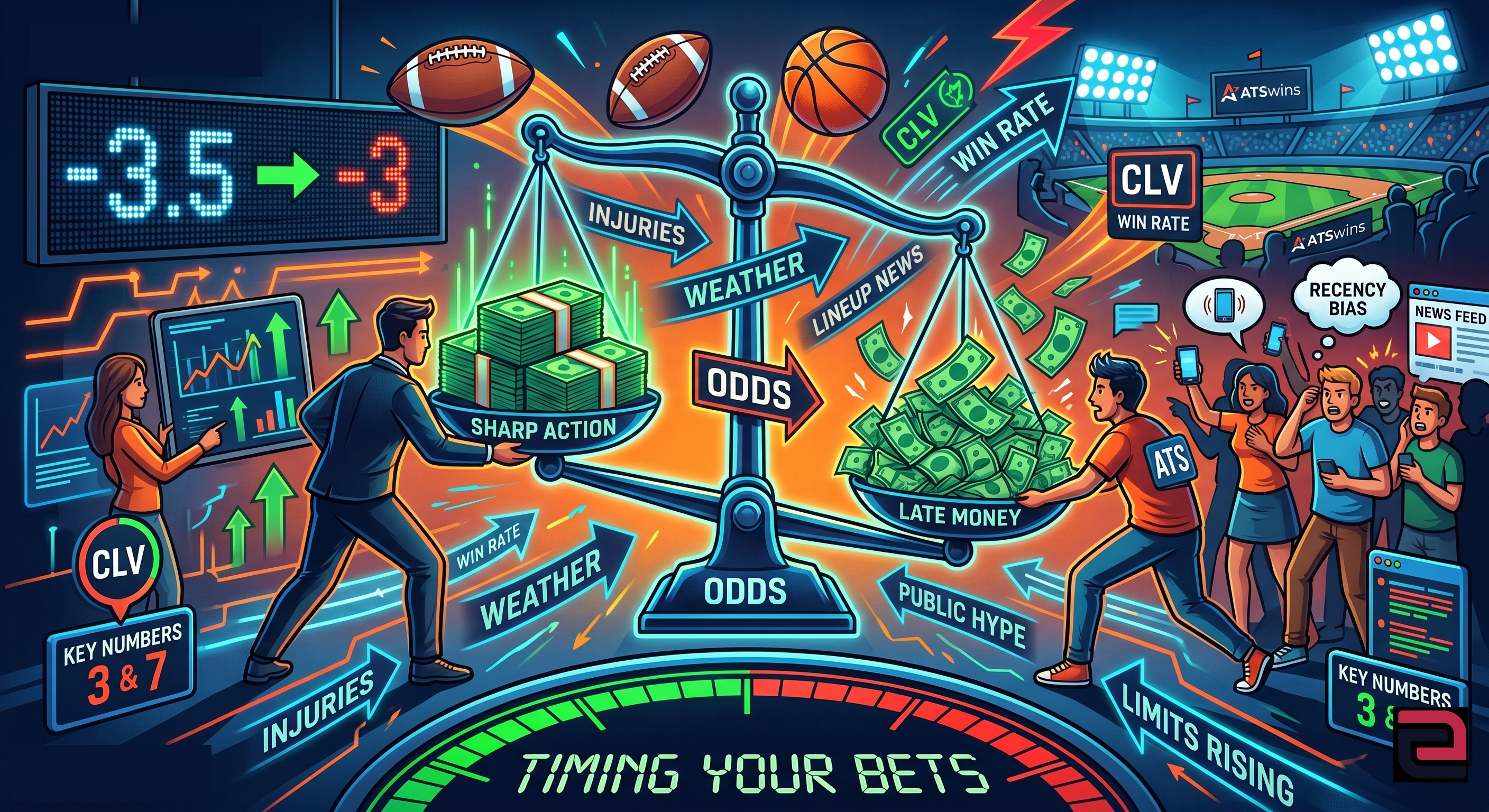
Understanding why betting lines move is the fundamental skill that separates people who just gamble from people who approach sports betting like a professional analyst. If you have ever wondered why a spread shifts from -3 to -3.5 exactly ten minutes before kickoff or why a total in an MLB game drops suddenly despite no obvious injury report, you are looking at the mechanics of the market. Betting lines are not static numbers. They are living, breathing prices that react to money, new information, and the risk tolerance of the sportsbook itself. As someone who spends my days building AI power ratings to find an edge, I have learned that the key is not to overreact to every single tick of steam. Instead, the goal is to understand the underlying force pushing the price and to identify when that move offers you an opportunity to grab closing line value. When you master these mechanics, you stop chasing the market and start anticipating it. If you want to grow as a bettor, you should start by focusing on understanding betting odds and probability to ensure that you are always operating with a clear grasp of what the market is implying.
Market mechanics behind why betting lines move
At its core, a betting line is just a price. It exists to balance the risk for the sportsbook while attracting action on both sides of a contest. When you see a number move, it is usually because there is a supply and demand imbalance that the book needs to correct. Imagine the book is an inventory manager. If they have way too much money backing the favorite, they are essentially short the underdog. To fix that, they will make the favorite more expensive or the underdog more appealing. This process continues until the flow of money reaches a point where the book is comfortable with their exposure. It is rarely as simple as just counting up total tickets. A fifty thousand dollar bet from a player with a history of being sharp carries significantly more weight than a fifty dollar bet from a casual fan.
At ATSwins, we spend a massive amount of time analyzing how this money flows throughout the day. We look at betting splits and projected handle to figure out where the market is going to tilt next. You have to understand that sharp money and public money act in very different ways. Public money usually floods in right before the game starts, often driven by recency bias or favorite-supporting narratives. On the other hand, sharp money—the syndicates and pros—tends to hit the openers or specific news windows where they think the market has miscalculated. When you track a line moving on a screen next to the insights provided by ATSwins, you can start to see which books are reacting to professional accounts and which ones are just following the public drift.
Sportsbooks also love to shade their numbers to preemptively discourage one-sided action. If they know a specific team is going to be a popular public play, they might open the line slightly worse for that side. If the line is -3, they might open it at -3.5 to keep people away. This isn't a massive shift, usually just half a point or a few cents on the price, but it changes the math for you. If you are betting against the public, this shade can actually be a massive advantage.
Beyond money, news is the great accelerator. If a starting quarterback is suddenly ruled out in the NFL or an NBA star is pulled for rest, the line will move instantly. These are the most chaotic moments in the market. You will often see a violent jump, followed by a slight correction, and then a settling period. If you have already done the work of modeling what that player is worth to the point spread, you can beat the rest of the market to the window. Weather, travel, and fatigue also play into this. A strong wind in an MLB stadium can move a total by a full run, and a cross-country flight in the NBA can drag a line by a point or more. We model these things at ATSwins by isolating them from general team ratings so that we aren't just reacting to noise, but rather adjusting for real, tangible context.
Price formation and math
Every time a line moves, it is an update to a probability. You have to become comfortable translating spreads and moneyline prices into implied percentages. For example, if you see a moneyline price, you need to be able to instantly calculate the percentage of time that team is expected to win. When your own model says a team has a fifty-eight percent chance of winning, but the market implied probability is sitting at fifty-three percent, you have found an edge. Learning about expected value betting for beginners is a great way to start quantifying these edges, as it teaches you that you aren't just betting on who will win, but on whether the price being offered is worth the risk of the wager.
You also need to understand the concept of the vig, or the juice. This is the tax the book takes to facilitate the bet. When you see -110 on both sides, the book is essentially saying you need to win about fifty-two point four percent of your bets just to break even, not fifty percent. Books sometimes prefer to adjust the juice instead of the line itself. They might move from -110 to -125 to discourage action without actually crossing over a key number like 3. This is a subtle signal that the book is feeling pressure but isn't ready to change the spread yet.
Key numbers are everything in sports betting, especially in the NFL. Numbers like 3, 7, and 10 appear in final scores so often that they become anchors for the spread. Moving from -2.5 to -3 is a much bigger deal than moving from -1.5 to -2. Because these numbers are so important, books will often fight to stay there. They might hold at -3 and charge you more juice just so they don't have to cross that key number and expose themselves to middle risk. Understanding when a book is likely to freeze at a key number is one of the most powerful things you can learn as a bettor.
Timing and information flow
The market follows a distinct rhythm. The opener is when the market-making books first post their lines. At this stage, limits are very low because the book is essentially trying to find the right price. There is high volatility here because any smart bet can move the number. Overnight, the market starts to refine itself as more information comes out. By the time game day arrives, the limits are at their highest, and the public is fully involved.
You should treat your timing as a strategy. For the NFL, the window on Sunday morning is critical for catching line movements before the public shows up. For the NBA, those sixty minutes before tip-off are where the real work happens as lineups are finalized. You want to align your betting schedule with when you have the best information. If you try to bet in the middle of the game-day rush without a clear plan, you are just reacting to other people's decisions rather than your own analysis.
I see a lot of people fall for what I call head fakes. A group might place a small bet on one side at a few different books just to push the line, hoping to bait the public into overreacting. They then hit the other side with a much larger, real position once the line reaches a more favorable point. You can spot these head fakes because the move usually happens on very low limits and there is no resistance at the market-making books. Real steam is different. It is broad, it happens across multiple reputable books simultaneously, and it is usually backed by correlated moves in other markets like totals or player props.
Practical read-and-act for bettors
Closing Line Value, or CLV, is your north star. If you are consistently betting at a price that is better than the final number at kickoff, you are winning the battle against the market in the long run. Even if you lose individual games, having positive CLV proves your process is sound. You should be keeping a log of every bet you make, including the time, the stake, the closing price, and the spread. Reviewing this data allows you to see exactly where you are beating the market and where you are getting beat. When you have sports betting expected value explained to you in detail, you realize that maximizing CLV is essentially maximizing the mathematical frequency with which you are making the correct long-term decision.
Managing your exposure is just as important as the bets themselves. You should never bet so much that a single bad beat ruins your bankroll. Set clear unit sizes based on how much of an edge you think you have. At ATSwins, we offer profit tracking that allows you to see how your different types of bets are performing, which helps you identify if you are over-allocating funds to high-variance markets like player props.
Build a workflow. You do not need to be a professional programmer, but you should have a system. Keep your power ratings updated. Have a cheat sheet for injury impacts so that you do not have to do the math in your head while the line is moving. Use alert tools to track when a number hits your target or when a star player is ruled out. If you know that a specific team's line moves exactly two points when their starting point guard sits, and you see that point guard is questionable, you can have your bet ready to fire the second the news drops.
Risk management at the book
It is important to remember that the book has different goals than you. They are not trying to predict the outcome of the game as accurately as possible; they are trying to manage their own risk and maximize their hold. Sometimes they will hold a line that seems out of sync with the rest of the market because they are opinionated about a specific side or because they have taken a large, unbalanced position from a client they trust.
If you see a book that refuses to move its line even when the rest of the world has, pay attention. They might be waiting for more action on the other side, or they might have an internal data point that you do not have access to. You can use these moments to your advantage by line-shopping across multiple books to see where the real value is. If you find a book that is lagging, that is often where you can get the best price.
Price action case studies and micro-patterns
The NFL is the classic example of late-week movement. Public money loves favorites, so you will often see the line drift toward the favorite on Sunday morning. If you like the underdog, the best strategy is often to wait until just before kickoff when the public money has fully baked into the price. In the NBA, lineup news causes whiplash. You can see a line move six points in just a few minutes when a star is ruled in or out. Having pre-calculated scenarios for these players is the only way to stay ahead. MLB is all about the pitching and the wind. If the wind starts blowing out, the total is going to go up. Smart bettors are watching those forecasts all day, and they are usually moving the total before the books even have a chance to manually adjust the props.
Tools that make this easier
You need to surround yourself with the right information. Use an odds screen that provides alerts for price and juice changes. Have a reliable injury database that you check at specific times throughout the day. And of course, use the tools available to you at ATSwins. We provide model outputs and prop projections that can save you hours of work. Instead of spending your time calculating the impact of a backup quarterback starting, you can see our projections, align them with your own power ratings, and get your money down with confidence.
Common mistakes to avoid
Do not chase steam. If you see a line move thirty cents and you only calculated an edge of ten cents, you have already lost. The value is gone. Do not focus solely on the spread while ignoring the juice. A change from -110 to -125 is a massive move even if the spread number stayed exactly the same. And please, do not overreact to one bad week. Teams are not the same every single Sunday. Stick to your ratings, trust your process, and stop thinking that one bad game means your model is broken.
How AI helps you anticipate moves
AI is the future of this space because it is so much better at processing structured data than the human brain. We use gradient boosting and logistic models to simulate games thousands of times per second. By merging things like travel schedules, rest days, and historical usage rates, we can flag when a team is potentially overvalued before the market has a chance to catch up. AI allows you to set alert bands so that you are not staring at your phone all day. You can tell the system to alert you only if the moneyline hits a certain threshold, which lets you go about your day and only step into the market when the opportunity actually presents itself. ATSwins automates the heavy lifting of updating player props as news hits, which is the difference between getting a good price and being late to the party.
A simple, repeatable process you can start today
Start with one sport and one market. Do not try to bet everything at once. Build a ten-line power rating sheet and include your own adjustments for injuries or travel. Get a basic probability converter. Set your alerts for key numbers and major status changes. Most importantly, log every single bet. After four weeks, look at your average CLV. If it is positive, you are doing it right. Keep doing that for three hundred bets, and if you are still ahead, consider increasing your unit size. It is a slow, methodical process, but it is the only way to build long-term success.
References worth bookmarking
If you want to dive deeper into the mechanics of these markets, look for resources that teach you about vigorish from sites like Investopedia, read up on the analytical work done by the Harvard Sports Analysis Collective, and keep an eye on the work being done by the International Betting Integrity Association. These organizations provide a great deal of information on how professional markets operate.
Conclusion
Understanding why lines move is the key to evolving from a casual fan into a sharp bettor. It is about recognizing that lines are not just numbers, but markets that react to money, info, and risk. By tracking news, understanding the math behind the moves, and focusing on closing line value, you can build a consistent advantage. You don't need to chase every fluctuation, and you certainly shouldn't overreact to every flicker of steam. You need a process, you need discipline, and you need the right data. For that, you have the team at ATSwins. Our platform is designed to give you the data-driven edge you need to stay ahead. We provide the picks, the props, the betting splits, and the profit tracking for the NFL, NBA, MLB, NHL, and NCAA. Whether you are looking for free insights or you are ready to commit to a professional strategy, we are here to help you make smarter, more informed decisions every time you log on to your account.
Frequently Asked Questions (FAQs)
What does why betting lines move actually mean?
When people talk about why betting lines move, they are essentially talking about the price discovery process of sportsbooks. A book is trying to balance its books to minimize its risk, so as money flows in or new information like injuries or weather updates becomes available, the book adjusts its numbers to encourage or discourage further action. It is essentially a market response to information.
What are the main reasons why betting lines move from open to close?
The primary drivers are money, information, and limits. If a lot of money hits one side, the book moves the price to balance their exposure. If an injury report drops, the book moves the line to account for the change in team strength. Early in the week, limits are low, so small bets can shift the market, but as kickoff approaches, the limits increase and it takes much more volume to move the number.
How do I use why betting lines move to time my bet for better CLV?
Understanding the movement allows you to anticipate where the market is headed. If you think the public is going to hammer a favorite closer to game time, you might want to wait and grab the underdog at a better price. If you have a strong read based on a model, you should bet early to lock in your position before the market catches up. The goal is to always be on the right side of the closing line.
Does sharp money vs public money change why betting lines move?
Absolutely. Sharp money is the primary mover of lines because books respect these accounts and adjust their lines immediately to avoid being exposed. Public money can move lines as well, especially on high-profile games right before they start, but books only move if they feel they need to mitigate risk. A good rule of thumb is that if a line moves against the public, it is almost certainly because sharp money is backing the other side.
How does ATSwins.ai help me understand why betting lines move and act on it?
ATSwins.ai provides the tools to take that theoretical understanding and turn it into practical action. We offer an AI-powered platform with data-driven predictions, player props, betting splits, and robust profit tracking. By comparing our model projections against the current market prices and monitoring where the smart money is flowing, you can make decisions that are based on data rather than just guessing. Our free and paid plans give you the competitive edge you need to stay in control of your betting process.