

Beating the number is honestly the only thing I really care about at this point. Wins and losses come and go, but if I am consistently getting better prices than the market, I know I am doing something right. That is where Closing Line Value, or CLV, comes in. I use it as my main way to measure whether I actually have an edge or if I am just getting lucky for a stretch.
I work with AI models and sports data every day, so I am always comparing my projections against the market. CLV is basically the scoreboard for that comparison. If my numbers consistently beat the closing market, then I know I am thinking about the games correctly. If I am not, then something is off and I need to fix it.
This is not some complicated or overly technical thing either. It is mostly just about tracking your bets the right way, being consistent, and actually reviewing your results without lying to yourself. That is the hard part for most people.
Table Of Contents
- What is Closing Line Value (CLV) and why it matters
- Data you need and setup
- Step by step tracking workflow
- Interpreting CLV and improving edges
- Practical references and templates
- Conclusion
- Related Posts
- Frequently Asked Questions (FAQs)
What is Closing Line Value (CLV) and why it matters
Closing Line Value is just the difference between the number you bet and the number the market closes at. That’s it. It sounds simple, but it is one of the most powerful concepts in sports betting.
If you bet a team at +120 and it closes at +105, you got a better price than the market. That is good CLV. If you bet -3 and the line closes -4, you beat the number. Also good. Over time, those small edges add up.
What makes CLV so important is that it tells you something that your bankroll alone cannot. You can win a bunch of bets in a short period just by running hot. That happens all the time. But CLV strips away that noise and shows whether your bets were actually good at the time you placed them.
I look at it like this. Every bet is a decision. CLV tells you if your decisions were better than the market’s final opinion. If you keep winning that comparison, you are probably on the right track.
ROI is still important, obviously. We all want to make money. But ROI over small samples can be super misleading. CLV is way more stable over time. If you have positive CLV across hundreds or thousands of bets, that is a strong signal that you have an edge.
When it comes to actually measuring it, you have to treat different bet types differently. For spreads and totals, you look at the difference in points. If you bet under 215 and it closes 213, you got two points of value. For moneylines, you convert the odds into implied probability and compare those instead.
The math itself is not that complicated. For positive American odds, the implied probability is 100 divided by odds plus 100. For negative odds, it is the absolute value of the odds divided by that number plus 100. Once you have probabilities for both your bet and the closing line, you can compare them directly.
The key is consistency. Pick a way to calculate CLV and stick with it. Do not keep changing your method depending on whether your results look good or bad.
Data you need and setup
If you want to track CLV properly, you need to log your bets in a structured way. This is where most people get lazy. They either do not track anything or they only track wins and losses. That is not enough.
At a minimum, you need to record the basics for every bet. That includes the sport, league, teams, and game time. You also need the type of bet, like moneyline, spread, or total, and the exact number or odds you got.
You should also record your stake, the sportsbook you used, and the exact time you placed the bet. The timing part matters more than people think because line movement is heavily tied to when you bet.
Then you need the closing line. This is the most important piece for CLV. You want to capture the final number right before the game starts. That is your benchmark.
On top of that, I like to track a few extra things. If you have your own model, log your projected line or probability at the time of the bet. That helps you compare your model directly to the market later. I also add notes when something unusual happens, like late injury news or weather changes.
When it comes to formatting everything, keep it simple. A spreadsheet works perfectly fine. Just make sure your columns are consistent and your data is clean. Mixing odds formats or forgetting timestamps will mess up your analysis later.
If you are using ATSwins, you can use their projections and betting insights as your starting point. Then you log your actual bets separately and compare them to the closing lines. That combination works really well because you get both the prediction side and the execution side.
Step by step tracking workflow
The workflow itself is pretty straightforward once you get used to it. The key is doing it consistently.
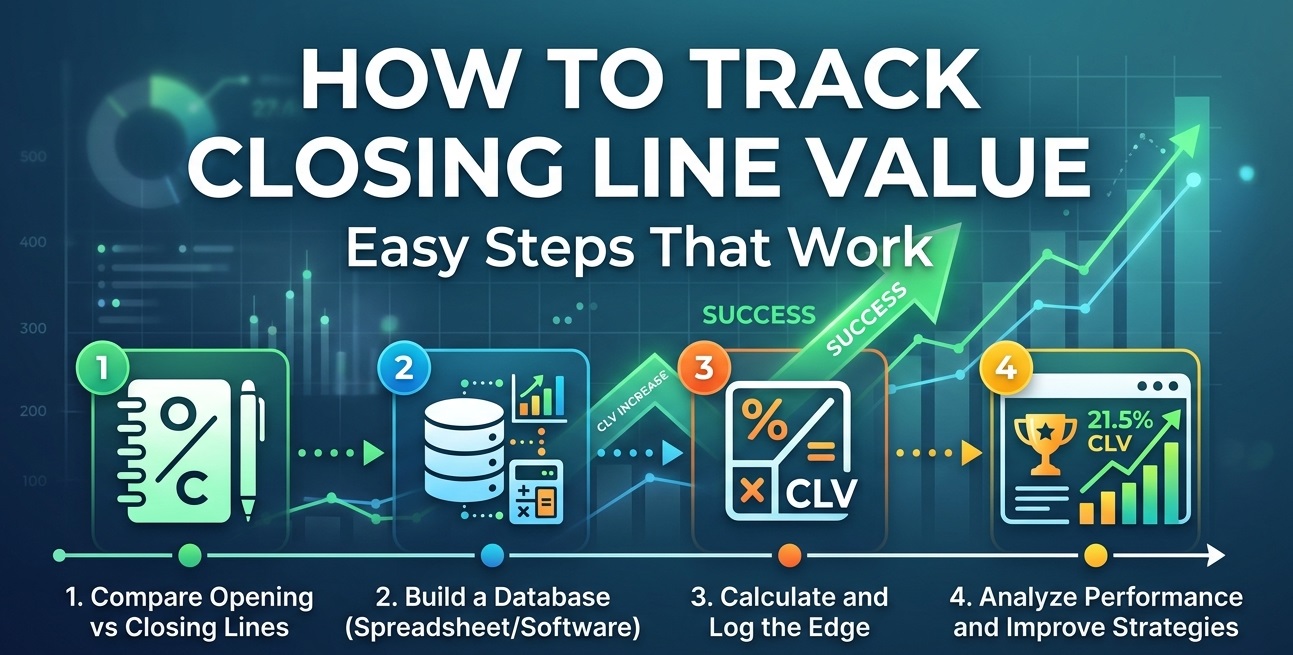
First, you log the bet as soon as you place it. Do not wait until later because you will forget details. Write down the line, odds, stake, and time. If you have a model edge or projection, include that too.
Second, you capture the closing line. This can be done manually or automatically, but the important thing is that you get it as close to game time as possible. If you miss the close, your CLV calculation is basically useless.
Third, you calculate CLV for each bet. For spreads and totals, you subtract the closing line from your line. For moneylines, you compare implied probabilities. You can also track whether you beat the close as a simple yes or no.
After that, you start looking at aggregates. This is where things get interesting. You want to see your average CLV, how often you beat the close, and how that varies by sport or bet type.
Visualization helps a lot here. Even something simple like a histogram can show whether your CLV is centered above or below zero. Rolling averages are also useful because they smooth out short term noise.
Segmentation is another big one. You should break your data down by sport, market, and timing. You might find that you are great at NBA totals but terrible at MLB moneylines. Or maybe your early bets are bad but your late bets are strong.
Once you have that level of detail, you can actually start improving.
Interpreting CLV and improving edges
This is where CLV really becomes valuable. It is not just about tracking numbers. It is about understanding what those numbers are telling you.
If you have positive CLV and positive ROI, that is obviously ideal. It means your model and execution are both working. If you have positive CLV but negative ROI, that is usually just variance. It sucks, but it happens. Stick with the process.
If you have negative CLV but positive ROI, that is a warning sign. You are probably getting lucky. That kind of performance usually does not last.
The worst case is negative CLV and negative ROI. That means something is clearly wrong. Either your model is off, your timing is bad, or both.
When you see patterns like that, you need to dig deeper. Look at your segments. Maybe one specific market is dragging everything down. Maybe your early bets are consistently worse than your late bets.
Timing is a huge factor. Lines move for a reason. If you are always betting after the move, you are going to have negative CLV. That is more of an execution issue than a modeling issue.
Execution improvements can make a big difference. Things like setting alerts, pre planning your bets, and reacting quickly to line changes can all improve your average CLV.
Risk management is also important. You should have rules for when to stop betting a certain market if your CLV drops below a certain level. That prevents small issues from turning into big losses.
Weekly reviews help keep everything on track. Look at your total bets, your CLV metrics, and your ROI. Compare everything across different segments. Also review your notes so you remember any unusual situations that might have affected your numbers.
At some point, you might realize your model needs a bigger overhaul. If your CLV is consistently negative across a large sample, it is probably not just bad luck. That means your assumptions or inputs are off.
When that happens, go back to the basics. Re evaluate your features, your weights, and your assumptions. Test changes carefully and track how they affect your CLV over time.
Practical references and templates
Having a solid template makes everything easier. Your spreadsheet should include all the key fields like bet details, closing lines, and calculated CLV metrics.
You can add formulas to automatically convert odds to probabilities and calculate CLV. That saves time and reduces errors.
You should also build simple summaries. Pivot tables work well for this. They let you quickly see your performance by sport, market, or time bucket.
Sanity checks are important too. Make sure you are not missing closing lines, mixing formats, or recording incorrect times. Small mistakes can throw off your entire analysis.
One thing a lot of people overlook is context. Numbers alone do not tell the full story. That is why notes are useful. They help you understand why certain bets had unusual outcomes or line movements.
When you combine all of this with ATSwins, you get a pretty complete system. ATSwins helps you find opportunities, and your CLV tracking tells you whether you are actually executing well on those opportunities.
Conclusion
At the end of the day, CLV is the closest thing we have to an objective measure of skill in sports betting. It cuts through the noise of short term results and shows whether you are consistently making good decisions.
The process is not complicated, but it does require discipline. You need to log every bet, capture the closing line, and review your results regularly. You also need to be honest with yourself when the numbers are not good.
If you stick with it, CLV becomes incredibly valuable. It helps you identify strengths, fix weaknesses, and build a more consistent approach.
Pairing this with a platform like ATSwins makes things even better. You get strong data driven projections on the front end and a solid evaluation framework on the back end.
That combination is what separates casual bettors from people who actually treat this like a process.
Related Posts
How Sharps Beat The Closing Line - 7 Ways to Gain CLV
Mastering the CLV Betting System: Maximizing Long-Term Sportsbook Variance
Closing Line Value Explained: Outsmarting the Market with CLV
Frequently Asked Questions (FAQs)
Closing line value is just a way to compare your bet to the market’s final number. If your bet is better than the closing line, you did well. Tracking it is as simple as recording your bet, recording the close, and comparing the two.
The data you need is not complicated. Just make sure you log your bet details, timing, and the closing line. Consistency matters more than complexity here.
For different bet types, the math changes slightly. Spreads and totals are measured in points, while moneylines are measured using implied probabilities. Once you understand that, everything else falls into place.
ATSwins helps by giving you strong projections and insights before you place bets. You can then use CLV tracking to evaluate how well you executed those bets. That combination makes your overall process much stronger.
A good CLV depends on the market, but generally speaking, positive CLV over a large sample is what you are aiming for. It does not guarantee profit in the short term, but over time it is one of the best indicators that you actually have an edge.
The biggest thing is to stay consistent. Track everything, review regularly, and make adjustments when needed. If you do that, CLV will become one of the most useful tools in your betting process.