

Table Of Contents
- Market mechanics and why closing line value (CLV) matters
- Finding edges early - a model-first workflow to beat the move
- Execution and timing - from line shopping to bankroll control
- Measurement, tracking, and feedback loops
- Data and references to level up
- Conclusion
- Related Posts
- Frequently Asked Questions (FAQs)
Market mechanics and why closing line value (CLV) matters
If you’ve been around betting Twitter or sports betting Discords for more than five minutes, you’ve probably seen people flex wins like they just cracked the code. But honestly, wins don’t mean much in the short term. The real signal, the thing that actually separates people who are guessing from people who know what they’re doing, is closing line value. That’s the whole game.
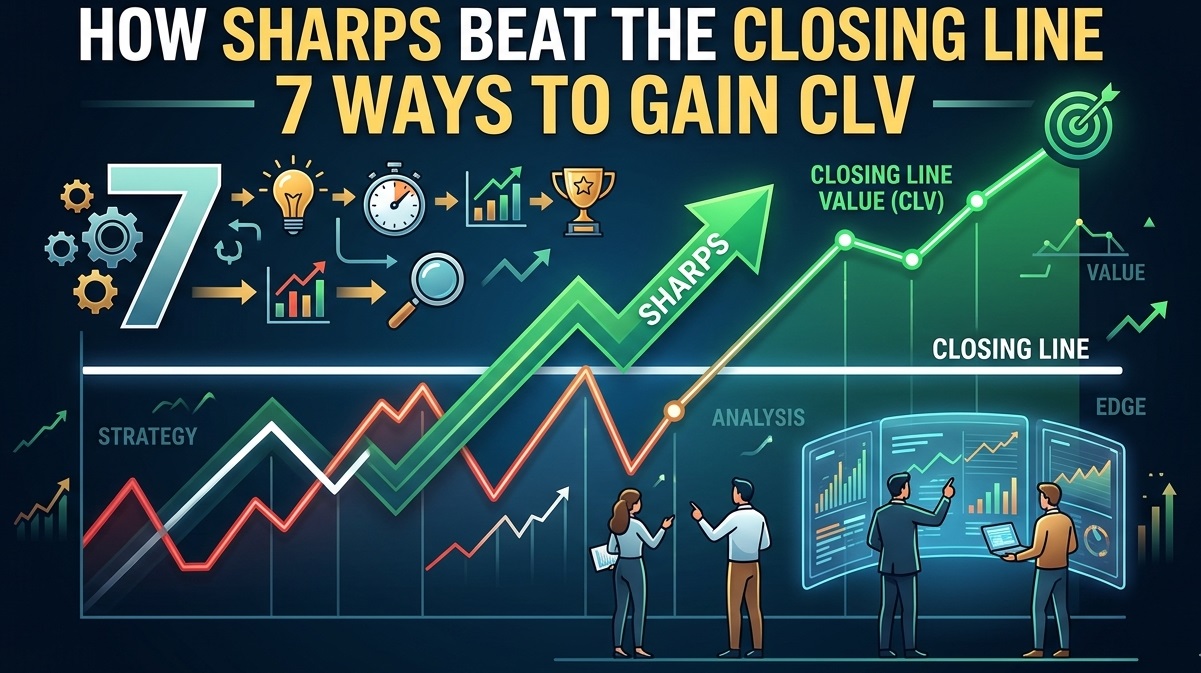
Closing line value, or CLV, is basically a way to measure whether you beat the market. It compares the number you bet to the number the market settles on right before the game starts. If you consistently get better numbers than the closing line, you’re doing something right. If you’re always behind it, you’re probably just donating money long term.
Think about it like this. You grab a team at -2.5 and by tip-off it’s -4. That means the market moved in your favor. You got a better price than everyone betting later. That gap is your edge. Same idea with underdogs. If you take +150 and it closes at +130, you locked in a stronger number than the final consensus. Over time, that matters way more than whether that one bet won or lost.
The reason CLV matters so much is that sports betting is insanely noisy. Even if you’re good, you’re going to lose a lot. Edges are small. Variance is huge. You can go on a brutal losing streak while making good bets. That’s just how probability works. CLV cuts through that noise. It tells you whether your process is actually sharp or if you’re just getting lucky.
Markets don’t just magically land on the closing number either. There’s a whole process behind it. Early lines are softer because there’s less information. Books are basically testing the waters. Limits are lower, and they’re more willing to move based on sharp action. As the day goes on, more information comes in. Injuries get confirmed. Lineups drop. Weather updates hit. Limits go up. More money enters the market. The number gets sharper.
By the time you reach close, that line is the most efficient version of the market’s opinion. It’s not perfect, but it’s the best collective estimate. That’s why beating it consistently is such a big deal.
Another thing people misunderstand is how line movement actually works. Not every move is meaningful. Sometimes the market is reacting to real information. Other times it’s just noise or early speculation. You’ll hear terms like steam and reverse line movement thrown around a lot. Steam is when a line moves fast across multiple books at the same time. That usually means respected money hit the market. Reverse line movement is when the line moves against the majority of bets, which can signal sharper action on the other side.
But here’s the thing. You can’t just blindly follow moves. That’s how people get trapped chasing numbers. The goal isn’t to react to the market. The goal is to be ahead of it.
There’s also a difference between books that shape the market and books that follow it. Some books take sharper action and move quickly. Others are slower and more recreational. If you’re measuring CLV, you want to compare your bets to a sharp closing line, not some soft number that lagged behind all day. Otherwise you’re just lying to yourself.
At the end of the day, CLV is your scoreboard. It’s the one metric that actually reflects skill over time. If you’re serious about improving, you need to track it, understand it, and build your entire process around beating it.
Finding edges early - a model-first workflow to beat the move
You don’t beat the closing line by guessing. You beat it by knowing what the number should be before the market fully gets there. That’s where models come in. And no, you don’t need some insane PhD-level system to get started. Simple, well-structured models can go a long way if you’re consistent with them.
The key is speed and structure. You want to generate fair prices early, then compare them to what the market is offering. If there’s a gap, that’s your opportunity.
One of the easiest starting points is something like an Elo rating system. It’s basically a way to assign strength ratings to teams and update them over time based on results. You adjust for things like home advantage and recent performance, then convert those ratings into spreads or moneylines. It’s not perfect, but it’s fast and surprisingly effective.
From there, you can layer in more detail. Bayesian updates are a big one. Instead of overreacting to small samples, you start with a baseline and adjust gradually as new data comes in. This is huge for dealing with injuries or lineup changes because it lets you update your expectations without going completely off the rails.
If you’re into soccer, Poisson models are the go-to. They estimate how many goals each team is likely to score based on attack and defense strength. From there, you can simulate outcomes and generate probabilities for different markets. It sounds complicated, but once it’s set up, it runs pretty smoothly.
For something like the NBA, player-level impact matters a lot. Not all injuries are equal. Losing a bench player is not the same as losing a star. Even within starters, roles matter. A player who drives spacing or controls pace can have a bigger impact than raw stats suggest. That’s where adjusted plus-minus style thinking comes in. You’re looking at how lineups perform together, not just individual numbers.
The biggest edges usually come from information gaps. Injuries, rest, travel, and weather all play a huge role in line movement. If you can process that information faster or more accurately than the market, you’ll find value.
Travel and rest are especially underrated. Back-to-backs in the NBA, long road trips in the NHL, and weird scheduling spots in MLB all affect performance. Books adjust for this, but not always perfectly. If your model accounts for it better, you gain an edge.
Once you have your projections, you need to translate them into actionable bets. That means setting thresholds. Not every small edge is worth betting. You want a buffer to account for uncertainty and vig. If your model says a team should be -3 and the market is -2.5, that’s probably not enough. But if it’s -1.5, now you’re talking.
Early markets are where a lot of value lives. Limits are lower, but numbers are softer. Props and derivatives are especially vulnerable. These markets don’t get as much attention, and adjustments are often slower. If you know what you’re doing, you can pick off value before it gets corrected.
There’s also a feedback loop here. When you bet into a market and the line moves quickly in your favor, that’s a good sign. It means you were ahead of the curve. If nothing happens, it doesn’t necessarily mean you’re wrong, but it’s worth paying attention to.
Tools like ATSwins.ai can help speed this process up. Instead of building everything from scratch, you can use AI-driven projections as a baseline and compare them to your own numbers. When both line up and the market is off, that’s usually a strong signal.
The goal is simple. Know the number before the market does, act when there’s value, and stay disciplined about when to pass.
Execution and timing - from line shopping to bankroll control
Even if you have a solid model, execution can make or break you. You can have the right idea and still lose value if you’re slow or sloppy with your bets.
First thing is line shopping. You need access to multiple books. Prices vary, and those differences add up over time. Getting an extra half point or a few cents on a moneyline might not feel like much, but over hundreds of bets, it’s massive.
Timing is just as important. Markets move in waves, usually around information drops. Injury reports, lineup announcements, and weather updates all create volatility. If you know when these moments happen, you can plan around them.
Sometimes it makes sense to bet early. Other times it’s better to wait. If you expect a line to move in your favor, you can grab it early. If you think the market might overreact to news, you can wait and take the other side later.
Scaling your bets is another big piece. You don’t want to go all in on every edge. That’s how you blow up. A lot of sharp bettors use some version of Kelly sizing, but usually a reduced version to control variance. The idea is to bet more when you have a bigger edge and less when you’re unsure.
Bankroll management is honestly underrated. People focus so much on picking winners that they forget about survival. You need to stay in the game long enough for your edge to play out. That means keeping bet sizes reasonable and avoiding emotional decisions.
There’s also a practical side to managing accounts. Spreading bets across books helps you get better prices and reduces risk of limitations. Acting like a normal bettor helps too. If you only hit the best numbers at weird times with max bets, you’re going to stand out.
At the end of the day, execution is about consistency. Same process, same discipline, over and over again.
Measurement, tracking, and feedback loops
If you’re not tracking your bets, you’re basically flying blind. You might think you’re doing well, but without data, you have no idea.
Every bet should be logged. Time, odds, stake, your projected number, and the closing line. That’s the minimum. From there, you can start analyzing patterns.
CLV should be tracked for every single bet. Not just overall, but broken down by sport, market type, and timing. This helps you see where you’re actually strong.
Sometimes you’ll have good CLV but bad results. That’s normal. Variance happens. Other times you might be winning but not beating the close. That’s a red flag. It usually means you’re running hot and it won’t last.
Reviewing your data regularly is key. Look for trends. Are you better in certain leagues? Do you struggle with props? Are you consistently late to moves? These insights help you refine your process.
Drawdowns are part of the game too. Everyone goes through them. The important thing is understanding why. If your CLV is still strong, it’s probably just variance. If it’s not, you might need to adjust your model or approach.
Over time, this feedback loop makes you sharper. You learn what works, what doesn’t, and where to focus your effort.
Data and references to level up
You don’t need to reinvent the wheel. There’s a ton of data out there if you know where to look. Historical results, player stats, and betting lines can all be used to build and test models.
The key is using that data effectively. Start simple. Build a basic model. Test it. Track your results. Then improve it step by step.
Platforms like ATSwins.ai can also speed things up. Instead of spending hours building projections, you can use their data-driven insights as a starting point. It’s especially useful for comparing your numbers to the market and spotting discrepancies early.
The real edge comes from combining good data with disciplined execution. Data alone isn’t enough. You need a process.
Conclusion
Beating the closing line isn’t about luck. It’s about preparation, timing, and discipline. You build a model, you find edges, and you act before the market fully adjusts. Then you track everything and refine your process over time.
CLV is the center of it all. It’s the one metric that tells you whether you’re actually doing this right. Focus on that, stay consistent, and the results will follow.
Tools like ATSwins.ai can help along the way, but the real work comes from your process. Keep it simple, stay disciplined, and don’t chase noise.
Related Posts
Mastering the CLV Betting System: Maximizing Long-Term Sportsbook Variance
Closing Line Value Explained: Outsmarting the Market with CLV
How To Track Closing Line Value - Easy Steps That Work
Frequently Asked Questions (FAQs)
What does beating the closing line actually mean?
It means you consistently get better odds than the final market price. That difference is your edge, and over time it’s what leads to profit.
Why is CLV more important than winning?
Because winning in the short term can be random. CLV reflects whether your bets were actually good. It’s a better measure of skill.
When do lines usually move the most?
Around key information drops like injuries, lineups, and weather updates. These are the moments where the market adjusts quickly.
Can beginners use this approach?
Yes, but keep it simple. Start with a basic model, track your bets, and focus on small edges. Don’t overcomplicate it.
How does ATSwins.ai help?
It provides AI-driven projections, props, and tracking tools that help you identify value and monitor your performance, making it easier to stay ahead of the market.