
How AI Finds Sportsbook Pricing Errors: A Professional Analyst’s Guide to Spotting Value Fast
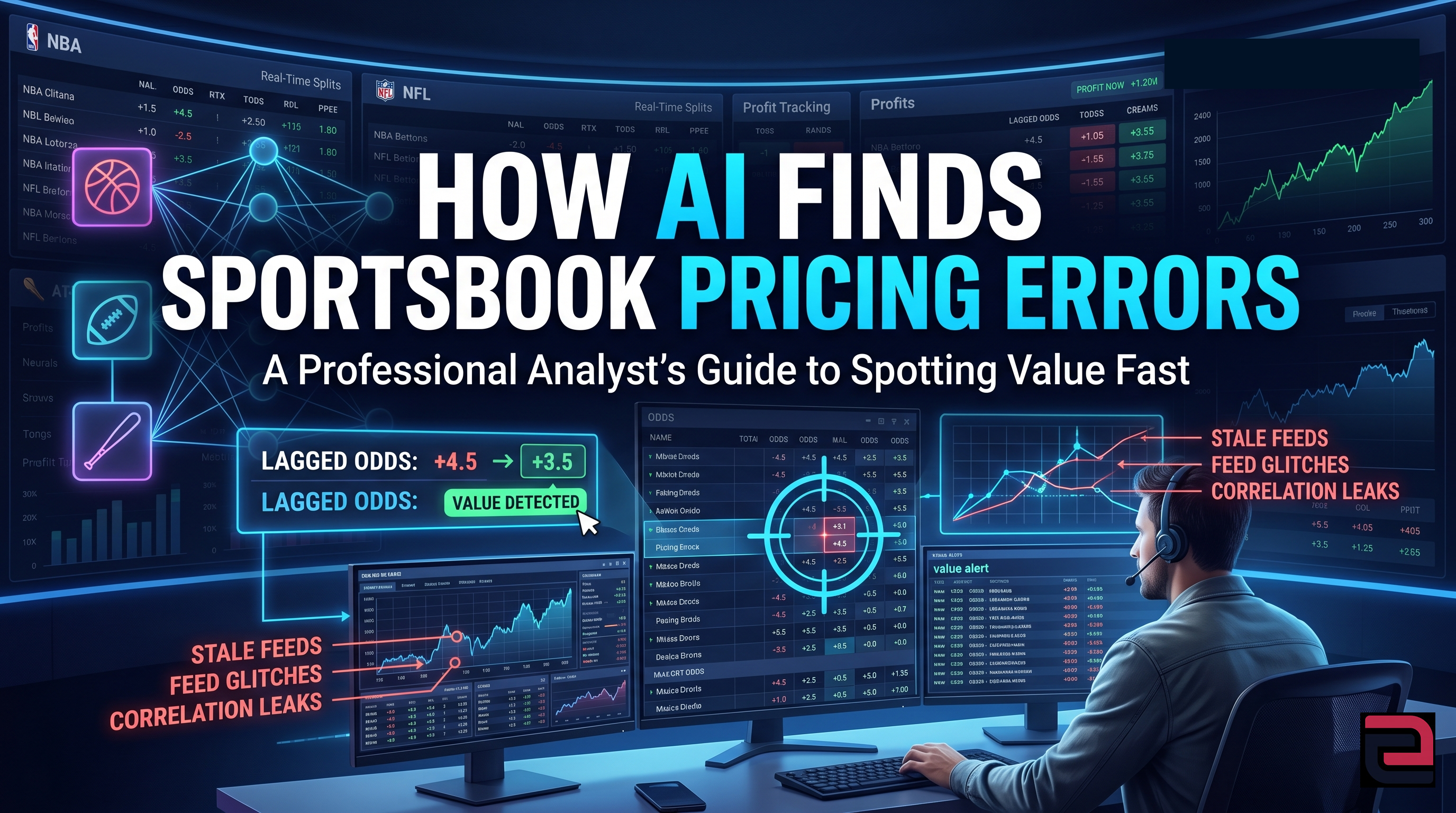
Sportsbooks set numbers with speed, but they do not set them with perfection. As a professional analyst who builds AI models for a living, I spend my days tracking exactly how these lines are made, exactly where they tend to break, and exactly when those elusive edges start to appear. This piece is meant to be a deep dive into my step-by-step process for spotting mispriced odds, managing risk and your bankroll effectively, and converting closing line value into steady, repeatable returns over the long haul. Understanding how ai predicts baseball scoring is central to this effort, as modern algorithms now synthesize massive amounts of pitcher, hitter, and ballpark data to project outcomes with unprecedented precision.
Pricing mechanics and error modes
When we talk about how books originate prices, it is important to distinguish between market-makers and the various clone books. Market-makers set the first efficient line because they have massive models, traders who actually possess domain expertise, and the liquidity to take early action. Their openers effectively steer the entire market. On the other side, you have clone books and regional operators that simply copy or shade their lines off of a few highly respected sources. They add their own specific margin and use auto-movers based on the incoming bet flow. When a clone book lags or misreads a shift, that is when a temporary edge finally opens up for us to exploit. For props and Same Game Parlays, there are only a handful of specialists who publish the reference feeds that most of the industry uses. If that primary feed hiccups, or if the internal rules fail to properly reconcile correlations, you end up with mispriced tails that provide incredible value.
Books quote American odds with built-in margin, which we call the vig. The hold is carefully spread across both sides to ensure that the house maintains a positive expected value over time. They also use auto-movers to adjust based on the flow of money. If sharp money hits a book, the line jumps price levels or even crosses important key numbers like moving from NFL minus two and a half to minus three or even minus three and a half. Some shops weight steam from a curated list of accounts they deem to be sharp, while others are much slower to move lines to protect public-facing odds. This inconsistency is the primary fuel for our outlier detection models.
Errors persist because of a few structural realities. We see stale or lagged updates where a slow clone fails to mirror a market-maker immediately after breaking injury news. The window for these opportunities can be several minutes in props or just a few seconds in major spreads. Then there are mispriced correlations on player props and parlays, such as passing yards plus receiver yards that sum to more than the actual team total. Over-weighting independence assumptions remains the classic mistake that books make. We also see feed glitches where a vendor pushes a wrong rotation number or misses a minus sign entirely. Because of low liquidity on some openers, the book will often refuse to take enough action to move the line, which means bad prices stay live much longer than they should. Traders also manually override lines around milestones or weather reports, and they occasionally forget to link those changes to related markets like team totals or alternative spreads. Cross-market inconsistencies are a huge tell as well. Moneyline, spread, and total should always agree with one another. When they do not, a triangle of potential edges opens up.
AI workflow for spotting misprices
To build a robust workflow, you need to collect the right data. Start with historical odds by timestamp, including openers, mid-stream updates, and closers from multiple books. Use closing lines as your baseline truth because they are the most efficient price point available. You also need comprehensive game results and player stats, along with context features like injury reports, rest days, travel distance, altitude, and even weather patterns. The market structure itself, specifically limits set by the book, acts as a very useful confidence signal. If you prefer to have a lot of this heavy lifting done for you, ATSwins.ai is an excellent resource. It provides an AI-powered sports prediction platform where you can scan betting splits, props, and model edges to move much faster than you could on your own.
Once you have your data, you must normalize your odds to remove the noise. You should convert American odds into implied probabilities and strip away the book’s vig to get to a fair probability for each market. Standardizing your rotation IDs and timestamps to UTC is a non-negotiable step. You also want to tag your liquidity windows, such as early openers versus the pre-close, because these tags should drive your alert thresholds. I recommend using a mix of model families for this work. Logistic regression is fantastic for its speed and transparency when dealing with sides and totals. Gradient boosted trees, like XGBoost or LightGBM, are the gold standard for tabular data and handle non-linearities in props incredibly well. For newer players or scenarios with scarce data, Bayesian hierarchical models are much more robust. You should always check your calibration using reliability plots and Brier scores to ensure your model probability actually reflects real-world win rates.
When analyzing the diamond, a sophisticated AI MLB run projection model integrates everything from barrel rates and wOBA to pitcher-specific spin rates and fatigue markers to estimate the true scoring potential of a game before the first pitch. Computing your edge is the next step. Your edge is simply the model probability minus the book’s fair probability. You should calculate the expected value for every bet to ensure you are maintaining a positive growth rate. Tracking your closing line value is the ultimate reality check to ensure you are not falling victim to selection bias. I always prefer to have many small, independent edges rather than a few large ones that might just be high-variance flukes. Your alerting windows should be strictly defined by liquidity. You want higher edge thresholds for early openers when the error rate is high and the limits are low, and much tighter thresholds for pre-close markets where the prices are sharpest.
Step-by-step build: from raw odds to actionable signals
The build process starts by defining your scope. You should pick sports where you have access to truly reliable data. Focus on a very small set of markets initially, such as main spreads, totals, and player props. Document your latency goal, which should be sub-one-second for any in-market alerts, and decide on the maximum number of daily bets you are willing to make to protect your bankroll. You need to collect and align your odds snapshots, closing lines, and team features, ensuring that everything is cleaned and mapped to unique IDs.
Feature engineering is where the real work happens. You need rolling efficiency metrics, rest and travel flags, and usage indicators like minutes, touches, or target shares. Train your baseline models using a rolling window approach to mirror how you will actually deploy them in a live environment. Once the models are trained, calibrate them using isotonic scaling on out-of-fold predictions. Only after this do you build your edge calculations and alert logic. Your bankroll policy should be based on a fractional Kelly criterion, with strict caps per bet and per day. Finally, conduct rigorous walk-forward backtesting that includes your rejection rates and line slippage. Never simulate a perfect world; simulate the world as it actually exists, including the friction of real-world sportsbooks.
Signal detection and constraints
Your signal detection needs to be smart enough to handle consensus versus outliers. You should build a consensus price from top-tier books using a median or a trimmed mean. Flag any book that deviates from this consensus by a dynamic tolerance level. If your model disagrees with the market and there is no outlier book confirming your thesis, you should proceed with extreme caution because your model is likely the one that is wrong. Use time-series drift monitors to track how each book’s line behaves against the consensus over time. If a book consistently lags, you have found a target-rich environment.
Arbitrage triangles are rare, but they serve as amazing canaries in the coal mine. Even if the arbitrage opportunity vanishes in a heartbeat, it tells you that the prices in that set are likely stale. Always run sanity checks across moneyline, spread, and total. If your math suggests a team total should be significantly different from the posted line, prioritize the cheaper resolution, which is usually the team total or an alternate line. Regarding Same Game Parlays and props, you must implement correlation controls. If you are betting a QB passing yards prop and a WR receiving yards prop, realize that these are highly correlated. If the book prices them as independent events, you have a massive advantage, but you need to cap your combined exposure so you do not accidentally violate your own risk rules. Your execution windows should remain very short. Most edges die within sixty to one hundred and eighty seconds, so prioritize your bets by the expected value per second of latency. Furthermore, when the market overreacts to a big name pitcher or a high-profile lineup, reliable ai baseball over under predictions help filter out the noise and highlight when the totals are actually misaligned with the historical weather and park-factor baselines.
Validation, risk, and operations
Validation requires walking forward through time with data clustering to ensure no information leaks from the future into the past. You must conduct leakage audits to confirm that the injury status you used in your model was actually public information at the exact time the line was set. A/B test your alert thresholds constantly to see if a two percent edge performs better than a two and a half percent edge in the real world. You also need to build a per-book friction model that accounts for the average allowed stake, the frequency of price changes during your execution, and the probability of a bet being rejected.
Limit-aware execution is mandatory. If the current limit at a book is not compatible with your Kelly fraction, you should either downsize your stake or skip the bet entirely. Latency budgets are your lifeblood, so target end-to-end alert latency of under five hundred milliseconds for liquid markets. Use SHAP values to interpret your model and confirm that it is making decisions based on factors that actually make sense in the real world, such as wind speed for passing props or back-to-back scheduling for NBA minutes. Monitoring for concept drift is an ongoing monthly task. If your model calibration starts to degrade, it is time for a retrain. Finally, log every single detail of your process. A post-mortem is the only way to determine if a loss was due to bad variance or a flaw in your underlying logic.
Resources, templates, and how to use ATSwins in the loop
To keep your workflow reliable, you need a stable set of tools. I rely on scikit-learn for fast baselines and logistic regression, and I use PyTorch when I need more flexibility for feature interactions. You can use SHAP documentation to compute feature attributions and validate what your model truly believes. For historical stats and schedules, Sports Reference is a gold standard for engineering your context features.
When setting up your system, follow a strict odds normalization checklist. Always convert to implied probabilities and de-vig, then align your timestamps and markets across all your books. Tag your liquidity windows and drop any erroneous ticks immediately. My model and calibration template usually involves a logistic regression baseline for spreads and totals, and gradient boosting for props. I calibrate everything with isotonic regression on out-of-fold predictions. My alert playbook is aggressive; I set my outlier thresholds based on sigma and I look for edge thresholds that change as we move closer to the start of the game. I also implement hard risk controls like daily exposure caps and market-specific loss limits.
Using ATSwins in this loop is a massive efficiency booster. If you do not want to maintain the entire infrastructure yourself, you can use the platform for data-driven picks, detailed player props, and betting splits. When the model inside ATSwins agrees with your own outlier screens, that is the signal to size up within your pre-defined caps. I suggest reviewing their specific analytics pieces on how to catch sportsbook errors fast, as these are great primers for anyone getting into the weeds of pricing models.
Operational tips often matter more than the fancy math. Track your rejection rates and limits by book and sort your alerts by stakeable expected value rather than raw expected value. Keep separate budgets for different types of bets because props have significantly more drift and variance than main lines. Preserve your accounts by varying your bet sizes within a reasonable band. If you hit the same derivative at the same shop every single time, you are begging to get limited. Post-mortem your performance weekly. Look for trends in your closing line value and your calibration stability.
Before every slate, run a simple checklist. Is your injury and availability sweep finished? Is the weather feed fresh for outdoor games? Is your consensus model updated and calibrated? Are your outlier thresholds set for the current market phase? Are your bankroll caps reset and your correlated exposure checked? Finally, make sure you cross-check your own model edges with the ATSwins platform to see if there is alignment or conflict.
Common pitfalls include overfitting on short samples, which happens constantly because sports seasons are actually quite small. Keep your models simple and rely on calibration. Never ignore transaction costs; slippage and rejections can turn a profitable edge into a loser very quickly. Do not chase every alert. It is perfectly fine to miss a bet if the liquidity is not there. Over-trusting Same Game Parlays is a trap because if the engine ignores the internal correlation of the legs, the value you think you see is often a complete illusion. Always remember that the moneyline, the spread, and the total must reconcile.
Conclusion
AI helps us spot sportsbook pricing errors fast by catching stale lines, bad correlations, and timing gaps that a human analyst would never see. The best results always come from calibrated models, clean data, and exceptionally firm bankroll rules. Keep your eyes on expected value, closing line value, and constant cross-market checks. If you want to act on this with confidence, ATSwins provides a fantastic AI-powered sports prediction platform offering data-driven picks, player props, betting splits, and profit tracking across the NFL, NBA, MLB, NHL, and NCAA. Their free and paid plans give you the insights and the guides needed to make smarter, more informed decisions in a market that never stops moving.
FAQs
What does it mean when AI finds sportsbook pricing errors?
It means the model identifies odds that do not match the true win probabilities. In practice, AI converts sportsbook prices to implied probabilities, compares them to calibrated projections, and flags gaps like stale lines or mismatched totals and spreads. When the model shows positive expected value, that is a likely pricing error worth taking seriously.
How does AI actually find sportsbook pricing errors in real time?
The process is methodical. The AI ingests odds feeds, normalizes lines across books, removes the vig, and compares those implied probabilities to live model outputs. It watches for sudden market moves, stale numbers, and cross-market inconsistencies. It also checks derivative markets for correlation misses. If the edge exceeds a threshold and liquidity is available, you receive an alert that is both quick and focused.
What data matters most for how AI finds sportsbook pricing errors?
Four buckets are critical. You need player and team performance with context like form and usage. You need news signals that shift your priors such as injuries, rest, travel, and weather. You need market structure data including consensus lines and line movement. Finally, you need a historical truth set of closing lines and outcomes for calibration. With these, your model stays grounded and avoids chasing noise.
How should I act when AI says there is a sportsbook pricing error?
Treat it like a professional. Verify the market, confirm the liquidity, then size your bet using a fraction of the Kelly criterion or fixed units. Avoid chasing thin openers, cap your exposure across correlated bets, and track your closing line value to see if you are truly beating the closing price. If the edge is small or latency is high, pass. Discipline beats volume every single time.
How does ATSwins.ai help with how AI finds sportsbook pricing errors?
ATSwins.ai is an AI-powered sports prediction platform offering data-driven picks, player props, betting splits, and profit tracking across the NFL, NBA, MLB, NHL, and NCAA. Their free and paid plans provide bettors with insights to make smarter, more informed decisions. It means you get cleaner projections, expected-value-focused signals, and tracking that shows whether your edges are real. This includes splits and trends that help you avoid traps and act at exactly the right time.