
How AI Estimates Game Outcomes: A Pro-Level Guide for 2026
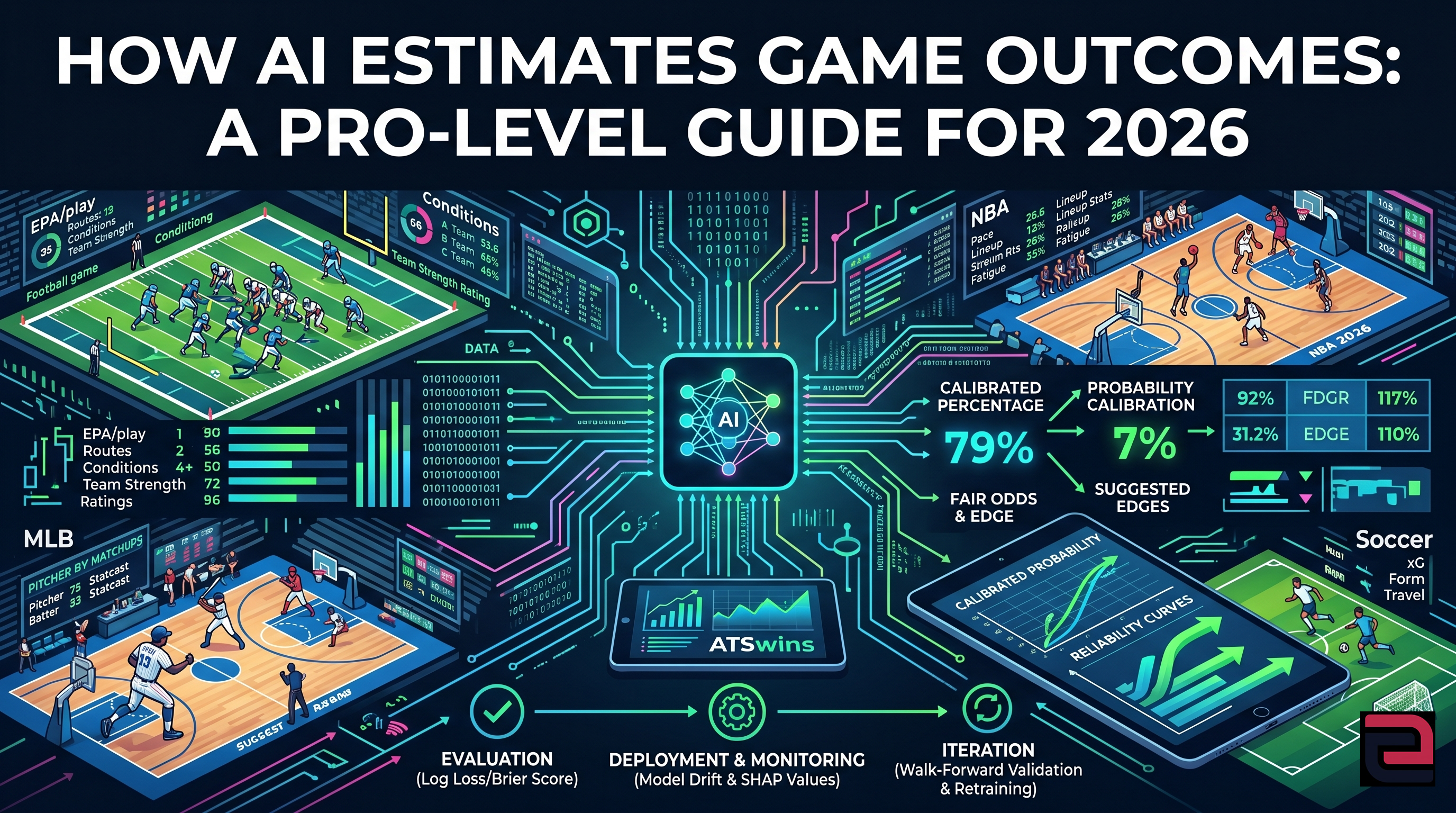
As a sports analyst living in the thick of the data revolution, I’ve seen firsthand how AI has changed the game. Forget the old-school gut feelings; we’re now building systems that assign real, calibrated probabilities to every play. If you want to know how AI estimates game outcomes without falling for the hype, you’re in the right place—let’s break down the logic behind the numbers.
When people talk about how
AI estimates game outcomes
, they often imagine a computer magically picking winners. In reality, it is much less like a crystal ball and much more like a weather forecast. We aren’t trying to predict the future with 100 percent certainty. Instead, we are trying to assign a probability to every possible outcome and then figure out where the market is mispricing those chances. If a model says a team has a 60 percent chance of winning, that number needs to hold up over a thousand games. If it doesn’t, your model is just guessing.
The most important thing to grasp is that sports betting markets include an overround, or the "vig," which is how the house guarantees their profit. If you just take your raw model probabilities and compare them to the betting lines without adjusting for that vig, you are going to be chasing ghosts. You have to remove the house edge first to see the true market probability. Once you have that "fair" number, you can see if your model actually has an edge.
Another huge hurdle is class imbalance. In sports like the NBA or MLB, favorites win more often, but underdogs win enough that a naive model might just get lazy and pick the favorite every single time. You have to teach the model to respect the nuance of the game. And finally, you have to be absolutely ruthless about data leakage. If you accidentally include a stat that only existed after the game was over, your model will look like a genius in your tests and then lose all your money the second it goes live. You have to be perfect with your timestamps.
Problem framing and targets
When we look at how AI estimates game outcomes, we usually frame the problem around three specific outputs. First, for the moneyline, we want the probability of each team winning. If it is soccer, we need to account for the draw, which adds a whole layer of complexity. Second, for totals and spreads, we are often looking at expected point totals or goal counts. We want to build a distribution of scores so we can tell you not just who will win, but how many points they might win by. Third, for playoffs, we use those individual game probabilities to run Monte Carlo simulations. We play the series out ten thousand times in the computer to see how likely a team is to advance.
To make this work, you have to normalize the market odds. You take the decimal odds, calculate the implied probability, sum those up, and divide each one by the total. That gives you the fair market percentage. That is the benchmark your AI has to beat. If the market says a team is 54 percent to win and your model says 56 percent, that two percent difference is your edge. If you don't do this, you’re comparing apples to oranges. At the highest level, an effective sports market trading strategy relies on identifying these small discrepancies between your internal probabilities and the market's implied pricing, allowing you to treat betting like a quantitative trading desk.
Data and feature engineering
Building a data pipeline is the foundation of everything. You need a process that pulls schedules, weather reports, injury news, and historical odds every single day. The most important rule here is using "as-of" timestamps. Every single piece of data has to be tagged with exactly when it became known. If a player is ruled out at 4:00 PM, your model cannot know that for a 3:30 PM game. If you aren't strict with this, you are cheating.
For team strength, most analysts rely on an Elo or Glicko rating backbone. These are just ways of tracking team quality that update after every game based on the margin of victory. They are boring, but they work. You can add more complex features on top, like rolling averages for offensive and defensive efficiency. At ATSwins , we view these ratings as the essential glue that holds everything else together. Whether we are looking at player props or market splits, the ratings form the base.
Fatigue is another massive factor. You should be tracking back-to-back games, total miles traveled in the last week, and rest differentials. If a West Coast team is playing an early game on the East Coast, that’s a clear data point. You should also look at venue factors like altitude or stadium turf. In the NFL, wind speed is the single most important weather variable. If it’s blowing over 15 miles per hour, your total projections need to shift immediately.
When it comes to injuries, don’t just use a binary "in or out." If you have access to player-level data, try to model the impact of missing specific starters. In the NBA, missing a star player changes the entire team’s pace and shot profile. We also use Poisson-derived scoring rates for low-scoring games like soccer or hockey. It allows us to estimate the expected goals for each team based on their historical attack and defense strengths, which is way more accurate than just throwing a random number at the total.
Modeling approaches that work in production
Start with something simple. A logistic regression model is often the best baseline because it’s fast and very easy to interpret. You can quickly see which features are actually moving the needle. Once you’ve got that down, you can move to tree-based ensembles like XGBoost or LightGBM. These are incredible for capturing the weird, non-linear relationships in sports. For example, the effect of wind on an NFL game might not be a straight line; it might only matter once it hits a certain speed threshold. Trees handle that naturally.
If you are dealing with sparse data, like in college sports, Bayesian hierarchical models are your best friend. They allow you to "shrink" the predictions toward a league average when you don't have much info on a specific team. And if you are really advanced, you can build neural networks with team and player embeddings. These can learn subtle synergies between players that you couldn't possibly code by hand.
The most important part of your modeling workflow is walk-forward validation. Never just do a standard random train/test split. Because sports data is a time series, you have to train on the past and test on the future. Slide your training window forward day by day to see how the model would have performed in real-time. If it performs well, you might be ready for production.
Probability calibration and evaluation
Calibration is the most overlooked part of how AI estimates game outcomes. You can have a model that is "accurate" but still totally useless because it’s overconfident. If your model says an event has a 90 percent chance of happening, it better actually happen 90 percent of the time. If it only happens 75 percent of the time, you are going to lose your shirt on bad bets.
We use log loss and Brier scores to measure this. These metrics punish you for being confident and wrong. To fix miscalibration, you can use techniques like Platt scaling or isotonic regression. These are basically just post-processing steps that take your raw model output and "smooth" it so it matches reality. It’s like recalibrating a scale that is slightly off; it’s a simple fix that makes a massive difference in your long-term bankroll.
Deployment, monitoring, and iteration
Once you go live, your job isn't done. You have to monitor for "model drift." This happens when the league changes how it plays. For example, if the NFL suddenly decides to call more holding penalties or the NBA changes its defensive foul rules, the game itself shifts. If your model is still using data from three years ago, it’s going to be looking at a sport that doesn't exist anymore.
You should have automated alerts that trigger when the distribution of your predictions changes too much. If your model suddenly starts predicting that every team is going to score 150 points, something is wrong with your data pipeline. You also need to keep your SHAP values handy. These tell you exactly which features are driving each prediction. If the model suddenly loves the underdog, you can look at the SHAP report and see, "Oh, it's because the underdog is playing at home on three days of rest." It builds trust and makes it way easier to debug when things go wrong.
Practical build: a step-by-step template you can adapt
If you want to build this yourself, start by assembling your historical data. Clean it, timestamp it, and put it into a database where you can pull snapshots of what the world looked like at any given moment. Next, build your Elo ratings. Even a basic Elo system that accounts for home-field advantage will beat a huge chunk of the casual betting market. Then, layer in your rolling averages for stats like offensive efficiency.
After that, run your model training. Use a library like LightGBM to start. Apply monotonic constraints if you know for a fact that certain variables should only move the needle in one direction. Then, set up a walk-forward validation loop. If your Brier score is improving over time, you’re on the right path. Finally, build a dashboard where you can see the fair odds versus the market odds. That is your decision-making engine.
Tools we like for this workflow
The Python ecosystem is the gold standard for this. Use Pandas for data manipulation, Scikit-learn for your base models, and XGBoost or LightGBM for the heavy lifting. If you want to dive into the Bayesian side of things, PyMC is incredibly powerful. For versioning your data—which you absolutely must do so you can reproduce your results—DVC or LakeFS are lifesavers. For scheduling your daily pipeline, tools like Airflow or Prefect are the industry standard.
For visualization, keep it simple. Streamlit is perfect for building a quick internal dashboard where you can view your model's daily predictions. Don't waste time making it pretty; just make sure the information is easy to read. You need to be able to scan the list of games and instantly see where the edge is.
Common pitfalls and quick fixes
The biggest pitfall is almost always data leakage. It’s so easy to accidentally use a "final score" feature or a "season-to-date average" that includes the game you are trying to predict. If your performance seems too good to be true, you have a leak. Go back and check your timestamps. Another common error is overfitting. If you have a thousand features and a small dataset, your model is going to memorize the noise rather than learn the patterns. Keep your feature set lean.
Another classic mistake is ignoring the importance of line movement. Sometimes the market knows something you don't—like an injury report that hasn't hit the main news sites yet. If the line moves hard against your model, don't double down. Take a step back and see if your model missed a piece of data.
What the outputs should look like (and how to use them)
Your final dashboard should be clean and actionable. Don’t show your users a wall of raw code. Show them the probability of the home win, the away win, and the draw. Provide the "fair odds" based on your model, and then show the market odds alongside them. Calculate the "edge" percentage so they can see exactly what the value is.
If you are using a Kelly Criterion approach for bankroll management, show the recommended stake. But keep it conservative. Even if the model loves a pick, don't put 20 percent of your bankroll on it. Real life isn't a textbook, and variance is a killer. Use fractional Kelly to keep your exposure in check.
Mini “blueprints” by sport
Every sport is a different animal. For the NFL, focus on EPA per play and situational awareness. The quarterback is everything, so have a specific way to handle backup QB scenarios. For the NBA, it’s all about rotation and pace. If a superstar sits out, the game changes entirely, so your model needs to be able to simulate games with different lineup assumptions.
MLB is a completely different game because of the pitching. You need to model the starting pitcher’s current form separately from the rest of the team. Use Statcast data for this; it’s the best in the business. In fact, building a sophisticated AI MLB run projection model allows you to break down these individual player contributions into a cohesive score, making it much easier to value run lines and totals. Furthermore, for those looking to capitalize on specific game environments, utilizing AI baseball over under predictions provides a data-backed edge that considers park factors and weather in ways the public market often misses.
For hockey, goalie performance is the biggest variable. If your goalie model isn't solid, you’re basically betting on a coin flip. And in soccer, you have to be comfortable with the draw. If you are only modeling win/loss, you are missing out on the most profitable part of the market.
A simple checklist for production readiness
Before you turn your model on, check your basics. Is your data pipeline fully automated and does it handle missing values gracefully? Have you run a walk-forward backtest that covers at least two full seasons? Is your calibration actually working, or are you just assuming it is? Do you have an "emergency stop" button in case your pipeline fails and starts sending out garbage data? If you can’t answer yes to all of these, you aren't ready for production.
Calibration and metrics quick reference
Keep a reference sheet on your desk. Know your Log Loss targets for your specific sport. Know what your baseline Brier score should look like. If your reliability curve starts to deviate, you know exactly what tool to use to fix it. This isn't just about having cool charts; it's about having a standardized way to measure your own performance so you can improve.
Notes on markets, edges, and realistic expectations
The most important advice I can give is to be realistic about your edge. Even the best models in the world are only beating the market by a few percentage points. If you think you’ve found a "system" that is going to win 80 percent of your bets, you are delusional. That doesn't exist. Professional betting is about grinding out small edges over a massive sample size. It's not a get-rich-quick scheme; it's a business.
External references worth bookmarking
If you want to keep learning, start with the Scikit-learn documentation on probability calibration. It is the gold standard for how to make sure your numbers are actually meaningful. Wikipedia’s entry on the Brier score is also a great read for understanding the math behind your performance metrics. For general machine learning, Google’s Machine Learning Crash Course is the best place to start if you feel like your foundations are shaky.
Conclusion
At the end of the day, how AI estimates game outcomes is really just about reducing uncertainty. You are taking a chaotic, unpredictable event and using data to bring some order to it. It’s hard work, it requires constant maintenance, and you will have days where the model gets it completely wrong. That’s okay. Focus on the process, keep your risk management tight, and let the math do the work.
When you need a platform that does the heavy lifting, ATSwins.ai is an AI-powered sports prediction platform offering data-driven picks, player props, betting splits, and profit tracking across NFL, NBA, MLB, NHL, and NCAA. Our goal is to provide the insights and guides you need to make smarter, more informed decisions, giving you the edge you need in a competitive market.
Frequently Asked Questions (FAQs)
What does how AI estimates game outcomes actually cover?
It covers the entire pipeline from raw data to final probability. When we discuss how AI estimates game outcomes, we are talking about gathering data, creating features that matter, training models that don't overfit, and then calibrating those results so they reflect reality. It is a full-stack analytical process.
Which data matter most in how AI estimates game outcomes?
The data that matter most are the ones that are timestamped and accurate. We focus on team ratings, recent performance metrics, injury reports, and situational factors like travel and rest. The "what" is important, but the "when" is everything.
How accurate can how AI estimates game outcomes be, and how do I read the numbers?
Accuracy isn't about being right every time; it's about being right more often than the market over a long period. If your model gives you a probability, look for the delta between that and the market. If you are consistent, you will find your edge.
How can bettors use how AI estimates game outcomes in a simple way?
Keep it to two things: compare fair odds to market odds, and manage your stake sizes. Don't overcomplicate it. If the value is there and your model is calibrated, the math will work out in the long run.
How does ATSwins.ai apply how AI estimates game outcomes in real life?
We use our own models to drive our platform. ATSwins.ai is an AI-powered sports prediction platform offering data-driven picks, player props, betting splits, and profit tracking across NFL, NBA, MLB, NHL, and NCAA. We track the results, learn from the misses, and give our users the same data-driven insights we use ourselves.