
Which AI Is Best for Sports Predictions? How to Choose the Right One for You
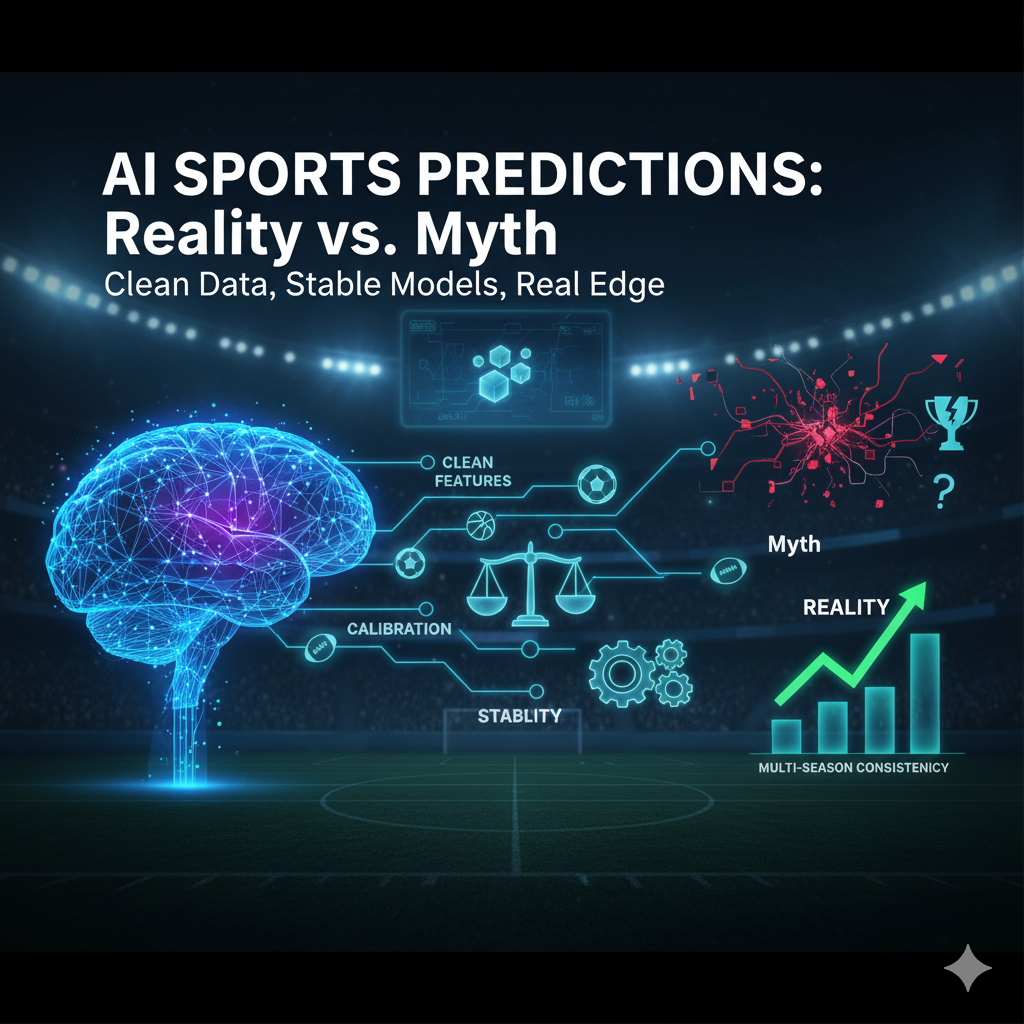
Table Of Contents
- What “best” really means for sports predictions
- Data readiness and feature craft
- Model families that actually deliver
- Testing, calibration and monitoring
- Workflow and stack
- Practical step by step: building your first reliable stack
- Templates and checklists you can reuse
- Notes on explainability and user trust
- When to favor each model family quick rules of thumb
- Upgrade path as you scale
- Example pitfalls from real world ops
- Final takeaways you can act on today
- Conclusion
- Frequently Asked Questions
Sports predictions sound like they should be easy. You grab some stats, toss them into an AI model, hit run, and boom, you get the winning picks. But most of the time, that idea falls apart fast because the quality of sports predictions always comes down to two things: the quality of the questions you ask and the quality of the data you trust. Once I started building models every week instead of once in a while, it became obvious that the myths around the best AI for sports predictions are way louder than the reality. The reality is more boring but way more powerful. Success in sports modeling comes from clean features, choosing the right model for the specific task, calibrating the outputs, avoiding accidental data leakage, and keeping things stable across multiple seasons, not just a hot streak.
ATSwins is one of the few platforms that leans into this reality by grounding predictions in data, calibration, and workflow instead of hype. That is the kind of mindset you need if you want results that actually hold up across NFL, NBA, MLB, NHL, and NCAA instead of just posting highlight reel wins.
What follows is a full breakdown of what actually makes an AI good for sports predictions, how to build models that don’t collapse once the season gets weird, and the kind of workflow you need if you want to move beyond surface level picks and into repeatable edges.
What “best” really means for sports predictions
The first mistake almost everyone makes is trying to answer the question of which AI is best without defining the actual job the AI is supposed to do. Sports predictions are not one thing. Predicting an NBA spread is not the same as projecting MLB totals or forecasting an NFL player prop. So before choosing an AI model, you need to define the task with painful clarity.
For example, if your goal is to predict moneyline outcomes the job is estimating win probabilities. If you are predicting spread performance the job becomes estimating margin of victory relative to a specific line at a specific time. If the goal is props then you are predicting distributions of player performances that can vary wildly from game to game depending on usage, injuries, pace, matchups, and season context. Live predictions mean the model needs to update in near real time whenever the game state changes.
All these tasks behave differently, have different levels of noise, and require different features to work correctly. NBA player props need rotation and usage context. MLB totals rely heavily on park factors, wind, and starting pitching. NHL sides rely heavily on goaltending and travel. NCAA spreads require careful stabilization because some teams blow out tiny schools and inflate their numbers. There is no single model that can handle all of this perfectly.
This is why ATSwins relies on multiple models and blends that get calibrated for each sport and market instead of trying to jam everything into one generic system. It is also why you should think of the best AI not as a single algorithm but as the right model for the right job.
When you think about constraints, the picture becomes even clearer. Live models need extremely fast update times. Pregame models can be heavier and slow. Some users care about explainability because they want to know why a pick is being made. Some sports have dense data. Others barely have any. Some markets move early. Some move late. And your system also needs to be something you can monitor without breaking every week. The best AI is always the one that fits your constraints and delivers stable performance.
When it comes to success metrics, most people chase accuracy which sounds logical but almost always misleads because accuracy does not reward calibrated confidence. A model predicting every game at 51 percent will technically look accurate but will be completely useless. Instead, you need log loss, Brier score, ROI, and season by season stability. If your probabilities do not reflect reality, your bankroll will eventually bleed out.
The part most people miss is calibration. You want your 60 percent predictions to actually hit around 60 percent long term. Raw models are rarely calibrated out of the box which means you need isotonic or Platt scaling to make the numbers real. Calibration and stability are way more important than exotic modeling techniques.
The public conversation around AI for sports predictions often ignores the boring truth that no single model is dominant across all sports and tasks. What wins is typically a stack of models blended together and calibrated properly.
Data readiness and feature craft
I cannot overstate how much sports prediction quality comes down to the raw data you use and the features you engineer. Even the fanciest model collapses if your data is sloppy.
High quality data includes box scores, schedules, play by play logs, weather, travel information, injury reports, lineup confirmations, and market odds snapshots. For baseball you need park factors and wind. For NFL you need surface type, injuries, offensive line health, and expected snap distributions. For NBA you need pace projections, usage rates, rotations, and travel miles. NHL needs goalie confirmations, shot attempt context, and rest.
But raw data is not enough. You need sport specific features that actually matter. Rolling team efficiencies matter way more than season long averages. Opponent adjusted ratings matter more than raw numbers. Travel and rest matter a lot more than fans expect. Weather matters in MLB totals. Altitude matters at Denver games for NBA and MLB. Player usage trends matter for props. And minutes projections in NBA matter more than almost anything else.
Feature engineering is also where most data leakage happens. Leakage means your model uses information that would not have been available at prediction time. If you accidentally let future data creep into rolling averages or allow lineup confirmations into predictions that simulate earlier bet times you will end up with artificially strong backtests that collapse in real time. And if your data splits are not strictly chronological you are basically training your model with future knowledge without realizing it.
The cleanest workflow is to version raw data so you never overwrite anything, build immutable feature tables for each time window, and use only information that would have been known at the moment of prediction.
Model families that actually deliver
Most people think neural networks are automatically better because they feel more futuristic. But in sports data, the best model family depends entirely on the sport, the density of your dataset, and the type of feature space you have.
Gradient boosting models tend to be dominant for tabular data. They are fast, reliable, and incredibly good when your features are well crafted. Pregame NBA sides, NFL sides, MLB totals, and NCAA spreads all perform extremely well with gradient boosting. They usually form the baseline model in a multi model stack because they respond well to sport specific features.
Neural networks shine when the data is dense and sequential, like NBA play by play or MLB pitch by pitch interactions. Player embeddings can capture deep connections that basic tabular models cannot. Live win probability also gets a boost from small sequence models that understand game flow. But neural networks can get unstable when data is thin, like weekly NFL props, so they need calibration and careful training.
Bayesian hierarchical models step in when you have small sample sizes and need stable estimates. This is perfect for NFL positional groups, NHL goaltenders, and NCAA teams with uneven scheduling. Partial pooling helps prevent extreme predictions when the underlying signal is weak. They also produce full predictive distributions which help with bet sizing.
But the real power comes from ensembles. Combining calibrated outputs from multiple model families smooths out weaknesses and produces more robust predictions. The trick is to calibrate each model first, then blend. If you blend uncalibrated models you end up with misleading probabilities.
Different sports need different blends. For NFL sides and props you often combine gradient boosting with Bayesian components. For NBA props you combine neural embeddings and boosted models. For MLB totals you rely on gradient boosting with environment features and sprinkle in sequence models for bullpen effects. For NHL sides you blend boosted models with Bayesian goalie adjustments.
Testing, calibration, and monitoring
Even if you build a great model, you can still get wrecked if your testing process is wrong. Backtests need to reflect reality. That means you need to simulate the exact window in which your bets would have been made. If you are simulating one hour before an NBA tip you cannot include injury confirmations that came out 15 minutes before the game. If you are simulating early MLB totals you cannot include updated wind speeds.
Backtests also need vig free implied probabilities to measure ROI correctly. And you need to explicitly define your decision rule. For example, you only bet if your probability clears a certain edge threshold above break even.
Time series cross validation is also mandatory. Random splits do not reflect actual predictive difficulty because sports data is sequential.
Probability calibration is non negotiable. Isotonic regression works well when you have enough validation data. Platt scaling is better when the data is thin. Reliability plots help show whether your predicted probabilities match real world hit rates.
Feature attribution tools help keep the model honest. SHAP values let you see which features matter most. If your model suddenly stops caring about weather or pace you know something is wrong in your pipeline.
Monitoring in production is also essential. Feature distributions can drift. Sports environments can shift. Models can degrade. So you need drift alerts, scheduled retraining, and canary deployments that test new models in limited situations before fully launching them.
Workflow and stack
A good workflow matters as much as the model itself. You want a system that starts simple, grows in complexity only when needed, and stays stable during the season. Prototype with simple data, upgrade to licensed data later, keep raw data immutable, and log every model run for traceability.
ATSwins follows this kind of structure by blending boosted models, neural models, and Bayesian pooling depending on the sport. But the important part is not the tech stack. The important part is the repeatability and the transparency.
A good sports prediction workflow starts with data validation every week. That means checking injury feeds, lineup confirmations, weather forecasts, and market odds snapshots. Then you refresh models, update backtests, generate picks, and monitor performance.
Your workflow should include feature interaction tests, calibration checks, SHAP audits, and drift monitoring. The goal is to create a model that is strong enough to trust and transparent enough to debug.
Practical step by step guide for building your first reliable stack
Instead of trying to build everything at once, pick one sport and one market. For example, start with NBA against the spread one hour before tip. Then define your metrics. Build your features. Train a strong gradient boosting model. Calibrate it. Then build a second model that captures sequences or alternative signals. Blend them. Backtest across multiple seasons. Monitor. Deploy cautiously. Iterate.
This approach teaches you everything that matters without getting overwhelmed by the complexity of full multi sport modeling. Once you master one market you can start expanding.
Templates and checklists you can reuse
Having checklists keeps you from making catastrophic mistakes like accidentally leaking future information into your features or overfitting one season.
You want feature readiness checklists, backtest design checklists, calibration monitoring checklists, and deployment safety checklists. These make your workflow stable.
Notes on explainability and user trust
Sports bettors want clarity. They want to know why a pick is suggested. They want to know the confidence level, not just the raw number. Being honest about uncertainty goes a long way. A well calibrated 55 percent prediction is more valuable than a fake confident 65 percent guess.
When to favor each model family
Use gradient boosting for most pregame tasks with tabular data. Use neural networks when sequences or roles matter. Use Bayesian models when the sample size is small. And always blend models when possible.
Upgrade path as you grow
Start with one sport. Expand to multiple. Then add live models. Then add better data sources. Then refine your calibration pipeline. Then refine your deployment flow. Over time you build a stable system.
Example pitfalls from real world ops
Everyone has been burned by weather leakage. Everyone has had a model collapse after a big trade. Everyone has accidentally underweighted backup goaltenders or messed up injury timing.
These are normal mistakes. What matters is building guardrails so they do not keep happening. Monitoring, good data practices, and clear documentation solve most problems.
Final takeaways you can act on today
Pick the right objective. Use the correct features. Build a solid baseline model. Calibrate everything. Blend models. Test honestly. Monitor drift. Document your process. This is the foundation for reliable sports predictions.
ATSwins follows these principles by delivering calibrated probabilities, transparent picks, player props, betting splits, and profit tracking across multiple sports.
Conclusion
There is no single best AI for sports predictions. The best system is a stack of calibrated models built on clean data, clear objectives, and realistic backtests. Good sports predictions come from discipline, not flashiness. If you want a platform built on these principles, ATSwins gives you data driven picks, props, betting splits, and profit tracking across the major sports so you can make smarter decisions.
Frequently Asked Questions
What does the best AI depend on?
It depends on your specific goal, the type of data you have, and how fast you need predictions. Gradient boosting is great for structured stats, neural networks help with sequences, and Bayesian models help with small sample situations. Regardless of the model, calibration is critical.
Is there a single best AI across all major sports?
No. Different sports reward different model types. Baseball benefits from event independent modeling with strong environment features. Basketball benefits from usage context and pace. Hockey benefits from goalie adjustment. NCAA needs stabilization. The best option is usually an ensemble.
What about in game predictions?
For live markets you need models that run extremely fast. Lightweight gradient boosting or compact neural models usually work best. You also need tight feature pipelines that update in real time.
What if my data is messy or limited?
Bayesian models and regularized approaches help stabilize noisy data. Rolling averages, simplified features, and strict time splits also help. Calibration is even more important when the data quality is low.
How does ATSwins help with all this?
ATSwins blends multiple model types, runs honest time based backtests, calibrates predictions, and provides users with picks, props, betting splits, and profit tracking. It gives everyday users access to multi model sports predictions without needing to build everything from scratch.
Related Posts
AI For Sports Prediction - Bet Smarter and Win More
AI Football Betting Tools - How They Make Winning Easier
Bet Like a Pro in 2025 with Sports AI Prediction Tools
Sources
The Game Changer: How AI Is Transforming The World Of Sports Gambling
AI and the Bookie: How Artificial Intelligence is Helping Transform Sports Betting
How to Use AI for Sports Betting
Keywords:
MLB AI predictions atswins
ai mlb predictions atswins
NBA AI predictions atswins
basketball ai prediction atswins
NFL ai prediction atswins
using ai to predict sports