

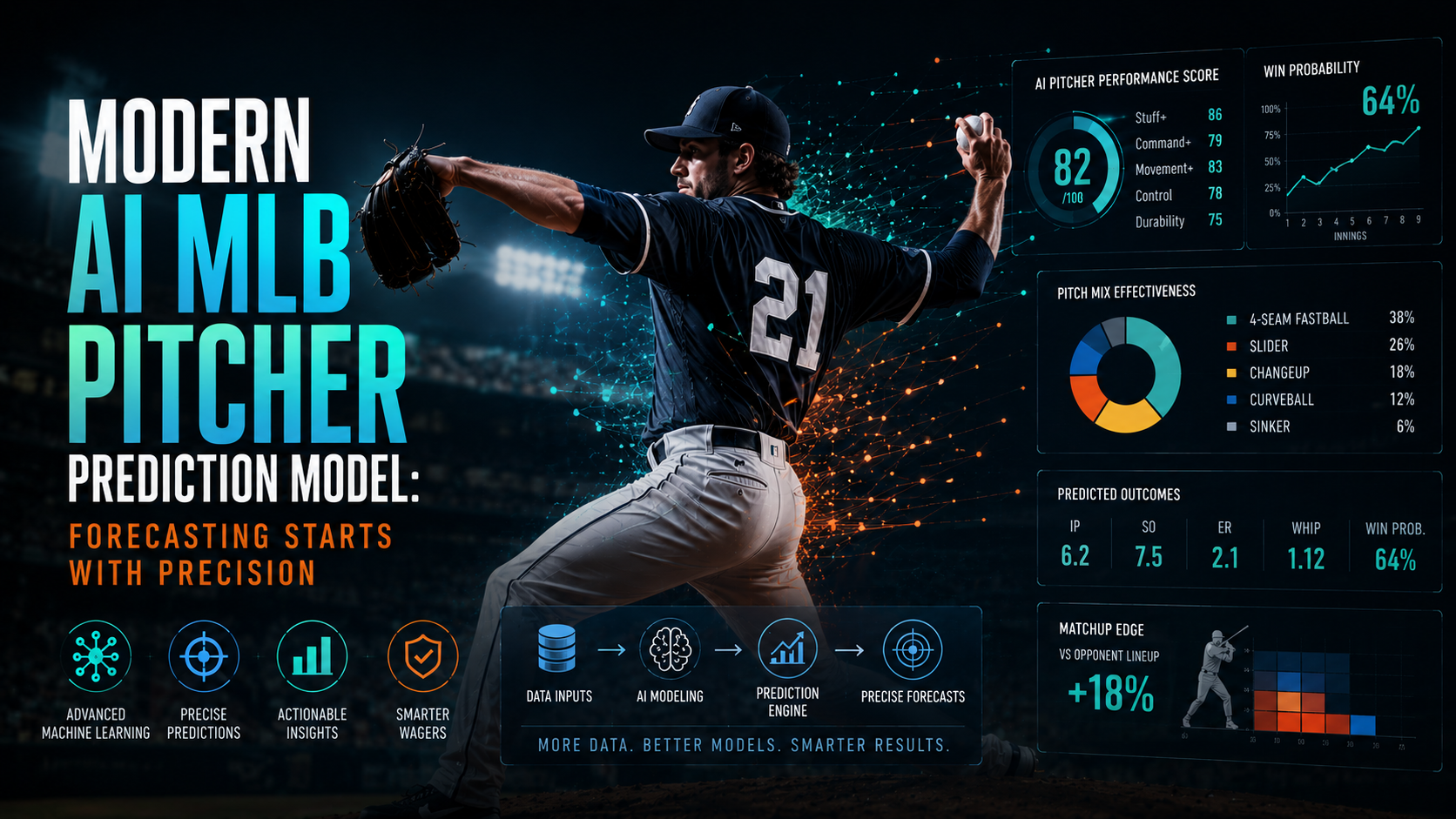
Forecasting how an MLB starting pitcher will perform isn’t guesswork for data analysts. It requires building an analytical model. I blend pitch-level Statcast data, travel and rest context, weather, and opponent profiles to project strikeouts, run prevention, and win probability. In this piece, I will unpack my AI-driven MLB pitcher prediction model, showing the steps, validation checks, and tools I use every day to identify betting edges.
Table Of Contents
- AI MLB Pitcher Prediction Model: From Raw Pitches to Profitable Props
- Data Foundations and Labeling
- Feature Engineering and Contextual Factors
- Modeling and Training Workflow
- Validation, Calibration and Backtesting
- Deployment, Monitoring and Ethics
- Step-by-Step Build Checklist
- Common Pitfalls and Frequently Asked Questions
AI MLB Pitcher Prediction Model: From Raw Pitches to Profitable Props
The modern betting market moves incredibly fast, and relying on traditional statistics like ERA or basic win-loss records is a quick way to drain your bankroll. To find real value in player props and moneyline variants, you need to break down a baseball game into its smallest components. This means analyzing every single pitch, tracking how velocity fluctuations affect a hitter's timing, and measuring the exact environmental conditions of the ballpark. By building a systematic pipeline, we can transform raw tracking data into sharp, calibrated probabilities. Whether you are targeting strikeout over/under thresholds, first-five-inning totals, or live in-game edges, the process requires a disciplined combination of data engineering, statistical modeling, and rigorous backtesting. Let's look at how we build this framework from the ground up.
Data Foundations and Labeling
To build an outcome model, you must start with a concrete question. For ATSwins users, most predictive targets tie directly to props, sides, and live betting markets. Per-start run prevention models predict runs allowed or earned runs, which are useful for game totals, first-five-inning wagers, and team-level projections. Strikeout performance models predict strikeout percentages, total strikeouts relative to market thresholds, and swinging-strike rates. This maps cleanly to popular player prop markets. Additionally, win probability contributions estimate a pitcher's impact on win probability added or expected fielding independent pitching per start. This provides necessary context for moneyline value. Pick one specific target per model to avoid muddled signals. You can stack models later inside a broader portfolio. For example, a strikeout prop model utilizes a logistic target, yielding a binary output based on whether a pitcher clears a market line. An earned run model acts as a count target for runs allowed in a specific inning window, trained via specialized distributions. Meanwhile, a called strikes plus whiffs model operates as a regression target on a rate statistic bounded between zero and one.
Your primary data pipeline requires stitching three core datasets together. Pitch-level tracking from platforms like Baseball Savant provides velocity, spin rate, pitch type, horizontal and vertical movement, location coordinates, and exact plate appearance outcomes. Game logs and play-by-play data from historical resources provide essential game context, substitutions, batting lineups, and umpire assignments. Finally, roster and biographical tables offer a stable registry of player identities, handedness, and team histories across seasons. Stitching player identities across these sources is the first major hurdle. You must unify different player identification keys across tracking databases using a centralized crosswalk table, falling back to name and date of birth combinations if a mismatch occurs. Time zones must be normalized to a standard format, while local game times are preserved as predictive features. Most importantly, you must prevent lookahead leakage. Every feature used at training time must be available prior to the first pitch of the target game. This means computing rolling windows up to the day before the match and freezing ballpark factors to the previous season's metrics while navigating an active schedule.
Feature Engineering and Contextual Factors
Pitcher stuff and command trends explain the largest chunk of variation in game outcomes. You should engineer features across rolling windows, such as the last seven, fourteen, or thirty days, along with short-term samples covering a player's last three to five starts. Velocity deltas track the average change in four-seam fastball or sinker velocity relative to a long-term baseline. Sudden drops in spin rates across pitch types can flag fatigue or reduced effectiveness. Pitch-mix shares monitor the percentage of sliders or sweepers thrown versus fastballs. Changes in this distribution often precede strikeout spikes or sudden changes in run prevention efficiency. You should also track the standard deviation of release points to detect command drift, while monitoring edge rates and middle-middle meatball percentages to quantify spatial location quality.
Pitching outcomes are not solo performances. Your model must integrate opponent hitter quality, environmental conditions, and catcher framing metrics. For opponent quality, calculate team rolling weighted on-base percentage, isolated power, and chase rates against a pitcher’s primary pitch types, separating metrics for left-handed and right-handed hitters. Catcher effects can be captured by checking if a catcher has handled a pitcher's recent starts, alongside a team-level metric for called strikes over expectation. Ballpark factors must account for multi-year baseline runs and home run environment tendencies, while weather features transform game-time temperature, humidity, and wind velocity into definitive crosswind or distance vectors.
Fatigue directly impacts velocity, command, and overall longevity in a game. Track the exact number of days since a pitcher's last appearance alongside cumulative pitch counts over the previous two weeks. A three-start moving average of total batters faced reveals current workload stress. If a starting pitcher experienced an unusually high pitch count in their previous outing, a descriptive flag should be triggered, as this often correlates with a shorter managerial hook in the subsequent matchup. To prevent your model from chasing noise, implement strict stabilization rules. Require a minimum of two hundred pitches within a current season before trusting full-season baselines. For sparse data like catcher framing, apply empirical shrinkage techniques to blend individual player estimates with league averages. This ensures that extreme early-season outliers are pulled back toward a realistic baseline until a statistically significant sample is established.
Modeling and Training Workflow
Start with simple statistical baselines to establish a performance floor before layering on complex machine learning algorithms. For runs allowed, a baseline Poisson regression with a log-link functions as a starting point. When overdispersion emerges, shift to a Negative Binomial distribution. For strikeout thresholds, a standard logistic regression trained on standardized features provides an interpretable probability baseline. These foundational models set clear expectations and generate baseline prices before you attempt to capture nonlinear interactions. When baseline statistical models leave value on the table, transition to modern tree ensembles within robust data libraries. Gradient boosting frameworks and random forests offer strong predictive capabilities for count data and complex interaction variables. Elastic Net regularized linear models work exceptionally well for strikeout logits, as they gracefully handle collinear features like correlated velocity and spin metrics. A practical deployment stack uses regularized models for baseline strikeout prop thresholds and gradient boosting trees for earned run counts and rate regressions.
Strikeout prop lines are often highly imbalanced around specific numbers. To combat this, implement balanced class weights during logistic training or leverage specialized focal loss functions within your gradient boosting configurations. For earned run count targets, consider truncating your window to the first six innings to align neatly with first-five-inning and early-game derivative markets, ensuring your model isn't penalized by late-game bullpen variances. Hyperparameter optimization requires a disciplined approach to prevent overfitting. Run an initial randomized search across your parameter space, followed by a tight grid search around the most promising configurations. Apply strict regularization parameters, limiting tree depth and setting high minimum sample thresholds for individual leaves. Integrate early stopping criteria during gradient boosting phases, using a time-aware validation split to halt training the moment validation loss plateaus.
Sharp, un-biased probabilities are vital for pricing accuracy. For logistic strikeout models, utilize Platt scaling or isotonic calibration to align your output probabilities with actual realized hit rates. For count distributions, convert your negative binomial cumulative distribution function into distinct event probabilities, validating those frequencies with reliability curves. Always calculate the Brier score across specific prop buckets to verify that your calibrated probabilities translate to accurate betting forecasts. To maintain internal trust and catch data anomalies, integrate explainability tools like SHAP into your post-training workflow. Generate feature impact plots for individual pitcher starts to see exactly why a model favors an over or an under. If an opponent's high whiff rate against sliders or a pitcher's recent velocity uptick is driving a projection, your analysts can easily verify the underlying logic. Tracking the stability of these feature drivers across a season allows you to detect systemic data drift early.
Validation, Calibration and Backtesting
To ensure your model can beat real market prices, you must avoid traditional random cross-validation. Random splits cause data leakage because baseball statistics are heavily tied to time, roster shifts, and evolving league rules. Instead, implement a time-aware rolling-origin cross-validation framework that mirrors live deployment. For example, you can train your model on historical datasets spanning 2021 through 2023, then validate its performance on early 2024 outcomes. In the next iteration, expand the training set to include mid-2024 data and validate on late 2024 games. Finally, train up to the end of 2024 to predict the 2025 season. This architectural validation flow ensures that your model is evaluated solely on data it has never seen, proving its resilience against changing environments such as baseball construction updates or pitch clock implementation.
Always preserve a clean, untouched seasonal holdout set for your final validation testing. Stratify your training folds to guarantee a balanced distribution of months and ballpark types, since cold April games in the Northeast behave differently than mid-summer games in high-altitude environments. Additionally, explicitly test how your model handles rookie pitchers or players returning from long injury layoffs, monitoring how your shrinkage parameters handle these low-sample scenarios. Your backtesting metrics must directly relate to betting efficiency rather than generalized accuracy. Track log-loss, Brier scores, and area under the curve for binary strikeout props, while evaluating Poisson deviance and mean absolute error for earned run configurations. Most importantly, simulate real-world financial performance by running your historical predictions against actual closing market lines. Calculate the average expected value and monitor the simulated return on investment using flat staking or fraction-based bankroll management rules to verify an enduring edge.
Concept drift can quietly destroy a model's edge over time. Monitor feature distributions across seasons, triggering alerts if league-wide strikeout frequencies or average velocities shift past a defined baseline. If your top-ten feature drivers change abruptly, pause the system to check for underlying data feed alterations. Maintain a strict retraining schedule, executing light parameter refreshes monthly during the season and comprehensive architectural updates during the winter. Finally, your model must consistently beat basic heuristics to justify its deployment. Test your system against simple baseline rules, such as a pitcher's raw season average adjusted solely by the opponent's strikeout rate, or a naive short-term moving average. If your advanced pipeline cannot deliver a lower log-loss or higher simulated profitability than these simple rules, or if it struggles to beat market consensus price moves, you must stop and re-examine your feature engineering choices.
Deployment, Monitoring and Ethics
A production-ready modeling pipeline must prioritize absolute reproducibility and containerization. Package your workflow by pinning exact software library versions, archiving frozen training datasets, and securing your feature store transformation logic with verified checksums. Every deployment should include strict data contract specifications detailing columns, data types, and null value permissions, alongside an updated model card that clearly logs targeted outcomes, training boundaries, and known blind spots. Daily inference routines should be fully automated using orchestrators like Airflow or Prefect to manage data ingestion, feature generation, and prediction publishing. Implement rigorous data quality gates at the front of the pipeline. Your system must automatically reject future dates within training sets, flag missing value rates that breach acceptable thresholds, and catch illogical data anomalies—such as a fastball velocity reading over 105 miles per hour or a spin rate falling outside realistic bounds.
For active bettors on platforms like ATSwins, clarity and transparency are everything. Your final dashboard should display fair odds alongside calculated confidence intervals, rather than just returning a raw projection number. Pair each prediction with a brief, text-based summary of the top feature drivers explaining the algorithmic decision. Visual elements should feature clean indicators showing short-term velocity adjustments or specific matchup advantages, giving users actionable insights before they lock in a position. Never treat an active model as a finished project. Implement continuous post-release backtesting by re-scoring your live predictions every week against realized outcomes without altering the historical model snapshot. To protect your bankroll, establish strict risk mitigation controls that limit daily financial exposure on a single player or team, avoid stacking highly correlated propositions unless you model joint probabilities, and maintain clear transparency by documenting pass decisions when a slate offers no mathematical edge.
Step-by-Step Build Checklist
Building a fully automated pitcher prediction framework from scratch requires following a precise sequence of development steps:
Environment Setup: Structure your local repository into separate directories for raw data ingestion, processed features, serialized models, and exploratory notebooks. Pin your core analytical libraries and write automation scripts to streamline feature construction and daily scoring runs.
Data Alignment: Ingest historical pitch tracking data, historical game logs, and biographical databases. Build an ID crosswalk table to resolve conflicting player keys across sources using exact matches and fuzzy fallback logic.
Label Construction: Aggregate pitch-level events into start-level count and rate metrics, establishing clean boundaries for early-game parameters to ensure your targets are free from late-game bullpen variables.
Feature Extraction: Compute rolling pitcher summaries, opponent hitter metrics, and environmental profiles. Ensure all continuous tracking variables are passed through stabilization functions to mitigate early-season noise.
Baseline Modeling: Train regularized linear models and count regressions on standardized features to establish a clear baseline performance floor.
Ensemble Implementation: Integrate gradient boosting algorithms using time-series cross-validation splits to optimize tree depth, learning rates, and leaf sample sizes.
Probability Calibration: Apply scaling methods to raw classifier outputs, verifying probability distributions with historical reliability curves.
Explainability Audit: Generate SHAP values across validation sets to confirm that the underlying feature drivers align with sound baseball logic.
Backtest Execution: Evaluate your pipeline's predictive lift against naive heuristics and actual closing market prices across multiple past seasons.
Value Calculation: Convert your calibrated probabilities into fair financial lines, identifying discrepancies between your projections and posted sportsbook prices to isolate actionable edges.
Production Scheduling: Automate morning data updates, feature building, and scoring runs, setting up automated alerts to flag data delivery delays or unexpected distribution shifts.
Continuous Auditing: Execute weekly performance reviews on live predictions, updating ballpark adjustments and refreshing model parameters whenever structural shifts are detected in the active environment.
Common Pitfalls and Frequently Asked Questions
When managing an active predictive pipeline, data analysts regularly encounter systemic modeling traps that can destroy an edge if left unaddressed. Lookahead leakage represents a persistent risk, often occurring when in-season ballpark adjustments or team performance averages inadvertently swallow data points from the game you are trying to project. You must ensure that your data queries use strict inequalities based on time, cutting off all feature aggregations the evening before a matchup takes place. Overfitting to short-term hot streaks is another frequent issue. Baseball is filled with high-variance stretches where a mediocre pitcher looks unhittable for three starts. If your model weights recent outcomes too heavily without applying proper empirical shrinkage toward a multi-season baseline, it will consistently overvalue players at their peak price and undervalue them during temporary slumps.
Market-chasing is a subtle trap that occurs when you include opening lines or consensus odds directly as features inside your training pipeline. Doing this causes your model to learn how to replicate bookmaker behavior rather than forecasting the actual sport. Keep your market lines completely isolated in an evaluation framework to judge value, ensuring they never touch the core predictive features. Finally, weather and catcher framing metrics require cautious handling. Raw wind directions can create noisy features if fed into a model as precise angular degrees. Coarsen those values into broad categories like blowing in, blowing out, or crosswinds to prevent your algorithms from finding false patterns. Similarly, catcher framing metrics can easily distort a projection if you do not apply significant shrinkage to backup catchers with low sample sizes.
Frequently Asked Questions (FAQs)
How does this AI model handle a starting pitcher returning from an extended injury layoff?
When a pitcher has been sidelined for an extended period, their short-term rolling features are entirely missing or outdated. The pipeline handles this by applying severe empirical Bayes shrinkage. The model automatically pulls the player's projected features back toward a weighted blend of their pre-injury baseline and the baseline of a league-average pitcher of similar age and style. Additionally, the system triggers a workload flag that reduces the projected batters faced target, anticipating a strict pitch count from the coaching staff.
Why does the system prioritize pitch-level Statcast metrics over traditional stats like ERA or WHIP?
Traditional outcome statistics like ERA and WHIP are heavily contaminated by sequence luck, defensive fielding quality, and bullpen performance. A pitcher can surrender four hard-hit line drives directly at fielders and emerge with a clean inning, or give up three broken-bat singles that result in multiple runs. Statcast tracking looks past that noise by isolating inputs the pitcher controls directly: velocity, spin axis, horizontal and vertical movement, and location quality. These metrics stabilize much faster than traditional outcomes, providing a cleaner signal of a player's true skill level.
What happens to the daily prediction if a team announces a last-minute change to their starting lineup?
Because opponent lineup quality is heavily tied to platoon splits and specific pitch-type vulnerability, a sudden change can shift a projection. The inference pipeline is built to run on an hourly schedule as game time approaches. If a manager benches a high-strikeout left-handed batter in favor of a contact-oriented right-handed hitter, the feature store updates the opponent vector during the next automated run. The system re-scores the matchup and adjusts the fair odds on the ATSwins dashboard before the game begins.
Can this model architecture be applied effectively to other major sports leagues?
The core data engineering philosophy—isolating micro-level events, preventing lookahead leakage, and executing time-aware validation—applies universally across sports analytics. For example, when building an advanced UFC stats model, you replace pitch velocity and spin metrics with striking volume, positional control rates, and damage proxies. The mathematical validation remains identical: you must avoid random splits, calibrate your probabilities, and ensure your model can beat a closing market line.
How many past seasons of baseball tracking data are required to train a reliable predictive model?
While having more data generally helps, going too far back introduces obsolete environments. Major League Baseball has undergone structural transformations over the last decade, including changes to baseball manufacturing, sticky-stuff crackdowns, and the implementation of the pitch clock. Training on data older than three to four seasons can pollute your model with relationships that no longer exist in the modern game. A rolling three-year window provides an optimal balance, giving you ample sample size while keeping the data relevant to the current era.