

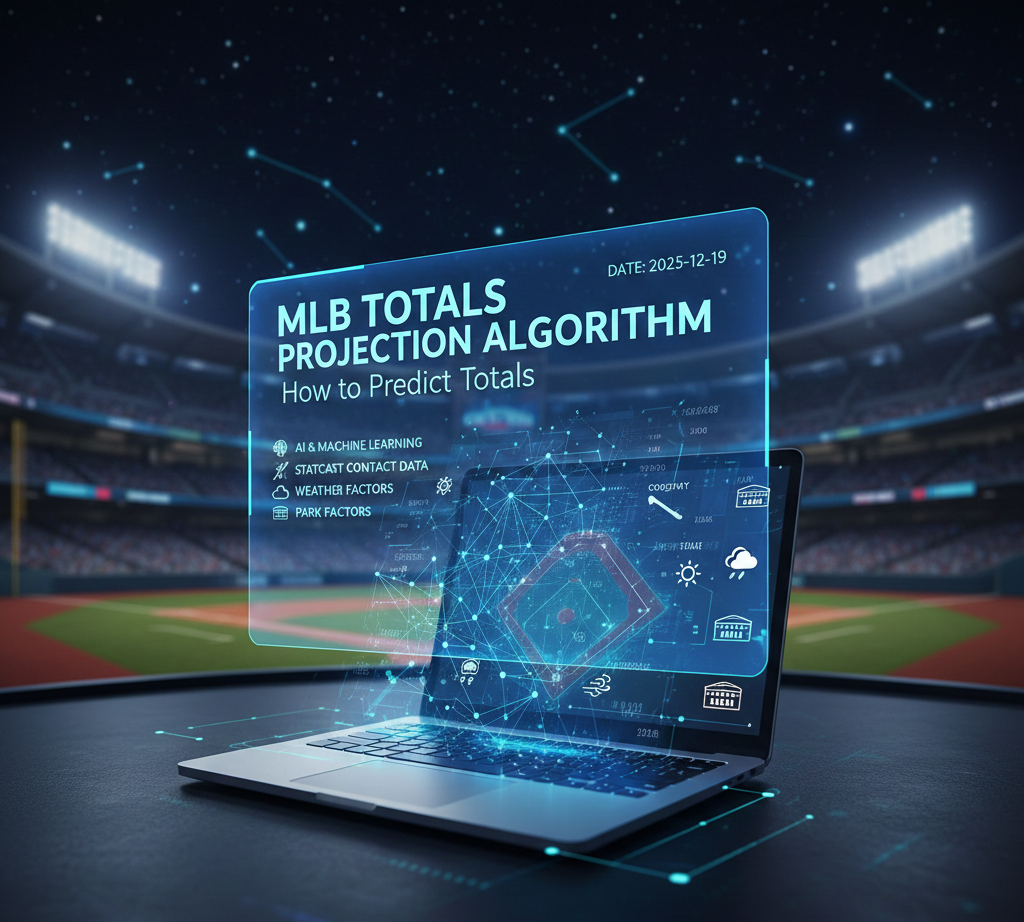
As someone who builds sports models for a living and leans on AI every single day, I want to walk through how I actually project MLB totals in a way that is structured, repeatable, and realistic. This is not about guessing or chasing vibes. This is about taking the same public data everyone has access to, treating it carefully, and turning it into something disciplined enough to survive a full baseball season. We are going to blend contact quality data, park and weather context, lineups, bullpen workload, and then wrap it all together with calibration so the numbers behave like real probabilities. The goal here is clarity and control, not flash.
This guide is long on purpose. MLB totals are one of the hardest betting markets to model correctly because run scoring is noisy, contextual, and heavily influenced by late game dynamics. If you skip steps or rush assumptions, the model might look sharp for a week and then quietly bleed over a month. What follows is the full process I use to create totals projections that can feed directly into ATSwins picks without constantly needing manual overrides.
Table Of Contents
- Building an MLB Totals Projection Engine That Wins
- Problem framing and data map
- Feature engineering and assumptions
- Modeling architecture and math
- Step-by-step build
- Backtesting, calibration and risk
- Production workflow and monitoring
- Practical templates and tools
- From projections to ATSwins picks
- How to implement, step by step
- Edge attribution examples
- Common pitfalls and how to avoid them
- QA workflow before publishing picks
- Useful tools and references
- A note on ATSwins product integration
- Template: minimal MVP to first ROI
- FAQs we get from bettors
- Extending to F5 and team totals
- What makes this approach durable
- Final checklist for your mlb totals projection algorithm
- Conclusion
- Frequently Asked Questions (FAQs)
Key Takeaways
The foundation of any strong mlb totals projection algorithm is modeling each team’s run output separately and then combining them into a full game distribution. Calibration matters more than being clever, especially over a six month season. Park and weather context tend to move totals more reliably than short-term hitting streaks, which are often noise.
Clean and current data is non-negotiable. You need contact quality metrics, pitcher splits, pitch mix trends, park effects, roof and altitude information, real-time weather, umpire tendencies, confirmed lineups, and bullpen rest. If any of those inputs are stale or missing, the projection should widen its uncertainty instead of pretending everything is fine.
Sturdy models beat flashy ones almost every time. A negative binomial framework with partial pooling, thousands of simulations, and explicit starter to bullpen transitions will outperform overly complex black boxes. Every assumption should be written down and justified.
Validation has to be done like a professional operation. Rolling-origin backtests, proper scoring rules, and calibration plots are mandatory. If the model is miscalibrated, you fix it with scaling or monotonic adjustments before you ever think about tightening confidence.
ATSwins is an AI-powered sports prediction platform that turns these projections into usable picks, player props, and long-term profit tracking across multiple sports. The entire approach described here is designed to plug directly into that ecosystem without hand waving.
Building an MLB Totals Projection Engine That Wins
The reason totals are so attractive and so dangerous is that they compress a huge amount of information into one number. Nine innings of decisions, substitutions, fatigue, weather shifts, and randomness all collapse into a single over or under. A winning mlb totals projection algorithm does not try to predict a single outcome. It tries to describe the entire range of plausible outcomes accurately.
The mental shift that matters most is this: you are not predicting runs, you are predicting distributions of runs. Once you accept that, everything else becomes more structured. Your job becomes identifying which factors shift the mean, which ones widen or tighten variance, and how those effects interact throughout the game.
This is where ATSwins benefits. Instead of asking the model to spit out one sharp number, we let it produce a full probability curve that can be compared to the market, stress tested, and tracked over time.
Problem framing and data map
At its core, modeling MLB totals means modeling each team’s run scoring process independently while acknowledging that they share the same game environment. Both teams are influenced by the same park, weather, umpire, and travel context. They are also linked late in games through bullpen usage and leverage decisions.
The first framing decision is simple but critical. We always start by modeling team runs first, then summing them. We do not model totals directly. Modeling totals directly hides information and makes calibration harder.
The objective of this mlb totals projection algorithm is long-run reliability. A model that is slightly wide but honest will outperform a sharp but biased model over hundreds of games. This philosophy underpins every downstream choice.
In practice, this means assembling a complete data map that covers player skill, context, and uncertainty. Contact quality data acts as the backbone for hitter and pitcher evaluation. Park factors and weather shape how that contact turns into runs. Lineups and platoon matchups define opportunity. Bullpen usage defines late inning volatility. Travel and rest act as subtle modifiers.
When all of these inputs are stitched together correctly, the model can explain why a game projects at 8.9 runs instead of 8.1, not just state that it does.
Feature engineering and assumptions
Feature engineering is where most models quietly fail. It is easy to add signals. It is much harder to add them in a way that remains stable when samples are small and conditions change.
For pitchers, we separate skills into components rather than using a single catch-all metric. Strikeouts and walks describe command. Contact quality metrics describe damage allowed. Home run suppression and ground ball tendencies influence tail risk. Each component gets its own prior and its own regression behavior.
For hitters, we do something similar. Contact quality, swing decisions, and handedness splits are treated separately. A hitter running hot on batting average but showing no change in contact quality gets pulled back aggressively toward baseline.
Park effects are never treated as static. Parks behave differently by handedness and batted ball type, and those effects drift over time. Weather interacts with parks in nonlinear ways, especially when wind and temperature stack.
Umpire effects are included, but with heavy shrinkage. They matter at the margins, especially when combined with certain pitchers or weather bands, but they should never dominate a projection.
Bullpen fatigue is encoded as a volatility driver more than a pure mean shifter. Tired bullpens create wider late game distributions, which matters a lot for totals near key numbers.
All of these features are stabilized with regression to the mean. Small samples are treated as suggestions, not truths.
Modeling architecture and math
The statistical backbone of this mlb totals projection algorithm is a negative binomial framework for team runs. Baseball scoring exhibits over-dispersion relative to a Poisson process, and ignoring that reality leads to systematic underestimation of high totals.
We begin with a generalized linear model to establish baselines and diagnose dispersion. This keeps things interpretable and makes it easier to spot broken features early. Once the baseline behaves, we layer in partial pooling so that new pitchers, rookies, and role changes do not blow up projections.
Dependence between team runs is introduced explicitly. Games are not independent coin flips for each side. Weather, park, and game flow create shared variance. We encode this through a game-level latent factor that moves both teams together.
Rather than solving totals analytically, we simulate games thousands of times. Each simulation samples lineups, starter length, bullpen allocation, and run outcomes. This approach captures nonlinear interactions that are hard to express in closed form.
Calibration is treated as a formal step, not an afterthought. If the model is too confident, we scale variance. If it is systematically biased in certain ranges, we apply monotonic corrections. Only after calibration holds do we consider tightening distributions.
Step-by-step build
The build process starts with data ingestion. Contact quality data, lineup projections, weather forecasts, bullpen usage, and schedule context are all pulled into a unified schema. Every record is timestamped so that projections can be reproduced exactly.
Next comes feature construction. Multi-year priors are created for hitters and pitchers with decay weights. Rolling windows are layered on top with regression. Context features are joined at the game level.
The baseline negative binomial model is then fit and validated using rolling-origin splits. This mirrors live betting conditions and avoids lookahead bias.
Once the baseline is stable, hierarchical structure is added. Pitchers and hitters share information with similar peers. Park and weather sensitivities vary by team.
The simulation engine is built next. For each game, thousands of simulated outcomes are generated, producing a full distribution of totals and team runs.
Finally, calibration is applied using recent out-of-sample performance. Diagnostics are rerun to confirm improvement.
Backtesting, calibration and risk
Backtesting is done chronologically. Random splits are avoided because they leak future information in a drifting environment like baseball.
We evaluate models using proper scoring rules that reward honest probability forecasts. Distributional accuracy matters more than simple hit rates.
Calibration plots are reviewed weekly. If the model drifts, adjustments are made deliberately and logged.
Risk management is handled through conservative staking and exposure limits. Weather-driven slates are capped to avoid single-factor drawdowns.
Production workflow and monitoring
In production, data freshness is monitored continuously. If a critical feed lags, projections are paused.
Models are versioned and promoted only after sustained out-of-sample performance. Shadow testing is used to prevent regressions.
Lineup updates trigger fast re-computation for affected games, with clear change logs.
Drift dashboards track residuals, feature distributions, and market comparisons over time.
Practical templates and tools
Templates are used for hitter skill vectors, pitcher skill vectors, and context vectors so that features remain consistent across seasons.
Diagnostics are standardized so that issues are caught early.
Model changes are documented in plain language so results can be audited later.
From projections to ATSwins picks
Once distributions are generated, they are translated into fair prices for main totals and alternate lines. Expected value is computed relative to the market, and only edges that clear calibrated thresholds are eligible.
These projections also feed related markets, such as player props, in a consistent way. Correlations are respected so that risk is not accidentally doubled.
ATSwins tracks performance by edge driver, allowing continuous refinement.
How to implement, step by step
Implementation begins with a clean data warehouse and reproducible pipelines.
Baselines and priors are established before any tuning.
Dependence and simulation are added only after calibration holds.
Productionization includes monitoring, alerts, and documentation.
Edge attribution examples
Edge attribution breaks down why a projection differs from neutral expectations. Weather, park, bullpen fatigue, and regression signals are quantified so decisions are explainable.
Large swings are only trusted when multiple factors align and validation supports the sensitivity.
Common pitfalls and how to avoid them
Small-sample overconfidence, static park assumptions, and overreacting to early-season noise are the most common mistakes.
Heavy shrinkage and rolling validation help prevent these errors.
QA workflow before publishing picks
Every pick passes sanity checks against the market and internal expectations.
Late changes trigger recomputation and review.
Only plays with clear explanations and calibrated edges are published.
Useful tools and references
Modeling is done with standard statistical and Bayesian libraries, relational databases, and workflow orchestration tools. The emphasis is on reliability, not novelty.
A note on ATSwins product integration
Daily runs populate ATSwins dashboards with totals, team totals, and derivative markets.
Player props and totals are aligned to avoid internal conflicts.
Profit tracking ties outcomes back to inputs so learning compounds over time.
Template: minimal MVP to first ROI
A minimum viable version can be built in phases, starting with a baseline model and gradually adding dependence, simulation, and calibration.
Each phase is validated before moving on.
FAQs we get from bettors
Common questions revolve around variance, umpire effects, and lineup surprises. The consistent answer is that uncertainty is modeled explicitly, not ignored.
Extending to F5 and team totals
First five inning totals and team totals are natural extensions of the same framework, with adjusted variance assumptions.
What makes this approach durable
Durability comes from calibration, restraint, and operational discipline. The model is designed to survive a full season, not win a week.
Final checklist for your mlb totals projection algorithm
A complete data map, stabilized features, calibrated simulations, rolling validation, and conservative decision rules form the backbone of a durable approach.
Conclusion
Projecting MLB totals is about respecting uncertainty and context. By modeling team runs, simulating outcomes, and calibrating relentlessly, you can turn public data into actionable insight. ATSwins applies this exact framework to deliver transparent, data-driven picks and long-term tracking.
Frequently Asked Questions (FAQs)
What is an mlb totals projection algorithm?
An mlb totals projection algorithm is a system designed to estimate how many total runs will be scored in a baseball game by modeling each team’s expected run output separately and then combining them. Instead of predicting one final score, it generates a full distribution of possible outcomes using inputs like pitcher quality, contact data, park factors, weather, bullpen usage, and lineup strength. The goal is not to be perfect on one game, but to be calibrated and reliable over hundreds of games.
Why do you model team runs separately instead of projecting the total directly?
Modeling team runs separately preserves more information and leads to better calibration. Each offense faces a different pitcher, bullpen, and platoon mix, even though they share the same environment. When you project totals directly, you lose that structure and make it harder to diagnose errors. Separating team runs also allows the same projections to be reused for team totals and player props within ATSwins.
How important is weather in an mlb totals projection algorithm?
Weather is one of the most consistently impactful contextual factors, but only when handled carefully. Temperature, wind direction, and humidity can all change how far the ball carries, which directly affects run scoring. The key is not to overreact. Weather should nudge projections, widen or tighten variance, and stack with park effects, not dominate the model on its own.
Do umpires really matter for totals betting?
Umpires do matter, but only at the margins. Some strike zones produce slightly higher walk rates or suppress strikeouts, which can push run environments up or down. In a strong mlb totals projection algorithm, umpire effects are heavily shrunk toward league average and only add value when combined with other factors like weather, park, and pitcher profiles.
Related Posts
AI For Sports Prediction - Bet Smarter and Win More
AI Football Betting Tools - How They Make Winning Easier
Bet Like a Pro in 2025 with Sports AI Prediction Tools
Sources
The Game Changer: How AI Is Transforming The World Of Sports Gambling
AI and the Bookie: How Artificial Intelligence is Helping Transform Sports Betting
How to Use AI for Sports Betting
Keywords:
MLB AI predictions atswins
ai mlb predictions atswins
NBA AI predictions atswins
basketball ai prediction atswins
NFL ai prediction atswins
ai betting analysis