

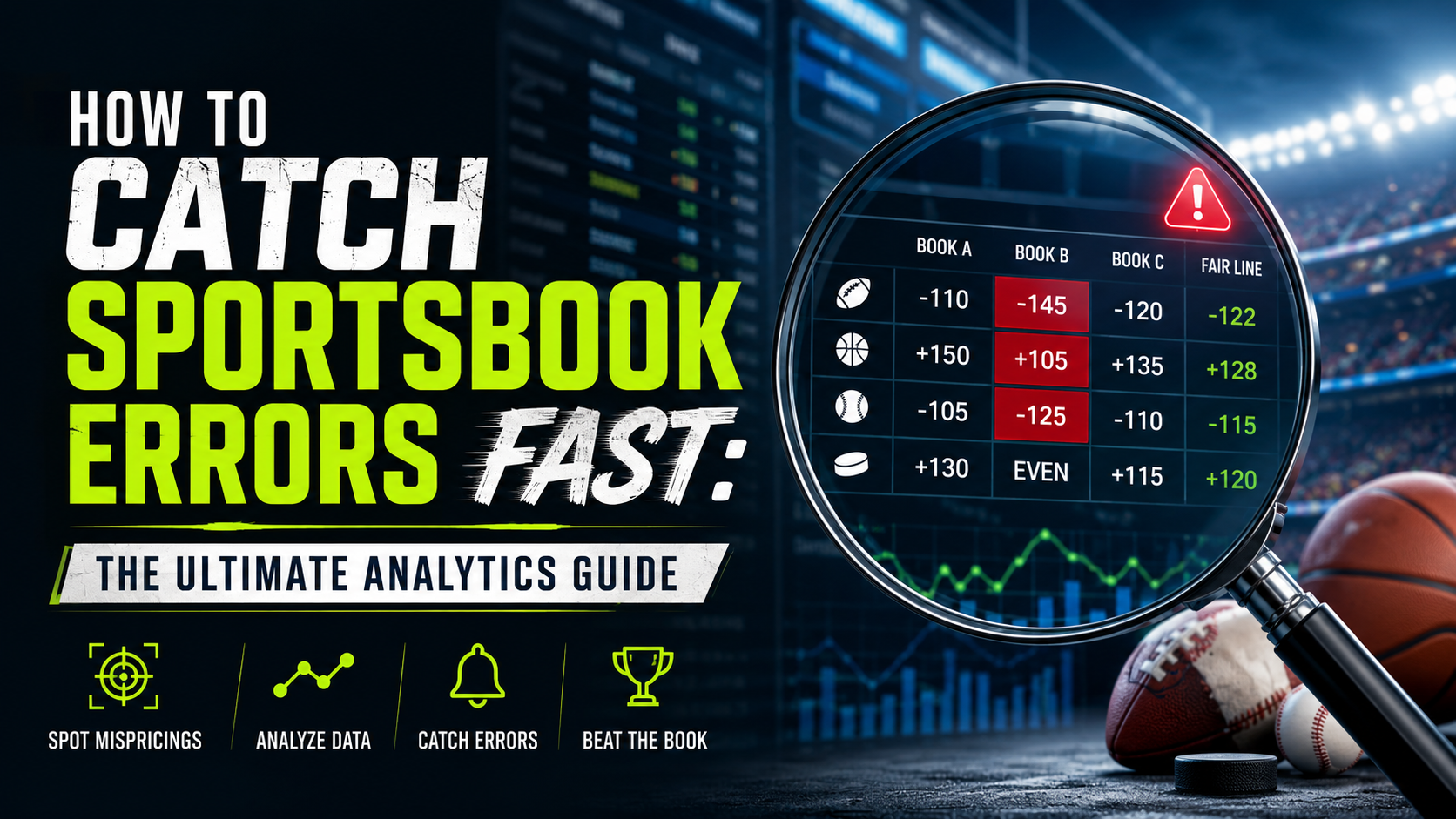
As a sports analyst who spends my days building predictive models, I can tell you that sportsbooks make mistakes constantly. Whether it is a slow line update after an injury or a blatant typo, catching these slips is one of the most profitable edges you can build.
To turn these inefficiencies into a consistent revenue stream, you need a systematic approach. By combining fast data checks with sharp risk management, you can spot and exploit bad lines before the house realizes its mistake.
Table Of Contents
- Understanding Common Sportsbook Anomalies
- Building an Efficient Detection Workflow
- Validating Lines with Advanced Metrics
- Navigating Risk and Betting Regulations
- Automating Data Logs and Bulletproof Evidence
- Real-World Betting Scenarios Analyzed
- Frequently Asked Questions (FAQs)
Understanding Common Sportsbook Anomalies
To build an automated detection engine, you must first understand exactly what you are scanning for. Sportsbook pricing errors generally fall into four distinct buckets.
The Big Four Error Types
A palpable error, or "palp," represents an obvious typographical slip. This occurs when a book flips a plus and minus sign, transposes numbers, or lists odds like +1200 instead of the intended +120. House rules almost universally allow books to void these tickets or settle them at the true consensus price.
Off-market prices happen when a single book sits significantly away from the general market consensus. This isn't a typo, but rather a trader holding a rogue opinion or balancing heavy local liability. Betting these will immediately land your account on a risk manager's radar.
Stale lines are prices that fail to update after major news drops or market-wide shifts. You will see these constantly in niche prop markets right after an injury report or during live-betting commercial breaks when secondary books experience data lag.
Mis-graded props involve wrong settlements due to data feed glitches. This looks like a book grading an under as a loss because they forgot to exclude overtime, or scraping incorrect box scores. These are highly fixable if you bring ironclad data to customer support.
Signals in the Odds Feed
To catch these errors programmatically, look for specific data anomalies:
Sudden Odds Drift: A book’s price drifts by 40 cents while market-makers stay completely static.
Derivative Mismatches: The moneyline, point spread, and game total do not mathematically align. For instance, if an NBA team is a massive -9.5 favorite on the point spread but their moneyline is sitting at a cheap -250, the math is broken.
The Ghost Re-open: A market gets suspended during a critical game break and re-opens at the exact same pre-break price while the rest of the industry adjusted by multiple points.
By utilizing the predictive data on ATSwins, you can easily surface these anomalies. Comparing live book lines against real-time projections and lopsided betting splits lets you isolate true pricing errors from simple bookmaker opinions.
Building an Efficient Detection Workflow
You cannot find market edge if your data workflow is messy. Speed and accuracy are paramount when line hunting.
Multi-Book Snapping
You need to pull data snapshots across your sports betting ecosystem every 10 to 30 seconds. Focus on capturing the book name, precise market types, event IDs, timestamps in UTC, and the complete price ladder.
Always ensure your data scraping routines comply with the terms of service of your providers. Use official odds APIs where possible, or structure your headless browser scripts to respect rate limits so you do not get your IP blacklisted.
Data Normalization
Raw sportsbook data is notoriously dirty. Before running any statistical analysis, you must convert all team names to a single canonical ID to account for changing city abbreviations or nicknames.
Standardize all time stamps to UTC and convert American odds into clean implied probabilities calculated out to at least four decimal places. Keep your line hooks precise; rounding a +5.5 to a flat +5 will break your detection algorithms.
Outlier Detection
To identify genuine errors without chasing phantom noise, calculate a trimmed mean or median probability from a basket of sharp market-makers. Once you have a clean benchmark, apply a Z-score filter to flag outliers.
Z = (Implied Probability - Market Median) / Standard Deviation
For highly liquid pre-game markets, set your trigger threshold at a Z-score greater than 2.5. For low-liquidity player props that exhibit wider natural distributions, substitute standard deviation with Median Absolute Deviation to keep your alerts clean.
Validating Lines with Advanced Metrics
Never place a bet based solely on a raw data alert. You must overlay contextual sports analytics to ensure the alert represents a genuine error rather than a perfectly logical price adjustment.
Contextual Verification
When an outlier alert triggers, immediately check primary information sources. If a star player is unexpectedly ruled out, market-makers will adjust their numbers instantly. Check deep analytic pages like the ESPN NBA Player Profiles to cross-reference recent injury designations and player usage trends.
If the market shifted because a team announced a lineup change, it is a valid market move. If a rogue book is lagging behind that news by five minutes, you have found a profitable stale line.
Derivative Reconciliation
Every derivative market must anchor back to a main market reality. Point spreads and moneylines share a rigid mathematical bond dictated by the game total.
If you notice an NFL team total that fails to drop after the full-game under gets bet down heavily, check the individual team trends on the CBS Sports NFL Team Page to see if the pricing mismatch creates a high-EV betting opportunity on a team total under.
Navigating Risk and Betting Regulations
Exploiting sportsbook errors requires strict bankroll discipline and an intimate understanding of betting legalities.
Understanding House Rules
Every sportsbook operates under explicit terms that protect them from major pricing screw-ups. If you aggressively hammer a line that is clearly a palpable error, the book will invoke its palpable error clause and void your ticket.
To gauge how regulatory bodies govern these disputes, you can review the enforcement standards outlined on the Nevada Gaming Control Board Official Site, which details the strict fairness guidelines licensed sportsbooks must follow when managing disputed wagers.
Strategic Bankroll Sizing
When betting lines that carry a high risk of being voided, you must alter your bet sizing. Never use a full Kelly Criterion strategy on an anomaly play. Instead, implement a strict fractional Kelly system capped at 10% to 20% of your calculated edge.
Fractional Kelly Bet Size = 0.20 * ((BP - Q) / B)
This ensures that if a book decides to cancel your wager after the game concludes, your bankroll won't suffer a massive liquidity lock.
Automating Data Logs and Bulletproof Evidence
If you want to win grading disputes against sportsbooks, you need undeniable proof of what the market looked like at the exact millisecond your wager was accepted.
Evidence Bundling
Develop an automated script or a manual habit to capture three pieces of evidence for every single anomaly wager:
A full-screen capture of the market page showing the line, the price, and your synchronized system clock.
A snapshot of the final betslip confirmation displaying the unique bet ID.
A post-game grab of the settled ticket.
For maximum protection on high-stakes disputes, paste the market URL directly into the Internet Archive Wayback Machine to create an unalterable, third-party public record of the sportsbook's live web page.
The Feedback Loop
Maintain a comprehensive betting ledger that logs the anomaly trigger reason, the pre-bet market median, your model's true price, the closing line value, and the final settlement notes. Review this data monthly to identify which sportsbooks consistently clear their stale lines and which books frequently trigger voids. This allows you to continuously refine your alert thresholds.
Real-World Betting Scenarios Analyzed
The Correlated Derivative Slip
An NBA game total plunges from 230 down to 224 across the entire market due to a late-breaking injury. While primary books drop the individual team totals accordingly, a lagging secondary book leaves a team total over/under sitting at its opening number. By checking the official roster modifications on NBA.com, you confirm the defensive anchor is sitting out, rendering the lagging team total over an incredibly high-EV play.
The Mis-Graded Prop Dispute
You wager on an NHL player prop over for total shots on goal. The player records three shots in regulation and one shot in overtime, clearing the line of 3.5. The sportsbook mistakenly grades the ticket as a loss because their automated data feed excluded overtime statistics.
To resolve this efficiently, pull up the official box score on the Fox Sports NHL Page along with a screenshot of the book's own house rules stating that overtime counts for player performance markets. Submit this formal bundle to customer support to get the grading error corrected within hours.
Frequently Asked Questions (FAQs)
What does “finding sportsbook errors” actually mean, and why does it matter?
Finding sportsbook errors means spotting odds or markets that are wrong, stale, or out of sync with the wider market. It matters because these pricing mistakes can create positive expected value (EV) spots. In practice, finding sportsbook errors often looks like a book leaving +145 when most others are +120, a typo on a player prop line, or a mis-graded market. When you’re consistent about finding sportsbook errors, you’re effectively capturing value that should have been priced out—before it disappears.
How can I start finding sportsbook errors in live betting without fancy tools?
For live betting, start simple and stay quick. Finding sportsbook errors in-play is about watching for sudden odds drifts without a clear game event to back them up. Keep one "sharp" sportsbook open on one screen and your local betting apps open on another. If the sharp book moves a line by a full point after a timeout, but your local book lags behind for 15 seconds, that is your window to catch a stale live line.
What should I do if a sportsbook voids my bet and calls it a “palpable error”?
First, check the book’s specific house rules regarding palpable errors. If the line you bet was clearly an inversion—like a heavy favorite priced at +400 instead of -400—the book is legally within its rights in most jurisdictions to void the ticket. However, if the line was simply a bad, slow, or unadjusted market price rather than a true typo, gather your screenshots, timestamped market logs, and submit a formal dispute ticket to their compliance team.
Can running data scripts to find sportsbook errors get my account banned?
Sportsbooks do not ban you for using data scripts to find errors, but they will absolutely limit your max bet sizes if you consistently beat their closing lines or exclusively target their pricing mistakes. To maintain healthy accounts, mix your anomaly wagers with standard, highly liquid main-market bets on prominent events like the games featured on the Fox Sports NFL News Page. This blends your sharp activity in with everyday retail public betting volume.
Smart betting comes down to a clean, repeatable workflow. By tracking multi-book data feeds, confirming anomalies with real-world news, and keeping pristine evidence logs, you can scale your sports betting edge safely and professionally.