
How AI Predicts MLB Games Better Than Public Betting Trends
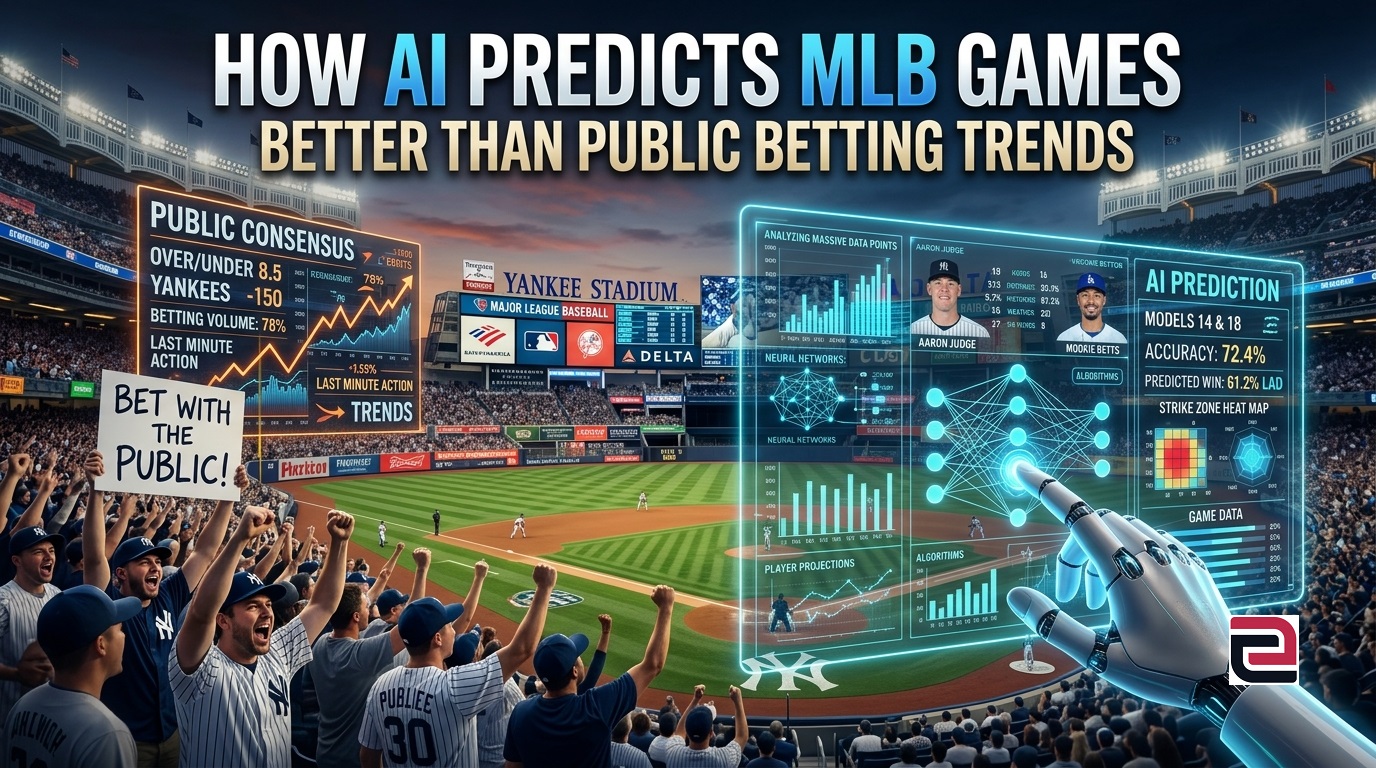
Public betting splits in MLB look super tempting at first glance. You open up a sportsbook, see that 75% of people are on one team, and it feels like free money to just follow the crowd. I used to think the same thing. It feels logical, right? If most people are betting one side, they must know something. But once you actually dig into it and track results over time, you realize pretty quickly that it does not work like that.
I spend a lot of time building AI models for sports betting, and MLB is one of the clearest examples where public trends just do not hold up. The edge is not in following what everyone else is doing. The edge comes from understanding the price, the data, and how small factors stack together. This whole breakdown is about separating noise from the real signal and building a process that actually gives you a chance long term. A lot of these thinking lines up with the ideas explored in the ATSwins article How AI Identifies Mispriced MLB Odds and Outsmarts Sportsbooks , which basically dives into how pricing inefficiencies happen and how models take advantage of them before the market corrects.
Table Of Contents
- Why public betting trends underperform in MLB
- What AI sees that the public misses
- Data pipeline and modeling that actually holds up
- Measuring edge against public trends
- Practical MLB betting workflow with ATSwins
- Why public betting trends are noisy and how AI translates to decisions
- Putting it all together with a repeatable system
- Conclusion
- Frequently Asked Questions
Why public betting trends underperform in MLB
The biggest issue with public betting is something called herding behavior. People naturally follow what looks popular or what feels safe. In sports betting, that usually means betting on favorites, big-name teams, or whatever storyline is trending that day. MLB is a terrible environment for that kind of thinking because the season is so long and the edges are so small.
Baseball is not like football, where one game can define everything. It is a grind. There are 162 games, and variance plays a huge role. A team can look unstoppable for a week and then completely fall apart the next. When people bet based on what just happened, they are usually reacting to noise instead of something that actually predicts the next game.
Another thing that kills public bettors is price. Even if they pick the right team, they often pay too much for it. Sportsbooks adjust lines based on where the money is going. If everyone is betting the same side, the price moves against that side. So now you are not just betting on a team, you are betting on that team at a worse number than it should be. Over time, that small difference adds up and eats away at your bankroll.
Narratives are another big trap. You hear things like wind blowing out means take the over, or two good pitchers means take the under. Those ideas sound simple and clean, but reality is way more complicated. Wind direction matters, not just wind speed. Pitchers change their approach depending on the opponent. Even umpire tendencies can shift how a game plays out. The public rarely accounts for those details, and that is where mistakes happen.
The biggest concept that separates winning bettors from losing ones is closing line value. If you consistently get a better number than the closing line, you are doing something right. Public betting trends do not help with that. They usually push you into worse prices because you are following moves instead of anticipating them.
What AI sees that the public misses
This is where things get interesting. AI models look at the game completely differently. Instead of focusing on narratives or recent results, they break everything down into measurable components.
One of the biggest edges comes from Statcast data. This includes things like exit velocity, launch angle, and contact quality. Most people look at batting average or home runs, but those stats are heavily influenced by luck. A hitter can crush the ball all game and still go 0 for 4 if the defense is positioned well. AI models look at how the ball is actually being hit, not just the outcome.
Pitching is another huge area. People notice velocity changes, but there is way more going on. Pitch movement, spin, release point, and pitch usage all matter. A pitcher might still be throwing hard, but if their slider loses movement, they become much easier to hit. Those are the kinds of details that models pick up before the public catches on.
Then you have contextual factors like park effects and weather. Not all stadiums play the same. Some favor hitters, some favor pitchers, and some change dramatically based on temperature and humidity. A warm night game can play completely differently from a cool afternoon game in the same park. AI models adjust for that in real time.
Bullpens are another area where the public struggles. Most people look at the bullpen ERA, which does not tell the full story. What matters more is usage and fatigue. If a team used their best relievers heavily in the previous game, they might not be available or effective the next day. That can swing a game late, especially in close matchups.
Lineups also matter more than people think. A single player being out can shift win probability by a couple of percentage points. That might not sound like much, but in betting, that is a big deal. Models update instantly when lineups are confirmed, while the public often reacts too late. This is another concept that gets emphasized in “How AI Identifies Mispriced MLB Odds and Outsmarts Sportsbooks,” where timing and information edges are just as important as the raw numbers themselves.
Data pipeline and modeling that actually holds up
Building a model that works is not just about throwing data into a system and hoping for the best. You need a structured pipeline that keeps everything clean and consistent.
The first step is collecting reliable data. This includes pitch-level data, player stats, weather conditions, and historical game results. Everything needs to be timestamped so you know exactly what information was available at the time of the bet. This avoids something called lookahead bias, which can make results look better than they actually are.
Once you have the data, the next step is feature engineering. This is where you turn raw data into something meaningful. Instead of just using basic stats, you create context-based metrics. For example, instead of looking at a hitter’s overall performance, you break it down by pitch type and location. That gives a much clearer picture of how they will perform in a specific matchup.
Validation is another key part of the process. You cannot just train a model on past data and assume it will work going forward. You need to test it in a way that mimics real betting conditions. This usually involves walk-forward testing, where you train on past data and test on the next time period. That way, you are always evaluating the model on unseen data.
After training, you need to calibrate the model’s probabilities. This ensures that when the model says a team has a 55% chance to win, it actually reflects reality. Poor calibration can lead to overconfidence and bad betting decisions.
Finally, you need to monitor performance over time. Baseball changes constantly. Players get injured, teams adjust strategies, and even the ball itself can change. A model that worked last season might not work the same way now, so regular updates are necessary.
Measuring edge against public trends
The key to betting success is understanding value. It is not about picking winners; it is about finding bets where the odds are in your favor.
To do this, you convert betting odds into implied probabilities. This tells you what the market thinks the chances are. Then you compare that to your model’s probability. If your number is higher than the market’s, you might have an edge.
Expected value is the metric that ties everything together. It measures how much you can expect to win or lose on average from a bet. Even a small positive edge can be profitable over time if you repeat it enough.
Closing line value is another important metric. If your bets consistently beat the closing line, it is a strong sign that your model is working. It means you are getting better prices than the market by the time the game starts.
Bet sizing is also crucial. Even with a good model, you can lose money if you bet too aggressively. That is why many bettors use a fractional Kelly strategy. It helps balance risk and reward while protecting your bankroll from large swings. This exact idea is also reinforced in “How AI Identifies Mispriced MLB Odds and Outsmarts Sportsbooks,” where exploiting small edges consistently is shown to outperform chasing big wins.
Practical MLB betting workflow with ATSwins
Having a structured workflow makes a huge difference. Without it, it is easy to fall into emotional decisions or chase losses.
The process usually starts with gathering data and running initial projections. This gives you a baseline for each game. At this stage, you are not placing bets yet, just identifying potential opportunities.
Next comes lineup confirmation. This is where things can shift quickly. Once lineups are announced, you update your projections and see if any new edges appear.
Then you check the market. Compare your numbers to the available odds and calculate expected value. Only consider bets that meet your threshold. This helps filter out marginal plays that are not worth the risk.
Execution is all about discipline. You stick to your plan, size your bets properly, and avoid chasing moves. If the market moves against you and your edge disappears, you simply pass.
Postgame review is where improvement happens. You analyze your bets, not just the outcomes but the reasoning behind them. If something consistently underperforms, you adjust your model or process.
ATSwins fits into this workflow by providing model-driven projections, betting insights, and tracking tools. It helps streamline the process so you can focus on decision-making instead of data collection.
Why public betting trends are noisy and how AI translates to decisions
Public betting trends are essentially a snapshot of what people have already done. They do not tell you what will happen next. They are lagging indicators, not predictive ones.
Another issue is that not all bets are equal. A large percentage of tickets might be on one side, but that does not mean the majority of money is. A few large bets from sharp bettors can outweigh hundreds of small public bets.
AI models take a completely different approach. They focus on inputs that actually influence the outcome of the game. Instead of asking who people are betting on, they ask what factors increase or decrease the probability of a team winning.
Decision-making with AI is about consistency. You only bet when the numbers justify it. You do not chase trends or react emotionally. You trust the process and let the math play out over time. This mindset is basically the core takeaway from “How AI Identifies Mispriced MLB Odds and Outsmarts Sportsbooks,” which emphasizes trusting probability over perception.
Putting it all together with a repeatable system
The goal is to create a system that you can follow every day without second-guessing yourself. It starts with clean data and a solid model. Then it moves into disciplined execution and continuous review.
Each day follows the same structure. You update your data, run your model, compare it to the market, and identify edges. You place bets only when they meet your criteria. After the games, you review your results and look for areas to improve.
Consistency is what makes this work. You are not trying to win every bet. You are trying to make good decisions over and over again. Over time, those small edges add up.
Conclusion
Public betting trends might look appealing, but they rarely lead to long-term success. They are driven by narratives, emotions, and incomplete information. If you want to take betting seriously, you need to focus on data, pricing, and process.
AI models provide a way to cut through the noise and identify real edges. They take into account factors that the public often overlooks and translate them into actionable probabilities. Combined with proper bankroll management and discipline, they give you a much better chance of staying profitable.
At the end of the day, it is not about finding the perfect pick. It is about consistently getting better prices than the market and making decisions that have positive expected value. That is what separates winning bettors from everyone else.
Frequently Asked Questions
What are public betting trends in MLB and why do they fail?
Public betting trends show where the majority of bets are going, but they do not account for price or context. They often reflect emotional decisions rather than informed ones, which leads to poor long-term results.
How should I use public betting trends?
They can be useful as context, but not as a primary signal. It is better to use them alongside data-driven analysis rather than relying on them alone.
What factors actually matter in MLB betting?
Key factors include pitching matchups, lineup strength, bullpen usage, park conditions, weather, and umpire tendencies. These elements directly impact the outcome of games.
How does ATSwins help?
ATSwins provides data-driven projections, betting insights, and tracking tools. It helps bettors focus on value and process instead of relying on guesswork.
How do I know if my strategy is working?
Track your bets, monitor closing line value, and evaluate your results over a large sample size. Consistent positive indicators are a sign that your process is effective.