

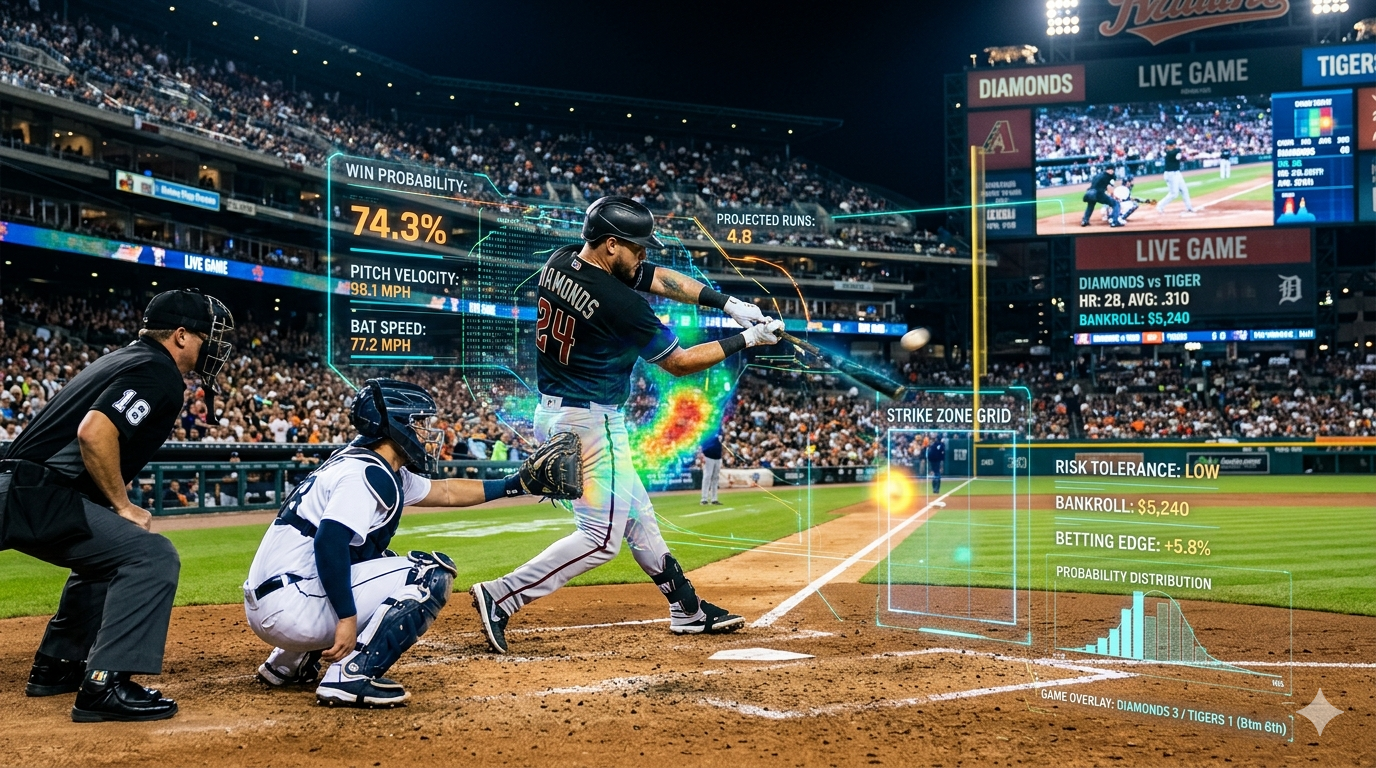
Sports analyst who leans heavily on artificial intelligence to spot mispriced Major League Baseball lines way before the broader market has a chance to catch up. In this deep dive, we are going to look at how to find mispriced sports odds, break down exactly , translate raw odds into true win probabilities, size our edges efficiently, and turn complex model outputs into smart, actionable wagers. You can expect clear math, on-field baseball context, and highly practical tools. There is absolutely no fluff here, just a completely repeatable process designed to help you find value and protect your bankroll over a grueling one hundred and sixty two game season.
Table Of Contents
- What “mispriced” means in MLB books
- Where baseball markets go soft
- Data the AI really needs
- Modeling workflow that actually finds edges
- Turning model outputs into bets
- Market microstructure and CLV
- Backtesting, validation, and iteration
- Repeatable checklist and templates
- Practical examples and mini-cases
- How to translate AI outputs into repeatable MLB edges
- Tools and references to keep handy
- Conclusion
- Frequently Asked Questions (FAQs)
What “mispriced” means in MLB books
Sportsbooks price a two-way Major League Baseball moneyline with a built-in profit margin. The fair probability is the true mathematical chance that a team wins the baseball game, while the posted odds from the book always include extra juice. To properly evaluate any potential mispricing, you absolutely need to back out the vig so you are comparing your personal model directly to a fair, no-vig probability. The overround is simply the sum of implied probabilities on both sides of the market minus 1.00. In typical baseball moneylines, this overround usually sits somewhere between two percent and six percent. It tends to be significantly higher at square, recreational sportsbooks and much lower at sharp, market-making sportsbooks. Your ultimate goal is to compare a fair, no-vig probability to your model’s output probability. That specific mathematical difference is where your edge lives.
To convert American odds to a raw implied probability, you have to use two different formulas depending on whether the price is positive or negative. For positive odds, such as plus one hundred and forty, the raw implied probability equals one hundred divided by the odds plus one hundred. For negative odds, such as minus one hundred and sixty, the raw implied probability equals the negative odds divided by the negative odds plus one hundred. If you are looking at decimal odds, the raw implied probability is just one divided by the decimal odds. To completely remove the vig on a standard two-way market featuring Team A and Team B, you first compute the raw implied probabilities for both teams from the posted odds. Then, you sum those two probabilities together to find your total baseline. Finally, you calculate the no-vig fair probabilities by dividing each team's raw implied probability by that combined total baseline. This crucial step puts both sides on a perfectly fair scale that sums up to exactly 1.00.
For any decimal odds and your model’s calculated probability, the expected value per single dollar wagered equals your model probability multiplied by the decimal odds minus one, minus the quantity of one minus your model probability. The true break-even probability is calculated as one divided by the decimal odds. Your net edge is simply your model probability minus the fair, no-vig implied probability. When looking for practical thresholds on spread or total edges, serious sports bettors often need a one to two percent edge before firing a wager. For traditional moneylines, because natural variance is much higher and betting limits can be decent, many experienced originators target a minimum edge of two to four percent, with some demanding even higher edges during the chaotic early parts of the baseball season.
Let us look at a quick, real-world example to illustrate this math clearly. A sportsbook posts a home team at plus one hundred and twenty, which is 2.20 in decimal, and an away team at minus one hundred and thirty, which is 1.77 in decimal. The raw implied probability for the home team is forty-five point forty-five percent, while the raw implied probability for the away team is fifty-six point fifty-two percent. When you sum these two raw numbers together, you get a total baseline of 1.0197. To find the fair, no-vig probabilities, you divide each raw percentage by that total baseline. This gives the home team a fair win probability of forty-four point fifty-nine percent and the away team a fair win probability of fifty-five point forty-one percent. If your proprietary AI model indicates that the home team actually wins this game forty-nine percent of the time, your total edge is forty-nine percent minus forty-four point fifty-nine percent, which equals a net edge of four point forty-one percent. The expected value at the 2.20 price works out to positive seven point eight percent per dollar. That represents a very real, high-quality bet, and you would fully expect to generate positive closing line value if the market later moves to agree with your model's number.
Where baseball markets go soft
Major League Baseball is incredibly modular and highly noisy. Variables like starting pitcher quality, bullpen depth, platoon splits, ballpark dimensions, and shifting weather conditions all change the true win probability of a game far more than public bettors realize. These specific inefficiencies are the exact spots where artificial intelligence and disciplined analysts can regularly exploit the market. Bullpen taxation and overall availability represent massive blind spots for the betting public. Back-to-back appearances, long extra-inning games from the previous night, or a severely shortened bullpen after a designated bullpen game matter immensely to the final outcome. Star reliever rest patterns, such as a closer pitching three times in the last four days, heavily reduce both availability and raw pitch quality. Late lineup scratches or a sudden opener replacing a listed starter shift massive leverage to middle relief, and this reality is often completely mispriced until the official lineups are fully confirmed by the teams.
To weaponize this information, you should track individual pitch counts over the last seven days for every single key reliever in a team's bullpen. Tag their status daily as fresh, available but taxed, or highly unlikely to pitch. This allows you to estimate a team’s effective innings quality after the starting pitcher exits the game. If a bullpen’s replacement-level innings rise from 2.0 to 4.0 for a particular night, you can jump early if sportsbooks are hanging stale prices that assume a fully rested relief core. Furthermore, platoon splits plus deep pitch-mix context provide another excellent layer of opportunity. You cannot simply stop at standard left-handed versus right-handed splits. You need to map hitters to expected pitch types from the opposing starting pitcher. This means evaluating four-seam percentage versus sinker percentage, slider or curveball usage, and the overall platoon run value on each distinct pitch type. Some lineups absolutely mash heavy sinkers but struggle immensely against high heat at the very top of the strike zone. If a starting pitcher’s exact profile matches a massive team hole, you have found a clear edge.
Lineup news timing is another critical variable. Major League Baseball lineups typically drop sixty to one hundred and twenty minutes before the first pitch is thrown. The odds in the market will drift rapidly once sharp bettors see who is getting a rest day. Catcher defense, baserunning capabilities, and exact batting order locations dramatically change a team's total run expectancy. Sportsbooks frequently lag when accounting for changes to the eighth and ninth hitters or late-breaking defensive swaps. Travel schedules, ballparks, and weather quirks also introduce massive variance. West-to-east travel on a quick getaway day can completely sap a team's bats. High humidity levels boost the overall carry of a baseball, while thick marine layers reduce it significantly. Ballpark factors are never static. The exact same wind speed can play completely differently in a stadium like Wrigley Field compared to Dodger Stadium. Similarly, the roof status at retractable stadiums changes the run environment at the absolute last minute.
Umpire tendencies provide another fantastic angle for finding mispriced lines. Umpires with wide strike zones push games heavily toward the under and significantly favor command pitchers who live on the black. Conversely, small strike zone umpires naturally lengthen plate appearances, boost overall walk numbers, and severely punish wild pitchers who lack elite control. Pitch-clock emphasis and strict mound visit enforcement also shift a pitcher's natural rhythm and stamina, especially during hot summer games. Schedule effects that slip past casual models include jet-lag clusters on long, multi-city road swings, day-games-after-night-games with aging rosters, and early-season cold weather that suppresses home-run-to-fly-ball ratios before the summer heat spikes them. When you pair two or three of these distinct factors together, such as a heavily taxed bullpen combined with a small-zone umpire and humid eighty-five degree weather, you will routinely find massive mispricings that move incredibly fast once sharper sportsbooks open up their betting limits.
Data the AI really needs
Great features win the sports betting arms race. If your underlying data inputs are weak, your edge will quickly die out. To build a highly predictive baseball model, you need to feed it Statcast batted-ball quality metrics, including exit velocity, launch angle, barrel rate, and sweet-spot percentage for both individual hitters and pitchers. The best source for this granular data is Baseball Savant. You also need pitch-level traits such as raw velocity, spin rates, vertical and horizontal movement, release height, and seam-shifted wake signals whenever they are accessible. Pitch-mix usage must be tracked by count and platoon alignment, alongside outcome run values per pitch versus specific batter profiles.
Rolling form is equally vital for accurate predictions. For starting pitchers, your AI needs to evaluate their last three to five starts based on expected earned run average, called-strikes-plus-whiffs percentage, location metrics, hard-hit percentage, and maximum exit velocity allowed. For hitters, you should look at their last fifty to one hundred plate appearances, tracking expected weighted on-base average, chase rates, contact percentages, and rolling barrel trends across seven-day and fourteen-day windows. Ballpark and weather factors must include park-specific home run factors broken down by spray angle, alongside air density, wind vectors, and temperature. Umpire reports require tracking zone size, strike propensity at the edges, and historical walk and strikeout deltas. Bullpen availability needs to account for precise rest days, last seven and fourteen-day workloads, high-leverage usage, and overall handedness depth. Lineup confirmations and late scratches must be ingested instantly to capture batting order changes, defensive upgrades, defensive downgrades, and catcher framing metrics. Finally, your market data must include opening versus closing prices across sharp and recreational books, limits, time-of-day liquidity, and exact injury timestamps.
For sourcing all of this advanced information, FanGraphs is an incredible tool for tracking advanced metrics like weighted runs created plus, expected fielding independent pitching, wins above replacement, platoon splits, BaseRuns data, and comprehensive schedule grids. Baseball Savant is the gold standard for real-time Statcast feeds and intricate pitch movement tracking. For your odds data, you want to pulls histories from market-making books or reliable third-party feeds. When it comes to building out the actual modeling workflows, the Python ecosystem, specifically libraries like scikit-learn, provides everything you need to manage your data pipelines. If you happen to prefer an entirely done-for-you analytical layer, ATSwins aggregates AI-powered projections, splits, and profit tracking into a single, cohesive interface.
Modeling workflow that actually finds edges
Feature engineering is where real model alpha is created or lost. You want to focus heavily on platoon and pitch-mix interactions. A highly effective engineered feature would be a hitter's performance against a right-handed pitcher's sinker run value, multiplied by the opposing starting pitcher's actual sinker usage percentage, and adjusted by the specific ballpark's sinker home run factor. You should also build ballpark-adjusted expected weighted on-base average features, taking a hitter's rolling expected weighted on-base average and multiplying it by the ballpark adjustment and the current weather ball carry factor. Rest-day decay is another massive variable. You can model a pitcher’s seven-day and fourteen-day workload using a non-linear penalty for any reliever who has thrown more than twenty-five pitches on back-to-back days, creating a comprehensive bullpen stress index for the entire team. Umpire modifiers should be mapped using z-scores for strike zone size, walk rate deltas, and high-strike biases. Defensive context must look at a team's infield outs above average, outfield arm runs, and the catcher’s framing runs for that specific game. Sequence-aware features should capture the first time through the order penalty for starting pitchers, modeling how their performance degrades by archetype as they face a lineup for the second and third time. Market-aware features can look at the opening price no-vig, early line movement in basis points, the current betting limit window, and the consensus market split.
It is critical to keep your feature set lean because including too many noisy variables will quickly invite severe overfitting. Your primary target should always be the overall game moneyline win probability. However, there are several derivative markets where massive edges frequently pop up. The first five innings moneyline or total is an outstanding alternative target because it heavily reduces the unpredictable noise associated with late-game bullpen management. Team totals adjusted for precise park and weather conditions are also highly viable targets. Player props, including total pitcher outs, individual strikeouts, or home runs allowed, often lag significantly behind fast-moving pitch-mix and lineup news. When setting up your labeling for the model, use a clean binary target where Y equals one if the team won the game and zero otherwise for your moneyline models. For props, you can utilize Poisson or binomial approximations, or run direct regressions to predict a specific expectation, which you can then convert back into a fair price.
Your training and testing data splits must be handled with extreme care. You should split your data by series-week or calendar blocks rather than using completely random row splits. Major League Baseball games naturally cluster tightly by opponent and ballpark, meaning that random splits will inevitably leak crucial future information into your training set. Use a strict walk-forward validation strategy by week or by homestand and road-trip segments. Always ensure that your lineup confirmation time occurs after your feature timestamp to prevent your model from accidentally peeking into the future during training. For your actual model choices, start simple. Calibrated logistic regression, gradient boosting models like XGBoost or LightGBM, or a well-interpreted random forest are excellent choices. Post-train calibration is non-negotiable. Use isotonic regression or Platt scaling on your validation folds to ensure your model outputs truly well-calibrated probabilities. Evaluate your performance using Brier score and log loss, and constantly check your reliability curves by plotting predicted versus observed outcomes in bins. Do not blindly chase tiny improvements in area under the curve if your overall calibration worsens, because you are betting real prices and you absolutely require highly accurate probabilities.
Explainability is your ultimate safety valve to sanity-check what is actually driving your model's predictions. Use SHAP values or permutation importance to spot red flags early. If a variable like the team name or the market opening price completely dominates your model's feature importance, your system is merely shadowing the sportsbook rather than predicting actual baseball outcomes. You want to see hitters’ quality of contact, starting pitcher pitch-mix alignment, ballpark weather, and bullpen availability sitting near the very top of your feature importance list. Use partial dependence plots to monitor specific interactions, such as how a pitcher's slider percentage performs against hitting groups that historically chase pitches out of the zone. Always utilize scikit-learn pipelines to clean up your preprocessing and model steps, version-control your models, freeze your training windows, and log a feature snapshot per game day.
Turning model outputs into bets
To systematically turn your raw model outputs into profitable wagers, you must follow a disciplined, five-step execution process every single day. The first step requires you to build a fair price from the current sportsbook line. You convert the posted American or decimal odds into raw implied probabilities for both teams, and then you completely remove the vig by normalizing those two numbers so they sum up to exactly 1.00. This leaves you with a clean, fair implied probability. The second step is to directly compare that fair price to your model's calculated win probability. Your edge is simply your model probability minus the fair implied probability. You should only ever place a wager if your edge clears your pre-established threshold. As a solid rule of thumb, you should demand an edge greater than three to four percent during the early season or when confidence is low, while you can scale that back to an edge greater than two to three percent during the mid-season with a highly calibrated model. If you find that your model is consistently beating the closing line value, you can gradually relax your entry thresholds.
The third step is to turn your calculated edge into expected value and an exact betting stake. If you are converting from American odds to decimal odds, a positive price means decimal odds equal one plus the odds divided by one hundred, while a negative price means decimal odds equal one plus one hundred divided by the absolute value of the odds. Expected value per dollar equals your model probability multiplied by the decimal odds minus one, minus the quantity of one minus your model probability. To calculate your exact stake, use a Kelly Criterion fraction with strict fractional control. Your stake equals your total bankroll multiplied by your raw Kelly fraction, multiplied by a fractional Kelly factor. A fractional Kelly factor between 0.25 and 0.50 is highly common among professional bettors to tame natural variance. You must also cap your total stakes to protect against correlation risk. If you have several distinct wagers on a single day that all hinge on the exact same bullpen or the same volatile weather regime, you should haircut each individual stake size by thirty to fifty percent.
Let us walk through a practical, worked stake example. Imagine your model spots a price of plus one hundred and twenty-five, which translates to 2.25 in decimal odds, and your model calculates a true win probability of forty-eight percent. Your raw Kelly fraction works out to point zero sixty-four. If you are operating with a conservative half-Kelly multiplier of 0.5 and a total starting bankroll of ten thousand dollars, your calculated stake size comes out to approximately three hundred and twenty dollars. However, if this specific game is heavily correlated with another position on your board because both teams are utilizing the same tired bullpen, you would immediately cut that risk down to roughly two hundred dollars.
The fourth step requires you to screen all of your potential plays for closing line value potential. You must actively avoid chasing steam in the market. If sharper sportsbooks have already moved a line by twenty-five to forty basis points, the vast majority of the value is likely entirely gone. You should always prefer to establish positions where you possess an early lineup or weather signal that is not yet widespread, or where you highly anticipate the broader market will react aggressively once the official lineups are posted. The fifth and final step is your rigorous pre-game execution checklist. You must confirm the starting pitchers and watch closely for late-breaking openers. You must verify the confirmed lineups, checking for resting catchers, platoon advantages, and batting order shifts. You must verify the roof status and weather updates sixty to thirty minutes before the first pitch. You then re-run your edge calculation using these finalized inputs, place your wagers at lagging sportsbooks that have not yet adjusted, and log your price, stake, timestamp, and pre-game model probability into your tracking database. If you prefer utilizing pre-built dashboards to streamline this process, ATSwins features AI projections and profit tracking tools that handle the heavy lifting.
Market microstructure and CLV
Understanding market microstructure is absolutely critical for long-term survival in sports betting. Early openers feature low betting limits and higher bookmaker errors. This environment is absolutely fantastic for establishing small, high-edge positions if your AI model is fully prepared to fire the moment the lines drop. Conversely, how sportsbooks make mistakes the market close features much higher betting limits and incredibly sharp lines. The close is far better for getting down larger stakes, provided your model still shows a viable edge after the lineups and weather conditions have completely finalized. You must also recognize the massive difference between recreational sportsbooks and market-making sportsbooks. Recreational books spend their time copying sharp lines, shading prices based on public team bias, and dealing significantly higher juice to their customers. Market-making books operate on incredibly low volume-based vig and high limits, and they actively set the truer prices. Consistently beating the closing line at these market-making books is the ultimate gold standard for any sports bettor.
Closing line value simply measures how your entry price compares directly to the final closing price of the market when the game begins. You should always track this metric in percentage points of fair probability or in basis points of line value, rather than tracking it in raw cents, so you can easily normalize your performance across wildly different price ranges. If you can habitually beat the closing line at a sharp sportsbook, even a flat breakeven short-term return on investment will almost always turn into a highly positive profit margin once you accumulate significant betting volume over time. A critical practical habit to maintain is to never buy tails. If a number has already steamed heavily across the market, you must wait, because lines will frequently bounce back slightly once the official lineup news drops. If you successfully predicted a line move based on heavy bullpen stress and a projected lineup downgrade, and the market later confirms your thesis by moving the line in your direction, that is a clear signal that your model is highly aligned with sharp market force. For a rapid refresher on these exact mechanics, you can read the quick checklist article on spotting mispriced odds over at ATSwins.
Backtesting, validation, and iteration
When building your backtesting environment, you must utilize strict walk-forward validation tests using rolling, time-ordered data windows. For example, you should train your model on data from April through June, validate its performance on July data, and then test it on August data, constantly sliding your training window forward on a monthly or weekly basis. You must maintain a completely ironclad separation between your feature creation time and the actual game start time to eliminate any chance of data leakage. Beyond tracking standard financial return on investment, there are several critical analytical metrics you need to monitor continuously. You must track your Brier score and log loss to judge the raw quality of your probability outputs. You must build detailed calibration plots to ensure that games placed into your forty to fifty percent predicted probability buckets are actually winning forty to fifty percent of the time over a massive sample size.
You must also analyze your closing line value distribution. Track your mean closing line value and its overall variance broken down by specific sportsbook and by the exact time of day you placed the wager. If you discover that you are only beating the closing line at soft, recreational books while getting crushed at sharp books, your model’s edge is incredibly fragile and will not survive long-term. Luck normalization is another essential practice. Use advanced baseball metrics like Pythagorean win percentages or BaseRuns data to contextualize your actual run scoring and win outcomes. If your bankroll is down units over a two-week stretch but you are absolutely crushing the closing line and BaseRuns indicates that your teams simply ran terribly with runners in scoring position, you must stay the course and trust your system.
Furthermore, you should regularly stress test your model's performance under extreme conditions. Create specific subsets to evaluate how your model performs during games with rain delays longer than thirty minutes, during designated bullpen games using openers versus traditional starting pitchers, and during extreme weather scenarios such as games played in over eighty-five degree heat, under fifty-five degree cold, in high wind conditions, or inside closed domes. You must also monitor potential model drift during specific rule-shift months, such as when the league introduces a new baseball batch or alters pitch-clock enforcement. Establish a strict retraining cadence where you refit your model weekly or biweekly during periods of high market volatility, and monthly once the baseball environment stabilizes. Constantly monitor your feature importances and SHAP values. If weather variables suddenly begin to completely dominate your model's outputs out of nowhere, you need to immediately audit your underlying data feeds and your preprocessing pipelines. Always archive every single model iteration so you can easily revert back to a previous build if a new update starts to significantly underperform in the market.
Repeatable checklist and templates
To maintain complete consistency across a long season, you should follow a rigid daily checklist broken down by time blocks. During the overnight window, you pull all probable starting pitchers, calculate precise bullpen workloads, and ingest rolling hitter and pitcher form to generate your initial model probabilities for both the full-game moneylines and the first five innings markets. Compare these numbers against the newly opened lines and tag any potential candidates showing an edge greater than or equal to three percent. In the morning block, you update your weather and ballpark factors, check the official umpire assignments, recompute your total edges, and place your early positions if a sportsbook is hanging a completely off-market number.
During the critical pre-game window, which occurs ninety to sixty minutes before the first pitch, you import all confirmed starting lineups, adjust your model for batting order shifts and catcher framing metrics, verify the stadium roof status, and re-run your model to filter out edges that still hold expected closing line value. In the final thirty minutes leading up to the game, you closely monitor late market steam to avoid chasing bad numbers, size your exact fractional Kelly stakes, cap your risk for correlation, and officially log your wagers with precise timestamps and sportsbook labels. For your weekly maintenance routine, you retrain or recalibrate your model, audit your historical edges by specific market segments, such as home favorites or underdogs between plus one hundred and twenty and plus one hundred and sixty, and conduct a detailed post-mortem on your five largest losing wagers to determine if they were the result of standard bad luck or a fundamental miss in your feature engineering.
You should construct and maintain five distinct functional templates within your software pipeline to keep your operations running smoothly. First, build an odds-to-probability sheet where you input American odds and automatically output the fair, no-vig probabilities for both teams. Second, create an expected value and Kelly calculator that takes your model probability, the current book odds, your total bankroll, and your fractional Kelly multiplier to instantly output your exact expected value and suggested stake size. Third, maintain a bullpen stress index sheet that sums up weighted pitch counts over the last three, five, and seven days, automatically flagging relievers who are highly likely to be unavailable for the upcoming game. Fourth, utilize an umpire impact lookup tool that maps the plate umpire to historical walk and strikeout deltas, providing a clean run-adjustment factor for totals and player props. Fifth, build a robust profit and closing line value tracker to log your exact entry odds and the ultimate closing odds, automatically computing your fair-probability closing line value and net unit deltas. Many advanced bettors prefer running these exact steps inside the ATSwins ecosystem to centralize all of their projections, logs, and outcomes in one place, which eliminates messy copy-and-paste errors and ensures complete repeatability.
Practical examples and mini-cases
Let us look at three distinct mini-cases to see exactly how this workflow functions in real-world betting scenarios. In our first example, we encounter a classic taxed bullpen and small-zone umpire setup. Team A played a grueling twelve-inning game last night, forcing their top two high-leverage relievers to throw twenty-five and twenty-two pitches respectively. Their starting pitcher tonight is a low-efficiency arm who rarely makes it past five innings. Furthermore, the designated plate umpire possesses a historically tight strike zone, averaging positive zero point four walks per game above league baseline, which naturally runs up pitcher pitch counts much faster. The opening market hangs Team A at minus one hundred and ten, and Team B at plus one hundred and two.
To process this game, you first calculate the raw implied probabilities from the odds, which gives Team A fifty-two point thirty-eight percent and Team B forty-nine point fifty percent, summing up to a total baseline of 1.0188. Normalizing these numbers gives you a fair, no-vig line of fifty-one point forty-three percent for Team A and forty-eight point fifty-seven percent for Team B. Your AI model applies a three percent penalty to Team A’s win probability due to their severely depleted bullpen coverage, and an additional one percent penalty because the small-zone umpire heavily pressures Team A’s wild starting pitcher. This shifts your model's true win probability for Team B up to fifty-two point five percent. Your net edge on Team B is fifty-two point five percent minus forty-eight point fifty-seven percent, which equals an edge of three point ninety-three percent. At the plus one hundred and two price, this yields a positive expected value of six point zero five percent per dollar. Your execution strategy here is to fire a half-size stake before the official lineups drop, fully anticipating the market will steam toward a pick-em price or make Team B a small favorite by closing time, booking you excellent closing line value.
Our second case involves a platoon-punishing sinkerballer facing a heavy pull-hitting lineup. The starting pitcher relies on his sinker fifty-five percent of the time and his slider thirty-eight percent of the time. The opposing lineup features several prominent left-handed bats who possess terrible historical run values against heavy sinkers and feature severe roll-over groundball profiles. Additionally, the ballpark plays incredibly large to opposite-field power, and a stiff wind blowing straight in from right field will heavily suppress any home run distance for left-handed hitters. Despite these metrics, the sportsbook hangs the opponent as a minus one hundred and twenty favorite due to their high-profile public brand name bats.
Your model's feature engineering layer processes the interaction of starting pitcher sinker percentage, left-handed hitter sinker penalties, and the right field wind vector, resulting in a strong negative adjustment for the favorite's lineup and shifting three point five percent of the win probability directly toward the underdog sinkerballer. The raw market implied probabilities work out to fifty-four point fifty-five percent for the favorite and forty-seven point sixty-two percent for the underdog, creating a no-vig fair line of fifty-three point forty-one percent and forty-six point fifty-nine percent respectively. Your model spits out a true win probability of fifty point three percent on the underdog, giving you a clear net edge of three point seventy-one percent. At plus one hundred and ten odds, this translates to a positive expected value of five point sixty-three percent. Your execution plan is to wait patiently for the official lineups to confirm that the team is indeed rolling out their left-handed heavy order. Once confirmed, if the price remains intact, you place the wager. If the opposing manager suddenly swaps in two right-handed bats to counter the matchup, you instantly re-run the numbers, as your edge may completely vanish.
Our third case highlights a specific first five innings angle when the full-game line looks incredibly tight. An elite starting pitcher is facing off against an elite lineup, but the opponent's bullpen ranks in the bottom five of the league and is heavily taxed from recent workloads. The full-game market is shaded heavily toward the elite lineup because the bookmakers are factoring in that massive late-game bullpen mismatch. However, your model isolates the starting pitcher's immense advantage early in the game, calculating a first five innings win probability of fifty-seven percent, even though your full-game win probability sits at a tight fifty-one percent. Your tactical approach here is to completely bypass the full-game market noise and directly bet the first five innings moneyline or the first five innings minus zero point five run line. This allows you to keep your model targets perfectly isolated, ensuring you do not force full-game team features into a first-five structure without properly removing the late-game bullpen variables.
How to translate AI outputs into repeatable MLB edges
To successfully translate your raw model outputs into a highly repeatable daily edge, you must follow a condensed pre-and-post-market operational workflow. Before the markets open, run your baseline projections using the previous day's updated workloads and rolling form data, tagging potential soft spots like travel schedules, weather changes, and umpire assignments. From opening line release until midday, compare your model's probabilities directly to the no-vig opening prices, taking small, disciplined stabs on edges between three and five percent at soft, recreational sportsbooks. Monitor line movement closely, but completely avoid blindly copying sharp steam if your model did not independently predict that specific move. When the lineup window opens, update your data fields instantly and recalculate your model probabilities. Place your wagers on edges that successfully held their value after the lineup shifts, and look to isolate first five innings angles if you detect high late-game bullpen risk. During the late window, check the final weather patterns and stadium roof statuses, and make your final portfolio adjustments based on your closing line value metrics and your total correlation risk.
You must also actively avoid two massive traps that routinely destroy aspiring sports bettors. First, never double-count your edges. For example, you cannot manually lower a starting pitcher's quality rating while separately raising the opposing lineup's baseline hitting metrics for the exact same injury or rest signal, because this will severely artificially inflate your model's edge. Second, never overfit your model to tiny sample sizes, such as a hitter's specific ten plate appearance history against a particular starting pitcher. Most batter-versus-pitcher data is complete statistical noise unless it serves as a direct proxy for a broader, verifiable pitch-shape matchup. Finally, never bet large amounts without knowing the current market limits and juice profiles. Finding a three percent model edge at a price of minus one hundred and thirty-five with forty-cent juice is completely illusory if you cannot consistently beat the sharp closing price.
Tools and references to keep handy
To keep your baseball betting process incredibly tight, you should keep several key references and analytical tools open on your desktop at all times. For advanced baseball metrics and on-field context, FanGraphs is indispensable for its rolling team dashboards, updated relief pitching workloads, BaseRuns team quality charts, and static ballpark factors. Baseball Savant is your mandatory home for real-time Statcast feeds, individual pitch movement tracking, and raw batted-ball profiles. For the technical modeling side, keep your scikit-learn documentation handy to constantly optimize your preprocessing pipelines, probability calibration methods, and walk-forward cross-validation utilities.
For your direct betting tools and platform resources, you can always utilize the comprehensive features over at ATSwins. You should reference their detailed daily Major League Baseball workflow write-up titled How to use AI to find mispriced MLB lines daily (quick wins) to keep your morning routine optimized. To sharpen your execution speeds, consult their guide on How AI exposes bad MLB betting lines instantly to speed up decision-making. Lastly, whenever you need a fast conceptual refresher on market pricing dynamics, check out their quick checklist article titled Mispriced betting lines — how to spot mispriced odds fast.
Conclusion
We have thoroughly covered how to spot mispriced Major League Baseball lines using artificial intelligence by blending advanced on-field data, market microstructure signals, and highly disciplined bankroll staking methods. The core pillars of this entire strategy require you to constantly convert raw sports betting odds into fair probabilities, build highly predictive features that reflect how baseball actually works on the field, protect your training data against future information leakage, and only ever place wagers on clear edges that actively generate long-term closing line value. Maintaining records and sharp timing is paramount. The platform expertise of ATSwins provides an outstanding AI-powered sports prediction tool that delivers data-driven picks, player prop insights, public betting splits, and automated profit tracking across the NFL, NBA, MLB, NHL, and NCAA. Their combination of free and paid plans gives bettors all the necessary insights and structured guides to make much smarter, highly informed betting decisions rather than relying on random hunches. Keeping your daily analytical routine incredibly tight over a grueling season is what ultimately separates systematic, professional profits from random hot streaks.
Frequently Asked Questions (FAQs)
What are mispriced MLB betting lines and why do they happen?
Mispriced Major League Baseball betting lines are simply market odds that do not accurately represent the true mathematical probability of a specific game outcome. They happen because sportsbooks frequently shade their opening lines to account for heavy public team biases, react far too slowly to late-breaking lineup changes or shifting weather news, or fail to fully price in complex, niche matchups like a specific starting pitcher's pitch-mix versus a hitting group's launch angle profile. As a sports analyst, I am constantly hunting for those exact operational gaps where my modeled win probability sits higher than the implied probability extracted from the sportsbook's odds. Because sports betting markets are not completely perfect and baseball is naturally filled with random noise, these specific mispricings show up far more often than casual bettors think, particularly around complex bullpen games and late-afternoon lineup scratches.
How can I check if mispriced MLB betting lines have positive expected value?
The process always starts by converting the posted sportsbook odds into raw implied probabilities. For traditional American odds, a positive price like plus one hundred and twenty means your raw implied probability equals one hundred divided by one hundred and twenty plus one hundred, which gives you forty-five point forty-five percent. A negative price like minus one hundred and thirty means your raw implied probability equals one hundred and thirty divided by one hundred and thirty plus one hundred, which gives you fifty-six point fifty-two percent. Once you remove the built-in juice and calculate the fair no-vig line, you compare it to your model. If your model's true win probability is higher than the book's fair implied probability, you have found a mathematical edge. Calculating your exact expected value is straightforward: expected value equals your true probability multiplied by your potential payout, minus the quantity of one minus your true probability multiplied by your stake. If you track these edges diligently over time and consistently beat the sharp closing line value, you can rest assured that you are finding real mispriced lines rather than just experiencing temporary variance.
Which signals help me spot mispriced MLB betting lines before the market moves?
I choose to heavily prioritize highly actionable on-field signals that feature a strong timing element. These include confirmed starting lineups where elite hitters are getting an unexpected rest day, a starting pitcher's precise pitch-mix matching up against specific batter weakness groups, severe bullpen fatigue caused by heavy back-to-back usage, rapid weather changes that alter the stadium's run environment like a strong wind blowing in at Wrigley Field, and individual umpire tendencies that dramatically expand or contract the strike zone. You should also watch for complex travel spots, altitude adjustments, and catcher framing capabilities. When two or more of these distinct variables stack on top of each other, such as a fly-ball left-handed pitcher throwing in a home-run-friendly stadium with a heavily taxed bullpen backing him up, mispriced lines will pop up all over the market. You must move incredibly fast, because sharp sportsbooks will typically correct these line errors within a matter of minutes.
How should I size bets on mispriced MLB betting lines without risking the bankroll?
You should always utilize a strict fractional Kelly Criterion approach to heavily smooth out the natural ups and downs of a long betting season. First, calculate your net edge by subtracting the fair implied probability from your model's true win probability. Run that edge through the standard Kelly formula to find your raw suggested stake, and then voluntarily cut that number down to a half-Kelly or quarter-Kelly size to severely tame your overall bankroll drawdowns. It is smart practice to cap your absolute risk per individual play to between zero point twenty-five percent and one percent of your total bankroll, completely avoid stacking highly correlated wagers on the exact same game, and maintain immaculate records of every play. If you find that your model's mispriced lines are consistently showing a positive edge but your actual bankroll swings still feel far too sharp for your risk tolerance, you should immediately cut your fractional unit sizes down even further and focus entirely on maximizing your closing line value as your ultimate north star.
How does ATSwins.ai help me act on mispriced MLB betting lines with confidence?
ATSwins is a premier AI-powered sports prediction platform designed to deliver highly detailed data-driven picks, specialized player props, real-time public betting splits, and automated profit tracking across the NFL, NBA, MLB, NHL, and NCAA. For my personal Major League Baseball workflow, I use the platform to quickly view comprehensive model outputs, track fast-breaking line movements directly against our internal projections, and seamlessly log every single wager so I know exactly which analytical angles are truly generating long-term profits. The platform surfaces advanced splits and macro trends that perfectly complement my manual reads on mispriced lines. Furthermore, their flexible offering of free and paid plans allows developing sports bettors to start out small, learn the ropes, and safely scale up their operations once they prove they can consistently beat the market. It is built entirely to foster smart, informed decision-making rather than relying on blind hunches.