

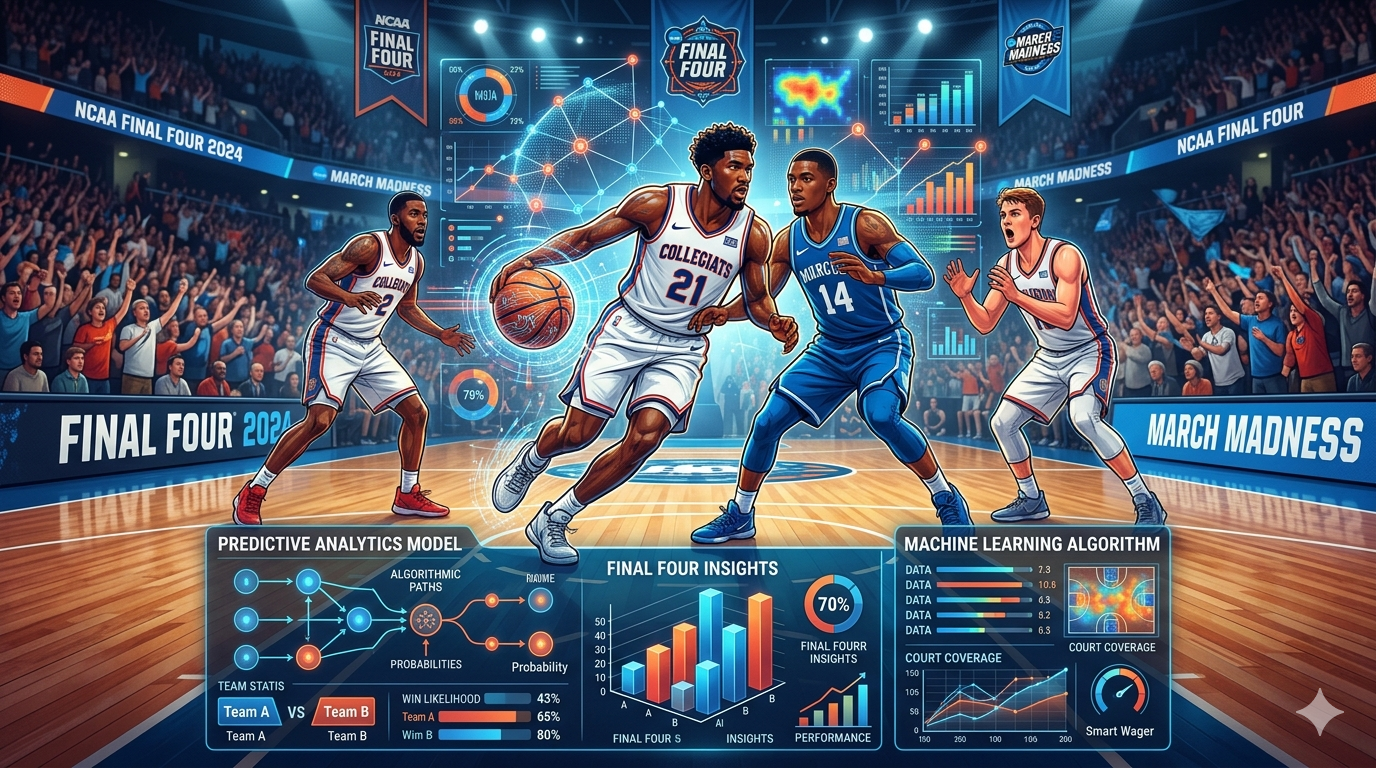
The world of sports betting is undergoing a massive shift, and nowhere is this more evident than during the high-stakes environment of the Final Four. For years, bettors relied on "gut feelings," box scores, and the "eye test" to determine which college basketball teams would advance to the championship. However, the sheer volume of data produced by modern sports—from player tracking metrics to advanced efficiency ratings—has made it nearly impossible for the human brain to process every variable effectively. This is where machine learning comes in. By utilizing complex algorithms that can identify hidden patterns across decades of tournament history, bettors are moving away from guesswork and toward a more calculated, data-driven methodology.
Machine learning doesn't just look at who won or lost; it analyzes the why behind the performance. It can weigh how a team’s defensive rotation reacts to a high-volume three-point shooter or how travel fatigue affects free-throw percentages in the second half of a game. For anyone looking to navigate the chaos of March Madness, understanding these technological tools is no longer optional—it is a necessity for gaining a competitive edge. This exploration covers how these algorithms function, how platforms like ATSwins.ai are democratizing access to elite data, and how you can blend this modern tech with traditional basketball wisdom to refine your betting strategy.
Table Of Content
- Machine Learning in Sports Betting
- Machine Learning Algorithms for Predictions
- Practical Applications in NCAA Betting
- Combining Machine Learning with Traditional Betting Wisdom
- Conclusion
- Frequently Asked Questions (FAQs)
Machine Learning in Sports Betting
If you are like me and spend the better part of March glued to a screen watching college kids dive for loose balls, you know that the Final Four is basically the Super Bowl on steroids. But honestly, the old way of betting—just looking at who has the hottest point guard or which coach has the most gray hair—is kind of dying out. We are living in 2026, and if you aren't using some form of advanced tech to back up your picks, you are basically just throwing money into a bonfire. Machine learning is the big buzzword everyone talks about, but at its core, it is just a way for us to process way more information than our human brains were ever designed to handle. Think about it this way: a computer doesn't get tired, it doesn't have a "favorite team," and it doesn't care about the narrative of a "Cinderella story" unless the numbers actually support it.
When we talk about the basics of machine learning in the context of the Final Four, we are looking at a subset of artificial intelligence that focuses on building systems that learn from data. Instead of a programmer telling the computer exactly what to look for, the computer looks at thousands of past NCAA games and figures out the patterns itself. This is huge for the Final Four because the tournament is famously unpredictable. By analyzing vast amounts of data, machine learning algorithms can uncover weird little trends that might not be evident through traditional analysis. Maybe a certain team always struggles when they have to play two games in forty-eight hours at a high altitude, or perhaps a specific defensive rotation is statistically proven to shut down elite perimeter shooters. These are the things that refine betting strategies and lead to much smarter decisions when the stakes are at their highest.
The first real step in making this work for you is the data analysis phase. You can't just feed a computer "vibes" and expect a winner. You have to gather and analyze hard data. One of the most useful techniques is historical performance tracking. This isn't just looking at wins and losses; it is looking at the efficiency of every possession. You want to see how teams did in past tournaments to predict future outcomes because the pressure of the Big Dance is a different animal than a random Tuesday night game in January. Then you have the player statistics. We aren't just talking about points per game here. We are looking at advanced metrics like effective field goal percentage, turnover rates under pressure, and how a player performs when their usage rate spikes. When you combine this with team matchups—like how a slow, methodical Big Ten team handles a fast-paced transition offense from the SEC—you start to see the matrix.
Leveraging these past performance stats is where the edge is won or lost. You have to consider things like game location, even though the Final Four is on a neutral court. Some teams travel better than others, and some arenas have sightlines that mess with shooters. You also have to factor in recent performance trends. Is a team peaking at the right time, or are they limping into April? Injury reports and player availability are obviously massive, but machine learning takes it a step further by simulating how a team functions without a specific "sixth man" or defensive specialist. The key is to filter out the "noise"—the irrelevant data that doesn't actually affect the score—so your analysis stays sharp and effective.
Machine Learning Algorithms for Predictions
Now, let's get into the "nerdy" side of things, but I'll keep it simple. There are a few main ways these computers actually "think." One of the most popular tools is called a decision tree. Imagine a massive flowchart. It starts with a question like "Does Team A have a top ten defense?" If the answer is yes, it moves to the next branch: "Does their opponent average more than fifteen turnovers?" It keeps splitting the data into various branches based on specific criteria. This method is awesome for us because it’s easy to visualize. It helps us understand outcomes based on different player and team attributes. If the decision tree shows that 90% of teams with a certain rebounding margin make it to the championship game, that is a signal you probably shouldn't ignore.
Then you have the heavy hitters: neural networks. These are modeled after the human brain, which sounds like sci-fi but is actually just really intense math. Neural networks can analyze incredibly complex patterns that a human would never see. They are particularly effective for predicting outcomes based on a mountain of inputs, like individual player performance metrics, historical game outcomes, and even coaching styles. While a decision tree is like a map, a neural network is like a GPS that is constantly recalculating based on live traffic. It learns from its own mistakes. If the model predicted a blowout and the game was actually close, the neural network adjusts its "weights" for the next time so it gets closer to the truth.
This is exactly why platforms like ATSwins.ai are becoming so popular. It is an AI-powered sports prediction platform that does the heavy lifting for you. They provide data-driven picks, player props, and insights into betting splits. The best part is that they offer both free and paid plans, so whether you are just a casual fan trying to win the office pool or a serious bettor tracking profits across the NFL, NBA, MLB, NHL, and NCAA, you have access to the same kind of tech the pros use. Using a tool like this means you aren't just guessing; you are leveraging algorithms that have been trained on millions of data points.
Practical Applications in NCAA Betting
So, how do you actually apply this when you're sitting on your couch with your sportsbook app open? Let's talk betting scenarios. The most common one is point spread analysis. You can use these models to predict if a team will cover the spread based on their past performance and current matchup. Sometimes the public overvalues a "big name" school, and the spread gets inflated. A machine learning model will see that the underdog actually matches up perfectly against the favorite’s zone defense, giving you a clear signal to take the points.
Then you have Over/Under bets. Everyone loves a high-scoring game, but the Final Four often gets "clamped up" because the nerves are so high. By analyzing scoring patterns and defensive statistics, machine learning can help you predict whether the total points will go over or under the set line with way more accuracy than a "gut feeling." Moneyline betting is another area where models shine. They evaluate the raw likelihood of each team’s victory based on statistical trends, often finding value in "plus money" dogs that the average bettor is too scared to touch.
Of course, none of this matters if you don't have a risk management strategy. You can have the best model in the world, but if you bet your entire rent on one game, you're doing it wrong. Bankroll management is the golden rule. You need to set a budget and stick to it, only wagering a small percentage of your total funds on any single bet. You should also look into diversified bets. Instead of putting all your eggs in one basket, consider spreading your money across different games or even different types of bets like player props. Finally, use the model's "confidence level" to adjust your stakes. If a model on ATSwins.ai is screaming that a certain pick is a lock, you might justify a slightly larger wager, while lower-confidence picks should always be kept small.
Combining Machine Learning with Traditional Betting Wisdom
I’m not saying you should completely ignore your instincts. The goal is a balanced approach. You want to stay informed by using both machine learning tools and traditional betting insights. Sometimes, there is a "human element" that data might miss—like a team playing for a coach who just announced his retirement or a player dealing with a personal issue that isn't on a stat sheet. Gut feelings can still be a tiebreaker in situations where the data is too close to call.
Engaging with betting communities is also huge. People in these groups often share tiny nuggets of info—like a star player looking sluggish in warmups—that can complement your machine learning findings. It’s all about continuous learning. The world of sports and the world of tech move fast. What worked last year might not work this year, so you have to keep your strategies updated.
There are plenty of resources out there to help you stay sharp. You can find massive datasets on places like Kaggle or read up on new models through sites like Towards Data Science. But for the actual day-to-day betting, incorporating a platform like ATSwins.ai into your routine is the easiest way to get that competitive edge. They provide the picks, the player props, and the betting split insights that are tailored to help you make informed decisions without needing a PhD in data science.
Conclusion
To wrap this all up, using machine learning for Final Four betting is a total game-changer. We’ve talked about how analyzing data helps you make better predictions, from understanding deep trends to using player performance stats and watching the betting splits. It's about working smarter, not harder. You want to be the person who is making moves based on evidence, not just because you liked a team's jersey when you were ten years old.
ATSwins.ai really is the move here. Their platform gives you that AI-driven edge with data-backed picks and tools to track your profits across all the major leagues. It makes the whole process way less stressful and a lot more calculated. If you’re serious about making this Final Four a profitable one, it’s time to embrace the tech. Start making smarter betting choices today and see the difference that real data can make.
Frequently Asked Questions (FAQs)
What is machine learning and how can it help in Final Four betting?
Machine learning is basically a branch of AI that teaches computers to find patterns in data without being explicitly programmed for every scenario. In Final Four betting, it helps you analyze team performance and player stats to spot trends that the general public completely misses.
How do I use historical performance stats for betting?
You should look at how teams performed in past NCAA tournaments specifically, because the pressure is different. Compare those "postseason" stats with their current season performance. If you find patterns where a team consistently over-performs or under-performs in these high-stakes moments, you’ve found your edge.
Which machine learning algorithms are best for making predictions?
Decision trees and neural networks are the big ones. Decision trees are great for "if/then" scenarios, while neural networks are better for complex, multi-layered data. Both are used by top-tier analysts to figure out who has the statistical advantage.
How can ATSwins.ai enhance my Final Four betting strategy?
It takes the guesswork out of the equation. It is an AI-powered platform that gives you data-driven picks and player props. You can track your wins and losses across different sports, which helps you stay disciplined and see exactly what is working in your strategy.
What are some common mistakes bettors make during the Final Four?
The biggest mistake is betting with your heart or following the "hype train" on social media. People also tend to overreact to one good game and bet too much on a "favorite" that is actually overvalued. Using data and machine learning tools keeps you grounded and helps you avoid those emotional traps.
Related Posts
Final Four AI Odds Prediction Model: Smarter March Madness Betting Insights
Final Four AI Betting Tips - Find Winning Expected Value Angles
The Final Four AI Simulation Model In NCAA Basketball: The Future Of March Madness
Sources
The Game Changer: How AI Is Transforming The World Of Sports Gambling
AI and the Bookie: How Artificial Intelligence is Helping Transform Sports Betting
How to Use AI for Sports Betting
Keywords
final four ai odds prediction model
final four ai expected value betting angles
final four ai simulation model ncaa basketball
final four betting angles with machine learning
final four ai prediction algorithm march madness