
AI Sports Betting Strategy - How To Bet Smarter In 2025
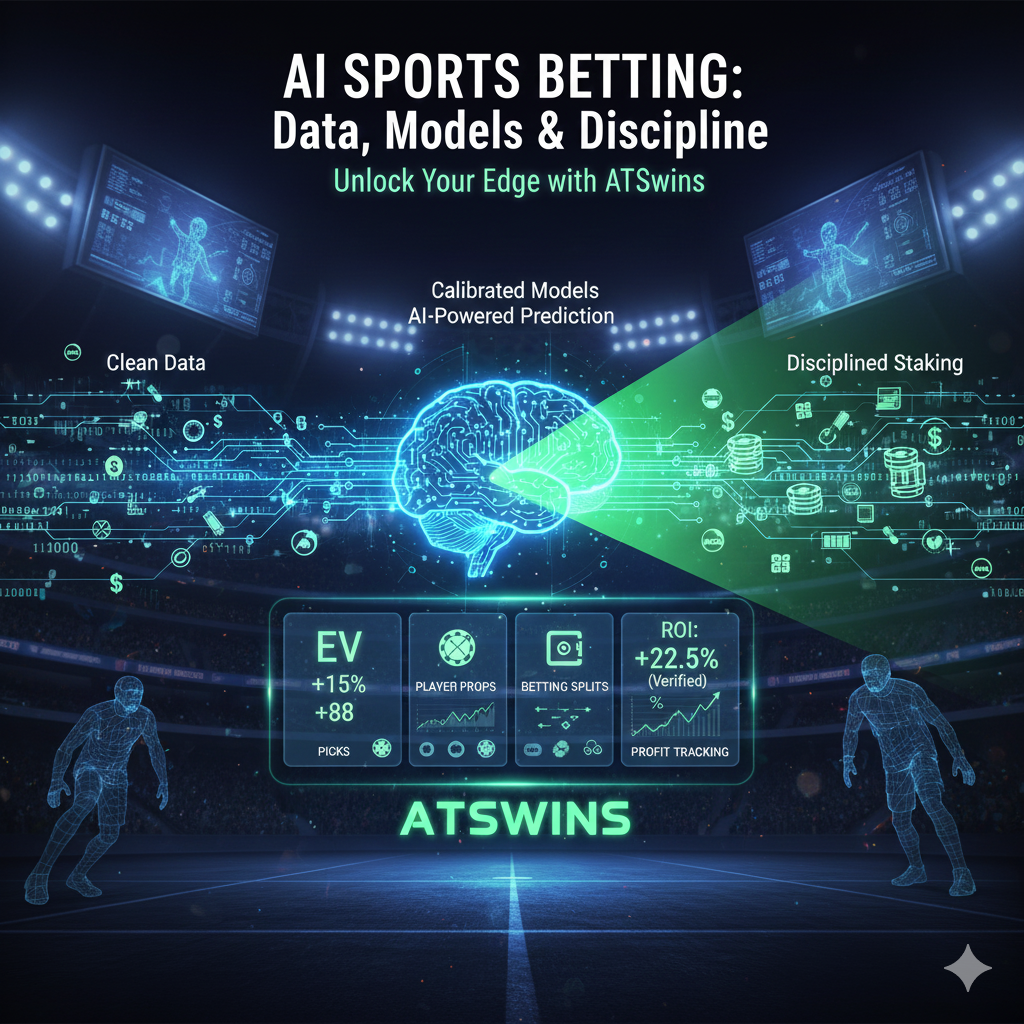
Table Of Contents
- Objectives, constraints and ethics for an AI sports betting strategy
- Data pipeline and feature engineering
- Modeling and ensembling
- Betting execution, bankroll and evaluation
- Workflow, tooling and references
- Objectives, constraints, and ethics in action: an example mini-plan
- Practical heuristics and pitfalls to avoid
- How-to: building a minimal ATS model in a weekend
- Templates you can copy
- Translating ATSwins signals into action
- Step-by-step: preventing leakage and overfitting
- Evaluation metrics that matter (and how to read them)
- Scaling responsibly
- Example value thresholds and execution rules by market
- Bringing it together with a simple daily routine
- Quick troubleshooting checklist
- Final notes on validation and transparency
- Conclusion
- Frequently Asked Questions (FAQs)
Key Takeaways
Betting with a clear edge requires patience and discipline. Only place bets when your calculated number beats the market, and make sure your data is clean and your models are calibrated. Tracking expected value (EV) and closing line value (CLV) is essential because a hot streak is never a reliable indicator of long-term success. Bankroll discipline is crucial. Most pros stick to a small fraction of their bankroll, typically 0.5–1% per play or a fractional Kelly approach. Avoid stacking correlated bets in the same game and log every result, accepting that some weeks will be swingy. When building and maintaining models, time-aware splits and walk-forward testing are necessary, and you should never peek at future outcomes. Features should start simple and only get more complex after you’ve nailed your data pipeline. In practice, start with one league and one market, paper trade, and scale gradually. Always respect privacy and wager responsibly. ATSwins is your ally in this. The platform provides AI-powered sports predictions, betting splits, player props, and profit tracking across NFL, NBA, MLB, NHL, and NCAA, giving bettors the context and tools to make smarter decisions.
AI Sports Betting Strategy That Actually Goes From Model To Bet Slip
Objectives, constraints and ethics for an AI sports betting strategy
Defining goals from the start keeps your process honest, measurable, and aligned with your bankroll, models, and ATSwins insights. Start by focusing on the sports and markets that give you the cleanest data and the most predictable outcomes. Core leagues are NFL, NBA, MLB, NHL, and NCAA because ATSwins covers them thoroughly, and the data is mature. Stick to markets that have a track record and are stable: point spreads, totals, moneylines, and select player props. Exotic parlays, micro-bets, and long-tail derivatives should be avoided until you have enough sample size to understand the edge.
The main metric that drives your decisions is expected value. Calculate the difference between your model-implied probability and the implied probability from the odds, which gives you the expected profit per unit. Track closing line value as well; seeing your bets beat the closing number consistently is a huge indicator of real edge. Hit rate is less important than price quality. A high EV with positive CLV wins over the long term even if your win rate is below 50%.
Time horizons matter. In the short term, you should track CLV weekly and score your execution. Medium-term performance should be evaluated over a sample of 250–500 bets or a full season per league, looking at ROI, Sharpe ratio, and drawdown profile. Long-term checks are about regime changes, whether it’s rule tweaks or meta shifts in team styles or betting trends.
Risk limits are critical. Use fractional Kelly to size bets and set weekly caps per market and sport. Limit daily exposure and avoid multiple correlated bets on a single team or game. Stop-loss rules should exist, like pausing new staking if your drawdown hits 15% after a model release. Ethics and compliance are just as important. Always protect personal data, limit logging to what is necessary, and only bet with legal books. ATSwins fits seamlessly here by providing model picks and betting splits that you can use for context. By overlaying your model’s predicted price with ATSwins’ picks and live odds, you create a strong decision framework. Profit tracking on ATSwins complements your internal logs, letting you pinpoint where your real edge exists.
Data pipeline and feature engineering
Messy data kills edge. Build a simple, boring, and reliable pipeline first. Start with historical box scores and play-by-play data. Consistency and timestamps are key. Subscription feeds are great, but public sources are sufficient to get started. For player props, you’ll need historical lines, results, and minutes played.
Begin your ingestion with five core fields: game date, teams, closing spread/total, final score, and minutes or pace. Create lightweight parsers that output a single typed schema and version each raw dump with a date-stamped folder. Run daily ETL jobs at a fixed time, reporting on rows added and missing data.
Data cleaning is critical. Standardize team names, time zones, and season identifiers. Impute missing categorical data with “Unknown” and numeric data with medians by team and season. Remove games with suspicious discrepancies and flag missing injuries or forecast weather. These flags can serve as features. Quality control is simple: row counts should match season totals, point totals should match game scores, and spread direction should be consistent with final posted odds.
Feature engineering is where you capture what actually moves lines. Focus on causal or tightly correlated features. Look at rolling 5–10 game differentials in efficiency, adjusted for recency. Factor in rest, back-to-back games, and cross-country travel. Altitude and venue conditions matter for certain events. Track lineup continuity, pace and style, weather, and schedule quirks like rivalry games or trap spots. ATSwins betting splits can be used as a confidence feature but should never be used as a training label. Always prevent feature leakage; any data unavailable at bet time must be excluded or lagged.
Create bookmaker-agnostic targets. Spread outcome is binary, whether the team covers the spread. Totals are over or under. Moneyline is simple: win or loss. Player props are over or under on projections, but ensure minutes are set before market open. Use closing lines for training but evaluate open line impact if you intend to bet early. Split your data by season and league structure, using time-aware cross-validation to prevent leakage. Keep league pipelines separate but share utilities for transformations.
Document everything for trust. Maintain a data dictionary with field names, types, sources, and update frequencies. Store model-ready datasets with immutable checksums, no ad-hoc edits. Tools that help include notebooks for iteration, Google Colab for quick GPU/CPU experiments, scikit-learn and XGBoost/LightGBM for modeling, and ATSwins historical signals to pair with your own datasets.
Modeling and ensembling
Start simple and grow. Baseline Elo models are fast and surprisingly strong for spreads and totals. Include home-field advantage, rest, and travel adjustments, then map predicted margins to probabilities for covering the spread. Logistic regression is interpretable and stable; gradient boosting models handle nonlinearities, interactions, and missingness. Feature tiers are essential: Tier 1 includes form, rest, travel, pace, and home advantage; Tier 2 is lineup continuity, injury aggregates, and weather; Tier 3 is schedule quirks and contextual metrics.
Simulation is useful for totals and spreads. Fit predictive distributions for team scores and simulate thousands of games to estimate probabilities. Calibrate probabilities with Platt scaling or isotonic regression. Proper calibration ensures your sizing and value detection is trustworthy. Cross-validation should respect time. Rolling or expanding windows prevent peeking into future data. Ensemble models by averaging calibrated probabilities across Elo, logistic regression, and gradient boosting, weighted by out-of-sample performance metrics. Always monitor leakage, quantify uncertainty, and set practical betting thresholds. Only place bets where your edge is meaningful.
Betting execution, bankroll and evaluation
Execution is part of your edge. Convert book odds into implied probabilities and compare to your model probability. Calculate edge and apply a fractional Kelly approach to size bets, controlling drawdowns. Maintain minimum and maximum stakes, set daily exposure caps, and limit correlated bets. Track CLV, ROI, and Sharpe to evaluate performance. Record a bet execution score to see if you captured the best market price. Backtest with out-of-sample splits, paper trade, then scale gradually. Avoid correlated exposures and overfitting, and incorporate injury or news features gradually. Game-day checklist: confirm data cut-off, compare your line with ATSwins picks, check exposure and correlation, place bets, and log everything.
Workflow, tooling and references
Build in notebooks for iteration and pipelines for reliability. Version datasets and models, storing parameters and metrics under each version tag. Use transparent libraries like scikit-learn and gradient boosters with careful CV. Track experiments including dataset versions, hyperparameters, and metrics. Integrate ATSwins signals for consensus confidence and market context. Use profit tracking on ATSwins to reconcile with your ledger. Keep experiments reproducible and documented.
Objectives, constraints, and ethics in action: an example mini-plan
Over a 10-week sprint in the NBA: Week 1 focuses on data ingestion and baseline models, Week 2–3 adds features and simulation, Week 4 blends models and evaluates performance. Weeks 5–6 implement bankroll management and start live small stakes, overlaying ATSwins picks. Weeks 7–8 incorporate injury context, Week 9 consolidates results and refines pipelines, and Week 10 scales or pauses depending on performance.
Practical heuristics and pitfalls to avoid
Don’t chase steam or reduce your edge threshold in frustration. Bet early when your model shows strong edges and public likely disagrees. Bet late when you need confirmed news. Limit player props to stable-minute players and avoid rookies unless usage is predictable. Keep market labels consistent and document every change. Stick to your process and thresholds to maintain edge.
How-to: building a minimal ATS model in a weekend?
Pull five seasons of historical NBA data, create simple rolling features, fit logistic regression and Elo models, calibrate, backtest with fractional Kelly, and overlay ATSwins picks for review. Paper trade next week’s board and track everything. This gives you a transparent, reproducible, minimal viable strategy.
Templates you can copy
Maintain bet slips with date, league, game ID, market, side, line, price, stake, model probability, implied probability, edge, Kelly fraction, result, closing line, CLV, and notes. Keep a one-page risk policy outlining bankroll, unit size, edge thresholds, correlation rules, and stop-loss criteria. Maintain a model changelog documenting changes, backtest results, and rollout plans.
Translating ATSwins signals into action
Use ATSwins picks as a second opinion. Bet full size when both your model and ATSwins agree strongly. Consider small stakes when your model is borderline but ATSwins shows confidence. Use betting splits to gauge public or sharp sentiment, optimizing timing and sizing accordingly. Reconcile weekly results with ATSwins tracking to identify where your edge is strongest.
Step-by-step: preventing leakage and overfitting
Track feature availability relative to game start. Exclude post-game or post-open odds data from training. Use bet-time flags, lock calibration to past data, separate tuning and evaluation datasets, and rerun baseline checks after major changes to prevent data snooping.
Evaluation metrics that matter (and how to read them)
Key metrics include Brier score for calibration, log loss for overconfident predictions, ROI and Sharpe for returns, and CLV for trade quality. Interpret discrepancies carefully: good CLV with poor ROI indicates variance, bad CLV with good ROI may indicate luck. Flat metrics suggest zero edge; revisit features and calibration.
Scaling responsibly
Increase bet sizes only after 500+ bets with stable CLV and acceptable drawdowns. Add markets gradually, from spreads and totals to selective moneylines and props. Simplicity beats complexity.
Example value thresholds and execution rules by market
For NBA spreads, aim for minimum 2.5% edge, maximum 1.5 units, and early betting if your price deviates from consensus. NFL totals require 2% minimum edge and weather confirmation. MLB moneylines need 1.5% edge and confirmed pitchers. Player props demand 5–8% edge with stable minutes.
Bringing it together with a simple daily routine
Mornings: update data, refresh features, compare with ATSwins picks. Midday: pull lines, compute edges, place fractional Kelly bets. Pre-game: confirm injuries/weather, log everything. Post-game: update results, compute CLV, note execution issues for review.
Quick troubleshooting checklist
If your model shows huge edge but the market disagrees, check inputs and stale lines. Swingy results with neutral CLV require reduced Kelly fractions. Flat performance signals calibration or base-rate issues. Too many small bets dilute focus; raise minimum stake. Pause props dragging down performance and double down on ATS or totals if performing.
Final notes on validation and transparency
Public datasets and clear metrics validate assumptions. Small experiments, honest testing, and documentation are key. Use ATSwins as a second lens: when your model and ATSwins align with available price, your edge is likely repeatable and disciplined.
Conclusion
AI sports betting works when clean data, calibrated models, and disciplined staking come together. Focus on EV and CLV, manage exposure carefully, and verify results with ROI before scaling. ATSwins is an AI-powered sports prediction platform that provides picks, player props, betting splits, and profit tracking across NFL, NBA, MLB, NHL, and NCAA, helping bettors make smarter, more informed decisions.
Frequently Asked Questions (FAQs)
What is an AI sports betting strategy in plain terms? It uses historical data, math models, and some automation to turn game info into fair odds. Compare your model’s price to the sportsbook line and bet when you have a positive expected value. Over time, this process beats randomness without guessing.
Which numbers matter most? EV and CLV are essential. Win rate and ROI are useful but noisy. Calibration ensures your probabilities reflect real outcomes. Drawdown shows how deep losing streaks get. Measure consistently and don’t chase variance.
How do I start without coding a huge system? Begin small with one league and market. Gather clean data, build a basic model, backtest with walk-forward splits, bet only when your edge is meaningful, use fractional Kelly, and track everything. Avoid overfitting and adding too many features at once.
How does ATSwins help? ATSwins provides AI-powered picks, player props, betting splits, and profit tracking, giving context to your decisions. Whether you already run models or are just starting, ATSwins helps you monitor performance and identify real edges.
Is bankroll management really that important? Absolutely. Use a fixed fraction of your bankroll per play, or fractional Kelly. This keeps you in the game during downswings and lets you grow when your model is working. Avoid stacking correlated bets and never chase losses.
Related Posts
AI For Sports Prediction - Bet Smarter and Win More
AI Football Betting Tools - How They Make Winning Easier
Bet Like a Pro in 2025 with Sports AI Prediction Tools
Sources
The Game Changer: How AI Is Transforming The World Of Sports Gambling
AI and the Bookie: How Artificial Intelligence is Helping Transform Sports Betting
How to Use AI for Sports Betting
Keywords:
MLB AI predictions atswins
ai mlb predictions atswins
NBA AI predictions atswins
basketball ai prediction atswins
NFL ai prediction atswins
ai betting analysis