

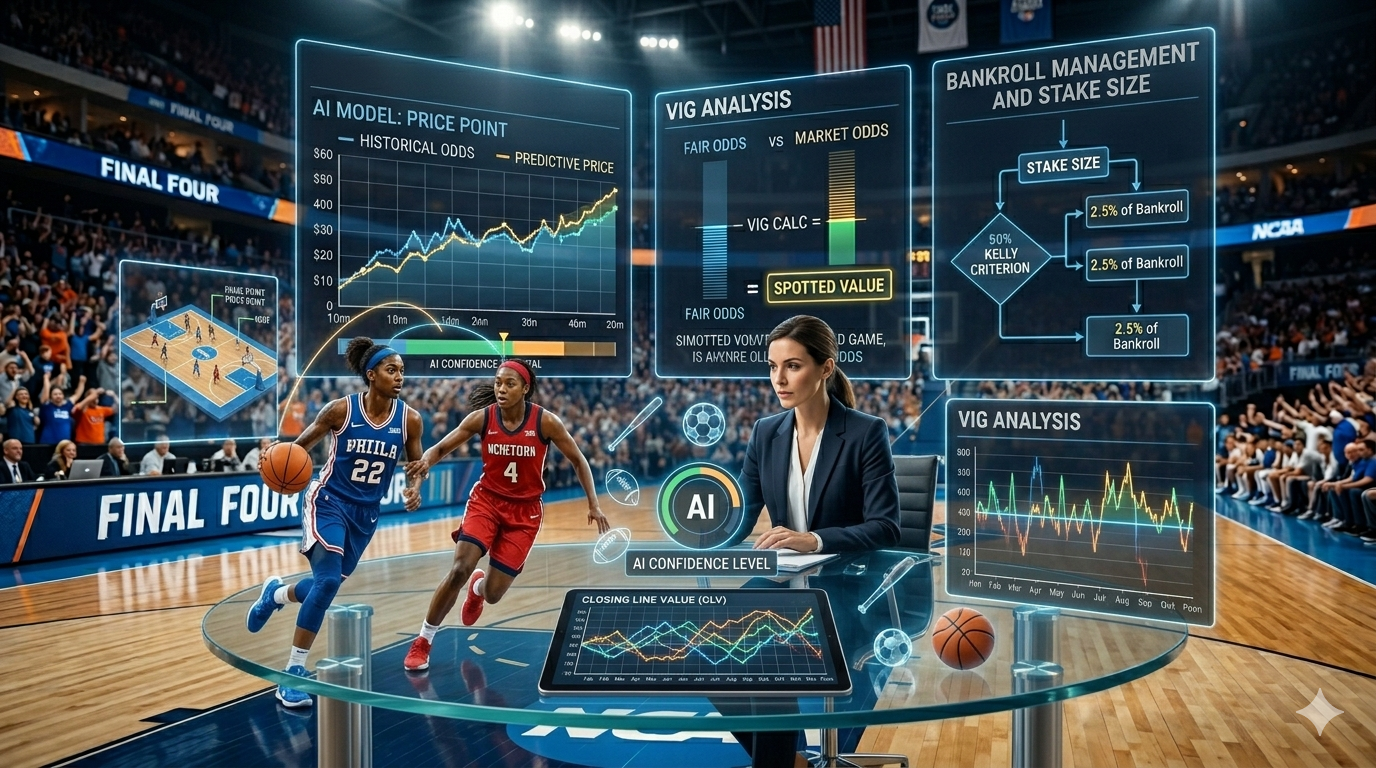
Sports betting has changed a lot over the last decade. What used to be mostly gut feeling, basic stats, and lineup news has turned into something way more analytical. These days the people consistently winning long term are not guessing or chasing trends they saw on social media. They are building systems that measure probabilities and find small edges in the market.
The rise of Machine learning AI sports betting models has completely changed the conversation around betting. Instead of simply predicting who will win a game, bettors now try to estimate probabilities more accurately than the sportsbooks do. If you can consistently produce better probability estimates than the market, even by a small margin, you can build a repeatable edge over time.
That is really the foundation behind any serious betting strategy. It is not about winning every night. It is about creating a process that produces positive expected value bets over hundreds or thousands of wagers. Once you understand that mindset, everything from data collection to model building starts to make a lot more sense.
This article walks through how a real data driven betting process works. We will talk about the data stack, modeling techniques, bankroll management, and how tools like ATSwins can be used alongside your own models. The focus is on practical concepts you can actually apply, especially if you are building a mlb early season betting strategy baseball model.
Table Of Contents
- Finding an Edge with AI: A Practical Sports Betting Strategy
- AI Sports Betting Edge Strategy
- Data Stack and Feature Engineering
- Modeling Strategy and Testing
- Bankroll and Execution
- Continuous Improvement and Governance
- How-To: Build a Minimal Viable Pipeline
- Converting Odds, Removing Vig, and Calculating EV
- Using ATSwins Alongside Your Models
- Common Pitfalls (and how to avoid them)
- Tools You Can Use Today
- Conclusion
- Frequently Asked Questions
Finding an Edge with AI: A Practical Sports Betting Strategy
The word edge gets thrown around a lot in sports betting. People say they have an edge when they feel confident about a pick or when they win a few bets in a row. In reality, an edge has a very specific meaning. It is the difference between your estimated probability of an event and the probability implied by the betting odds after removing the sportsbook’s vig.
If a sportsbook price suggests a team has a 50 percent chance to win but your model estimates the probability at 54 percent, that difference represents potential value. Over a single bet it might not seem like much. Over hundreds of bets it becomes the difference between winning and losing long term.
One of the most common mistakes bettors make is confusing short term variance with skill. Even a profitable bettor can lose 10 bets in a row because probabilities do not guarantee outcomes. The goal is to find repeatable situations where the market misprices games.
This is where Machine learning AI sports betting models come into play. Instead of relying on simple trends, these models evaluate dozens of variables at once. They process injuries, travel schedules, player performance metrics, and market movement. The result is a probability estimate that can be compared to the sportsbook line.
When those probabilities differ enough, you have a potential bet.
Platforms like ATSwins show how this concept works in practice. Their AI driven prediction tools highlight games where statistical indicators suggest possible value. It does not replace your own model, but it provides a second layer of analysis that can help confirm signals.
AI Sports Betting Edge Strategy
To build a real sports betting strategy around AI models, you need three things working together. The first is data quality. The second is modeling accuracy. The third is disciplined execution.
Most people underestimate how important calibration is. A model might correctly rank teams but still produce inaccurate probabilities. For example, if your model predicts games at 60 percent but those picks only win 52 percent of the time, the model is poorly calibrated.
Calibration techniques like Platt scaling or isotonic regression help adjust predicted probabilities so they match real outcomes more closely. Once your probabilities are calibrated, you can start calculating expected value.
Expected value measures the average profit or loss you would expect from a bet over time. If your model estimates a 55 percent win probability for a bet priced at minus 110, the expected value might be slightly positive. That does not mean the bet will win tonight, but it suggests the price is favorable.
Another important concept is closing line value. Closing line value compares the odds you bet to the final odds before the game starts. If you consistently beat the closing line, it usually means your model is identifying value earlier than the market.
This is one of the strongest indicators that a sports betting AI model is working correctly.
Data Stack and Feature Engineering
Data is the foundation of every serious sports betting model. Without clean data, even the best algorithm will produce unreliable predictions.
A typical sports betting data stack includes historical odds, game results, player statistics, injury reports, weather information, and scheduling factors. For baseball specifically, starting pitcher information becomes extremely important.
In a mlb betting strategy model, small sample sizes create a lot of noise. Teams may only have played a few games, so early season statistics can be misleading. That means historical performance, projections, and underlying metrics become more useful than raw results.
Feature engineering is the process of turning raw data into meaningful model inputs. Instead of simply feeding batting averages into a model, you might calculate rolling offensive efficiency ratings or pitcher matchup indicators.
Rest and travel also play a role. Teams traveling across time zones or finishing long road trips may perform differently than rested teams. Weather conditions, especially wind direction in baseball stadiums, can influence totals markets.
Another useful technique is opponent adjusted ratings. Instead of measuring a team’s performance in isolation, you evaluate how they performed relative to the strength of their opponents. This creates a more balanced view of team quality.
The goal is to create features that capture meaningful signals without leaking future information into the model.
Modeling Strategy and Testing
Once the data is prepared, the next step is training prediction models.
Many bettors assume they need extremely complex neural networks to succeed. In reality, simpler models often perform surprisingly well. Logistic regression models are frequently used as baseline predictors because they are easy to interpret and calibrate.
Tree based models such as gradient boosting often perform even better on structured sports data. They can capture nonlinear relationships between variables without requiring extensive feature engineering.
Regardless of the model type, testing methodology is extremely important. Random cross validation does not work well for sports betting because it mixes past and future games together. Instead, time based validation should be used.
A typical process might train a model on several past seasons and test it on the following season. Walk forward testing can simulate real betting conditions by updating the model each week and evaluating predictions on the next set of games.
Performance metrics should include both machine learning measures and betting metrics. Brier score and log loss evaluate probability accuracy. Expected value and closing line value evaluate betting performance.
When these metrics align, the model is more likely to be reliable.
Bankroll and Execution
Even the best sports betting AI model will fail without proper bankroll management.
Many bettors focus heavily on prediction accuracy but ignore bet sizing. If stakes are too large relative to the bankroll, a short losing streak can wipe out months of progress.
The Kelly Criterion is often used to determine optimal bet sizing. It calculates how much of your bankroll should be wagered based on your edge and the odds offered. In practice, most bettors use fractional Kelly sizing to reduce volatility.
For example, if the full Kelly calculation suggests betting four percent of your bankroll, a quarter Kelly approach might bet only one percent.
Exposure limits are also important. Multiple bets on the same team or game can create correlated risk. If those bets lose together, the bankroll impact becomes larger than expected.
Using structured limits helps maintain consistency. Many bettors cap individual bets at around one percent of bankroll and limit daily exposure to a small percentage.
Execution discipline is where many bettors struggle. The temptation to bet extra games or chase losses can override the model’s recommendations. Treating the process like a system instead of a guessing game is critical.
Continuous Improvement and Governance
Building a sports betting model is not a one time project. Sports environments change constantly. Rule adjustments, roster changes, and evolving strategies can alter how games are played.
That means models need to be monitored regularly for performance drift.
Data drift occurs when the distribution of input variables changes over time. Concept drift occurs when the relationship between those variables and game outcomes changes.
Tracking model performance metrics weekly or monthly helps identify these issues early. If probability calibration begins to drift or closing line value declines, it may be time to retrain the model or adjust features.
Explainability tools can also help identify unexpected model behavior. If the model begins relying heavily on a feature that should not matter, it may indicate a data problem or spurious correlation.
Maintaining version control for models and datasets is another good practice. Every major change should be documented so results can be compared objectively.
How To Build a Minimal Viable Pipeline
Creating a basic sports betting AI model does not require a massive infrastructure. A minimal pipeline can still produce useful insights.
The first step is collecting odds data for the markets you want to model. This typically includes spreads, moneylines, and totals.
Next, gather historical game data and team statistics. Store both raw and cleaned versions of the data so you can reproduce experiments later.
Feature engineering then transforms the raw data into model inputs. This might include team ratings, rest indicators, travel distance, or pitcher performance metrics.
Once features are ready, train a baseline classification model that predicts the probability of each outcome. After training, apply calibration methods to improve probability accuracy.
Finally, simulate betting decisions using historical odds. Only place bets when the model probability exceeds the market probability by a chosen threshold.
Over time this pipeline can be expanded with additional data sources and more sophisticated models.
Converting Odds Removing Vig and Calculating EV
Understanding how betting odds translate into probabilities is essential for any AI driven betting strategy.
American odds can be converted into implied probabilities using simple formulas. Positive odds represent underdogs while negative odds represent favorites.
After converting both sides of a market to probabilities, the sportsbook margin must be removed. This process is called removing the vig. The resulting probabilities represent the market’s estimate of the true odds.
Expected value calculations then compare the model probability to the market probability. If the model probability is higher than the fair market probability, the bet may have positive expected value.
Even small positive edges can be meaningful over a large sample size.
Using ATSwins Alongside Your Models
Many bettors combine their own models with information from ai sports betting prediction sites. Using multiple perspectives can help identify stronger signals and avoid blind spots.
ATSwins provides AI driven predictions across several major sports leagues. The platform analyzes historical data, player performance trends, and betting market movement to generate data backed picks.
For someone building their own sports betting ai model for spreads, tools like ATSwins can serve as a useful comparison point. If your model and the ATSwins projections both highlight value on the same game, it may strengthen confidence in the bet.
At the same time, differences between models can reveal interesting insights. If your model strongly favors one side but ATSwins shows no value, it might be worth reviewing your inputs or checking for missing information.
The goal is not to blindly follow predictions but to use them as additional context within your overall strategy.
Common Pitfalls
Even experienced bettors run into several common issues when building sports betting models.
Overfitting is one of the biggest problems. When a model becomes too complex, it may fit historical data perfectly while performing poorly on new games. Keeping models relatively simple often leads to more stable results.
Data leakage is another risk. If future information accidentally enters the training data, the model will appear extremely accurate during testing but fail in real betting situations.
Another challenge is unrealistic expectations. Many people assume a successful sports betting model will win most bets. In reality, even profitable models may only win slightly more than half of their wagers.
Long term discipline is far more important than short term win rates.
Tools You Can Use Today
There are several tools that make it easier to experiment with sports betting models. Programming languages like Python provide powerful machine learning libraries and data processing capabilities.
Spreadsheet tools can also be useful for quick probability calculations and bankroll tracking.
ATSwins can be used as a supplementary platform for monitoring predictions, tracking results, and comparing model outputs with market trends.
Combining these tools allows bettors to build a structured workflow without needing a massive technical setup.
Conclusion
Sports betting has evolved from intuition driven picks to data driven analysis. Machine learning models allow bettors to process large amounts of information and estimate probabilities more accurately than traditional methods.
The key idea behind a successful betting strategy is not predicting winners perfectly. It is identifying situations where the market price is slightly wrong.
By building a strong data pipeline, training well calibrated models, and applying disciplined bankroll management, bettors can create a process designed for long term profitability.
For those interested in ai sports betting prediction sites and building their own models, tools like ATSwins provide useful insights that can complement independent analysis.
At the end of the day, sports betting success comes down to consistency. The bettors who treat it like a research project rather than a guessing game are the ones who tend to last.
Frequently Asked Questions
What is an AI sports betting model
An AI sports betting model is a predictive system that analyzes historical data and statistical variables to estimate the probability of sports outcomes. These models often use machine learning algorithms to identify patterns that may not be obvious through traditional analysis.
Can AI predict sports results accurately
AI cannot predict individual game outcomes with certainty. However, it can estimate probabilities more accurately than simple analysis methods. Over many bets, these improved probability estimates can create profitable betting opportunities.
What makes a good MLB early season betting strategy
Early season baseball betting requires caution because sample sizes are small. Successful strategies often rely on historical player performance, pitcher matchups, and underlying metrics rather than early season win loss records.
Are AI sports betting prediction sites reliable
Some ai sports betting prediction sites provide valuable insights by analyzing large datasets and market trends. However, they should be used as tools rather than blindly followed picks.
How important is bankroll management
Bankroll management is essential for long term betting success. Even profitable strategies can fail if bet sizes are too large relative to the bankroll.
Related Posts
AI For Sports Prediction - Bet Smarter and Win More
AI Football Betting Tools - How They Make Winning Easier
Bet Like a Pro in 2025 with Sports AI Prediction Tools
Sources
The Game Changer: How AI Is Transforming The World Of Sports Gambling
AI and the Bookie: How Artificial Intelligence is Helping Transform Sports Betting
How to Use AI for Sports Betting
Keywords:
MLB AI predictions atswins
AI MLB predictions atswins
NBA AI predictions atswins
basketball ai prediction atswins
NFL ai prediction atswins