

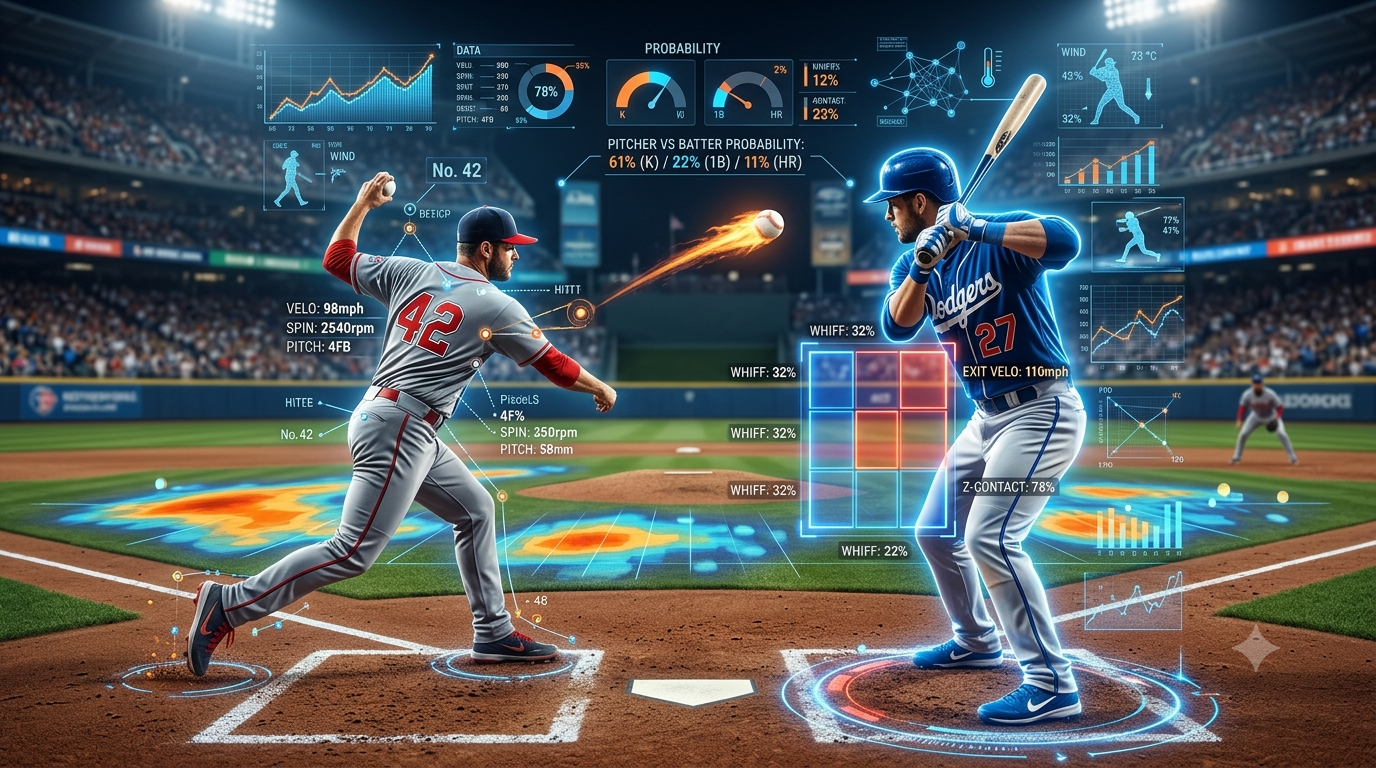
Baseball analysis has completely changed over the last few years. Decades ago, handicappers sat down with basic box scores, comparing a pitcher's home ERA against a team's left-handed batting average. Today, that approach feels almost primitive. Performing a real ai baseball game analysis means processing millions of pitch-tracking metrics in seconds, taking guesswork out of the equation and grounding every pick in raw probability.
Modern forecasting systems never promise 100% certainty—anyone claiming otherwise doesn't understand baseball. Instead, these models run historical patterns, weather shifts, and swing trajectories through complex algorithms. They evaluate how a hitter handles 97 mph high-and-inside heat, how a starter's spin rate drops in the 6th inning, or how a bullpen's fatigue level alters a game's late-inning dynamics.
At ATSwins.ai, we don't care about generating random "lock" picks. The goal is simpler and far more practical: calculate true probabilities, account for variance, and give bettors an objective framework to evaluate games every single day.
Table of Contents
What Is AI Baseball Matchup Analysis?
How AI Evaluates Pitcher vs. Hitter Matchups
The Data Behind Modern Baseball Forecasting Models
How Simulations Create Baseball Game Probabilities
Why Matchup Models Must Account for Uncertainty
Comparing Traditional Baseball Analysis With AI Matchup Modeling
How ATSwins.ai Approaches Baseball Analytics
Conclusion
Frequently Asked Questions About AI Baseball Matchup Analysis
What Is AI Baseball Matchup Analysis?
AI matchup analysis takes massive, chaotic datasets and compresses them into usable baseline projections. Standard handicapping looks at surface-level numbers like wins, losses, and team batting averages. AI models skip those surface stats and look directly at underlying mechanics.
Think about how many micro-battles happen during a single 9-inning game. A power-hitting lineup faces a control pitcher. A tired bullpen gets called up in back-to-back games. High humidity at Wrigley Field carries fly balls an extra 15 feet.
An mlb outcome prediction model processes all these moving parts simultaneously. It weighs walk rates, chase rates, pitch velocity drops, release-point shifts, and platoon splits. Rather than treating a team's recent winning streak as proof of quality, the model checks whether that streak came from genuine skill or just incredible luck on balls in play.
Baseball is notoriously noisy. Great teams drop 60 games a year, and bad teams throw shutouts out of nowhere. Probabilistic modeling separates meaningful trends from short-term randomness so you stop chasing fake momentum.
How AI Evaluates Pitcher vs. Hitter Matchups
The entire sport boils down to one primary interaction: the pitcher throwing a ball, and the batter deciding whether to swing.
AI models dive deep into these individual matchups. Say you have a left-handed hitter who crushes fastballs down the middle but misses late-breaking sliders away 40% of the time. If he faces a starter who throws that exact slider on 3-2 counts, the model immediately docks the hitter's expected output.
Modern pitch-tracking software measures details fans never used to see:
Velocity changes across starts
Vertical and horizontal movement
Spin efficiency and axis
Release point consistency
Swing-and-miss percentages by zone location
Expected metrics based on exit velocity and launch angle tell the real story. If a batter goes 4-for-4 with four weak bloop singles, traditional stats say he had a amazing game. An AI model sees four poor contact events and adjusts his future baseline downward. The same logic applies to pitchers whose ERA looks great only because their outfielders made spectacular diving catches behind them.
The Data Behind Modern Baseball Forecasting Models
An algorithm is only as smart as the data fed into it. Dump bad stats into a model, and you'll get useless projections back out.
Predictive models pull from several distinct data categories:
Player-level metrics: Exit velocity, hard-hit rates, chase percentages, pitch-type value.
Team dynamics: Bullpen availability, high-leverage workload, defensive run saves.
Environmental inputs: Park factors, temperature, wind direction, humidity, elevation.
Situational variables: Travel schedules, day-after-night games, rest days.
The real magic isn't gathering data—it's filtering out the junk. A common beginner mistake in sports modeling is adding 200 variables to a spreadsheet, thinking more data equals better results. In reality, useless statistics add noise. Successful forecasting requires stripping away useless stats, backtesting what remains, and giving proper weight to metrics that actually drive wins.
How Simulations Create Baseball Game Probabilities
Looking at season averages won't tell you how tonight's game plays out. That's why top quantitative analysts rely on Monte Carlo simulations.
Instead of predicting a static score (like "Dodgers win 5-3"), a simulation runs the matchup 10,000 times in software. It simulates every plate appearance based on player probability distributions. In run #412, the starter gets pulled in the 3rd inning. In run #1,890, the bullpen blows a four-run lead.
Once all 10,000 iterations finish, the model gives you a complete probability spread. It might show Team A winning 58% of the time, Team B winning 42% of the time, and the total score going over 8.5 runs in 54% of scenarios.
Comparing these model probabilities to sportsbooks' posted lines forms the foundation of a positive expected value betting strategy. If sportsbooks price a team at +120 (45.4% implied probability), but your simulation shows them winning 52% of the time, you've found a genuine mathematical edge. You aren't guessing—you're playing the numbers over a large sample size.
Why Matchup Models Must Account for Uncertainty
Variance is king in baseball. Umpires miss strike calls, wind gusts turn pop-ups into home runs, and star players occasionally drop routine fly balls. No algorithm on Earth can eliminate that randomness.
Smart models build uncertainty directly into their calculations.
Sample size is a huge factor here. If a rookie pitcher throws seven scoreless innings in his MLB debut, a bad model overreacts and prices him like Cy Young. A well-calibrated model applies regression to the mean. It recognizes that five innings of data contain high uncertainty, so it weighs historical minor-league baselines and league-average expectations far more heavily until a bigger sample accumulates.
Comparing Traditional Baseball Analysis With AI Matchup Modeling
Traditional analysis relies on human intuition, eye tests, and classical statistics. Analysts watch games, spot mechanical tweaks, and evaluate team chemistry. That human perspective has value—especially when tracking injuries or manager tendencies.
AI modeling handles heavy data lifting. Machine learning models spot multi-variable interactions that no human brain can track simultaneously.
A traditional scout might notice a pitcher struggles against lefties. An AI model takes that observation ten steps further: it calculates that the pitcher's fastball loses 1.8 inches of vertical break after 65 pitches against lefties when the temperature drops below 60°F.
Combining scout-level context with machine-level calculation gives you the best of both worlds.
How ATSwins.ai Approaches Baseball Analytics
At ATSwins.ai, we build modeling tools designed around probability evaluation rather than wild claims or guaranteed wins.
Our models evaluate matchups from top to bottom, combining player trajectories, bullpen metrics, and situational factors. But just as importantly, we track how model outputs compare against market line movement.
When sharp money moves a line, or when starting lineups get announced two hours before first pitch, probabilities shift. Sports betting isn't about finding "winners"—it's about pricing games accurately and executing disciplined risk management over the long haul.
Conclusion
AI baseball analysis changes how we look at daily matchups. By moving away from basic box-score stats and using simulation-driven probability, bettors gain a massive advantage in evaluating true team strength.
Uncertainty will always be part of the game—that's what makes baseball fun. But using structured data tools from ATSwins.ai helps you navigate that uncertainty with discipline, patience, and a long-term analytical edge.
Frequently Asked Questions About AI Baseball Matchup Analysis
What does AI baseball matchup analysis evaluate?
It analyzes pitch-tracking data, batter swing mechanics, bullpen workload, park dimensions, weather conditions, and situational trends to estimate win probabilities.
Can AI accurately predict every baseball game?
No. Baseball involves significant variance. Models estimate long-term probabilities, not guaranteed single-game results.
What data does an MLB prediction model use?
Models process pitch velocity, spin rates, exit velocity, launch angles, team bullpen usage, defensive efficiency, and environmental factors like wind and humidity.
Why are probabilities more useful than simple predictions?
Knowing a team has a 54% chance to win tells you how to price the matchup. Simply picking a "winner" ignores risk, odds value, and long-term bankroll strategy.