

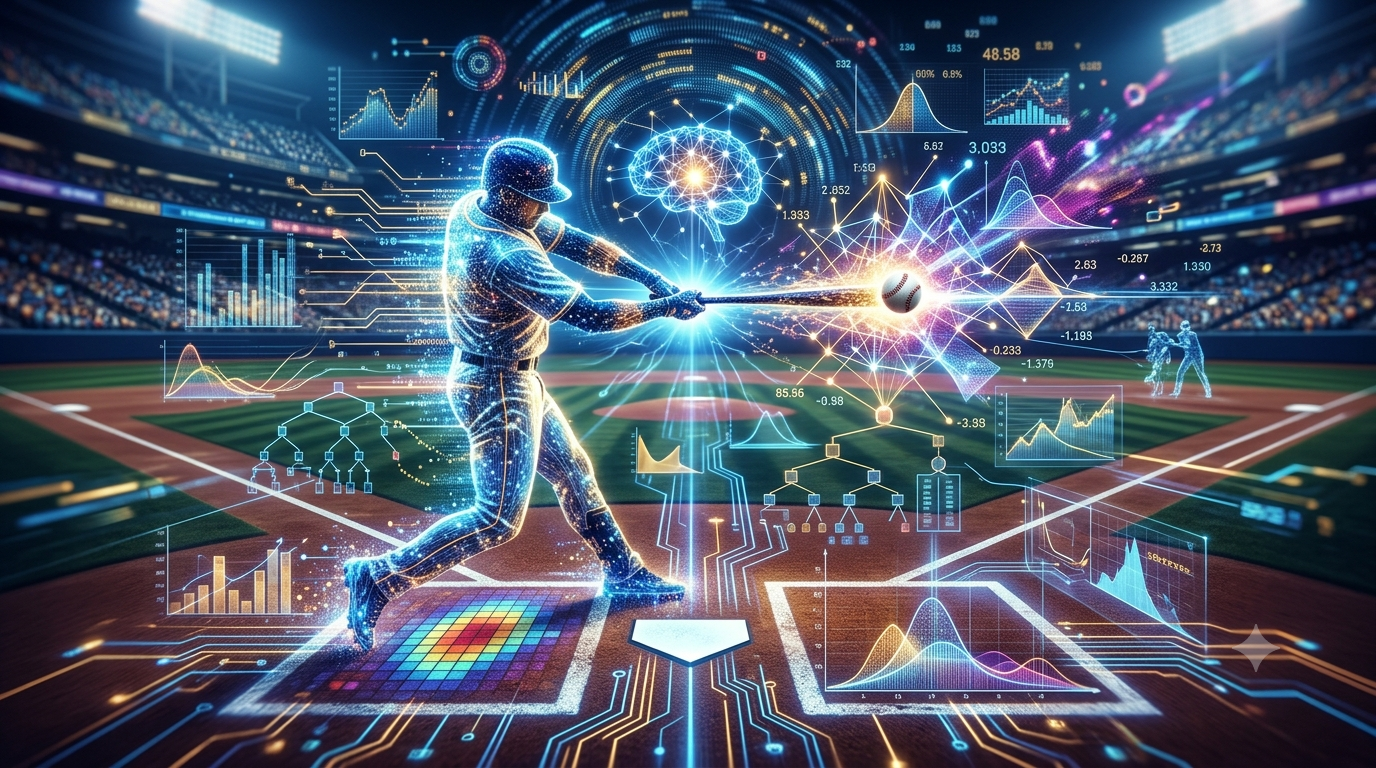
Artificial intelligence has completely flipped the script on how baseball games get evaluated. Forget relying purely on old-school win-loss records, traditional batting averages, or gut-feeling expert opinions. Modern baseball analysis meshes thousands of real-time data points together, calculating the raw probability of different outcomes long before the umpire shouts "play ball." Today's advanced models process player performance, pitching metrics, defensive range, weather shifts, ballpark dimensions, and lineup order to build forecasts that stay objective and remarkably consistent.
Instead of claiming to see into the future, modern AI assigns clear probabilities to potential outcomes. A team might hold a 58% shot at winning rather than just carrying a generic "favorite" tag. That distinction matters immensely. Baseball stands out as one of the most volatile professional sports on earth, where even world-class squads drop 60 or 70 games every single summer. Grasping probability over certainty gives fans and analysts a far sharper lens for evaluating matchups.
This article serves as a comprehensive Guide to Modern Sports analytics, unpacking the mechanics of Predictive Sports Analytics, breaking down , and showing how creates dependable expectations across a grueling 162-game season.
Table of Contents
What AI Baseball Game Analysis Really Means
Why Baseball Is Ideal for Artificial Intelligence
The Data Behind Modern Baseball Models
How Machine Learning Evaluates MLB Matchups
Simulations and Probability Forecasts
Why Human Analysis Still Matters in AI Baseball Game Analysis
How ATSwins Applies Data-Driven Baseball Analysis
The Difference Between AI Predictions and Simple Baseball Statistics
Common Limitations of AI Baseball Game Analysis
How Probability Models Improve Baseball Decision-Making
The Future of AI Baseball Game Analysis
Conclusion
Frequently Asked Questions About AI Baseball Game Analysis
What AI Baseball Game Analysis Really Means
Let's clear up a common misconception: AI in sports isn't some magic crystal ball. People often picture a supercomputer printing out guaranteed winners with perfect accuracy. That just isn't how modern sports analytics operates.
In reality, AI sifts through historical trends to spot subtle patterns that repeatedly influence game results. Machine learning algorithms digest years of MLB data, learning how dozens of distinct variables interact. The end goal isn't to pretend uncertainty doesn't exist, but rather to quantify it accurately.
Every matchup brings hundreds of measurable factors to the table. Starting pitchers bring unique strikeout rates, ground-ball tendencies, pitch movement profiles, and arm fatigue levels. Lineups vary wildly in how they hit left-handed throwing, generate extra-base hits, or avoid swinging strikes. Bullpens carry hidden fatigue based on recent workload, while ambient humidity and temperature alter ball flight.
Not all variables carry equal weight in every matchup. AI systems constantly adjust these weights as fresh data rolls in during the season. Unlike rigid, static formulas, machine learning evolves. Models get retrained on fresh outcomes, quickly adapting when league-wide run environments shift, teams pivot strategies, or players alter their approach. What you get is an evolving, dynamic forecasting system rather than a set-in-stone prediction.
Why Baseball Is Ideal for Artificial Intelligence
No major sport churns out structured data quite like baseball. Every single pitch, swing, hit, strikeout, and defensive dive produces clean, trackable data ready for storage and computation.
Unlike sports with chaotic fluid motion like soccer or basketball, baseball boils down to discrete, turn-based duels. Pitcher versus batter. Each pitch forms an isolated event with known participants, ball count, plate location, velocity, movement, and result.
Modern stadium tracking technology like Hawk-Eye has blown the doors wide open. Analysts now measure pitch velocity, spin rates, release points, exit speeds, launch angles, sprint speeds, defensive jump, positioning depth, split stats, and pitching sequences in real time.
With over 2,400 games played in a standard MLB regular season, algorithms have millions of individual events to learn from. Huge datasets give models structural stability. Outlier events—like a light-hitting shortstop launching a game-winning home run off an elite closer—don't throw off the system because they get weighed against thousands of historical comparisons. Randomness never fully vanishes, but algorithms isolate true, repeatable skill from short-term luck far better than human memory ever could.
The Data Behind Modern Baseball Models
High-level predictive modeling hinges entirely on data quality. Garbage in means garbage out, no matter how sophisticated your machine learning architecture happens to be. Winning models blend multiple layers of statistics rather than obsessing over a single headline metric.
Pitching metrics form the natural backbone of any baseball model because starting pitchers exert immense control over the outcome. Models weigh strikeout rates, walk percentages, expected ERA (xERA), pitch mix usage, velocity drops, whiff rates, and movement profiles to project future effectiveness.
Offensive evaluation goes way beyond surface-level batting averages. Models look under the hood at expected weighted on-base average (xwOBA), isolated power (ISO), hard-hit percentages, barrel rates, platoon splits, and recent lineup balance.
Defense counts heavily too. Range runs saved, fielding run value, outfield jump, and team infield positioning directly impact how many batted balls turn into outs instead of extra bases.
Contextual surroundings tie everything together. Travel schedules induce hidden fatigue. Weather shifts trajectory—warm air helps balls carry while damp sea-level air keeps them in the park. Wind direction can turn routine pop-ups into cheap home runs. Even individual home plate umpire strike zone tendencies play a measurable role over time.
Instead of treating every stat in isolation, AI evaluates how these variables collide. A fly-ball pitcher working against a power-hitting lineup in a tiny park on a hot, windy July evening creates a completely different math problem than that same pitcher throwing in a spacious stadium on a chilly April night. Context dictates the final probability.
How Machine Learning Evaluates MLB Matchups
When evaluating a slate of games, machine learning algorithms search history for historical situations that mirror today's matchup.
Imagine two starting pitchers who feature similar strikeout rates, workload histories, and pitch repertoires facing lineups with comparable success against left-handed throwing. Historical matchups sharing those core conditions serve as the benchmark for estimating what should happen today.
This capability is the engine behind Predictive Sports Analytics. Machine learning handles complex, non-linear relationships effortless. Some factors interact linearly, while others only trigger under specific conditions.
Take bullpen fatigue, for example. If a dominant starter routinely pitches seven or eight innings, bullpen tiredness barely impacts the game forecast. But if that same bullpen is depleted and today's starter usually exits after four innings, bullpen fatigue suddenly becomes a massive driver of the final outcome. Machine learning catches these conditional interactions naturally without requiring analysts to write manual IF-THEN rules for every edge case.
Data scientists deploy various algorithm types based on the job. Gradient boosting algorithms handle tabular baseball data exceptionally well, capturing complex relationships without overfitting. Neural networks dig out deep, subtle patterns across massive datasets. Bayesian models excel at handling uncertainty, which proves invaluable when projecting rookies or players returning from major surgeries.
Most top-tier sports analysts don't rely on just one model—they use ensembles, combining predictions across multiple distinct architectures. Rather than asking which model gets the winner right most often, they judge success by calibration. A well-calibrated model means that when it assigns a 60% win chance to 1,000 different teams, roughly 600 of them actually win. That reliability is worth vastly more than a lucky streak of picking straight-up winners.
Simulations and Probability Forecasts
Simulation is where modern AI sports modeling truly shines. Instead of spitting out a single projected final score like 5-3, advanced forecasting engines play out the exact same matchup thousands of times in virtual space.
How AI MLB Game Forecasts Work each individual simulation accounts for micro-variations in pitch location, weather, luck, and tactical choices. One run might yield a blowout, another a tight extra-inning pitcher's duel, and a small percentage might feature an unexpected bullpen meltdown .
Running 10,000 distinct game simulations turns random noise into a clear frequency distribution.
If Team A wins 5,900 of those simulated games while Team B wins 4,100 times, the output translates to a 59% win probability for Team A. This probabilistic output keeps expectations realistic. Even a 70% favorite is expected to lose 3 out of every 10 times they play, which explains why sweeping a three-game series is so tough in the big leagues.
Why Human Analysis Still Matters in AI Baseball Game Analysis
Despite the raw computing power of AI systems, human expertise remains vital. Algorithms are tools, not total replacements for baseball intuition and situational context.
Baseball is a living sport. A star player returning from a hamstring strain might technically be back in the lineup, but he might not run at 100% sprint speed. A young pitcher might secretly be working on a new sweeper grip that completely alters his strikeout potential overnight. A manager might restructure his bullpen usage pattern mid-season. These human elements create blind spots for purely historical algorithms.
Past numbers offer incredible context, but they aren't guaranteed prophecy. A veteran's three-year averages mean very little if his fastball velocity dropped two full miles per hour over his last three starts.
This is where sharp analysts step in. They evaluate the inputs going into the machine. They know when to discount old data and when to trust underlying metrics over lucky surface results. A hitter trudging through a 0-for-20 slump might actually be hitting the ball hard directly at defenders, signaling an imminent bounce-back that numbers alone might miss. AI models do heavy lifting, but human context ensures the inputs match reality.
How ATSwins Applies Data-Driven Baseball Analysis
Platforms like ATSwins approach game forecasting with mathematical rigor, leaning on probabilities, structural modeling, and disciplined research. The goal isn't to hawk "lock of the day" predictions, but to arm users with objective, structured probability landscapes.
In baseball evaluation, this means weighing every layer of influence systematically. Starting pitching matchups, bullpen availability, offensive metrics, travel schedules, roster moves, and stadium factors all blend into one coherent framework.
Consider how misleading surface stats can be. Team A might boast a far superior overall record compared to Team B. To a casual observer, Team A looks like an easy pick. But a deep simulation model catches critical caveats: Team A is sending their struggling fifth starter to the mound, Team B hits that specific style of pitching extremely well, and Team A's bullpen is gassed after working back-to-back extra-inning games.
Suddenly, the underlying math favors Team B despite their worse overall record.
This approach mirrors quantitative financial modeling. Wall Street analysts rarely buy stock based on a single quarterly metric; they study market variables, systemic risks, and probabilistic returns. ATSwins brings that exact same institutional discipline to sports evaluation, treating every matchup as a calculated distribution rather than a coin flip.
The Difference Between AI Predictions and Simple Baseball Statistics
Traditional baseball fandom has always relied on statistics, but traditional box-score stats mostly tell you what already happened. Modern AI focuses on what is most likely to happen next.
Standard analysis looks at earned run average (ERA) and wins. An AI predictive framework looks deeper: Pitch velocity trends, spin efficiency, contact quality allowed, pitch selection by count, matchup splits, defensive support efficiency, park factors, and bullpen rest.
The goal isn't to trash traditional statistics, but to upgrade them with predictive power. Surface stats are often noisy and heavily influenced by bad bounces or defensive misplays. Advanced predictive metrics peel back that luck to measure underlying skill.
If a hitter maintains a scorching .380 batting average over two weeks, a simple statistical view assumes he's locked in. An AI model checks his exit velocity, launch angles, and expected batting average (xBA). If his average is propped up by bloopers falling between outfielders, the model projects a sharp cool-down ahead. Conversely, a pitcher posting a bloated 5.50 ERA might actually be pitching brilliantly while being let down by atrocious fielding, signaling a prime candidate for a turnaround.
Common Limitations of AI Baseball Game Analysis
To use sports analytics Predictive Sports Modeling responsibly, you have to respect its boundaries. No algorithm can predict the future with total certainty, because baseball inherently carries a massive amount of unquantifiable randomness.
A pitch placed precisely on the outer edge can still get squibbed for an infield hit. A hung slider right down the middle might get pulled just two inches foul. Human athletes have good days, bad days, personal distractions, and sudden physical tweaks that no computer program can foresee.
Sample size issues cause headaches too, particularly early in the spring. A rookie with 40 major league plate appearances doesn't give a model enough baseline data to make firm predictions, forcing analysts to rely on minor league translations or age-curve projections.
Unannounced lineup scratches, sudden mid-game injuries, and sudden shifts in micro-weather like localized wind gusts all inject real-time volatility. Models provide a structured decision-support framework, but they aren't infallible oracle machines.
How Probability Models Improve Baseball Decision-Making
The real payoff of AI baseball analysis isn't getting a binary "pick." It's gaining a clear understanding of risk, uncertainty, and expected value.
Thinking in probabilities changes the types of questions you ask: What is the real likelihood of this outcome occurring? Which specific variables are driving this team's high win probability? How sensitive is this forecast to a change in starting lineups? Where does the market consensus differ from calibrated simulation results?
This mindset eliminates emotional bias. Instead of making emotional guesses, you evaluate games like an actuary weighing risk.
When a model is properly calibrated, a 65% favorite wins roughly 65% of the time over a large sample. Accepting that 35% loss rate as a normal, natural part of the process is what separates disciplined analysts from reactive fans.
The Future of AI Baseball Game Analysis
Sports analytics is moving fast. Future predictive models will integrate even granular data sources, including wearable biomechanical sensors, real-time swing-tracking metrics, advanced field-turf friction indicators, and ultra-high-resolution computer vision systems.
Yet no matter how advanced the technology gets, the underlying purpose remains unchanged: gathering high-grade data, applying smart modeling techniques, and managing real-world uncertainty with discipline.
AI won't ever "solve" baseball or take away the drama of a late-inning rally. What it does is give us a far more accurate map of the terrain before the first pitch is thrown. Bridging raw computing power with deep baseball knowledge remains the ultimate edge in sports research.
Conclusion
Artificial intelligence has transformed baseball evaluation from a guessing game into a sophisticated study of mathematical probability. Instead of asking who will win in absolute terms, modern predictive models break down why specific outcomes are more likely to occur based on millions of historical data points.
Uncertainty is embedded in the DNA of baseball—it's what makes the sport so captivating to watch. AI doesn't erase that unpredictability; it gives us a structured, rational way to measure and navigate it.
Platforms like ATSwins embody this analytical evolution, leveraging simulations, high-level projections, and data discipline to bring clarity to complex matchups. For anyone looking to analyze baseball through an objective lens, data-driven modeling offers the clearest path forward.
Frequently Asked Questions About AI Baseball Game Analysis
What is AI baseball game analysis?
AI baseball game analysis leverages machine learning algorithms, historical databases, and advanced tracking data to evaluate upcoming matchups. By weighing factors like pitcher metrics, hitter discipline, weather, defensive skill, and bullpen fatigue, these systems produce probability-based projections for game outcomes.
Can AI accurately predict MLB games?
AI significantly improves forecasting accuracy by identifying deep historical patterns, but it cannot predict outcomes with absolute certainty. Baseball involves inherent randomness, meaning unexpected plays, weather shifts, and emotional factors will always influence final scores.
What data does AI use for baseball predictions?
Predictive models utilize pitching metrics, exit velocities, launch angles, sprint speeds, defensive efficiency ratings, platoon splits, stadium dimensions, weather forecasts, umpire tendencies, and recent workload tracking to build precise forecasts.
How are AI baseball predictions different from expert opinions?
Traditional expert opinions rely on personal observation, gut feelings, and broad surface statistics. AI models analyze massive, multi-year datasets objectively without emotional bias, identifying subtle correlations across thousands of similar historical scenarios.
Does AI eliminate risk in baseball forecasting?
No algorithm can eliminate risk or guarantee results in a sport as volatile as baseball. AI serves as an analytical tool designed to quantify risk, calculate true probabilities, and help users make well-informed, rational evaluations.