

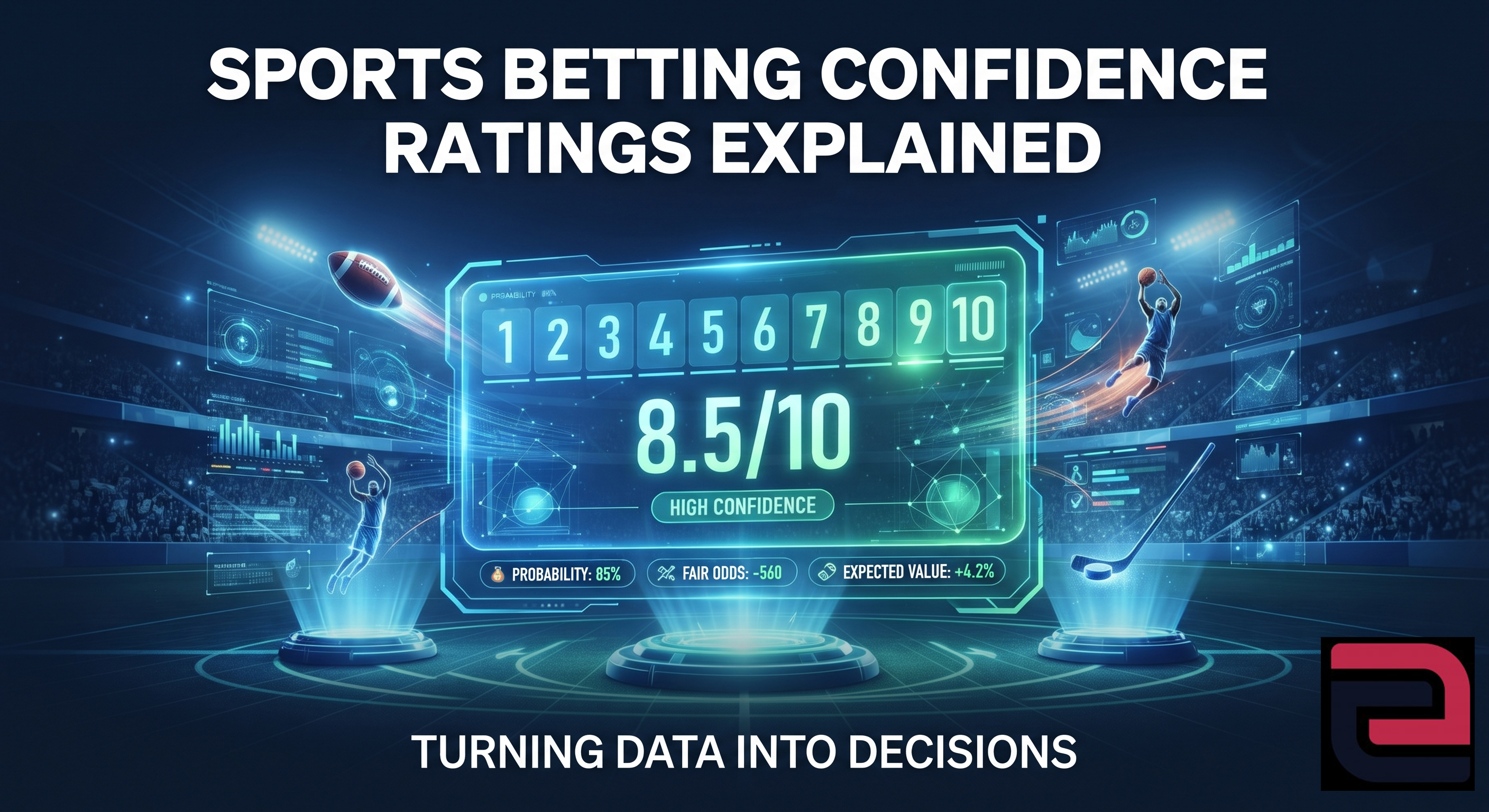
What a confidence rating really means is that a sports betting confidence rating is just a super compact way to communicate how certain the model and the analyst are that a given pick actually has positive expected value. It is absolutely not just a vibe score and it is definitely not a lock. It is really just a translation layer that turns a model win probability against the current market price into an easy and repeatable decision signal for bettors. Over at ATSwins where we publish data driven picks and player props across NFL NBA MLB NHL and NCAA a rating helps you compare different opportunities quickly and effectively. For those interested in understanding betting odds and probability, ATSwins serves as a bridge, helping you grasp how these numbers translate into actionable betting insights. But the score only really matters if it is calibrated to real probabilities and to the price you can actually bet right now. Two games can both be rated as a 7 out of 10 yet one could be a small edge at -105 and the other could be a huge edge at +140. The number alone is just not the bet.
Common scales you will see out there include a 1 to 5 scale which is simple and digestible for casual users because it uses coarse bucket mapping to probability bands. Then there is the 1 to 10 scale which offers more granularity and is common in professional analyst workflows because it is easier to map to specific stake sizes. You might also see stars or tiers like a 1 to 3 star system which is lightweight for social media posts or dashboards but is often way too vague for actual bankroll rules. It is totally fine to use any scale you want as long as you define what each point means in terms of probability and break even odds and expected value. You also need to keep the mapping consistent and update it only when your model calibration changes.
When it comes to mapping from score to implied probability and edge after removing the vig you have to realize that book odds include the house margin. To decide if a pick has positive expected value you need to estimate fair odds. Here is the basic process for a two way market like a moneyline example. First you convert American odds to implied probability. For negative odds like -130 the implied probability is 130 divided by 130 plus 100 which equals 0.565. For positive odds like +110 the implied probability is 100 divided by 110 plus 100 which equals 0.476. Next you remove the vig to normalize the numbers. If Team A is priced -130 and Team B is +110 the implied probabilities sum to 1.041. You divide each by the sum so Team A fair probability is about 0.542 and Team B fair probability is about 0.457. These are the market no vig or fair probabilities. Third you compare your model probability to the market fair probability. If your model makes Team A 0.56 and the market fair is 0.542 you have a 1.8 percentage point edge in probability. You then translate that to expected value against the best available price. If the best price on Team A is -125 in decimal that is 1.80 so the expected value equals the win probability times the profit if win minus the loss probability times the stake. That edge might equate to something like a 6 out of 10 on your scale if your rules define a 0.5 to 1.0 percent expected value as a modest rating. You should keep a mapping table so your rating ties strictly to expected value bands. This is the heart of a confidence rating because it is a probability based signal converted to a bet size decision after removing the vig.
Why calibration matters more than bravado is that calibrated ratings predict frequency. If your 7 out of 10 picks are supposed to hit 57 percent in comparable price bands they need to land near 57 percent long term. If they are actually 52 percent in out of sample tracking your scale is totally miscalibrated even if your unit count is positive for a short streak. Bravado and cherry picking just will not survive the closing line test or a whole season of out of sample bets. Calibrate the model first and then brand the confidence rating.
Building the rating
Data inputs that drive quality probabilities should start with the inputs that consistently move outcomes and you should only add variables that prove incremental value out of sample. Team and player efficiency is a big one like offense and defense efficiency and pace and shooting quality and expected goals in hockey or EPA in football and all of this should be contextualized by opponent strength. Injuries and availability matter like starters versus depth pieces and injury severity and rest days or back to backs. You have to consider travel and circadian impact for the NBA and NHL or short weeks in the NFL. Weather and surface are also key like wind and rain and temperature for NFL and MLB or ballpark factors in MLB or altitude in Denver which impacts pace and stamina. Matchup context matters too like scheme fit or pick and roll coverage impacts on specific players or bullpen fatigue in MLB or line continuity in NHL or offensive line versus pass rush in NFL. Market information like the closing line versus open and steam and the current vig is also crucial because market movement is often a signal especially near limits. For raw historical stats Sports Reference covers league specific pages with really rich splits. For NFL availability and snap counts and status the league public page at NFL injuries is a clean anchor. If you want to experiment with broader historical datasets or feature engineering examples Kaggle hosts many public sports datasets but you should always verify source quality before merging.
Market context like closing lines and vig is important because any rating that ignores price ignores reality. There are two quick rules I follow. I benchmark against the market no vig closing probability for a sanity check. If my model implies a 7 or 8 percent edge compared to the best closing price daily odds are that I am overfitting or missing a leak. I also capture both the posted price when I bet and the eventual close. Closing line value over hundreds of bets is a much stronger validation than a single week of return on investment.
Modeling approaches that scale mean you do not necessarily need a fancy neural net for most sports. You should start simple and only escalate when gains are real and stable. Baseline methods like Elo or power ratings are fast and transparent and great for sanity checks and outlier detection. Logistic regression is also great because probabilities are directly modeled and coefficients add interpretability. Tree based ensembles like gradient boosting or random forests are better at non linear relationships and interactions but you have to watch calibration and overfitting. Hybrid workflows are also common where you pre model with Elo or power indices and key features like schedule fatigue then feed that into a logistic or gradient boosting model for refinement. Each method should produce a win probability or score differential distribution. For totals and props modeling the distribution is even more important for prices across alternate lines.
Cross validation and holdouts are essential. You should use rolling origin or time based cross validation because sports data is time dependent and random K fold can leak future information backward. Always reserve a final untouched test set that is a full season or a large chunk spanning multiple schedule phases. You should tune on cross validation folds and report on the holdout. You should also resample per league and per market type like sides versus totals versus props because overlap is lower than you think.
Calibration like isotonic or Platt scaling is necessary because well performing classifiers still need work. Platt scaling is a logistic regression on the model raw scores to correct predicted probabilities. Isotonic regression is a non parametric monotonic mapping and it can be more flexible than Platt for sports models with weird tails. I store the calibration mapping separately and I version it. If I swap from Platt to isotonic my confidence ratings should shift accordingly which is fine but I document it.
Evaluation with Brier score and log loss is critical. Brier score is the mean squared error of predicted probability versus the outcome and lower is better and it is good for calibration across all probability bins. Log loss penalizes overconfidence harshly so if your 9 out of 10 bin is wrong too often log loss will tell you. Reliability plots are also important where you group predictions into bins like 0.45 to 0.50 and compare predicted versus observed frequencies. Your confidence must look like reality. For betting models I also care about closing line value which asks if your picks beat the closing line with statistical significance and realized expected value by bin which asks if your 8 to 10 bins are delivering larger expected value per unit than 4 to 6. If they are not your mapping or your model needs work.
Backtesting by season and by market segment is vital. Do not rely on one blended benchmark. I break performance by season and part season because edges shift with roster stability and fatigue. I also look at market segment like sides versus totals versus same game props and by sport. I look at price bands like big favorites and coin flips and medium dogs because models often behave differently across odds zones. I also look at contextual filters like travel spots and back to backs and weather buckets. The goal is to discover where the rating is strong and where it is noisy and where it should not be used at all. On ATSwins we throttle exposure in segments where the model is weak or fast changing like early season NBA while rotations settle.
Data you can actually pull today includes league box scores and team pages and player splits at Sports Reference. You can find injury statuses at NFL injuries and for other leagues team public relations reports and beat writers are still gold. You can find public datasets on Kaggle for experimentation but use caution about quality and definitions and time alignment.
Using the rating in the wild
Bankroll rules that keep you in the game are essential because a confidence rating without bankroll rules becomes a roulette wheel. Pick one of these simple frameworks and stick to it. Flat units means 1 unit for all standard plays and 0.5 for longshots or lower confidence props and this is the easiest to execute and minimizes error from miscalibration. Tiered units means mapping ratings to 0.5 or 1 or 1.5 or 2 units with caps and you should not exceed 2 percent of your bankroll per play for most bettors. Fractional Kelly means your stake is the Kelly fraction times your bankroll where the Kelly fraction is the edge divided by the odds and most people use 25 to 50 percent Kelly to reduce drawdowns. For reference on Kelly math Investopedia has a really straightforward explainer and even if you do not use Kelly it helps you sanity check your stake sizes. By applying these methods, you can approach expected value betting for beginners with a clear roadmap rather than guessing your way through.
Translating confidence to stake sizing involves a simple template you can adapt. It maps a 1 to 10 scale to probability and expected value bands and then to a suggested stake. You should replace these with your model numbers after calibration. For a 1 or 2 out of 10 the estimated expected value is below 0.25 percent or it is unclear and the model probability advantage is negligible so the stake is 0 units or pass or 0.25 if you are tracking signals. For a 3 or 4 out of 10 the expected value is roughly 0.25 to 0.75 percent and the edge is small and likely fragile so the stake is 0.5 units max which is good for long term grinding. For a 5 or 6 out of 10 the expected value is roughly 0.75 to 1.5 percent and the stake is 0.5 to 1 unit but lean lower if the price is volatile or limits are low. For a 7 or 8 out of 10 the expected value is roughly 1.5 to 3.0 percent and the stake is 1 to 1.5 units and you should verify closing line value routinely and reduce if you are not beating the close. For a 9 or 10 out of 10 the expected value is greater than 3.0 percent and stable across books and the stake is 1.5 to 2 units with a strict cap of 2 percent of your bankroll. Two key reminders are that you must recalculate expected value using the best price you can actually hit and your confidence must be anchored to your bet and not to a stale screen line. Also trim your stakes for correlated exposure because ten independent bets on the same game are not truly independent.
Correlation traps involve sides and totals and props. Correlation quietly doubles your risk. A team side and quarterback passing yards over in the same game might move together so stacking both increases variance. Player props that hinge on the same game script like running back rushing attempts over plus team under in a pass heavy trailing script can offset or amplify each other unintentionally. Same game parlays magnify correlation and while books price that in your portfolio risk still spikes. Practical steps include tagging bets by game and storyline like a run heavy script and limiting total exposure per game to a fixed cap like 3 percent of your bankroll. For props identify which metrics are most sensitive to script changes and hedge or size down when multiple props rely on the same script.
Timing entries is also crucial. Early openers are good for niche markets where your edge is largest before the market sharpens like certain NCAA props but beware of low limits and book moves against you if you are wrong. Closer to the close liquidity is high and prices are sharper. If your model shines with last minute news like inactives or rest then late entries can be higher expected value even with smaller edges. News windows like NFL inactives 90 minutes before kick or NBA load management close to tip or MLB lineups about 3 to 4 hours before the first pitch are vital. Set alerts and automate price checks and be ready to pass if the market moves first. For ATSwins users I often post a rating early with a note to hold until limits rise or to wait for inactives and the rating is stable while the timing suggestion reflects market microstructure.
Track performance versus the closing line as a sanity check. You should capture both the bet price and the closing price for every play. Compute closing line value by taking the closing decimal odds divided by the bet decimal odds for plus money and the analogous margin for favorites or convert both to no vig implied probabilities and compare. Over a few hundred bets positive closing line value is the strongest sign that your model and execution are working even if short term return on investment is noisy. If you are not beating the close reassess if you are posting picks too late or if your data is stale or if your calibration is off in certain price bands.
Showing probability and expected value side by side is why a 7 out of 10 is not magic. Every published pick should present model probability like a win probability of 56 percent and break even probability and price at your actual odds and expected value in percent and the confidence score and the variance context. Here is a worked example. Market odds are Team A at -110 or 1.91 decimal and your model probability is 0.56. Break even probability at -110 is 0.5238. Expected value percent is roughly 0.56 times 0.9091 minus 0.44 times 1 which equals plus 6.9 percent. The confidence is 8 out of 10 per the mapping. If the line creeps to -120 you recompute quickly and the break even rises to 54.55 percent and the expected value shrinks and the rating might downgrade to 6 out of 10.
Presentation and transparency
Keep a clear mapping table that is visible and simple. You can use a practical table for scores 1 to 2 where the probability band is small or has no modeled edge and the break even deltas are less than 0.5 percent advantage so the action is to pass or track only. For scores 3 to 4 the probability band is 0.5 to 1.5 percent versus break even and the fair odds versus offered are slightly favorable but may be volatile so the action is 0.5 units which is preferred in niche markets. For scores 5 to 6 the probability band is 1.5 to 2.5 percent and the action is 0.5 to 1 unit and you should verify line history and limits. For scores 7 to 8 the probability band is 2.5 to 4.0 percent and the action is 1 to 1.5 units and you should confirm closing line value trend in this market. For scores 9 to 10 the probability band is greater than 4.0 percent and the action is 1.5 to 2 units with a strict bankroll cap and you should reassess if the market disagrees sharply. This table is a starting point and after you calibrate with your own data you should rewrite the bands.
Show fair odds and expected value on every pick for transparency and to help newer bettors. Publish the model probability and fair odds or no vig and the offered book odds and the expected value percent and the confidence score together. Use color coding that matches risk like green for high expected value and yellow for marginal edges and keep it consistent across sports. Include a short note on key drivers like quarterback return upgrade or wind 15 to 20 miles per hour projected or back to back travel downgrade.
Note uncertainty bands and sample size because not all 56 percent probabilities are created equal. Two ways I communicate uncertainty are the confidence interval around probability like 56 percent plus or minus 3 percent based on bootstrap or predictive distribution width and sample or relevance like saying the model was trained with the last two seasons and player role change was flagged or that it is a props market with a smaller sample and higher variance. Small sample alerts are crucial for props or rookie driven rotations or early season form shifts. A 7 out of 10 in a stable market like NFL spreads is not the same as a 7 out of 10 in a niche player prop on opening week.
Disclose model versioning and data freshness because trust grows when bettors know what changed. Note the model version like version 2.4 and the calibration method like isotonic regression updated through games of Week 10 and data freshness like stats through last night games and injuries as of 2 pm ET. If you are late on injuries say so and size down. On ATSwins we log updates in release notes and mark stale data windows. Silent changes erode user trust and make your backtests meaningless.
Pitfalls and ethics
Avoid overfitting and data leakage. Overfitting happens with too many features chasing noise or tree depth that is too high or tuning on the test set by accident. Use regularization and early stopping and conservative feature sets. Leakage comes from using closing lines to train a model that is supposed to make pre close predictions or injecting post game stats into pre game features or mixing season totals that include the target game. Lock your time splits and validate carefully. If your confidence ratings look too good they probably are and the best defense is clean experimental discipline.
Beware survivorship bias. If you only evaluate teams or players or markets that stuck around like starters who were not benched your model will look sharper than it really is. Include duds and injured stretches and volatile players in historical training to avoid inflated certainty.
Do not overreact to tiny samples. Three straight winning weeks does not justify doubling your stakes and neither do five straight losing props justify ditching the model. Increase or decrease stakes only when out of sample performance has materially changed across hundreds of bets or your market structure changed or a major model component broke.
Understand parlays multiply risk. Parlays are fine when the expected value is positive per leg and the correlation is appropriately priced but otherwise you stack variance and kill bankroll health. For newer bettors I recommend using parlays for promotional overlays only like boosts or free bets where expected value is strictly positive and keeping single leg expected value focus for core staking. Your confidence rating applies leg by leg so do not let a flashy payout hide a weak leg.
Emphasize responsible wagering and local laws. Set a monthly cap you can afford to lose and if you hit it stop for the month with no exceptions. Obey local regulations and if it is not legal in your jurisdiction do not do it. Take breaks during drawdowns because variance is part of the game and fatigue leads to mistakes.
Practical tools and templates
A lightweight workflow you can start today includes data pulls like daily team and player stats from Sports Reference and injury statuses via NFL injuries and league or team reports for other sports and weather via your preferred API or park factors for MLB from public references. Modeling should start with baseline Elo or power ratings plus logistic regression for win probability and for props start with a simple Poisson or normal approximation with empirical variance then upgrade to gradient boosting. Calibration should fit isotonic regression on validation folds and apply to the test set. Evaluation should track Brier score and log loss and record closing line value for every bet. Delivery should publish each pick with probability and fair odds and book odds and expected value percent and confidence rating all on one card. Utilizing a dedicated ai sports betting research platform like ATSwins can automate many of these steps, keeping your data fresh and your models calibrated without requiring manual maintenance every single day.
A one pager rating card template includes the game and market like NFL Week 7 DAL -2.5 -110 and the model probability and fair odds and the offered price and the expected value percent and the confidence and key drivers like left tackle returns and pass blocking grade up and opponent on short week and travel and wind low and indoor stadium. Include an uncertainty note like variance moderate and size 1 to 1.5 units and a timestamp and model version like version 2.4 and data through Monday 12 pm ET.
A simple bet log structure should keep a spreadsheet with columns for the date and time posted and sport or league and market type and team or player and model probability and fair price and book price you bet and expected value percent and confidence score and stake in units and close price and closing line value and result and return on investment. This log powers your calibration updates and lets you evaluate performance by bin or market or season. It also keeps you honest when you are tempted to remember wins and forget losses.
How I map a 1–10 scale at ATSwins (example you can adapt)
The foundation at ATSwins involves a core model of gradient boosting for feature interactions with a logistic regression fallback for interpretability and calibration is isotonic per league and refit weekly in season with a rolling window. Market checks are done by comparing every pick to no vig consensus and outliers are flagged for manual review.
The mapping update bands include a 1 out of 10 where expected value is less than or equal to 0 percent so you pass. A 2 out of 10 is 0 to 0.25 percent expected value so track only or micro stake for testing. A 3 out of 10 is 0.25 to 0.75 percent expected value so 0.5 units if closing line value trend is positive in this market. A 4 out of 10 is 0.75 to 1.0 percent expected value so 0.5 units and prefer sharper books agreeing within reason. A 5 out of 10 is 1.0 to 1.5 percent expected value so 0.75 to 1 unit and verify injury freshness. A 6 out of 10 is 1.5 to 2.0 percent expected value so 1 unit and monitor for correlated exposure. A 7 out of 10 is 2.0 to 3.0 percent expected value so 1 to 1.25 units and prioritize best number and consider waiting if limits are about to rise. A 8 out of 10 is 3.0 to 4.0 percent expected value so 1.25 to 1.5 units and confirm closing line value history is strong. A 9 out of 10 is 4.0 to 6.0 percent expected value so 1.5 to 2 units and is rare so manual review before posting is required. A 10 out of 10 is greater than 6.0 percent expected value and is very rare so only if multiple sharp books are off market with news advantage and quick posting and you should cap at 2 percent of your bankroll.
Overrides and notes include downgrading by one point if the market is thin or highly volatile like certain props and downgrading by one point if two or more correlated positions are already live in the same game. An upgrade is never automatic and we do not auto escalate ratings post market move but instead recompute expected value at the new price first.
Step-by-step: vetting a new pick before it gets a rating
First pull the latest data like team efficiency updated and injuries confirmed and weather checked and if any critical data is stale like late breaking NBA rest delay posting. Second run the model and get the raw probability and predict the win or cover or prop over probability and store the raw score. Third apply calibration by mapping the raw score to calibrated probability using isotonic or Platt. Fourth remove the vig and compute fair odds by gathering multiple book prices and estimating no vig fair probability for the market. Fifth compute expected value and assign the rating using the best available price you can actually bet and map the expected value percent to confidence via the published bands. Sixth check correlation and exposure by asking if you are already long or short the same game script in other bets and if yes size down or skip. Seventh post with full transparency including model probability and fair price and book price and expected value percent and rating and drivers and risk note. Eighth track closing line value and result and update the log when the market closes and revisit calibration monthly or after 500 plus bets per market.
Calibration and evaluation details that save you months of pain
Reliability curves and binning require that you bin predictions into deciles like 0.45 to 0.50 and 0.50 to 0.55 and so on. For each bin report the mean predicted probability versus observed hit rate and sample size and expected value at the prices you actually took. If bins are off adjust calibration like isotonic which can fix non linear miscalibration or simplify features.
Segment your errors by price band because favorites versus dogs often calibrate differently. Segment by timing like early week NFL versus Sunday morning numbers or pre lineup versus post lineup NBA. Segment by market like sides versus totals versus props because props often need heavier calibration.
Monitor drift because injuries and rule changes and pace shifts and even ball changes in MLB create drift. Use rolling windows for calibration updates but do not overreact to weekly noise because monthly updates often strike a balance.
Early season caution means you should weight priors more heavily like the last season plus reasonable adjustments during the first 2 to 3 weeks of any league. Cap ratings early and for example use a 7 out of 10 maximum in weeks 1 and 2 of the NFL unless the market confirms the edge.
FAQs I get from bettors using confidence ratings
My 7 out of 10 lost so is the model broken. One bet proves nothing. Ratings target long run frequency. A 57 percent play will lose 43 percent of the time and sometimes in streaks. Revisit only if the bin level results or closing line value are slipping.
Why is your 8 out of 10 only 1 unit today. Because the line is fragile or correlation risk is high. Confidence reflects probability and expected value while the stake also reflects portfolio level risk and market microstructure.
Should I always take better than posted odds even if it changes your rating. Yes better price improves expected value. But if the price shift also implies a different fair probability due to new info re run the numbers. Be price sensitive and info sensitive.
What about middling or hedging using ratings. That is an advanced topic. Ratings help identify when the new number is off relative to your fair. But hedge or middle only if it increases your expected value and do not do it reflexively to lock profit which often just burns edge.
Quick-reference checklists
Pre bet checklist includes: calibrated probability computed and no vig fair estimated and expected value percent positive at the actual price you can bet and confidence score assigned per mapping and correlations and exposure checked and data freshness confirmed like injuries and weather and lineups and stake sized within bankroll caps.
Post bet checklist includes: closing price recorded and closing line value computed and result logged and bin level rollup updated weekly.
Monthly maintenance includes: refitting calibration mapping if bin drift is greater than 2 to 3 percentage points and reviewing by market and price band to trim weak segments and updating mapping bands if your distribution of expected value shifts due to market changes.
Ethical notes for creators and platforms
Do not market confidence ratings as locks and instead say what they are which is calibrated probabilities tied to actual prices. Disclose model changes and data lags because silence is not neutral. Promote responsible staking and show users how changing odds alter expected value and how that affects the rating. Respect local laws and age restrictions and add limits and self exclusion tools where possible.
Handy references
Kelly bankroll math overview can be found on Investopedia regarding the Kelly Criterion. Forecast calibration topics like Brier score and log loss are covered in most machine learning texts and you should apply them to sports picks for honest self checks. You can find raw stats and splits at Sports Reference and NFL injury statuses and context at NFL injuries. If you work with an AI powered platform like ATSwins use these pieces to build a rating that is honest and price aware and well calibrated. It will not win every day but it will keep you focused on the only thing that matters in the long run which is finding edges and sizing them sensibly and letting the math do the rest.
Conclusion
Calibrated confidence ratings turn opinions into probabilities and fair odds and expected value you can actually use. The key moves are mapping scores to win percentage and fair price and sizing stakes with unit caps or fractional Kelly and tracking results versus closing lines. Start small and log results and adjust. When you are ready ATSwins delivers AI picks and player props and betting splits and profit tracking across NFL and NBA and MLB and NHL and NCAA with free and paid plans for smarter and more informed decisions.
Frequently Asked Questions (FAQs)
What are sports betting confidence ratings. Sports betting confidence ratings are simple scores that tell you how strong a pick is based on data and market signals. Think of them like a 1 to 10 or 1 to 100 scale where higher means more confidence that the bet is positive expected value. Good sports betting confidence ratings blend team strength and matchup context and injuries and travel and weather and odds movement into one easy number.
How do I turn sports betting confidence ratings into odds I can use. Start by mapping the rating to a win percentage then convert that to fair odds. For example if a model sports betting confidence rating maps to a 58 percent win chance fair American odds are about -138. Compare that to the book price and if the book is -120 you have an edge. A small note is to remove the vigorish first when you can so you are comparing your fair price versus a no vig line which keeps expected value and decisions cleaner.
What inputs make sports betting confidence ratings reliable. Use a few stable inputs that are updated often like team efficiency for offense and defense and recent form and injuries and rest days and travel and back to backs and weather for outdoor games and matchup splits like pace and rebounding and run pass rate and market info like closing line movement. Calibrate the ratings so a 60 percent tag actually wins about 60 percent of the time over the long run. Track results and adjust. It is not perfect but consistency beats noise.
How do I bet with sports betting confidence ratings without overextending. Keep it simple and convert the rating to win percentage and fair odds and bet smaller when the rating is moderate and a bit larger when it is high and use flat units or fractional Kelly if you know your edge and cap exposure across correlated plays like sides and totals or props tied to the same game. Also log every wager next to the sports betting confidence rating and compare to the closing line later. If you beat the close often you are on the right track.
How does ATSwins use sports betting confidence ratings in practice. ATSwins is an AI powered sports prediction platform offering data driven picks and player props and betting splits and profit tracking across NFL and NBA and MLB and NHL and NCAA. Our models turn matchup data and market context into sports betting confidence ratings you can act on by showing fair odds and estimated edge and suggested unit size. With free and paid plans you get clear picks plus tools to monitor bankroll and results so your sports betting confidence ratings become real decisions and not just numbers.