

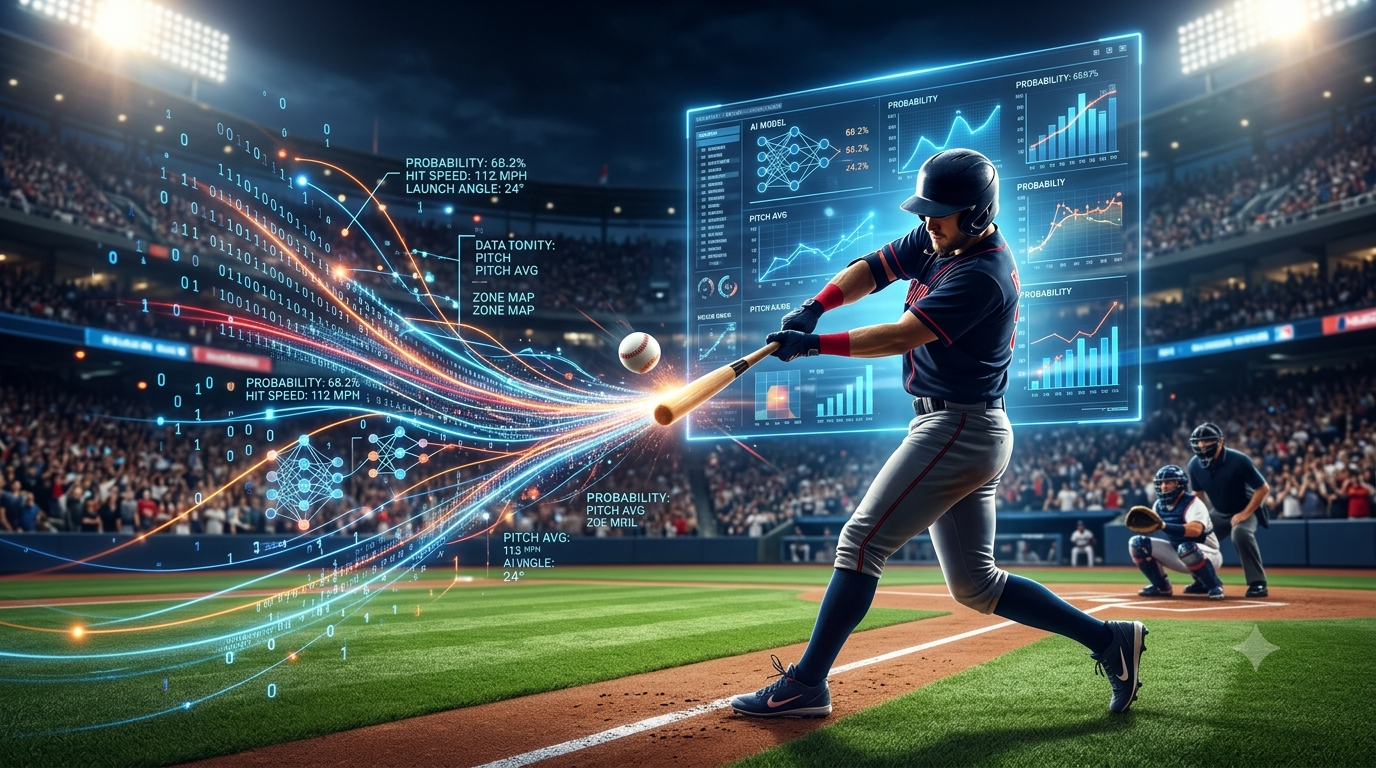
AI baseball forecasting has completely flipped traditional sports analysis on its head. Yet, what these modern prediction models actually do is still widely misunderstood. An AI model isn't some magic crystal ball predicting the future with absolute certainty. Instead, it looks at massive stacks of historical and live data to estimate the true likelihood of different outcomes. What you get in the end isn't a simple guess on who wins tonight, but a clear, probability-based breakdown of the entire game.
Modern baseball forecasting blends statistical modeling, machine learning algorithms, player projections, weather forecasts, starting lineups, and simulation tech to calculate each team's odds of winning. These forecasts shift constantly as fresh data trickles in, making them vastly more dynamic than old-school handicapping. This guide breaks down how AI baseball forecasting works, why calculating exact probabilities beats bold predictions every time, and how disciplined analytics paint a clearer picture of every matchup on the slate.
Table of Contents
What Is AI Baseball Forecasting?
Why Baseball Works Well for Artificial Intelligence
The Data That Drives Baseball Forecasts
How Machine Learning Builds Baseball Models
Why Probability Matters More Than Predictions
How Simulations Improve Baseball Forecasting
How New Information Changes a Forecast
How ATSwins.ai Applies Modern Forecasting Principles
Conclusion
Frequently Asked Questions
What Is AI Baseball Forecasting?
AI baseball forecasting is the practice of estimating future game outcomes using statistical algorithms and machine learning tools. Instead of relying on gut feelings, hot takes, or basic win-loss trends, these systems crunch thousands of metrics shaping how a baseball game unfolds.
A modern forecasting model starts with deep historical data gathered over many seasons. It evaluates team performance across various park environments, analyzes pitcher-versus-lineup splits, measures hitter success against specific pitch types, and factors in external elements like wind speed and humidity. Every single variable contributes to an overall win probability rather than a guaranteed result.
This distinction matters because baseball is inherently full of random noise. A ball crushed off the barrel might fly straight into an outfielder's glove, whereas a weak squibber down the line drives in two runs because of a defensive shift. Forecasting models cannot erase this built-in variance, but they can calculate it accurately and assign realistic probabilities to every scenario.
Rather than declaring that Team A will definitely beat Team B, an AI system calculates that Team A holds a 58 percent win probability while Team B sits at 42 percent. That margin accepts real-world uncertainty instead of pretending the outcome is set in stone. This probability-first mindset is what separates modern data science from simple guesswork.
Why Baseball Works Well for Artificial Intelligence
Out of all major professional sports, baseball stands out as the ultimate candidate for mathematical modeling. Almost every action on the field gets tracked, measured, and stored with remarkable precision. Every pitch thrown, swing taken, hit allowed, walk granted, and defensive play made creates structured data for computers to process.
Unlike continuous-action sports like soccer or basketball with overlapping possessions, baseball operates as a neat sequence of isolated events. Every pitch acts as a brand-new decision point with distinct inputs and observable results. This step-by-step structure makes it far easier to isolate individual variables and spot hidden relationships between them.
Starting and relief pitchers supply some of the richest data points available. Velocity, spin rate, release point, pitch movement, strike-zone efficiency, ground-ball rates, and recent pitch counts give algorithms strong predictive signals. On the other side of the plate, batters generate equally detailed metrics through exit velocity, launch angles, chase rates, contact quality, and performance against specific pitch velocities.
Because every player generates so much granular data, modern mlb game prediction software has an exceptionally sturdy foundation for building predictive algorithms.
Artificial intelligence also benefits from the sheer length of the baseball calendar. A 162-game regular season feeds algorithms a constant stream of live data, continuously refining player projections as the year progresses. Early-season noise slowly gives way to stable trends as real-world results replace spring assumptions.
The Data That Drives Baseball Forecasts
The true power of any forecasting model depends on the quality and depth of the data fed into it. Machine learning algorithms can process massive workloads, but bad or incomplete inputs will always yield unreliable outputs.
Building a dependable baseball forecast requires pulling together several layered categories of data into one cohesive system. Long-term team metrics establish an baseline expectation, helping the algorithm avoid overreacting to short winning or losing streaks caused by plain luck. Focusing on multi-year sample sizes allows models to separate genuine skill improvements from temporary statistical noise.
Player-level tracking adds crucial granularity. Rather than treating a club as a single unit, AI evaluates all nine starters and available relievers individually. Offensive run creation, defensive run savings, baserunning value, and projected plate appearances feed directly into the overarching forecast.
Pitching matchups remain the single most dominant factor in baseball analytics. Starting pitchers command a heavy portion of a team's projected win probability because they directly control run prevention across the early and middle innings. Meanwhile, bullpen usage and recent pitch counts grow increasingly important in close late-game scenarios.
Environmental factors matter just as much. Air temperature, humidity levels, elevation, barometric pressure, and wind velocity heavily dictate how far a ball flies and how sharply a pitch breaks. A strong breeze blowing out to right field boosts home run probabilities, whereas cold, dense evening air routinely keeps deep fly balls inside the park.
Ballpark geometry creates another critical baseline adjustment. Short porch dimensions or deep outfield gaps naturally alter run scoring, requiring models to adjust expectations based on where the game is played.
Finally, confirmed starting lineups frequently drive late adjustments. Missing a key middle-of-the-order bat or scratching a starting pitcher shifts run expectations significantly. Because managers release lineups just a few hours before first pitch, reliable forecasts must update dynamically until game time.
How Machine Learning Builds Baseball Models
Machine learning algorithms are trained to detect complex relationships buried deep inside vast historical datasets. Instead of human coders manually hardcoding rigid rules, the algorithm uncovers underlying patterns by comparing historical conditions with actual final scores.
The process kicks off with backtesting across thousands of past games. Each finished game acts as an isolated data entry loaded with hundreds of measurable parameters. These range from starting pitcher match-ups, bullpen fatigue levels, travel schedules, and rest days to park factors, umpire strike-zone tendencies, and real-time weather reports.
Through repeated iterations, the algorithm tweaks its internal weights until its projected win probabilities align tightly with actual historical outcomes. This training phase is an ongoing effort; baseball changes constantly as player skill sets evolve, tactical trends shift, and league-wide environments change. Consequently, models demand frequent retraining with fresh data to remain accurate.
One major challenge developers face is preventing overfitting. An overfitted model simply memorizes past game results rather than learning broad underlying principles, leading to stellar performance on historical data but poor accuracy on future games. Developers guard against this by validating algorithms on unseen out-of-sample data.
Forecast calibration is equally essential. A model shouldn't just pick the correct winner; its stated percentages must match long-run reality. If an algorithm identifies a 60 percent win probability across hundreds of games, those favored teams should win right around 60 out of every 100 contests. Properly calibrated models provide reliable foundational metrics for anyone studying how team performance maps to probability.
Why Probability Matters More Than Predictions
A common misconception about AI tools is that their main job is to pick guaranteed winners. In truth, the real value lies in generating accurate probability distribution models. Understanding how ai uses probability in betting and game analysis helps shift the focus away from picking simple winners and toward evaluating true underlying value.
Consider a model assigning Team A a 64 percent chance to win tonight. That percentage isn't a promise that Team A wins the game. It indicates that if you played this exact matchup 100 times under identical park, weather, and lineup conditions, Team A would come away victorious roughly 64 times.
That exact distinction marks the line between rigid prediction and flexible forecasting. Predictions push people into black-and-white thinking, whereas probability accounts for real-world variance. Baseball is packed with unexpected events that no software can foresee—a fly ball lost in the afternoon sun, a reliever suddenly struggling with strike-zone command, or a key starter leaving early with a minor strain.
Because randomness is baked into the sport, analytical minds focus on whether a calculated probability accurately reflects real-world conditions over time, rather than obsessing over a single game's outcome. A well-designed model can produce a completely correct probability even when the unfavored team pulls off a surprise win.
Working with probabilities also builds emotional discipline. Evaluating performance across a 500-game sample provides a far clearer picture of model accuracy than reacting to a single week of bad bounces or unexpected upsets.
How Simulations Improve Baseball Forecasting
Modern sports analytics rarely relies on a simple static formula to predict a final score. Instead, modern systems combine machine learning probabilities with Monte Carlo game simulations, running a single matchup thousands of times in seconds.
A simulation starts by establishing projected performance baselines for every player involved. Starting pitchers receive workload expectations based on recent pitch counts, efficiency, and matchup histories. Hitters receive projection profiles reflecting their platoon splits, strikeout tendencies, and recent contact quality.
The software then plays out every inning ball-by-ball and plate-appearance-by-plate-appearance. Walks, strikeouts, extra-base hits, double plays, and pitching changes occur based on calculated situational probabilities. Once the first simulated game finishes, the software repeats that process 10,000 times.
Simulating thousands of full games uncovers a broad range of potential outcomes. Some matchups lean toward low-scoring pitcher's duels, while volatile bullpens or hitter-friendly weather conditions produce a wide distribution of high-scoring games.
These simulations highlight underlying matchup stability. Two games might share identical head-to-head win odds, yet one matchup carries far greater scoring volatility due to unsettled bullpen situations or windy conditions. That context gives analysts a clear view of game flow dynamics that simple win probabilities miss.
How New Information Changes a Forecast
Unlike static seasonal projections, modern machine learning models update in real time. Every fresh piece of news shifts calculated win probabilities, particularly when it directly alters player availability or expected performance.
Official lineup cards drive major late-stage shifts. Resting a premier slugger or starting a backup catcher lowers projected run production. Likewise, a sudden pitching scratch due to forearm tightness can swing game probabilities dramatically in seconds.
Reliever availability demands constant tracking as well. A bullpen that worked heavy back-to-back innings is significantly less effective than a fully rested unit. Forecasting models track recent pitch counts and leverage appearances, adjusting expected run suppression for late-inning scenarios.
Mid-day weather updates introduce another crucial layer of refinement. Shifting wind patterns, temperature jumps, or incoming rain delays directly alter run expectations. A model that initially projected a low-scoring game might lift run totals if late stadium reports confirm warm air and strong winds blowing out.
Travel demands, cross-country flights, and day-after-night schedules also exert minor adjustments on team performance over a long 162-game campaign. While these factors are subtler than starting pitching changes, every small datapoint helps refine the overall forecast.
How ATSwins.ai Applies Modern Forecasting Principles
Platforms like ATSwins.ai approach game evaluation purely as a probability problem rather than a quest for guaranteed picks. By combining deep historical datasets, live player information, statistical modeling, and thousands of Monte Carlo simulations, the goal is to reveal how matchups are most likely to unfold.
Instead of hunting for lock picks, the platform focuses on disciplined, objective evaluation backed by verifiable data. Factors like starting pitcher adjustments, defensive positioning, recent contact metrics, and dynamic park conditions combine to build a complete analytical view.
This approach leverages cutting-edge ai sports betting intelligence to separate calculated game probabilities from public market expectations. An analytical model calculates how often an outcome should occur under real-world conditions, whereas public sportsbooks set lines based on liability, market action, and bettor sentiment. When a model's calibrated probability differs from the implied probability of a market line, disciplined analysts spot potential opportunities where the market may have overreacted.
Even in a heavily analyzed, data-rich sport like baseball, every individual game contains uncertainty. The goal of modern forecasting isn't to pretend randomness doesn't exist, but to measure that randomness accurately through consistent, objective math.
Conclusion
AI baseball forecasting isn't about erasing unpredictability from the sport. Baseball will always feature crazy bounces, surprise performances, and unexpected results that defy statistical logic. What modern forecasting tools offer is a disciplined, data-driven framework for mapping out those possibilities logically.
As player-tracking sensors, complex algorithms, and processing speeds advance, baseball models will continue to refine their accuracy. However, their outputs will always remain calculated probability distributions rather than absolute guarantees. Embracing that reality is the foundational key to effective, long-term sports analytics.
Frequently Asked Questions
Is AI baseball forecasting the same as predicting exact winners?
No. AI baseball forecasting calculates probability distributions rather than promising specific game outcomes. A team holding a 65 percent win probability will still lose roughly 35 out of every 100 games due to the natural randomness built into baseball.
How often should baseball forecasts be updated?
Forecasts ought to update whenever fresh, meaningful data becomes available. Official starting lineups, bullpen usage reports, unexpected pitching changes, weather updates, and late scratch news can all shift calculated win probabilities leading right up to first pitch.
Does artificial intelligence replace traditional baseball knowledge?
No. AI models function best when paired with sound baseball understanding. Statistical algorithms excel at recognizing complex trends across massive datasets, while human knowledge provides necessary context for unique situations that historical data alone might miss.
What makes baseball suitable for AI forecasting?
Baseball generates incredible amounts of clean, structured data. Every pitch thrown, swing taken, hit recorded, and defensive play made creates measurable datapoints for algorithms to evaluate. Additionally, the long 162-game schedule provides an ideal sample size for training and calibrating predictive models.