

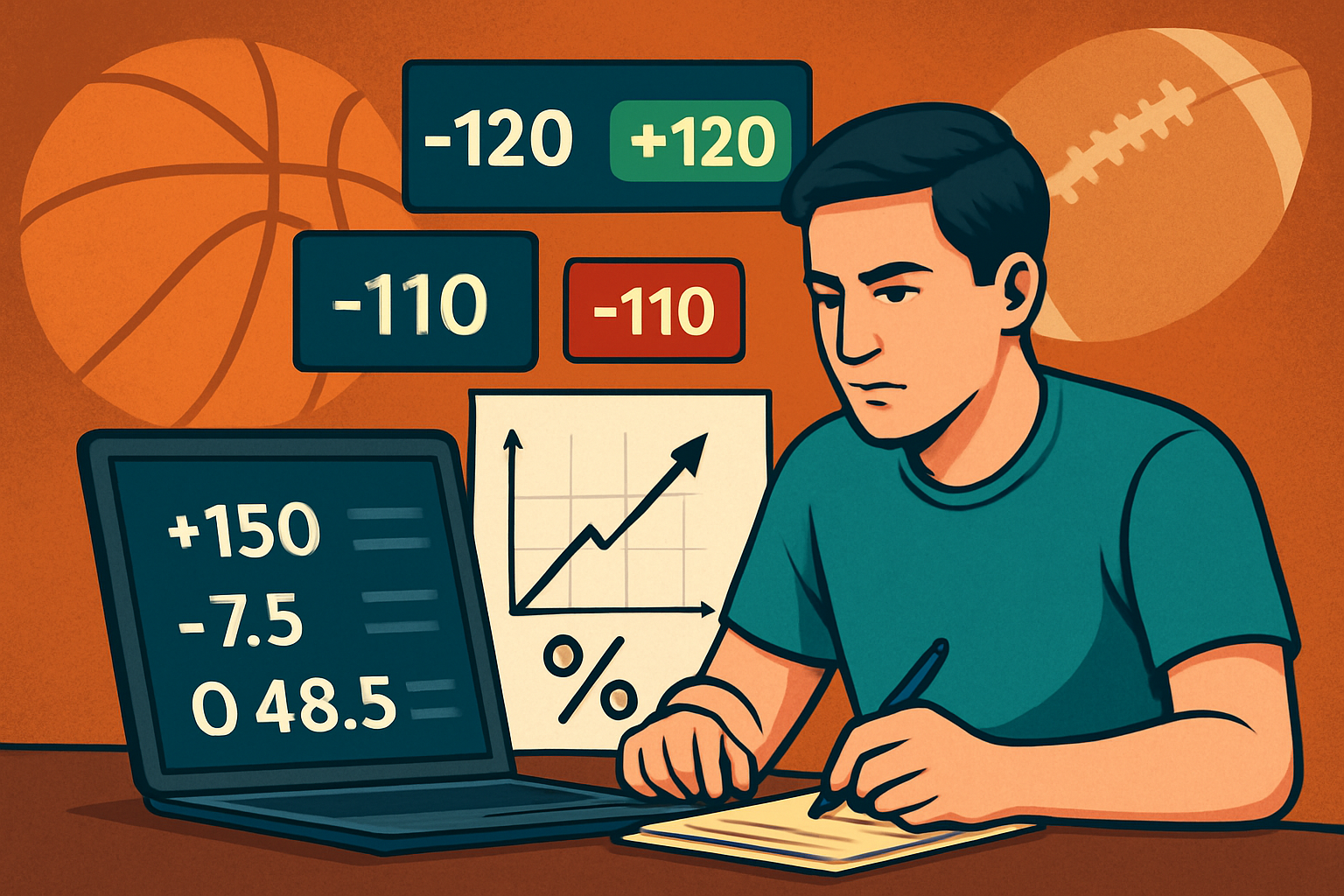
What is sports handicapping? Sports handicapping is not guessing. It is about measuring edges with clear math, disciplined processes, and consistent tracking. The goal is to understand probabilities, identify when the market is mispricing an event, and act only when your edge is larger than the sportsbook’s margin. In this guide, you will learn how to convert odds to probabilities, read line movement, build power ratings, and manage your bankroll. We will also cover the importance of timing, data evaluation, and tools, along with responsible play, so that you can wager smarter and track results with confidence. If approached methodically, sports handicapping transforms betting from luck-driven decisions into a structured approach designed for long-term success.
Table Of Contents
- Definition and Purpose
- Process and Methods
- Data and Factors to Evaluate
- Conclusion
- Frequently Asked Questions (FAQs)
Key Takeaways
Sports handicapping is about turning odds into real probabilities and betting only when your edge is higher than the vig. Tracking closing line value (CLV) helps you see whether your process is profitable over time, regardless of short-term wins or losses. Bankroll management comes first: set a fixed bankroll, flat-bet 0.5 to 1.5 units per wager, and avoid chasing losses. Once your data is solid, you can consider a small fraction of Kelly sizing, but only cautiously.
A solid handicapping process combines power ratings, matchup notes, injuries, rest, and weather factors. Keep logs of wins, losses, and CLV and review them weekly. Focus on doing less but doing it better. Timing is critical. Watch line moves, shop for the best numbers, and avoid overreacting to noise. Bet early when you have reliable information, or late if the market leaks key news. ATSwins provides an AI-powered sports prediction platform offering data-driven picks, player props, betting splits, and profit tracking across NFL, NBA, MLB, NHL, and NCAA. Free and paid plans offer bettors actionable insights and guides to make smarter, more informed decisions.
Definition and Purpose
What is Sports Handicapping?
Sports handicapping is the process of estimating the true probability of outcomes in sporting events and using those estimates to find bets with positive expected value, even after considering the sportsbook’s commission, often called the vig or juice. Handicappers study teams, players, matchups, and market prices to identify when offered odds are mispriced relative to their own projections. When your estimated probability is higher than what the odds imply, the bet has value. If not, passing is the smarter move.
At its core, handicapping is probabilistic. You are not predicting results with certainty. Instead, you are comparing your estimated probabilities to the market’s odds and only wagering when your edge exceeds the vig. Losses are inevitable, even on well-calculated bets, which is why process, long-term expectation, and disciplined bankroll management are emphasized over short-term outcomes.
How Handicapping Differs From Touting
Handicapping is a methodical process aimed at finding edges, while touting is a business model that sells picks. They are not the same. A good handicapper may share or sell analysis, but their primary focus is creating an edge, not generating confidence for the sake of sales. Touts often highlight impressive records without context, cherry-pick data, or claim “locks” without verification. Professional handicapping prioritizes testable methods, transparent tracking, and acknowledgment of uncertainty. Methodological accountability distinguishes handicappers from touts: you can explain why a number is mispriced and identify risk factors, while touts often cannot.
Roles of Point Spreads, Moneylines, and Totals
Point spreads assign a margin that the favorite must exceed for a bet to win. The spread incorporates team strength, matchups, pace, and scoring variance. Moneylines reflect the probability of a team winning outright, influenced by endgame variance and strategy. Favorites and underdogs have different value profiles. Totals, or over/under markets, predict combined points scored and are sensitive to pace, efficiency, weather conditions, officiating tendencies, and coaching strategy. To be effective, handicappers convert odds to implied probabilities, compare them to their projections, and act only when there is a meaningful edge.
Implied Probability, Juice, and Market Hold
Odds incorporate probability plus a margin for the book. Translating prices to implied probability and removing the vig helps estimate the market’s “true” consensus. For American odds, a favorite at -150 implies a 60 percent chance, while an underdog at +180 implies 35.7 percent. Decimal odds are converted by dividing one by the odds, and fractional odds are calculated with the denominator over the sum of numerator and denominator. Removing vig for two-outcome markets allows you to compare your probability estimates against a no-vig baseline. For example, if Team A has a no-vig probability of 53.4 percent and your estimate for Team B is 49 percent, you have a 2.4 percentage-point edge.
Line Movement and Closing Line Value (CLV)
Odds fluctuate as money and information enter the market. Early lines are often softer due to uncertainty, while later lines reflect sharper pricing after syndicates, modelers, and injury news are factored in. Beating the closing line, or placing wagers at better odds than the final consensus, is a core metric for professionals. CLV serves as a proxy for expected value. Over many bets, consistently securing prices better than the close indicates your process anticipates market movement. Line moves are driven by increased limits, confirmed injuries, weather updates, sharp action, and cross-market interactions. Knowing when to act—before or after line shifts—is as important as the initial handicap.
Process and Methods
Qualitative Versus Quantitative Approaches
Qualitative handicapping relies on domain knowledge such as coaching philosophy, locker-room dynamics, motivation, schematics, and matchup quirks that models might miss. It is particularly useful in niche markets or lower leagues with less robust data. Quantitative handicapping translates the game into numbers using power ratings, efficiency metrics, and probabilistic models. This approach is scalable and auditable but requires careful data handling and avoidance of overfitting. Most successful bettors blend both approaches, using quantitative baselines adjusted with qualitative context to generate reliable edges.
Power Ratings and Matchup Models
Power ratings assign numeric strengths to teams on a neutral field or court. Differences in ratings are converted into spreads or totals, adjusted for home advantage, injuries, pace, style, and situational factors such as rest or travel. Matchup models go further, breaking a game into components such as offense versus defense, special teams, or specific player matchups. Football may use expected points added by play type, pass-block versus pass-rush grades, red-zone efficiency, and weather-adjusted field goal expectations. Basketball evaluates offensive and defensive ratings, shot quality, rebound rates, foul rates, and net lineups. Baseball models include pitcher/batter splits, park factors, bullpen fatigue, defensive metrics, and exit velocity distributions. Power ratings are useful for broad market screening, while matchup models help refine individual bets and sizing.
Converting Odds to Probabilities and Evaluating Edges
Expected value per unit is calculated as (p × payout) − ((1 − p) × risk), where p is your estimated probability. For example, a +140 wager with a 43 percent estimated probability yields +3.2 percent EV. A -120 wager requires a 54.55 percent estimated probability to break even. Implied edge can also be measured as your probability minus the no-vig market probability. Betting should be cautious even with an edge, and many bettors use flat stakes or conservative Kelly fractions to reduce risk of ruin.
Sample Size and Regression to the Mean
Small samples can be misleading. Extreme performances often regress toward the mean as more data accumulates. Models should weight recent data while incorporating baseline or historical priors. Context is critical when evaluating outliers, such as hot shooting streaks or unusually favorable officiating. Metrics that stabilize quickly, like shooting location or turnover rates in basketball and strikeout/walk rates in baseball, provide more reliable signals. Bayesian updating or exponential weighting allows adaptation to real changes without overreacting.
Timing Bets Versus Market Moves
Market timing is separate from forecasting. Early markets tend to be softer with lower limits but higher information risk, suitable if you have reliable proprietary models. Late markets are sharper and reflect better-known lineups, injuries, and other information. Early triggers include confirmed starters, weather updates, and limits increasing. Late triggers include final injury reports and market inefficiencies. Monitoring opens and closes helps refine timing and maximize CLV.
Tracking Results in Units, ROI, and Avoiding Recency Bias
Standardizing bet size in units allows performance comparison across bets. ROI is calculated as net profit divided by total units risked. Tracking CLV provides a forward-looking metric to evaluate process effectiveness. Segmented records help identify strengths and weaknesses across markets, leagues, bet sizes, and sources. To avoid recency bias, define evaluation windows, maintain written post-mortems, use rolling averages, and ensure sample sizes are meaningful. Hundreds of bets per market are recommended before concluding.
Data and Factors to Evaluate
Injuries and Rest
Player availability significantly affects line value. Not all absences have equal impact. Quarterbacks, primary ball handlers, and elite pitchers have outsized influence, while cluster injuries to lineups can multiply effects. Rest and fatigue affect pace, efficiency, and execution, and should be quantified by league and season. Monitoring official reports, beat writers, travel schedules, and early line moves helps identify hidden signals before public announcements.
Weather
Weather materially affects totals and game scripts, particularly outdoors. Wind reduces passing efficiency in football and can affect kicking range, while heavy rain impacts handling and footing. Temperature and humidity influence stamina and ball flight. Baseball outcomes are sensitive to wind, temperature, and humidity, which affect home run probabilities. Accurate forecasting aligned with market timing is essential to avoid being caught off-guard by late weather changes.
Travel and Schedule Density
Travel impacts circadian rhythms, reaction times, and fatigue. Teams traveling east on short rest often underperform, and early local start times can alter shooting or reaction speed. Altitude affects stamina and performance, especially for teams not acclimated. Dense schedules, such as three games in four nights or long road trips, influence rotation choices and fatigue. Historical data helps quantify these effects rather than relying on generic assumptions.
Pace and Style Mismatches
Stylistic interactions create opportunities for edge. Basketball teams with different tempos, football teams with contrasting offensive schemes, and soccer teams with high-press versus low-block systems all provide nuances that affect totals and outcomes. Baseball matchups such as ground-ball pitchers versus fly-ball hitters in specific weather conditions also impact results. Effective handicapping models these interactions rather than relying solely on average outcomes.
Officiating Tendencies
Referees affect foul rates, penalties, pace, and total points. Different crews show varying propensities for certain calls, and home bias or superstar treatment can shift marginal outcomes. While smaller than player effects, these differences matter, particularly for totals and props. Multi-year data and adjustments for crew composition improve accuracy.
Historical Matchup Context
The public often overweights head-to-head history. Most predictive value lies in persistent styles, not past scores. Coaching schemes and personnel changes reduce the reliability of raw historical results. Extract the underlying “why,” such as tempo, shot quality, or defensive schemes, to make informed projections.
Public versus Sharp Action Signals
Reading the market complements quantitative modeling. Public money often concentrates near game time on favorites, overs, or popular teams. Sharp action tends to appear early at low limits, across multiple books, and with consistent behavior. Disagreement among books is more informative than consensus among small-limit bettors. Tools showing ticket percentages, handle percentages, and steam moves are useful, but blindly following them is dangerous. Confirm that moves align with your assumptions before acting.
Using Transparent Records and Basic Spreadsheets
Sophisticated infrastructure is not required. A well-designed spreadsheet can track bets, ROI, CLV, Kelly fractions, drawdowns, and volatility. It can automate power rating updates, injury adjustments, schedule calculations, and regression analyses. Transparency, including timestamped lines and posted closing lines, builds accountability and prevents cherry-picking.
Bringing it All Together: A Simple Workflow
Start with screening using power ratings. Adjust for injuries, rest, travel, weather, and stylistic mismatches. Compare projected probabilities to no-vig market probabilities. Decide on timing and place wagers at the best available price. Track CLV and update ratings after results. Review performance periodically to refine assumptions and detect drift.
Common Pitfalls and How to Avoid Them
Avoid overfitting by limiting variables to those with causal links. Resist chasing steam blindly. Account for correlated outcomes to prevent inflated perceived edges. Keep bet sizing consistent and controlled. Manage emotional tilt by codifying rules for handling bad beats or hot streaks. Follow a disciplined, repeatable approach rather than reacting to short-term fluctuations.
Why Handicappers Seek Closing Line Value
CLV is a North Star for handicappers. It reflects the market’s best collective information and correlates with long-term profitability. Tracking CLV helps refine timing, identify which model components lead or lag the market, and verify that your process anticipates consensus rather than reacts to it.
Purpose in a Single Sentence
Handicapping is the disciplined pursuit of small, repeatable edges by estimating true probabilities more accurately than the market and acting only when that advantage exceeds the vig, tracked transparently, refined iteratively, and executed with respect for variance and risk.
Conclusion
Handicapping is about turning odds into probabilities, seeking CLV, applying power ratings, managing bankrolls, tracking units, and timing bets relative to market shifts. Start small and review your performance monthly. ATSwins provides an AI-powered platform with data-driven picks, player props, betting splits, and profit tracking across NFL, NBA, MLB, NHL, and NCAA. Its free and paid plans help bettors make smarter, more informed decisions.
Frequently Asked Questions (FAQs)
What is sports handicapping in plain words?
Sports handicapping is the process of turning game information into odds you believe are more accurate than the market. You estimate true win chances, assess injuries, matchups, travel, weather, and prices, then act only when your edge is meaningful. The goal is long-term profit, not short-term thrills.
How do spreads, moneylines, and totals fit into handicapping?
Spreads even teams by points, moneylines give straight-up win odds, and totals project combined points. Compare your projections to the posted line and only act when your edge exceeds the vig. Successful handicappers understand when the line misprices a matchup and size wagers accordingly.
How is handicapping different from following touts or trends?
Handicapping is about research, modeling, timing, and bankroll control. Touts sell picks without a transparent methodology. Trends can help, but only when contextualized and with a sufficient sample. Focus on your edge and CLV rather than short-term results.
How do I start if I am new?
Start small. Identify leagues, statistics, and schedules you can maintain. Track news and injuries daily, create fair lines, compare them to the market, and wager only when your edge is clear. Log units and CLV. Quality beats quantity.
How does ATSwins help?
ATSwins.ai supports handicappers with AI-driven predictions, player props, betting splits, and profit tracking across NFL, NBA, MLB, NHL, and NCAA. It highlights line movements, tracks your wagers, and provides insights to improve your process. Use it to cross-check your numbers and refine your approach.
Related Posts
AI For Sports Prediction - Bet Smarter and Win More
AI Football Betting Tools - How They Make Winning Easier
Bet Like a Pro in 2025 with Sports AI Prediction Tools
Sources
The Game Changer: How AI Is Transforming The World Of Sports Gambling
AI and the Bookie: How Artificial Intelligence is Helping Transform Sports Betting
How to Use AI for Sports Betting
Keywords:
MLB AI predictions atswins
ai mlb predictions atswins
NBA AI predictions atswins
basketball ai prediction atswins
NFL ai prediction atswins