

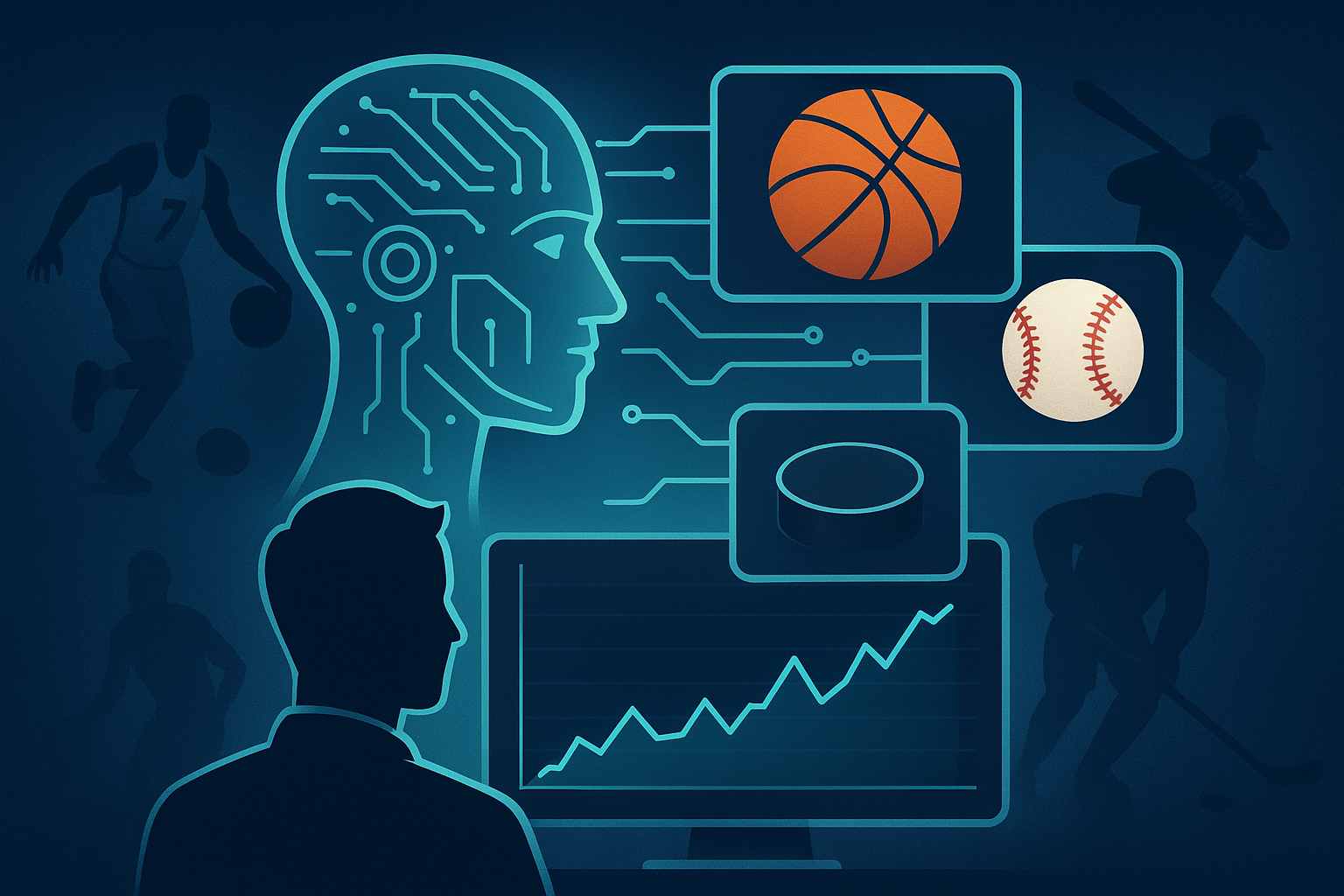
Every wager I post starts with data, not a gut feeling. I’m a sports analyst who uses AI models to find smart, responsible plays across the NBA, MLB, and NHL. I take all the chaos that comes with sports and translate it into probabilities that actually make sense. Whether it’s ATS, moneylines, or totals, it’s all about turning raw numbers into something real that helps bettors make informed, disciplined choices.
This guide explains how data becomes decisions. You’ll see where the stats come from, how they’re cleaned, how models are built, and how all of it turns into picks you see on ATSwins. It’s long and detailed because that’s how real analysis works.
Table Of Contents
- What AI Data-Driven Picks for NBA, MLB, and NHL Really Mean
- Data Pipeline and Validation
- League-Specific Modeling
- Deployment and Operations
- Ethics, transparency, and limits
- Step-by-step: from raw data to actionable picks
- Templates and checklists you can use
- Practical examples and edge cases
- What ATS, ML, and totals edges look like in practice
- Common pitfalls and how to avoid them
- Useful tools and resources
- Conclusion
- Frequently Asked Questions (FAQs)
What AI Data-Driven Picks for NBA, MLB, and NHL Really Mean
When people talk about “AI picks,” it might sound like magic, but it’s not. AI data-driven picks are simply probability estimates for markets like ATS, moneylines, and totals. These numbers come from models trained on years of detailed play-by-play or pitch-by-pitch data. The goal isn’t to predict the exact score. It’s to price a market.
That means instead of saying “Team A wins 4-2,” we’re saying “Team A has a 57% chance to win.” Once that probability is clear, we compare it to the odds being offered. If there’s value, that’s a potential edge.
Each league brings its own set of challenges and variables that the models must handle. The NBA has pace and possessions. MLB has starting pitchers and park factors. The NHL has goalies and shot quality. The model needs to understand these different dynamics to stay accurate.
For example, in the NBA, rest and travel make a big difference, especially on back-to-backs. In MLB, weather and altitude can change the total by a full run. In the NHL, the difference between a starting goalie and a backup can swing a line by a lot.
ATSwins focuses on translating these layers of complexity into something bettors can actually use. Whether it’s totals, spreads, or props, every prediction is based on structured, validated data. There’s no guesswork.
Data Pipeline and Validation
The backbone of every accurate prediction is clean data. If your stats are messy, your model is trash. That’s just reality.
It starts with event-level data that captures the actual flow of each game. For the NBA, that’s play-by-play records. For MLB, it’s every pitch with Statcast tracking. For NHL, it’s shot-by-shot with expected goals (xG) metrics.
Every dataset needs to be standardized so that nothing leaks or overlaps. Each player, team, date, and feature has to line up across different sources. Otherwise, you’ll be training your model on mismatched information.
You also need to version your data. Never overwrite old files. Sports evolve fast, and you’ll want those archives when you test historical changes.
Once the data is structured, we create the features that actually move predictions. Things like travel distance, rest days, park effects, and rolling team form all feed into the models.
Travel fatigue, back-to-backs, park dimensions, ice quality, weather, and altitude all matter, sometimes more than the stats themselves. That’s why the feature engineering process is where the magic really happens.
When it comes to modeling, ATSwins relies on ensembles and logistic regressions calibrated over time. Tree-based models help handle nonlinear relationships, like how temperature interacts with wind speed or how altitude affects fatigue. Logistic regressions help with clean, explainable probabilities for ATS and moneylines.
The next step is strict backtesting. You can’t cheat time. All training has to respect real-world chronology. Models train on past data and predict future data, never the other way around. Leak checks are constant because even one small data leak can blow up your results.
Calibration is key. The goal isn’t to be flashy. It’s to have reliable probabilities that hold up over thousands of games. That’s how ATSwins maintains stable long-term accuracy rather than chasing short-term streaks.
League-Specific Modeling
NBA
NBA models rely heavily on player context. One star sitting out changes everything: pace, shot distribution, even defense. Possession-adjusted ratings show which teams maintain efficiency under fatigue or travel stress.
In the NBA, on/off data is gold. It shows how much better or worse a team performs when a specific player is on the court. You can’t model this sport without understanding rotations, travel, altitude, and late-game free-throw variance.
NBA models also factor in game tempo, shot quality, rim protection, and 3-point attempt rates. Late-season games or playoffs often shift the equation as rotations tighten and possessions slow down.
MLB
MLB modeling is all about context. Everything starts with the starting pitcher. Their strikeout rate, walk rate, and groundball tendencies shape the entire matchup. You also need to account for weather, park dimensions, wind direction, and bullpen rest.
Statcast data helps measure contact quality like the launch angle, exit velocity, and spray direction, which predict how likely batted balls are to turn into hits or home runs. Batter-pitcher matchups matter too, especially platoon splits.
Bullpen management is another hidden variable. A tired bullpen changes the entire dynamic of a total. Playoff models weigh this even more since managers use their top relievers more aggressively.
NHL
In the NHL, small edges go a long way because games are often low scoring. Expected goals (xG) drive most of the prediction process. Special teams like power plays and penalty kills also weigh heavily.
Goalies are a huge part of variance. A hot goalie can defy expected goals, but over time, priors stabilize performance expectations. The model looks at both long-term form and short-term momentum without overreacting.
Travel and back-to-backs impact fatigue, especially for goalies. Ice conditions and home-ice matchups matter too, since coaches get last change and can optimize matchups.
Deployment and Operations
Data models don’t just exist in theory. They have to run on time, every day.
ATSwins uses automated data pulls each morning and refreshes them close to game time. This ensures late scratches, lineup changes, and weather shifts get caught before publishing picks.
Every morning, new stats are ingested and transformed into features. Models retrain weekly with lighter daily updates. By the time the timelines are finalized, the published probabilities reflect everything known at that moment.
Injury and news processing is one of the hardest parts. If a star player goes from questionable to out, the whole projection must update instantly. For MLB, that means pulling new lineups and bullpen availability. For the NHL, it’s confirming starting goalies.
Odds integration completes the workflow. The model’s probabilities are compared to market odds to find edges. If the model says 56% and the market implies 52%, that’s a 4% edge. It’s worth a play if it meets bankroll thresholds.
Risk management is another big deal. Flat staking (1–2% per play) keeps bankrolls stable. Fractional Kelly staking adds flexibility for bettors who like calculated risk. The goal is to play the long game.
ATSwins monitors performance through dashboards that track calibration, ROI, and closing line value. If a pick consistently beats the closing number, the model is doing its job, even when results swing short-term.
Versioning and documentation keep things transparent. Every change to the model, whether a new feature or recalibration, is logged, tested, and explained. That’s how you avoid data drift and keep models aligned with evolving league trends.
Ethics, Transparency, and Limits
AI doesn’t remove uncertainty. It helps measure it. That’s an important difference.
ATSwins communicates probabilities, not guarantees. Each prediction includes uncertainty ranges, especially for totals or games affected by lineup or weather volatility.
There’s no overhyping hot streaks or pretending variance doesn’t exist. Instead, everything’s measured over long samples. That’s where real calibration shows.
Fairness also means avoiding league bias. NBA, MLB, and NHL have different variance levels, so each model is tuned separately to reflect realistic expectations.
Responsible betting is always emphasized. Edges compound only when bankroll management is disciplined. That’s why ATSwins provides profit tracking and ROI metrics directly within its platform so users can stay accountable and informed.
Step-by-Step: From Raw Data to Actionable Picks
Here’s what the full daily workflow looks like behind the scenes.
It starts with ingestion. Every day, schedules, rosters, and previous results are pulled from verified league data. This gets cleaned, standardized, and validated.
Next comes feature building. Rolling stats, rest and travel metrics, park and ice adjustments, and lineup changes all get processed. League-specific metrics like xG, Statcast stats, or on/off impacts are generated too.
Then the models train and calibrate. They’re fitted by market type, ATS, ML, totals, and tested through walk-forward validation. Calibration checks make sure the probabilities are realistic.
Backtesting runs next, comparing historical predictions to outcomes. Metrics like Brier score, log loss, and profit under flat staking show how well the model performs over time.
Once everything checks out, the model’s outputs merge with the current odds. Each game’s edge, EV, and context notes are reviewed before publishing.
After release, the team monitors news and late updates. If something major changes before lock, probabilities are re-evaluated. Once games are live, results and line values are logged for audit and improvement.
That entire cycle repeats daily.
Templates and Checklists You Can Use
Each league has its own features that matter most. For the NBA, it’s pace, offensive and defensive efficiency, shot distribution, turnovers, rest, and injuries. For MLB, it’s starting pitcher metrics, weather, park effects, bullpen rest, and batter-pitcher matchups. For NHL, it’s xG, special teams rates, goalie quality, and schedule density.
Before any pick gets published on ATSwins, it goes through an internal checklist. The model’s probability is compared against the implied market probability. If there’s a clean edge, it’s flagged. Notes highlight key context, maybe a rested bullpen or a pace drop from a star injury.
Stake size is calculated next, staying within bankroll rules. No pick goes out without that structure.
Every model update is documented. That includes version number, changes made, expected outcomes, and validation stats. That’s how transparency stays intact.
Practical Examples and Edge Cases
Here’s what this looks like in real scenarios.
In the NBA, maybe a team plays at altitude after a back-to-back while the opponent just got a star back from injury. The model adjusts for fatigue, travel, and limited minutes for the returning player. The total drops slightly since the pace slows, but the ATS edge might be smaller than the market expects.
In MLB, think about two ground-ball pitchers on a cold, windy night with the wind blowing in. Even if both teams have solid lineups, run-scoring projections fall. The model catches that, unders tend to show value, but it still factors in HR variance from strong pull hitters.
In the NHL, a backup goalie confirmed on a road back-to-back against a team with a strong power play can move both the ML and total. But if the road team suppresses 5v5 shots well, the total doesn’t spike as much as the public might think.
Playoff adjustments hit all leagues differently. NBA games slow down and rotations shrink. MLB bullpens tighten, lowering totals. NHL pace drops with fewer rush chances, but overtime rules can stretch totals slightly.
These nuances are why AI models are built to adapt, not just predict.
What ATS, ML, and Totals Edges Look Like in Practice
An ATS edge starts by modeling the distribution of scoring margins. The probability that a team covers is just the share of that distribution beyond the spread.
Moneyline models estimate outright win probability, often using logistic regression. Each league is calibrated differently because scoring dynamics vary.
Totals are modeled differently by sport. NBA totals depend on possessions and points per possession. MLB totals depend on pitcher-batter interactions and environmental effects. NHL totals come from summing expected goals adjusted for goalie performance and special teams time.
Expected value is then calculated from those probabilities and odds. Even small edges (like 3–4%) matter when they’re consistent. Over hundreds of plays, that’s how bankrolls grow steadily.
Common Pitfalls and How to Avoid Them
The biggest trap is data leakage. If your model sees something, it shouldn’t like future injury info or closing lines. It’ll look great in testing and fail in reality.
Overfitting is another issue. A pitcher’s five-game stretch or a goalie’s two-week slump might not mean much long term. You have to use priors that balance short-term form and long-term quality.
Ignoring schedule context is a classic mistake. Travel, rest, and back-to-backs impact player efficiency across every league.
Also, stacking correlated bets is risky. If two picks depend on the same lineup news, reduce exposure. That’s how you avoid doubling risk without doubling edge.
Lastly, betting splits get overhyped. Public vs sharp money can help, but it’s just one feature among many. Never bet based solely on who the crowd is backing.
Useful Tools and Resources
ATSwins combines all the essentials: data ingestion, model calibration, and clear probability displays into one system.
The models pull from verified sources, integrate schedule, weather, and lineup data, and run predictive algorithms tuned for each sport. Everything from play-by-play to Statcast to xG is structured into usable, explainable metrics.
The result: a platform that gives bettors clean, data-driven insights backed by tested probabilities. Whether you prefer tracking your own plays or exploring model-driven ones, ATSwins keeps it transparent and actionable.
Conclusion
AI picks work best when you respect the process. Clean data, reliable models, and consistent bankroll rules is the real formula. You can’t eliminate variance, but you can manage it.
The methods behind ATSwins show what happens when data and discipline meet consistency. This isn’t guessing. It’s probability with purpose.
The takeaway is simple: bet numbers, not feelings. Keep your stakes steady. Log your results. And when the math says you have an edge, take it confidently but responsibly.
ATSwins delivers that edge through AI-powered predictions, player props, betting splits, and transparent profit tracking across major leagues. It’s not about gambling harder, it’s about betting smarter.
Frequently Asked Questions (FAQs)
What are AI data-driven picks for the NBA, MLB, and NHL?
They’re probability-based predictions built from clean data and AI modeling. Instead of trying to predict scores, these models price markets like ATS, moneylines, and totals. Once the probabilities are known, they’re compared to odds to find value.
How should I use AI data-driven picks for NBA, MLB, and NHL?
Use them as decision tools. Check the model’s fair line, confirm starters and injuries, factor in travel and weather, and see if the edge still exists before you bet. Stick to consistent stakes and never chase losses.
Are AI picks accurate?
They’re calibrated to be realistic. That means they’ll win slightly more often than the odds suggest, not magically pick every game. Over time, even small edges compound if you’re disciplined.
What bankroll rules work best?
Flat stakes of 1–2% per play or a light fractional Kelly system work well. Keep daily exposure capped and always track results. The long run is where the edge becomes profit.
Why trust ATSwins for AI-driven picks?
ATSwins was built for data accuracy and transparency. Every probability, model version, and performance metric is tracked. It’s a system designed to help bettors think logically, use data smartly, and stay consistent.
Related Posts
AI For Sports Prediction - Bet Smarter and Win More
AI Football Betting Tools - How They Make Winning Easier
Bet Like a Pro in 2025 with Sports AI Prediction Tools
Sources
The Game Changer: How AI Is Transforming The World Of Sports Gambling
AI and the Bookie: How Artificial Intelligence is Helping Transform Sports Betting
How to Use AI for Sports Betting
Keywords:
MLB AI predictions atswins
ai mlb predictions atswins
NBA AI predictions atswins
basketball ai prediction atswins
NFL ai prediction atswins