
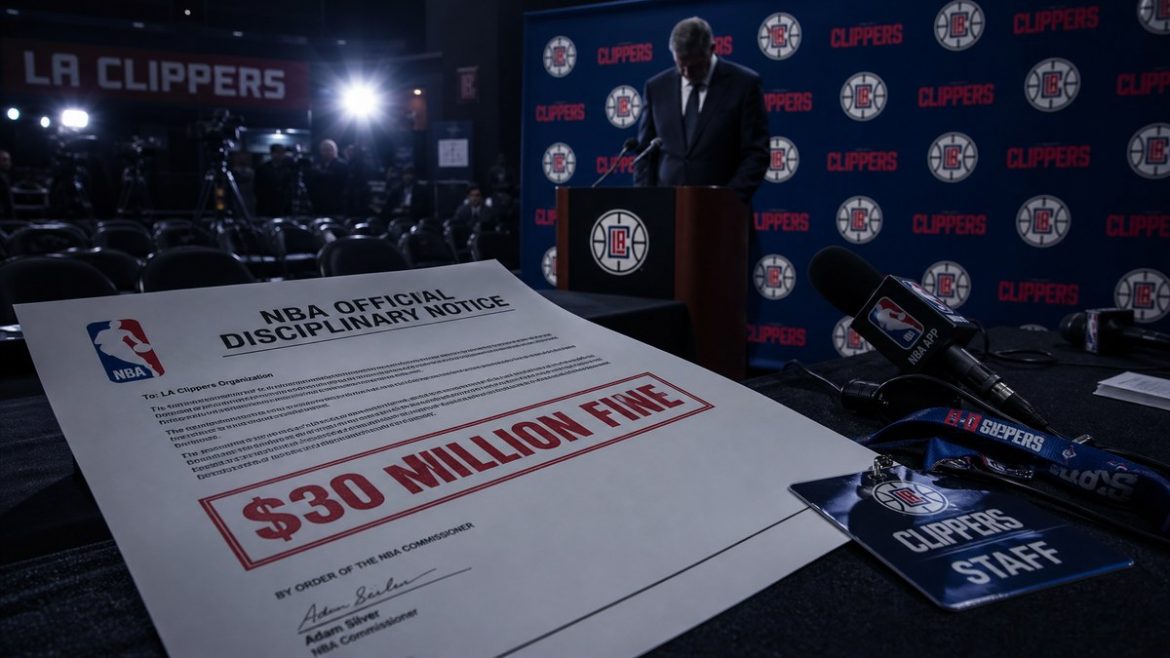
Los Angeles Clippers owner Steve Ballmer has apologized and backed away from opposing an NBA punishment, with the franchise accepting a reported $30 million fine. The decision matters beyond the size of the financial penalty because it ends, or at least significantly reduces, a public dispute between one of the league’s 30 teams and the NBA’s central authority.
Clippers accept reported $30 million NBA fine
Multiple reports published Monday said Ballmer and the Clippers had accepted the $30 million sanction. The available reports consistently describe Ballmer as backing down over the punishment and issuing an apology, although their headline summaries do not provide the full language of that apology or identify every party to whom it was directed.
The reports also do not fully detail the underlying findings, the specific league rules involved or whether the NBA imposed additional penalties beyond the fine. Without a complete league decision or a detailed statement from the team, those elements should not be inferred. What is clear from the accounts is that the Clippers are no longer resisting the reported financial punishment.
Acceptance of the fine represents an important procedural development. NBA discipline can remain an active story when a team disputes the league’s conclusions, considers an appeal or challenges the severity of a sanction. Ballmer’s change in position instead indicates that the franchise is prepared to move forward under the NBA’s decision, even if further details about the case are subsequently released.
Steve Ballmer’s apology changes the tone of the dispute
Ballmer’s apology is notable because it shifts the matter from confrontation toward compliance. An owner can disagree with a league decision while still paying a fine, but an apology conveys a broader acknowledgment that the dispute required a public response. The precise extent of that acknowledgment remains uncertain until the full statement is available.
That distinction is significant. Accepting a penalty does not automatically establish that a team agrees with every factual conclusion reached by the league. It can also reflect a decision that continuing the dispute would be more damaging or distracting than bringing it to an end. The reports characterize Ballmer as having backed down, but they do not establish whether the Clippers conceded every point connected to the NBA’s action.
For Ballmer, the episode places ownership conduct at the center of the Clippers’ offseason news. He has been the franchise’s controlling owner since 2014 and has maintained a highly visible presence around the team. When an owner with that profile publicly changes course, the consequences extend beyond an accounting entry. The response becomes part of how players, employees, business partners and other teams assess the organization’s leadership.
NBA discipline reinforces the league’s authority over teams
The NBA operates through a shared structure in which independently owned franchises agree to follow league rules and commissioner decisions. That structure depends on the league’s ability to investigate potential violations and impose discipline when warranted. It also depends on teams recognizing the process, particularly after a final decision has been reached.
A $30 million fine is substantial in ordinary financial terms, even for a franchise operating in a major media market. Its broader importance, however, lies in the message attached to it. League discipline is intended not only to address the conduct under review but also to establish expectations for every other organization. A prominent owner’s acceptance of a penalty helps affirm that individual franchises remain accountable to collective NBA rules.
The size of the reported fine will naturally attract attention, but a complete assessment requires the NBA’s reasoning. The seriousness of any sanction is best understood alongside the conduct cited, the relevant regulations and any precedent considered by the commissioner’s office. Those details were not included in the brief report summaries accompanying the initial news cluster.
Questions remain about the scope of the punishment
Several important questions remain unanswered in the material available Monday. It is not yet clear whether the fine is directed solely at the Clippers as an organization, whether Ballmer has a personal financial responsibility within the sanction or how the payment will be administered. The reports also do not specify a timetable for payment.
There is likewise no confirmed information in the supplied reports about competitive penalties. No conclusion should be drawn about draft assets, salary-cap consequences, suspensions or restrictions on team personnel unless those measures are identified by the NBA or documented in subsequent reporting. The only punishment consistently described in the reports is the $30 million fine.
Another unresolved issue is whether the apology and acceptance formally close the NBA’s case. They may settle the disagreement over the announced punishment, but leagues sometimes retain monitoring, compliance or reporting requirements after issuing discipline. Any such conditions would need to be confirmed through an official decision or a more complete account of the resolution.
Clippers can now redirect attention to basketball operations
From an organizational standpoint, accepting the punishment gives the Clippers a clearer path to redirect attention toward basketball operations. Disputes involving ownership can become a persistent distraction because they sit above the front office, coaching staff and roster. Unlike a routine personnel decision, an ownership-level conflict cannot be separated easily from the identity of the franchise.
The financial impact on basketball operations is not yet known. NBA team-building decisions are governed by league roster and salary rules, and a fine against the organization should not be treated as a salary-cap transaction unless the league says otherwise. Any claim that the penalty will directly alter roster spending, player contracts or personnel decisions would be premature.
The immediate task for the Clippers is therefore straightforward: comply with the NBA’s decision, clarify any remaining conditions and avoid allowing the matter to overshadow preparations for the season. Ballmer’s apology may assist that process, but the organization’s follow-through will determine whether the episode recedes quickly or prompts additional scrutiny.
Further NBA and Clippers statements will provide needed detail
The next meaningful development should be a full explanation from the NBA, the Clippers or Ballmer. That documentation would allow the public to understand the basis for the fine, the conduct covered by the apology and whether the settlement contains obligations beyond the reported payment.
Until then, the established news is limited but consequential: Ballmer has retreated from his opposition, apologized and accepted a reported $30 million fine on behalf of the Clippers. The resolution removes a layer of uncertainty surrounding the franchise while reaffirming the NBA’s ability to enforce its rules against one of its member teams.
Sources
- ABC News: Steve Ballmer backs down on NBA punishment, apologizes as Clippers accept $30M fine
- WFMZ: Steve Ballmer backs down on NBA punishment, apologizes as Clippers accept $30 million fine
- Tahlequah Daily Press: Steve Ballmer backs down on NBA punishment, apologizes as Clippers accept $30 million fine