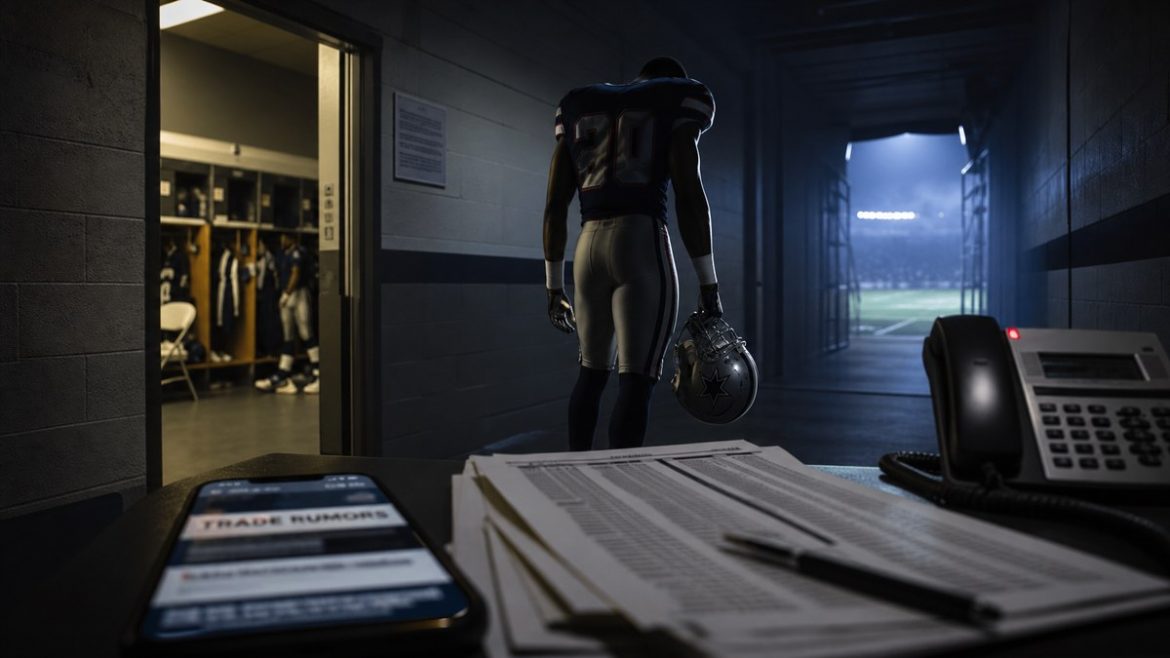
Tony Pollard’s name has returned to the Dallas Cowboys conversation, with published commentary raising the possibility of a trade that would reunite the veteran running back with his original NFL team. The idea is notable because of Pollard’s history in Dallas and the Cowboys’ recurring questions at the position, but the available reports do not establish that either team has made an offer or entered negotiations.
Tony Pollard trade discussion remains speculative
The distinction between a proposed move and a reported transaction is important. The items published Sunday frame a Pollard trade as a question for the Cowboys rather than describing a deal in progress. No compensation, formal proposal or confirmed contact between Dallas and Pollard’s current club was identified in the supplied reports.
The two listed stories also carry the same headline and publication time, indicating they may reflect the same underlying commentary or syndicated material rather than separate confirmation from multiple reporters. For now, Pollard should be viewed as a recognizable name being discussed in connection with a potential Cowboys need, not as a player known to be headed back to Dallas.
Trade speculation often increases once the NFL season begins and teams get a clearer look at their personnel. Injuries, early performance and changing depth-chart roles can lead front offices to explore additions. That broader environment can make a familiar veteran an obvious subject of discussion, particularly when he has already succeeded in the team’s offensive system. It does not, by itself, demonstrate organizational interest.
Pollard built his NFL reputation with the Dallas Cowboys
Dallas selected Pollard out of Memphis in the fourth round of the 2019 NFL Draft. Initially used as a complementary option behind Ezekiel Elliott, Pollard developed into one of the Cowboys’ most explosive offensive players because of his acceleration, receiving ability and capacity to create yardage in space.
His breakthrough came in 2022, when he rushed for 1,007 yards and scored 12 total touchdowns on his way to a Pro Bowl selection. That season showed he could contribute far beyond a limited change-of-pace assignment. His production also helped set up a major transition in the Dallas backfield after the team moved on from Elliott during the following offseason.
The Cowboys retained Pollard on the franchise tag in 2023, giving him the largest rushing workload of his career. He finished that season with 1,005 rushing yards, 55 receptions and 311 receiving yards. Although his efficiency declined from the previous year, he demonstrated that he could withstand a high volume of touches while contributing in both the running and passing games.
Pollard’s final appearance of the 2022 season had ended with a fractured fibula and a high ankle sprain in a playoff loss to the San Francisco 49ers. His ability to return for the start of the 2023 campaign and handle a full schedule was significant, even if he did not consistently reproduce the big-play rate that had defined his earlier role.
Why Pollard left Dallas for Tennessee
Pollard reached free agency in March 2024 and agreed to a three-year contract with the Tennessee Titans. Dallas elected not to match that level of commitment, ending his five-season run with the Cowboys. The decision reflected the league-wide caution surrounding substantial veteran running back contracts as well as the Cowboys’ broader salary-cap and roster priorities.
Tennessee added Pollard as part of its backfield transition following Derrick Henry’s departure. Pollard joined Tyjae Spears, giving the Titans two backs capable of running routes and operating from varied formations. In his first season with Tennessee, Pollard surpassed 1,000 rushing yards despite playing in an offense that struggled with consistency.
The original contract was structured to run through the 2026 season, although any current trade evaluation would require confirmation of subsequent salary, bonus and roster provisions. Those details matter because an acquiring team must consider more than the player’s on-field fit. Remaining compensation, guarantees and the cost in draft capital all shape whether a trade is practical.
What a Cowboys reunion would require
A Pollard reunion would begin with Dallas determining that its present backfield needs an outside addition. The Cowboys would then have to decide whether Pollard’s versatility and familiarity justify surrendering an asset rather than relying on current personnel, signing an available free agent or waiting for other options to emerge.
The Titans would have their own decision to make. A team does not move a useful veteran simply because another club has a familiar connection to him. Tennessee would need to weigh Pollard’s role, its competitive outlook, the development of other backs and the value of any return offered by Dallas.
Scheme familiarity could shorten Pollard’s adjustment period, but a reunion would not mean stepping back into an unchanged offense. Coaching responsibilities, blocking personnel and tactical priorities evolve quickly in the NFL. Even players returning to a former organization must learn updated terminology, protection rules and weekly game-plan responsibilities.
Workload would be another central question. Pollard was especially effective early in his Dallas career when his touches were managed and he could be deployed against favorable defensive looks. His later seasons proved he could carry a larger burden, but a team acquiring him would still need to identify whether it wanted a lead runner, a receiving complement or part of a rotation.
Dallas must balance familiarity with long-term roster value
The appeal of a familiar player is easy to understand. Pollard knows the franchise, has performed under the pressure attached to the Cowboys and offers a skill set that can affect both early downs and passing situations. Those qualities reduce some of the uncertainty that accompanies an outside acquisition.
Familiarity, however, cannot be the primary reason for a trade. Dallas would need to compare Pollard’s projected contribution with the value of the draft pick or player required to acquire him. The club would also have to account for its larger roster plan, including future contracts at premium positions and the importance of maintaining flexibility over a full season.
Running back trades are generally shaped by immediate need and modest acquisition cost. Teams know the position is physically demanding, and they can often find rotational help without making a major investment. A higher asking price would make it harder for Dallas to justify a move unless the front office believed Pollard could substantially change the offense.
No confirmed Cowboys-Titans negotiations have emerged
Pollard’s established connection to Dallas ensures that the possibility of a return will attract attention. He remains one of the most productive running backs developed by the Cowboys in recent years, and his departure was driven by free agency rather than a public breakdown between player and team.
Still, the current discussion has not advanced beyond the proposal stage based on the supplied coverage. There is no confirmed agreement, reported offer or established timetable for a move. Until credible reporting identifies direct contact between the Cowboys and Titans, the Pollard conversation is best understood as roster analysis built around a logical former-player connection.
Whether that connection eventually produces a transaction will depend on need, health, contract considerations and Tennessee’s willingness to listen. Those factors—not Pollard’s history in Dallas alone—will determine whether a reunion becomes more than an early-season NFL trade discussion.