
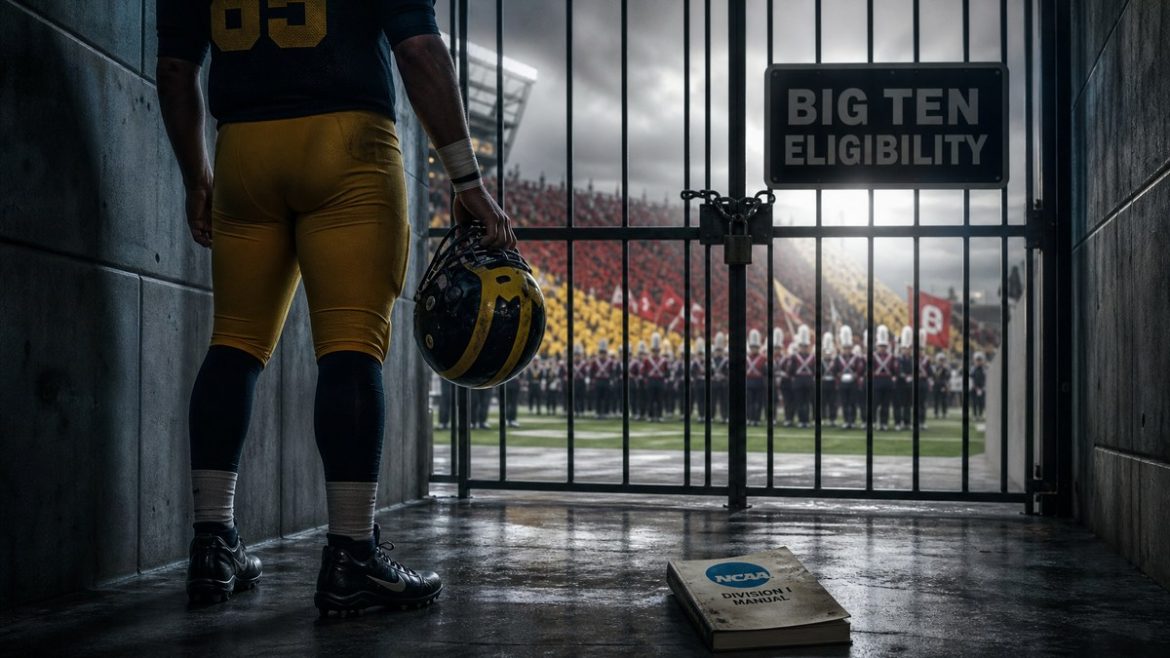
The Big Ten has reportedly moved to prevent players with NFL experience from returning to college football, establishing a conference position on an eligibility issue that could become more prominent as the NCAA’s athlete-participation model evolves. The reported restriction matters because it draws a boundary between college and professional football at a time when long-standing eligibility rules are facing legal and administrative scrutiny.
Big Ten reportedly sets limit on NFL-to-college returns
Reports published Tuesday said the Big Ten had banned NFL players from returning to college football. The available reports did not include the complete text of a conference policy, a list of affected players or a detailed explanation of how the rule would be administered.
That leaves several important distinctions unresolved. It is not yet clear from the reports whether the restriction applies only to players who appeared in regular-season NFL games or whether it also covers those who signed professional contracts, attended training camp, played in the preseason or spent time on a practice squad. Those categories could matter significantly if the conference is required to determine an athlete’s eligibility on an individual basis.
The timing and formal approval process also were not detailed in the supplied coverage. No direct Big Ten statement or policy document was included with the reports. Until the conference provides that material, the action is best described as a reported Big Ten policy rather than a fully documented national rule change.
College football eligibility enters another period of change
College sports have traditionally treated participation in a professional league in the same sport as a clear dividing line. The basic structure was designed around athletes competing in college before moving into the professional ranks, not returning to an NCAA program after beginning an NFL career.
That structure has become more complicated as legal cases, NCAA waivers and revised rules have changed how college athletes can transfer, receive compensation and challenge eligibility decisions. Name, image and likeness opportunities also have separated athlete compensation from the older amateur model, although NIL payments are distinct from employment by an NFL franchise.
The reported Big Ten action appears intended to preserve a firm separation between professional football experience and subsequent conference competition. It does not, based on the available information, reverse broader changes involving NIL rights, revenue sharing or transfer freedom. Instead, it addresses the narrower question of whether a player can compete professionally in football and later return to the college version of the same sport.
Key details of the Big Ten policy remain unanswered
Any formal rule will need precise definitions. “NFL player” can describe several different relationships with a team, and those differences may affect how a case is evaluated. A veteran who played multiple NFL seasons presents a different factual situation from an undrafted player who signed briefly during the offseason but never appeared in a game.
The conference also will need to clarify whether the policy applies prospectively or could affect an athlete who already had received an NCAA eligibility determination. Another question is whether the Big Ten would recognize waivers issued by the NCAA or reserve the authority to enforce a stricter conference standard.
Medical circumstances could create additional cases requiring review. A player might leave college early, sustain an injury soon after joining an NFL organization and later seek to complete an unused season of college eligibility. The reports do not say whether the Big Ten policy includes an appeal process or exceptions for unusual circumstances.
Academic requirements remain a separate issue. Even if a player were permitted to compete under national or conference rules, that athlete would still have to gain admission to a university, satisfy enrollment standards and meet applicable progress-toward-degree requirements. A conference policy would therefore be one part of a larger eligibility review.
SEC response has not been established
The reports raised the possibility that the SEC could take a similar approach, but the supplied coverage did not identify an SEC decision. A question about whether another conference will follow the Big Ten should not be interpreted as confirmation that it has done so.
Different conference policies could create an uneven national system. If one league prohibited former NFL players while another allowed them under certain circumstances, athletes and schools could face different participation standards depending on conference membership. That possibility could increase pressure for an NCAA-wide rule or a common policy among the major conferences.
At the same time, conferences often have their own governance procedures and may reach different conclusions about competitive eligibility. The SEC, ACC, Big 12 and other leagues would need to consider the issue through their respective administrative structures. No decision from those conferences was documented in the reports provided for this article.
What the reported rule means for Big Ten programs
For Big Ten coaches and compliance departments, a clearly written restriction would provide a direct answer when evaluating a prospective player with an NFL background. It also could prevent schools from investing recruiting and administrative resources in a player who ultimately would be unable to participate in conference competition.
The immediate roster impact is uncertain because the reports did not identify any current Big Ten recruit or player whose status prompted the action. The broader importance is administrative: the conference is reportedly attempting to define an outer limit while eligibility rules elsewhere in college sports continue to shift.
A formal policy also could become relevant during transfer reviews. Schools routinely examine an athlete’s playing history, seasons of competition and remaining eligibility. Professional football participation would add another layer, particularly if an athlete’s NFL experience was brief or did not include a regular-season appearance.
Formal conference guidance will determine the rule’s reach
The next significant development would be publication of the Big Ten’s actual language or an on-record explanation from conference officials. That guidance should establish who qualifies as a former NFL player, when the policy takes effect, whether appeals are available and how the restriction interacts with NCAA decisions.
It also will be important to distinguish repeated versions of the initial report from independent confirmation. The supplied stories appeared at the same time across multiple television-station websites and carried the same headline, so they should not automatically be treated as separate confirmations of additional details.
For now, the central development is that the Big Ten reportedly has chosen to bar NFL veterans from returning to college football within the conference. Whether that becomes a model for the SEC or a national NCAA standard remains unresolved.
Sources
- ABC10: Big Ten bans NFL players from returning to college football
- WKYC: Big Ten bans NFL players from returning to college football
- 11Alive: Big Ten bans NFL players from returning to college football
- WHAS11: Big Ten bans NFL players from returning to college football