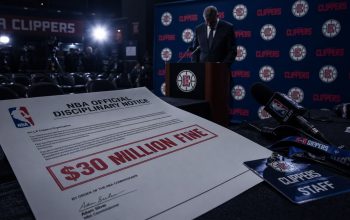
Los Angeles Clippers owner Steve Ballmer has reportedly accepted a punishment imposed by the NBA, prompting questions about whether the development could affect the team’s future with Kawhi Leonard. The reports connect Ballmer’s decision with the possibility of a Leonard trade, but the available information does not identify a trade partner, proposed terms or an agreement involving the Clippers’ star.
Steve Ballmer reportedly accepts NBA punishment
Multiple local television websites published the same report Monday stating that Ballmer had accepted the NBA’s punishment. The supplied summaries, however, do not specify the nature of the league’s action, the conduct that prompted it or the consequences imposed on Ballmer and the Clippers.
Those missing details are significant. An NBA punishment can take several forms, and its effect on a franchise depends on what the league found and which penalties were applied. Without the league’s ruling or a more detailed public statement from the team, it is not possible to determine whether the matter carries any direct consequences for basketball operations.
The reports also do not indicate whether Ballmer’s acceptance represents the end of the league process or merely his decision not to challenge the punishment. An official announcement from the NBA would ordinarily provide the clearest account of the underlying issue, the applicable rules and the discipline involved. Until that information is available, the scope of the case remains uncertain.
Ballmer’s reported acceptance is nevertheless notable because he is the Clippers’ controlling owner and one of the league’s most visible team governors. Any disciplinary matter involving an owner attracts attention beyond the immediate organization, particularly when questions remain about whether it could influence front-office decisions.
Kawhi Leonard trade speculation remains unconfirmed
The reports frame the Ballmer development alongside a question about whether a Leonard trade has moved closer to completion. That framing should not be treated as confirmation that the Clippers have agreed to a deal or are in advanced negotiations.
No team was identified as a prospective trade partner in the supplied reports. There were also no reported details about players, draft assets or other considerations that might be included in a transaction. Without those elements, there is not yet a verifiable trade framework to evaluate.
A completed NBA trade requires agreement between the participating teams, compliance with league transaction rules and formal approval after the necessary documentation is submitted. An owner’s acceptance of league discipline would not, by itself, establish that those steps have taken place. A direct connection between the punishment and Leonard’s status would need to be demonstrated through official information or detailed reporting.
The wording used in the reports leaves open several possibilities. The disciplinary matter could be connected to the Clippers’ broader operations, or the timing could simply have renewed existing questions about Leonard’s future. Based on the information currently available, the latter cannot be ruled out and the former has not been sufficiently explained.
Why Kawhi Leonard’s status matters to the Clippers
Leonard’s future is a major issue for the Clippers because he has been a central figure in the franchise’s competitive plans. Decisions involving a player of his stature affect far more than one roster spot. They shape the team’s short-term rotation, its salary planning, the roles assigned to other players and the direction taken by the front office.
If Los Angeles were to explore a trade, management would have to weigh Leonard’s on-court value against the return offered by another club. The Clippers would also need to decide whether the objective was to remain competitive immediately, add younger players and draft capital, create greater roster flexibility or combine several of those goals.
For another team, acquiring Leonard would require a corresponding evaluation of roster fit, financial commitments and the assets needed to complete the deal. Those considerations can make transactions involving established stars complex even when both sides have a reason to continue discussions.
None of that establishes that a move is imminent. It instead explains why credible details are necessary before a reported possibility can be described as a developing transaction. A named trade partner, an agreed return or confirmation from league and team sources would materially change the status of the story. Those details were not present in the supplied summaries.
Repeated reports do not necessarily mean independent confirmation
The four cited items appeared on WFMY News 2, 12News, 13News Now and WHAS11 with the same headline and publication time. That pattern indicates the sites may be carrying versions of the same distributed report rather than four separately reported accounts.
This distinction matters when assessing the strength of the information. Several outlets publishing identical material can expand a story’s reach, but it does not automatically provide independent corroboration. Confirmation is stronger when separate reporters obtain information from different sources or when the NBA, the Clippers, Ballmer or Leonard’s representatives issue an on-record statement.
The shared headline describes Ballmer’s acceptance of punishment as a reported development while presenting the Leonard trade angle as a question. Those are two different levels of certainty. The first is stated as news by the reports; the second remains an interpretation about what might happen next.
Separating those claims is especially important during the NBA transaction cycle, when personnel developments can generate immediate speculation. Trade discussions can change quickly, and preliminary conversations do not always produce formal proposals. Even advanced negotiations can end without an agreement.
What to watch next for Ballmer, Leonard and the Clippers
The next meaningful step would be a detailed explanation of the NBA’s punishment, including the rule involved and the penalties assessed. That information would clarify whether the matter is limited to Ballmer or has implications for the Clippers’ basketball operations and transaction options.
On the roster side, confirmation of trade talks would require more concrete reporting. Relevant details would include the identity of another team, the principal assets under discussion and whether the Clippers have authorized the front office to pursue a deal involving Leonard. An official transaction would then be subject to the NBA’s standard review process.
Until those facts emerge, the most accurate description is that Ballmer has reportedly accepted league discipline while Leonard’s future remains unresolved. The reports have raised a legitimate question about the direction of the Clippers, but they do not establish that a Kawhi Leonard trade is agreed upon or close to completion.
Sources
- WFMY News 2: Steve Ballmer accepts NBA punishment; Kawhi Leonard trade one step closer to completion?
- 12News: Steve Ballmer accepts NBA punishment; Kawhi Leonard trade one step closer to completion?
- 13News Now: Steve Ballmer accepts NBA punishment; Kawhi Leonard trade one step closer to completion?
- WHAS11: Steve Ballmer accepts NBA punishment; Kawhi Leonard trade one step closer to completion?