

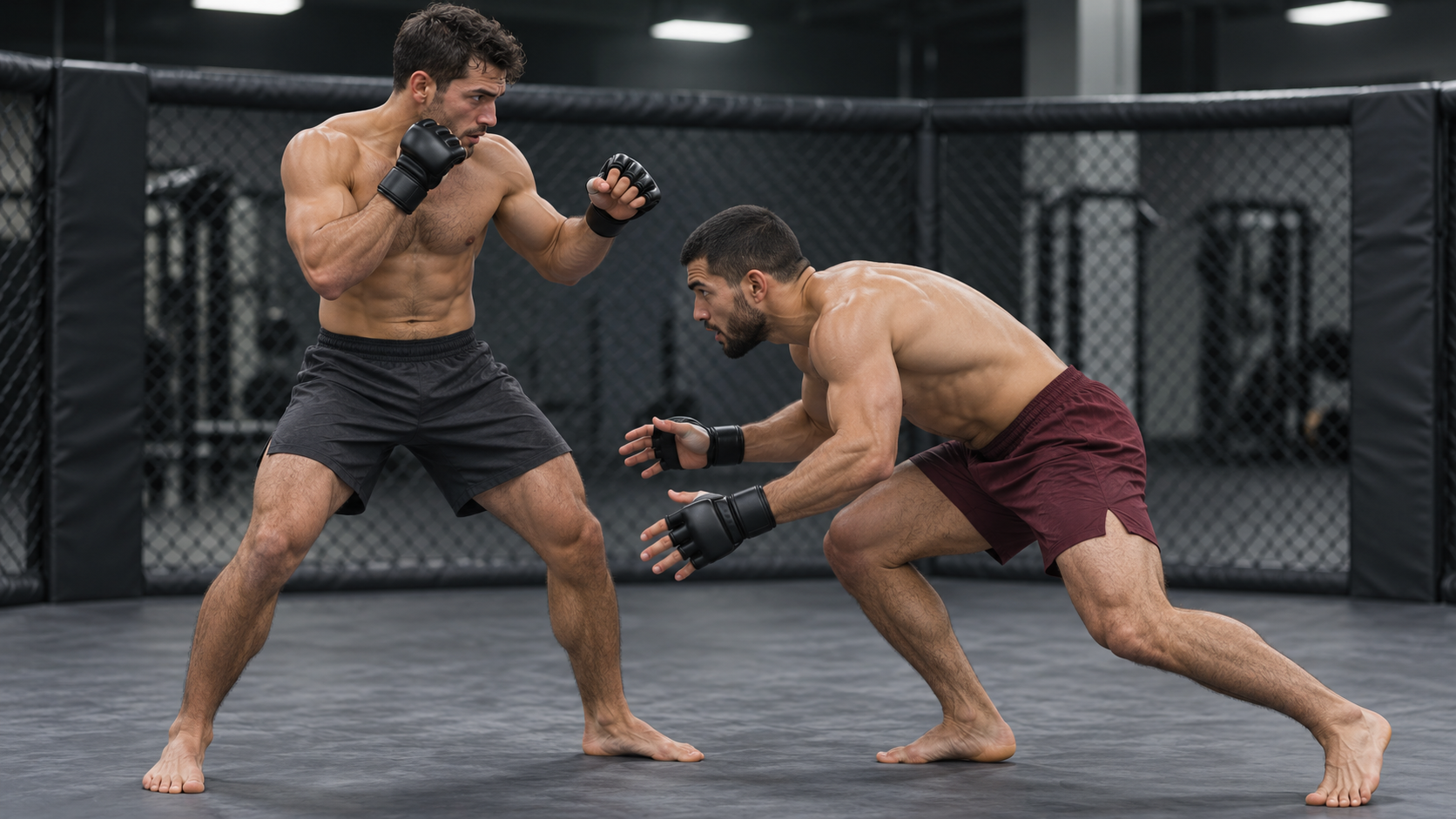
UFC AI matchup analysis uses historical fight data and statistical models to estimate how two fighters' skills might interact. A useful breakdown connects striking, wrestling, pace, and opponent quality to possible fight paths, then expresses the uncertainty as a probability. The interesting part is how the model reaches that estimate and where its assumptions could fail.
If you are looking for current matchups, the ATSwins UFC projections page is a starting point. Here, the focus is reading the analysis behind a forecast. You will see how to assess a style clash, spot weak explanations, and work through an invented striker-versus-wrestler example. All fighter profiles, scenario weights, and prices below are hypothetical teaching examples, not current picks or proprietary model outputs.
What Useful UFC AI Matchup Analysis Explains
A good report starts with the actual matchup. It identifies the opponents, scheduled format, and information cutoff, then describes each fighter's plausible route to winning. That sounds basic, but a smooth paragraph about someone's recent form can still avoid explaining how they handle the person standing across from them.
The next layer is relative skill. A fighter's historical output has meaning only in context. Five strikes landed per minute against weaker opposition may tell a different story from four against stronger opponents. A model should account for opponent quality instead of treating every recorded minute as equally informative.
Then come the interactions. Reach might matter when someone maintains distance, but less when an opponent repeatedly closes space. Wrestling pressure might reduce a striker's output even before a takedown lands. These are hypotheses to test against past fights and footage, rather than automatic bonuses attached to a style label.
Finally, the report should separate evidence from interpretation. A recorded takedown count is an observation. Saying a fighter will struggle with repeated fence wrestling is an inference. Both belong in analysis, but the reader should be able to tell which is which. A confident sentence cannot turn an unsupported inference into a fact.
Read the Striking Matchup in Context
Striking volume is a starting point. Accuracy, strikes absorbed, knockdowns, and the positions where exchanges happen add detail. The question is how those numbers might change against this opponent. A fighter who usually leads exchanges could spend this matchup backing up, defending entries, or waiting for counter opportunities.
Look at the denominator behind a percentage. Landing 12 of 20 attempts and landing 120 of 200 both produce 60% accuracy, but they do not offer the same amount of evidence. The smaller sample leaves more room for the observed rate to be a temporary result of the opponent or fight situation.
Defense needs similar care. An opponent missing does not necessarily mean every miss came from a deliberate defensive action. Distance, attempted strike selection, and pace affect the numbers. Pair statistical patterns with footage before declaring that a fighter has solved a particular kind of attack.
Power also deserves its own treatment. A high-volume fighter and a selective counterstriker may create danger differently. Averaging their activity into one striking score can hide that distinction. Ask whether the analysis explains the likely exchanges, including what happens if the lower-volume fighter lands the cleaner shots.
A practical viewing question is simple: what allows this fighter to use their best weapon? If the answer is space, check whether they can preserve it. If it is pressure, check whether they can advance without eating counters. That makes the footage review specific enough to challenge the statistical story.
Follow the Wrestling and Grappling Sequence
Calling a matchup striker versus wrestler skips several steps. The wrestler must enter safely, establish contact, complete the takedown, and create something useful afterward. The defender may stop the initial attempt, recover after landing, or force repeated effort. Each stage changes what the next stage looks like.
Takedown accuracy measures recorded completions relative to attempts. It does not directly tell you how long the fighter stays on top or how dangerous that position becomes. A fighter might complete takedowns but lose position quickly. Another might fail on an initial entry and succeed after chaining attempts together.
Control time has limits as an explanation, too. Time in a position does not fully describe the threat created there. Compare what happens during those minutes: meaningful offense, submission opportunities, escapes, or largely stalled exchanges. Avoid turning a control statistic into a complete prediction of the result.
For the defending fighter, inspect the recovery sequence. Stopping one clean entry in open space is different from defending repeated attempts near the fence. Getting up once is different from getting up repeatedly while preserving enough energy to strike effectively. The footage may reveal differences that a career defense percentage misses.
These observations should influence a model through consistent rules or tested features. Adding an unexplained wrestling bonus after seeing a favorite's highlight reel creates a judgment call without a clear audit trail. Record what evidence changed your assessment and how much weight you gave it.
Work Through a Striker-Versus-Wrestler Example
Imagine Fighter A prefers open-space striking and Fighter B relies on wrestling pressure. Instead of adding separate scores for reach, striking, and takedowns, build three illustrative fight paths. The paths must be mutually exclusive and cover the entire simplified scenario space if their weights are going to combine into one probability.
For this teaching example, assume a range-dominant fight has a 45% weight and gives A a 70% conditional win chance. A wrestling-dominant fight has a 35% weight and gives A a 30% chance. A mixed fight has the remaining 20% weight and gives A a 50% chance. Draws and no contests are excluded from this simplified two-outcome setup.
A's combined estimate is 0.45 multiplied by 0.70, plus 0.35 multiplied by 0.30, plus 0.20 multiplied by 0.50. The result is 0.52, or 52%. A is only a slight favorite, even though the range-dominant scenario looks favorable. The wrestling path pulls the overall forecast back toward an even matchup.
Now question the biggest assumption. Suppose the range-dominant weight drops to 35%, while the wrestling-dominant weight rises to 45%. Leave the mixed scenario and conditional win chances unchanged. A's combined probability becomes 0.35 times 0.70, plus 0.45 times 0.30, plus 0.20 times 0.50, which equals 48%.
That four-percentage-point swing changes the favored fighter. The useful discovery is that the forecast depends heavily on where the fight takes place. Your next research task is to examine entries, distance management, and recovery against comparable opposition. Another generic review of career records is unlikely to settle that specific question.
These scenario weights are invented assumptions, not outputs from a trained AI system. A real implementation would need a consistent way to classify fight paths, estimate their probabilities from pre-fight information, and validate the conditional forecasts. The example shows the reasoning structure without pretending the inputs are known.
Spot Where the Model Can Go Wrong
The first issue is missing information. A hidden injury, a new tactical approach, or a preparation problem may never appear in the dataset. A model cannot reliably adjust for an event it does not observe. Rumors do not fix this problem, because treating an unverified claim as confirmed can make the forecast worse.
Small samples are another problem, especially with debutants or fighters whose recent appearances ended quickly. Limited minutes can produce extreme averages. Statistical shrinkage toward a relevant group is one way to reduce overreaction, but it does not manufacture missing evidence. The uncertainty still belongs in the report.
There is also a difference between predictive modeling and AI-generated writing. A language model can produce a convincing explanation from supplied statistics without having a validated fight prediction model behind it. Ask where the probability came from, when its inputs were captured, and how earlier forecasts were evaluated.
An explanation of feature importance has limits as well. If reach contributes to a model's output, that does not prove reach causes the expected advantage in this fight. Correlated features and historical patterns can influence attribution. Treat the explanation as a view of the model's behavior, then check whether the matchup evidence supports it.
Testing should follow time order. Training on earlier fights and evaluating on later fights better reflects actual forecasting than allowing future information into past examples. Calibration checks whether probability levels align with observed outcomes over enough fights. Brier score and log loss evaluate probability quality, while raw winner accuracy leaves out how confident each prediction was.
Connect the Matchup to a Fair Price
Once you have a probability, a fair decimal price is one divided by that probability. The hypothetical 52% estimate produces approximately 1.923, equivalent to American odds of about -108. That is a price derived from the assumed forecast, without a bookmaker margin.
Suppose A is offered at +105. The break-even probability is 100 divided by 205, or about 48.78%. At a 52% estimated chance, a hypothetical $100 stake has expected net profit of 0.52 times $105 minus 0.48 times $100, which equals $6.60. That expectation assumes the forecast is appropriate and the wager settles as a win or loss.
Use the alternative 48% estimate from the scenario check, and the same calculation becomes negative $1.60. The price has not changed. Your assumptions have. A small apparent opportunity can disappear when a plausible reading of the style clash changes the win chance.
The broader ATSwins forecasting approach connects probabilities with market prices. For more on the underlying process, the UFC matchup analytics model guide covers model construction. When reviewing a forecast, keep the matchup explanation, probability estimate, and available price distinct so you can see exactly where your decision depends on an assumption.
Common Matchup Analysis Questions
Can AI read a style matchup better than a human analyst?
There is no automatic winner. A statistical model can apply a consistent process across many fights, while a knowledgeable analyst may notice tactical details missing from the inputs. Compare both approaches using forecasts recorded before the event. A convincing explanation or an impressive single pick does not establish which approach produces better probabilities over time.
What should I check when two AI reports disagree?
Start with the opponents, scheduled format, and information cutoff. Then find the main disagreement about how the fight develops. One report may expect sustained range striking while another expects frequent wrestling exchanges. Check their evidence and evaluation history before averaging their numbers. Two reports repeating the same underlying data may provide less independent information than they appear to.
Does a strong matchup advantage mean a likely finish?
No. An advantage might produce a higher overall win chance without producing a high finish probability. A fighter could have a dependable route through extended striking exchanges or positional work. Knockout, submission, and decision forecasts require separate estimates that account for the opponent. They also need outcome definitions that remain consistent with the overall win probability.
Keep the Explanation Accountable
A useful matchup report should leave you with a question you can investigate. Maybe the forecast depends on a fighter escaping the fence. Maybe it depends on maintaining pace after repeated wrestling exchanges. Find that pressure point and review the evidence around it before accepting a confident percentage.
Save the original explanation and assumptions before the event, then revisit them afterward. Did the expected fight path happen? Did an overlooked interaction matter? One result will not settle model quality, but an honest record makes recurring mistakes easier to recognize. Bring that habit to your ATSwins matchup research: use the forecast to organize your thinking, check what supports it, and be willing to pass when a small change in assumptions flips the decision.