

I live in that space where watching fight tape and writing code overlap. One minute I’m rewinding a scramble to see how a guy actually reacts under pressure, and the next I’m staring at a dataframe trying to figure out why a model is overrating clinch control. This piece is about how I turn UFC fight data into real, usable predictions. Not vague takes, not vibes, and definitely not hindsight. This is about building a UFC advanced stats prediction model that outputs probabilities you can actually trust.
We are going to walk through how to define the right prediction targets, what stats actually matter in MMA, how to collect and clean fight data without poisoning your model, and how to train, test, and deploy models without lying to yourself. The goal is not perfection. MMA is chaotic by nature. The goal is disciplined edges that compound over time.
Table Of Contents
• Metrics that matter for a UFC advanced stats prediction model
• Data collection and wrangling
• Modeling strategy
• Backtesting and calibration
• Deployment and practical notes
• Conclusion
• Frequently Asked Questions (FAQs)
Metrics that matter for a UFC advanced stats prediction model
Before touching a single line of data, you have to define what the model is actually predicting. This sounds obvious, but it is where a lot of people mess up. If you do not lock in your target clearly, you end up with features that accidentally leak information or models that optimize the wrong outcome.
The most common and most useful target is win probability. This is a binary outcome per fighter per fight and maps directly to moneyline betting. From there, you can branch into finish probability, method of victory, or even round props, but win probability should always be the backbone.
When labeling outcomes, keep it clean. No contests and overturned fights should not be used as training labels, but the performance data from those fights can still live in a fighter’s history if it reflects real output. You want the model learning from what happened in the cage, not from how commissions ruled edge cases.
Once the target is clear, the real work begins. UFC fights are won by minutes and moments. Your stats need to capture both.
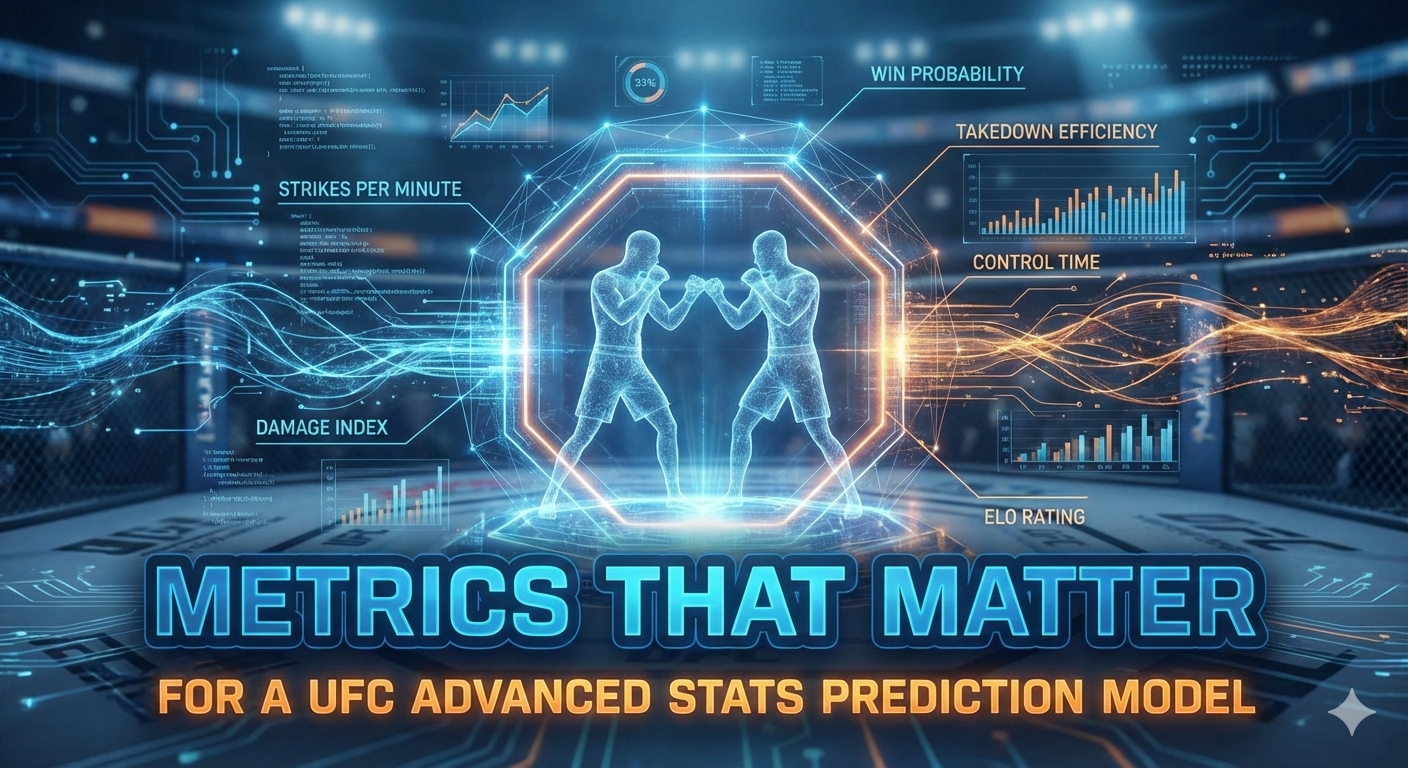
Striking volume and defense are the foundation. Significant strikes landed per minute and absorbed per minute are still some of the strongest signals in MMA, especially when you smooth them over multiple fights. Accuracy and defense percentages add context, but raw volume tends to stabilize faster.
Grappling metrics matter just as much, especially in close fights. Takedown attempts per fifteen minutes, takedown accuracy, takedown defense, and control time give you a sense of who dictates where the fight happens. Control time alone is not enough. You want to know how often a fighter gets there and how reliably they keep opponents off them.
Damage proxies are huge. Knockdowns per fifteen minutes, knockdown rate per strike attempted, and historical ability to finish or get finished add information that pure volume misses. A fighter who lands fewer strikes but consistently hurts opponents is very different from a point fighter.
Pace and durability live slightly below the surface. Attempts per minute, round one versus round three drop off, and historical knockdowns absorbed all hint at cardio and survivability. These do not always show up in one fight, but over time they separate front runners from late grinders.
Body metrics and bio data add structure. Age at fight date matters more than people admit, especially once you model nonlinear effects. Reach and height differentials matter more in lighter classes. Stance matchups create asymmetries that judges and fighters react to, even if fans ignore them.
Situational context often decides coin flip fights. Layoff length, short notice replacements, travel stress, altitude, and weight misses all introduce volatility. These events are rare, but when they happen, they matter enough that ignoring them hurts calibration.
Finally, you need a way to represent opponent strength. Records lie. An Elo style rating that updates fight by fight and decays with time gives the model a sense of who someone has actually beaten and how impressive those wins were. Margin of victory, control dominance, and early finishes all add signal when updating fighter quality.
Data collection and wrangling
Data is where most UFC models die quietly. Name mismatches, missing rounds, inconsistent time units, and accidental future leakage will sink even the best modeling ideas.
Start by building a complete bout list in chronological order. Every fight should have a unique event date, weight class, scheduled rounds, and outcome. Time ordering is non negotiable. If you cannot replay history one event at a time, your backtests are meaningless.
For each fight, extract fighter identifiers and round level stats. You want strikes, attempts, control time, takedowns, submissions, and knockdowns broken out by round whenever possible. Normalize everything to per minute or per fifteen minute rates so fighters with different fight lengths are comparable.
Fighter identity management is more important than it sounds. Name variations, accents, and suffixes will break joins. Use a canonical identifier for each fighter and maintain a manual override file for edge cases. It is boring work, but it saves you from silent data corruption later.
Missing stance and reach are common. Stance can usually be filled from prior fights. If it is missing entirely, treat it as unknown rather than guessing. Reach can be imputed from height and weight class, but you should always include a flag indicating that the value was imputed so the model understands the uncertainty.
Rolling windows are where signal really emerges. Three fight and five fight averages for striking, grappling, and control smooth out noise while still reacting to form changes. Opponent adjusted features are even better. A fighter’s output minus what their opponents usually allow tells you more than raw numbers.
Every feature must be computable using only data available before the fight date. This includes Elo ratings, rolling averages, and context flags. If you accidentally include post fight totals, your model will look incredible and fail immediately in the real world.
Version your datasets. Freeze training snapshots. Document feature definitions and null handling. Treat data like code. If you cannot reproduce a prediction, you cannot trust it.
Modeling strategy
The smartest thing you can do is start simple. A calibrated logistic regression with clean features will teach you more about your data than any fancy model. If this baseline cannot beat a coin flip in log loss, the problem is not the algorithm. It is your features.
Once the baseline works, move to models that capture interactions. Tree based ensembles handle nonlinear relationships like age interacting with weight class or reach interacting with stance. Regularization matters here. Shallow trees, subsampling, and early stopping keep things sane.
Calibration is not optional. Raw probabilities from complex models are often overconfident. You need to fix that before turning probabilities into betting decisions.
For UFC specifically, hierarchical models add a ton of value. Weight classes behave differently. Fighter samples are small. Partial pooling shrinks extreme estimates back toward the group mean and prevents debutants from looking like world beaters after one win.
One powerful approach is to predict underlying events first. Expected strikes, expected control time, and knockdown probability can be modeled separately, then fed into a meta model that predicts wins and finishes. This mirrors how fights are actually won and stabilizes predictions when raw data is noisy.
Elo style ratings should never be the only predictor, but they make excellent features. Updating them with margin of victory proxies and time decay gives you a dynamic sense of fighter quality that complements stat based features.
Backtesting and calibration
If you split your data randomly, stop. UFC betting does not work that way. You have to backtest chronologically, event by event, just like real life.
Train on past events, validate on the next block, then test forward. Group by event so camps and teammates do not leak across folds. Lock features to what was known before the event.
Log loss is the primary metric. It punishes confident mistakes, which is exactly what costs money. Brier score gives another view of probability accuracy. Accuracy alone is mostly useless in betting contexts.
Calibration curves tell you whether your 60 percent predictions actually win about 60 percent of the time. This matters more than raw hit rate. A slightly less accurate but well calibrated model is far more valuable.
Class imbalance is real, especially for finishes. Handle it with class weights and recalibration, not naive oversampling. After every calibration step, re check reliability.
Interpret your models. If reach dominates everything, something is wrong. If layoff days suddenly become the most important feature across all classes, investigate. Use explanations as a debugging tool, not marketing fluff.
Deployment and practical notes
In production, stability beats cleverness. The best setup is usually an ensemble. A stable core model trained on the full history, paired with a recency focused component that reacts faster to form changes.
Uncertainty matters. Debutants, long layoffs, and late replacements deserve wider confidence bands. Pretending otherwise is how bettors get burned.
Monitor drift. Fighter behavior changes over time. Scoring trends shift. If feature distributions move, retrain. Compare model probabilities to market prices and track expected value over time.
Map outputs directly to betting markets. Win probability feeds moneylines. Finish probability feeds inside the distance bets. Method splits need guardrails because correlation matters.
Inside ATSwins, UFC predictions go through both model checks and analyst review. Probabilities are posted with confidence tiers, and performance is tracked transparently. The same discipline used in other sports carries over to MMA, which keeps quality consistent.
Conclusion
Building a UFC advanced stats prediction model is not about finding one magic stat. It is about clean data, meaningful features, disciplined modeling, and honest backtesting. Avoid leakage. Respect small samples. Calibrate constantly. No shortcuts.
This is the same mindset used at ATSwins, where probabilities are treated as tools, not guarantees. When you do it right, the edge is not flashy. It is steady, boring, and profitable over time.
Frequently Asked Questions (FAQs)
What is a UFC advanced stats prediction model and how does it predict wins?
A UFC advanced stats prediction model uses structured fight data to estimate the probability of each fighter winning a matchup. It blends striking volume, accuracy, grappling success, control time, damage indicators, physical traits, age, and recent form. By adjusting those stats for opponent strength and context, the model outputs a clean probability instead of a gut feeling.
Which stats matter most when trying to predict UFC wins?
The strongest signals usually come from opponent adjusted striking volume, takedown defense, control time share, knockdown rates, age curve, reach and stance matchups, and recent activity. The key is balance. Minutes winning stats and moment winning stats both matter.
How do I know if my UFC model actually works?
Chronological backtesting is the answer. Split by event date, score with log loss and Brier score, and check calibration. If your predicted probabilities line up with real outcomes over time, the model is doing its job. MMA will always be volatile, but calibration tells you if you are honest.
Can these models handle late notice fights and debuts?
Yes, if you design them to. Late replacements and debuts should trigger higher uncertainty and partial pooling toward weight class averages. A good model knows when it does not know much.
How does ATSwins fit into this workflow?
ATSwins takes model probabilities and integrates them into a full betting workflow. Picks, props, confidence tiers, and profit tracking all sit on top of disciplined probability estimates. The goal is not just predicting fights, but betting them responsibly.
Related Posts
AI For Sports Prediction - Bet Smarter and Win More
AI Football Betting Tools - How They Make Winning Easier
Bet Like a Pro in 2025 with Sports AI Prediction Tools
Sources
The Game Changer: How AI Is Transforming The World Of Sports Gambling
AI and the Bookie: How Artificial Intelligence is Helping Transform Sports Betting
How to Use AI for Sports Betting
Keywords:
MLB AI predictions atswins
ai mlb predictions atswins
NBA AI predictions atswins
basketball ai prediction atswins
NFL ai prediction atswins
ai betting analysis