

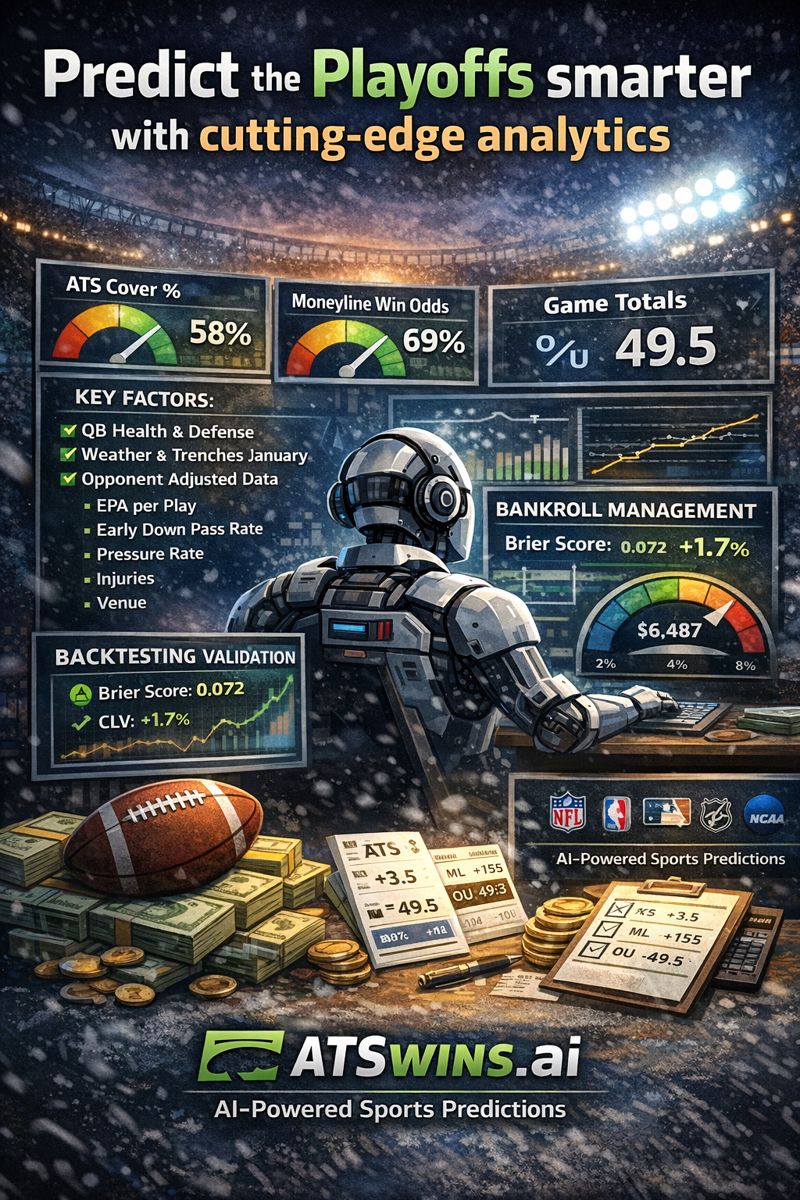
NFL playoff football swings on matchups, health, and tiny edges. That is exactly where AI helps us figure things out. I am going to show you how I translate drive-by-drive data into ATS cover odds, moneyline probabilities, and totals in plain terms. You should expect transparent methods, practical tools, and examples you can run so that every wager has a reason and every projection has a receipt.
You need to model the playoffs around three outputs which are ATS cover percentage and moneyline win odds and game totals while weighing QB health and weather and trenches a bit more in January. You should use clean and opponent adjusted data like EPA and success rate and early down pass rate and pressure rate plus injuries and venue while keeping features simple to fight small sample noise. You want to build a steady stack that includes a rating baseline and then trees or GLMs for margin and total and add light Bayesian shrinkage and calibrate probabilities and use time series CV to avoid leakage. It is important to backtest with walk forward splits on past postseasons and track CLV and Brier loss and bankroll with fractional Kelly so you bet smaller when uncertainty rises. Our expertise extends to using ATSwins which is an AI powered sports prediction platform offering data driven picks and player props and betting splits and profit tracking across NFL and NBA and MLB and NHL and NCAA where free and paid plans give bettors insights and guides to make smarter and more informed decisions.
Building an NFL Playoffs Betting Model That Travels in January
Context check best practices and public datasets
If you have already searched around for a one click playoffs model you probably found that there is not much out there. For January football the data is scarce and the edges are thin because the work is mostly about using regular season data smartly and avoiding leakage and leaning on robust public sources. I structure this build around a few key pillars. I rely heavily on nflverse and nflfastR for play by play and penalties and team identifiers. I also use rbsdm EPA models for team EPA and success rate and early down rates and opponent adjustments. I utilize scikit learn for model pipelines and calibration and time series CV.
ATSwins readers typically want clean probabilities and edges they can compare to ATS and moneyline and totals markets plus a workflow that can plug into picks and props and splits and profit tracking. This build tackles those outputs first and then shows how to assemble features and fit a modeling stack and backtest with walk forward evaluation. It is built to update daily during the playoffs and communicate uncertainty cleanly.
Topic 1 Scope and targets for an NFL playoffs betting model
Define the outputs
You need to set the contract for your model before you write a single line of code. Each weekly run should produce a specific set of numbers. You need the Moneyline win probability for each team. You need the ATS cover probability for the posted spread. You need a distribution of total points for the posted total and the expected points. You need confidence intervals for point spread and total such as fifty percent or eighty percent or ninety five percent ranges. You also want secondary outputs that help decision making like projected pace in plays per game or neutral site or weather adjusted scoring baselines or quarterback specific adjustments or unit vs unit leverage metrics like pass rush vs protection. A practical trick is to use one consistent game ID standard like nflverse IDs to tie everything together and avoid off by one merges.
Playoff specific wrinkles worth modeling
Playoffs are not just Week 19 because the signal can shift dramatically. You have to bake in several factors. Smaller sample volatility means that team means from Weeks 1 through 18 remain helpful but they shrink to league average faster. Use decayed priors so recent performance carries more weight but keep guardrails in place. Site and environment matter because Wild Card through Conference rounds are typically at home fields. Adjust home field for each team since some teams have bigger HFA even if historical signal is modest but measurable. The Super Bowl is a neutral site so treat HFA as zero but retain travel and time zone and surface type. Climate and temperature matter because cold or windy games reduce explosive pass rates and FG success while dome games stabilize scoring.
Rest and travel are subtle but real factors. Bye teams often benefit though the magnitude varies. A small rest bump that decays by quarter is reasonable. Cross country travel and short weeks can shift fatigue and pace. The effect is small but consistent. Quarterback health and cluster injuries are massive. QB status has an outsized impact because any downgrade from starter to backup can swing the spread three to seven points. Treat questionable statuses with scenario probabilities. Offensive line clusters where two or more starters are out increase pressure rate allowed while secondary clusters influence explosive pass allowed.
Priors from the regular season need decay. Create a base team strength rating with exponential decay and opponent adjustment. Give more weight to the last six weeks with penalties for garbage time splits or extreme injury noise. Matchup interactions are key because units interact rather than just add. Model pass rate over expected vs coverage success and pressure rate vs pressure allowed and short yardage run efficiency vs run defense adjusted line yards.
A quick word on ATSwins needs
ATSwins emphasizes data driven picks and profit tracking. That means you need calibrated probabilities to track expected vs realized outcomes. You need transparent splits to show how often the model shows value at different thresholds. You need consistent injury handling to avoid phantom edges from stale statuses. You need player prop ready inputs like pace and pass rate and target share drivers.
Topic 2 Data assembly and feature engineering
Step by step build your raw table joins
Create a repeatable pipeline so weekly updates are simple. A minimal and code friendly sequence starts with ingesting identifiers. Pull the schedule with game ID and home ID and away ID and week and season and site and kickoff time and surface. Map team abbreviations to consistent keys using nflverse team IDs.
Next you merge play by play aggregates. From nflverse or rbsdm you aggregate by team and week to get EPA per play for overall and pass and run. You get success rate for overall and pass and run. You get early down pass rate in neutral situations only. You get explosive pass and run rates which are gains of twenty yards or more. You get drive efficiency including points per drive and TD per drive and turnovers per drive. You get special teams EPA and punt efficiency and FG rate by distance. You get penalties per play and penalty EPA.
Then you do opponent adjustments and context. Join opponent adjusted metrics like rbsdm team summaries are helpful. Compute pace in seconds per play and situational pace for one score vs two score games. Get pressure rate and pressure rate allowed using PFF or public proxies or if not available use sacks plus QB hits per dropback as a rough proxy. Get red zone efficiency and goal to go conversion rate.
Weather and site data comes next. For outdoor or retractable roof games attach wind speed and temp and precipitation probability and field surface. For dome games set weather to stable constants where wind is near zero.
Injury reports are vital. For QB and OL and WR1 or WR2 and CB1 or CB2 and edge rushers you build binary flags for out or questionable or probable with expected snap impacts. Cluster flags like O line starters active less than three or secondary starters active less than three help quantify unit degradation.
Market context is optional but helpful. Get closing and open lines for backtesting. Get consensus totals. Get betting splits if available via ATSwins or other provider.
Construct team strength ratings by making a Weighted EPA index which is a composite of offense and defense EPA per play with recency weighting. Add QB and OL and WR or CB cluster adjustments as a baseline shift in expected points scored or allowed. Separate pass and run unit ratings.
Rolling and lag features are necessary to avoid leaking the future. Use rolling means over the last three and five and eight games while avoiding current week leakage. Get home and away splits and surface splits if significant. Calculate rest days since the last game.
Matchup features for each upcoming playoff game include Offense A pass EPA vs Defense B pass EPA allowed. Look at Pressure allowed A vs pressure generated B. Look at Early down pass rate A vs allowed early down pass success B. Look at Run block grade proxy A vs run stop success B. Look at Explosive pass rate A vs explosive pass allowed B. Look at Red zone offense A vs red zone defense B. Look at Special teams net advantage.
The final model matrix has each row as a game team for ML and ATS. For totals use game level features including both offenses and defenses aggregated. Targets include win as binary and cover as binary and total points as continuous and margin as continuous.
Feature engineering templates that help
Use a simple checklist before training any week. You need Recency weighted EPA index for team offense and team defense. You need QB status tier and estimated point shift. You need OL and secondary cluster injuries. You need Early down pass rate over expected or EDPROE. You need Pressure rate vs pressure allowed deltas. You need Pace baseline and neutral situation pace. You need Red zone and goal to go efficiency. You need Special teams EPA delta. You need Weather bucket for dome or cold windy or mild or rain risk. You need Rest and travel flags. You need Opponent adjustments baked in for all EPA and success rate stats. If you are short on time prioritize QB status and offense or defense EPA with opponent adjustments and EDPROE and pressure vs protection and weather bucket. Those deliver most of the actionable variance.
Handling missing or noisy data
Injury unknowns require you to run scenario weights. For example assume seventy percent starter active and thirty percent backup. Produce blended probabilities that reflect uncertainty. Small samples like a backup QB playing only two games mean you shrink to team level and league baselines using hierarchical priors which is discussed in Topic 3. For weather forecasts snapshot once at market settled time and do not hard swap mid day for backtesting consistency.
Topic 3 Modeling stack
Layer 1 Rating or Elo base with QB adjustments
Start with something stable that travels well in the postseason. Build offense and defense ratings using opponent adjusted EPA decayed toward league mean. Convert to an Elo like team strength with separate home field and surface factors. Apply QB specific adjustments based on historical prior performance with uncertainty bands for backups or limited QBs. Derive an initial game spread estimate and total via margin mean as a function of offense rating delta and defense rating delta and pace. Total mean is a function of offense scoring rates and defense allowed rates and pace and weather. This base is interpretable and ensures your more complex models do not drift.
Layer 2 Tree based models for classification and regression
Add gradient boosting like XGBoost or LightGBM or Random Forest. For Moneyline classification the target is win. For ATS classification the target is cover. For Totals regression the target is total points or optionally classification for over or under. Trees are great because they handle nonlinearities like cold weather or pressure mismatches. They interplay unit vs unit features and cluster injuries well. Feature importances and SHAP values can explain outputs to ATSwins customers.
Key tips for trees include using time series cross validation with folds by week and year and never random splits. Prevent leakage by ensuring features for week N come only from weeks less than or equal to N minus 1. For hyperparameters prefer shallower depth and heavier regularization to reduce overfit in small playoff samples.
Layer 3 Bayesian hierarchical shrinkage
Finally shrink noisy team level effects and stabilize estimates in January. Use Team level intercepts for offense and defense partially pooled across the league. Use QB random effects that borrow strength from similar QBs or historical comps. Use Weather and site effects with priors widening uncertainty for unusual settings like extreme cold. You can implement this with PyMC by fitting price sensitive parameters on regular season data and then predicting playoffs with posterior draws. The result is a distribution for margin and total not just a point estimate which you can translate into ATS cover probabilities and over or under probabilities.
Probability calibration and ensembling
Calibrate moneyline and ATS probabilities with isotonic regression or Platt scaling using held out seasons. The ensemble strategy involves combining Rating or Elo priors and tree model outputs and Bayesian posterior probabilities through weighted averaging. Weights can be learned via logistic regression on validation seasons constrained to sum to one. Sanity checks are vital. Home favorites near pick’em should not suddenly become seventy five percent due to a single feature spike. Very cold and windy games should push totals down but not every game to the same baseline.
Avoiding leakage and bias
Do not use closing lines as features for the same game in training. For injury statuses lock inputs at a cutoff that mirrors what you would have known pre kick. For late season trades or QB changes handle them as regime shifts and do not use early season performance blindly.
A quick comparison of model components
The Rating or Elo plus QB layer predicts Spread and total baselines and is Interpretable and stable and easy to update but it is Coarse and misses interactions though it is Fast. The Tree based GBM or RF layer predicts Win and cover and points and Captures nonlinearity and matchups but Can overfit and needs CV and is Moderate in speed. The Bayesian hierarchical layer predicts Distributions of margin and total and provides Shrinkage and uncertainty quantification but is More complex and Slower.
Topic 4 Backtesting and evaluation
Walk forward from past postseasons
Use the last eight to twelve postseasons for evaluation but train primarily on regular seasons with decayed weights. The Walk forward method means for each season S you train the rating base on Weeks 1 through 18 of S and prior seasons with decay. You fit tree and calibration on Weeks 1 through 18 of S minus 1 and S which is the walk forward window. You fit the Bayesian layer on historical data up to the end of S’s regular season. Then you predict the playoffs of S using only information available at the time of prediction. Store predictions and lines and results for each game and each output. This respects time ordering and prevents peeking at future playoffs.
Quality metrics
Check Edge vs closing line. Spread error is predicted spread vs closing spread. Total error is predicted total vs closing total. Implied hold adjusted edge is where your probabilities differ from market implied odds. Classification metrics include Brier score for moneyline and ATS and Log loss or cross entropy for probabilities. ROC AUC is fine but calibration is more important for betting. Calibration curves require you to bucket predicted probabilities into deciles and compare predicted vs realized. You want near diagonal performance especially in the forty five to sixty five percent range where most bets live. Distribution checks involve asking if your predicted margin distribution matches observed volatility. Use PIT histograms or probability integral transform to test shape fidelity.
Bankroll simulations with fractional Kelly
Implement realistic staking with risk caps. Compute edge per bet where Edge equals p win times payout minus one minus p win. For minus 110 spreads the payout is roughly 0.9091. Fractional Kelly means Bet fraction equals f times edge divided by odds factor where f is in the range of 0.25 to 0.5 for fractional. Cap max wager at one to two percent of bankroll per play to control risk. Scenario runs involve simulating bankroll evolution across historical playoff seasons. Include variance from correlated outcomes like totals and sides. Stress test with line moves asking if the line improves against you by one point how often do you still have an edge.
Outputs to track and share with ATSwins users include ROI distribution across seasons and Max drawdown and Hit rates in each probability bucket and How often the model beats the closing line or CLV.
Stress tests for line moves and injuries
Re run predictions with QB OUT vs QB IN scenarios. Try Wind plus five mph and temp minus ten degrees Fahrenheit. Try Spread and total moved by one to one and a half points against you. Record how edges change and only bet angles that are robust across minor perturbations.
Common pitfalls in evaluation
Overfitting to rare playoff events like one extreme weather game is bad. Overweighting special teams when small sample noise dominates is risky. Ignoring correlation between sides and totals such as underdogs correlating with unders more than favorites do leads to errors. Using post game status confirmations during backtest is cheating.
Topic 5 Ops and ethics
Daily updates and run of show
During the playoffs the update cadence matters more than fancy modeling. The Morning run local time involves pulling latest injuries and estimated participation and updating weather snapshots and refreshing team ratings with any last week data corrections and generating baseline projections and publishing initial edges. The Afternoon run involves re checking major injury moves especially QBs and OL. If a status flips from questionable to out re run scenario probabilities. Publish change logs because transparency helps trust. The Final pre kick run involves locking inputs at a fixed time before kick and publishing final probabilities and confidence intervals and recommended stakes if any and storing all inputs and outputs for audit.
ATSwins users value a consistent schedule and clear flags. Add uncertainty elevated tags when your scenario weight ranges are wide.
Injury and news ingestion
Build a small table for player availability with PlayerID and team and position and status and expected snap rate delta. Include Confidence level as high or medium or low and Timestamped source. Map injuries to unit effects. QB status modifies team offense rating. OL cluster modifies pressure allowed and run blocking. Secondary cluster modifies explosive pass allowed. If you do not have a player level model apply team level penalties that reflect historical impacts. Keep the penalties conservative.
Communicating uncertainty
Publish fifty percent and eighty percent intervals for margin and total. For ATS recs show edge under a one point line move and edge over a one point line move. Visualize calibration in simple text buckets like In the sixty to sixty five percent bucket last five years hit sixty two percent. This fits ATSwins’ goal of informed decisions rather than opaque picks.
Audit trails and reproducibility
Save the full parameter set for each run including Data timestamps and Injury statuses and scenario weights and Model versions and hyperparameters and Random seeds. Version your pipelines. A simple semantic version for each component works well like Data vX dot Y and Features vA dot B and Models vM dot N. For every published projection you should be able to replay the exact inputs and reproduce probabilities.
Responsible wagering
Emphasize variance in single game playoffs because edges are thinner than Week 7 slates. Apply smaller fractions of Kelly for postseason. De emphasize parlays unless specifically modeling correlation. Add clear language around limits meaning if the market moves and kills your edge pass because chasing is not an edge.
How to turning raw data into playoff ready predictions?
Quick workflow checklist
Assemble team week features including EPA and success and pace and pressure and opponent adjustments. Build rating baseline with QB and cluster injury adjustments. Generate matchup level features for each playoff game. Fit tree based models with time series CV and lock hyperparameters from prior years. Fit Bayesian shrinkage on top for uncertainty. Calibrate probabilities. Produce moneyline and ATS and totals distributions. Run stress tests and scenario toggles. Publish outputs with intervals and a short rationale.
Example converting model outputs to ATS cover probability
Predict the mean margin and margin variance. Assume margin is Normal with mean and variance or use an empirical distribution from posterior draws. Spread is s. Cover probability for favorite equals the probability that margin is greater than s. For underdog use probability that margin plus s is less than zero depending on your sign convention. Adjust for push by assigning mass at exactly s if using a discrete model otherwise note push odds are small but non zero in NFL.
Example totals probability for over or under
Predict total mean and variance or simulate from posterior draws. Over probability equals the probability that total is greater than line. Provide fifty percent and eighty percent intervals to inform alternative totals or alt lines.
Building unit vs unit deltas
Pass offense delta equals Offense pass EPA percentile minus Defense pass EPA allowed percentile. Pressure delta equals Pressure generated by defense minus pressure allowed by offense. Early down pass delta equals Offense EDPROE minus Defense early down pass success allowed. Red zone delta equals Offense RZ TD rate minus Defense RZ TD rate allowed. These deltas serve tree based models well and carry clear football meaning in write ups.
Data assembly with tools and small templates
Schema template ideas
You should have a team game table with season and week and team id and opponent id and home away and site and surface and temperature and wind and rest days. You need a performance table with epa off and epa def and sr off and sr def and edproe and explosiveness off and explosiveness def and pressure allowed and pressure generated. You need a special teams table with st epa and avg start pos and punt net and fg rate 30 to 49 and fg rate 50 plus. You need an injuries table with qb status and ol starters active and wr1 status and wr2 status and cb1 status and cb2 status and edge1 status. You need a market table with open spread and close spread and open total and close total and ml home and ml away. Keep numeric types consistent and avoid floats for team IDs or categorical flags.
Useful tools
For data use nflverse and nflfastR exports and rbsdm team pages. For modeling use scikit learn pipelines for preprocessing and calibration and PyMC for hierarchical shrinkage by referring to PyMC docs. For tracking use a simple SQLite or Postgres instance to store runs and ATSwins profit tracking for realized performance.
Joining and cleaning steps that prevent errors
Left join injuries by team and game week and fill missing with probable or active. Drop plays in garbage time when building EPA features for offense quality signals. Normalize rates per play or per dropback or per drive so do not mix denominators. Log transform volatile ratios like pressure if they skew heavily. Standardize inputs with z scores for models that need it because trees do not but calibration sometimes benefits from scaled inputs.
Cross validation and leakage control details
Time series CV setup
Fold by contiguous time blocks. For example Train Weeks 1 through 12 and Validate Weeks 13 through 15. Then Train Weeks 1 through 15 and Validate Weeks 16 through 18. Then Final train Weeks 1 through 18 and predict playoffs. Repeat for past seasons. Sum validation losses across folds to choose hyperparameters.
Target leakage traps to avoid
Avoid using Injury final status in training features for a game predicted before kick. Avoid using Weather at kickoff for earlier day predictions in backtests. Avoid using Closing line as a feature. Avoid using Yards per play without garbage time filters as it gives misleading signals for teams that sat starters.
Calibration and ensembling details
Calibration options
Isotonic regression per season or grouped seasons works but beware overfitting with tiny playoff sets. Platt scaling trained on regular season holdout applied to playoffs is safer. Reliability tables by probability bins enforce monotonicity where possible.
Ensemble weighting
If you have p1 from Rating or Elo and p2 from GBM and p3 from Bayesian posterior you fit a logistic regression on historical outcomes where logit y equals w0 plus w1 times logit p1 plus w2 times logit p2 plus w3 times logit p3. Constrain weights with L2 regularization and cross validate weights. For totals average predicted means and combine variances with covariance estimated from validation residuals.
Translating probabilities to decisions for ATSwins users
Decision thresholds
For Moneyline place a bet when p model minus p break even is greater than the threshold where p break even is the implied probability of offered odds after vig. For ATS only bet if your cover probability implies an edge greater than two or three percent after accounting for pushes. For Totals bet overs or unders when your mean is at least one and a half to two points from the line adjusted by variance and weather uncertainty.
Value clustering and bet limits
If multiple games show small edges prefer those with stronger calibration history in similar conditions like cold outdoor unders. Prefer those with robustness to one point line moves. Prefer those with lower injury uncertainty.
Integrating betting splits and props
Splits can be noise so use them as a market movement early warning not a feature to predict outcomes. For props reuse pace and pass rate features and adjust for WR1 or TE usage and target shares if data is available. Track realized performance via ATSwins profit tracking so users see win rates by bet type and confidence band and market.
Practical examples and sanity checks
Sanity check 1 QB downgrade scenario
Base case is Team A QB healthy so model makes Team A minus three. Downgrade to backup with limited reps means Offense rating drops by X points and pass EPA projection declines. Spread moves from minus three to plus one to plus four underdog depending on backup quality. Total decreases by one to two points if offense efficiency tanks. If your model barely moves on a QB out scenario your QB adjustment is underpowered.
Sanity check 2 Cold windy outdoor game
Base case is a total of 47 in a dome. Move to outdoors with 20 mph wind and temp in teens. Pass explosiveness is reduced and FG accuracy is worse and Pace is slightly slower. New total projection is 42 to 44 range and distribution skewed toward unders. If your total does not move at least a few points revisit weather effects.
Sanity check 3 Pressure mismatch
Defense B pressure rate is plus ten percent vs league while Offense A pressure allowed is high. Expect reduced EDPROE for Offense A and more sacks and negative plays. ATS cover probability for Team B upticks if Offense A is pass heavy without quick game answers. SHAP importances should highlight pressure delta in tree model explanations.
From outputs to writing picks that readers understand
ATSwins audiences want clarity. Each pick should summarize the Model edge and calibrated probability. Give the fifty percent and eighty percent interval for margin or total. Give the one or two football reasons that drive the model like QB status or pressure mismatch or weather. Add a note on sensitivity like Edge still exists if the line moves 0.5 to 1.0 points. Give a Stake suggestion based on fractional Kelly capped to one to two percent of bankroll. This adds accountability and aligns with profit tracking.
Maintenance playbook during the playoffs
Weekly scrubs and small refits
Lock features and hyperparameters before playoffs begin to reduce the temptation to overfit mid run. Only refit calibration if you have a clear drift signal like a league wide scoring regime shift. Refresh injury models daily and keep history of each change.
Data quality checks
Run outlier detection on EPA and success rate jumps to verify if we merged the wrong team week. Run injury mapping sanity checks because a QB cannot be simultaneously OUT and PROBABLE. Run weather re checks and swap to dome constants if roof status changes.
Post game updates
Update posterior team effects modestly and do not overreact to one game. Log the model miss reasons if any such as unexpected QB mobility or trick plays or special teams TDs. Use that for narrative clarity not for refitting.
Extensions if you have extra time
Player level modules
Add WR and CB matchup adjustments using target depth and coverage type splits. Add RB receiving usage impacting EDPROE in cold games. Add TE mismatches vs linebackers especially in red zone.
In game live model
Start with pre game prior. Update with drive level EPA and pace. Adjust for injuries sustained mid game. Output live moneyline and totals probabilities ensuring latency and integrity.
Market aware hedging
If your pre game over moves the market down post injury news evaluate offset via derivative markets like team totals or alt spreads rather than auto hedging the main bet. Keep hedging rules simple and rare because complexity can erode edge.
Quick reference links and where they fit
For play by play and team aggregates use nflverse and nflfastR. For opponent adjusted EPA and success rate benchmarks check rbsdm EPA models. For pipelines and calibration and time series CV utilities lean on scikit learn.
Final checklist before Wild Card weekend
Verify data joins so there are no missing team IDs. Encode injury scenarios with weights and double check QB statuses. Set weather buckets and apply neutral site flags where needed. Ensure Rating and Elo base agrees broadly with market spreads and totals. Ensure Tree models pass time series CV and overfitting is under control. Ensure Bayesian layer produces reasonable uncertainty bands. Ensure Calibration curves are stable and probabilities are within historical norms. Configure Bankroll rules and caps and have fractional Kelly ready. Test Publishing workflow with audit logs on. Write Picks with edges and intervals and football context and connect ATSwins tracking.
We framed a practical way to price NFL playoff games including ATS and moneyline and totals using clean data and calibrated models and steady bankroll rules. The biggest wins come when you track QB health and matchups and respect weather plus market movement and validate with walk forward tests. If you want faster and sharper decisions then ATSwins is an AI powered sports prediction platform with data driven picks and player props and betting splits and profit tracking across NFL and NBA and MLB and NHL and NCAA. Free and paid plans help you act smarter today.
Frequently Asked Questions FAQs
What data makes an NFL playoffs betting model accurate for ATS moneyline and totals?
Start with stable play by play metrics and then layer on playoff context. For an NFL playoffs betting model I pull EPA and success rate by offense and defense and early down pass rate and pressure rate and explosive play rate and red zone efficiency and special teams. You can source play by play and team splits from nflverse and EPA models at RBSDM and historical pace and rest and splits from Pro Football Reference. Add weather where wind and temp matter most from the National Weather Service and confirm surface and stadium info at StadiumDB. Then adjust for opponent strength and home or neutral site and rest or travel and QB health and trench matchups. Finally calibrate outputs so your ATS cover percentage and moneyline win odds and totals projections line up with reality over past postseasons.
How should an NFL playoffs betting model handle small samples rematches and QB injuries?
Keep your NFL playoffs betting model grounded with season long priors but decay them as you add recent form and player level news. For rematches do not overfit to one prior game instead tilt the matchup on units like WR vs CBs or OL vs pass rush and coaching tendencies. For QB injuries build explicit QB ratings and depth chart drop offs then use practice reports and inactives to shift projections late. I like simple Bayesian shrinkage so noisy late season spikes do not run the show. If you are coding this yourself you can do it with scikit learn for tree models or use PyMC for hierarchical updates either is fine just keep it calibrated and honest.
How do I turn my NFL playoffs betting model output into ATS ML and totals bets?
Convert your NFL playoffs betting model’s probabilities into fair odds. For moneyline fair decimal odds equal one divided by probability. For ATS simulate score distributions or use a margin model to get cover percentage. For totals model expected points and variance to price the number then translate to over or under probabilities. Compare your fair price to the market. If your edge clears costs and risk stake with a small fraction of Kelly like ten to twenty percent to manage drawdowns. Track closing line value and outcomes and if your ATS edge does not hold vs the close tighten the model. And if lines move fast prioritize liquidity windows and avoid chasing steam.
How do weather field and travel change an NFL playoffs betting model?
A lot. In an NFL playoffs betting model wind over about twelve to fifteen mph and extreme cold tend to suppress passing efficiency and explosives which flows into totals and even ATS through pace changes. Wet fields can mute pass rush and change footing. Domes and warm sites boost passing often nudging overs. Long travel and short rest can shave a bit off performance especially on the lines. Pull forecasts from the National Weather Service and cross check stadium surface and roof status at StadiumDB. Adjust pass rate expectations and explosive play odds and kicking. It does not need to be fancy because a few well tested weather and surface dials go a long way.
How can ATSwins.ai support my NFL playoffs betting model without replacing it?
Use it as a second set of eyes. ATSwins is an AI powered sports prediction platform offering data driven picks and player props and betting splits and profit tracking across NFL and NBA and MLB and NHL and NCAA. Free and paid plans give bettors insights and guides to make smarter and more informed decisions. With your NFL playoffs betting model you can compare your ATS and ML and totals edges to live betting splits and player prop trends on ATSwins. That helps validate signals and spot conflicts and monitor market sentiment and stake sizing. Keep your model and let ATSwins augment it with context and tracking so you stay disciplined.
Related Posts
AI For Sports Prediction - Bet Smarter and Win More
AI Football Betting Tools - How They Make Winning Easier
Bet Like a Pro in 2025 with Sports AI Prediction Tools
Sources
The Game Changer: How AI Is Transforming The World Of Sports Gambling
AI and the Bookie: How Artificial Intelligence is Helping Transform Sports Betting
How to Use AI for Sports Betting
Keywords:
MLB AI predictions atswins
ai mlb predictions atswins
NBA AI predictions atswins
basketball ai prediction atswins
NFL ai prediction atswins
ai betting analysis