

Super Bowl betting predictions live and die by timing. Lines move fast, and edges vanish quicker. I’m a sports analyst who leans on data, film context, and AI models to turn noise into signal. In this piece, you’ll see how I translate pressure rates, coverage tendencies, and market shifts into actionable picks—with practical checks & safeguards.
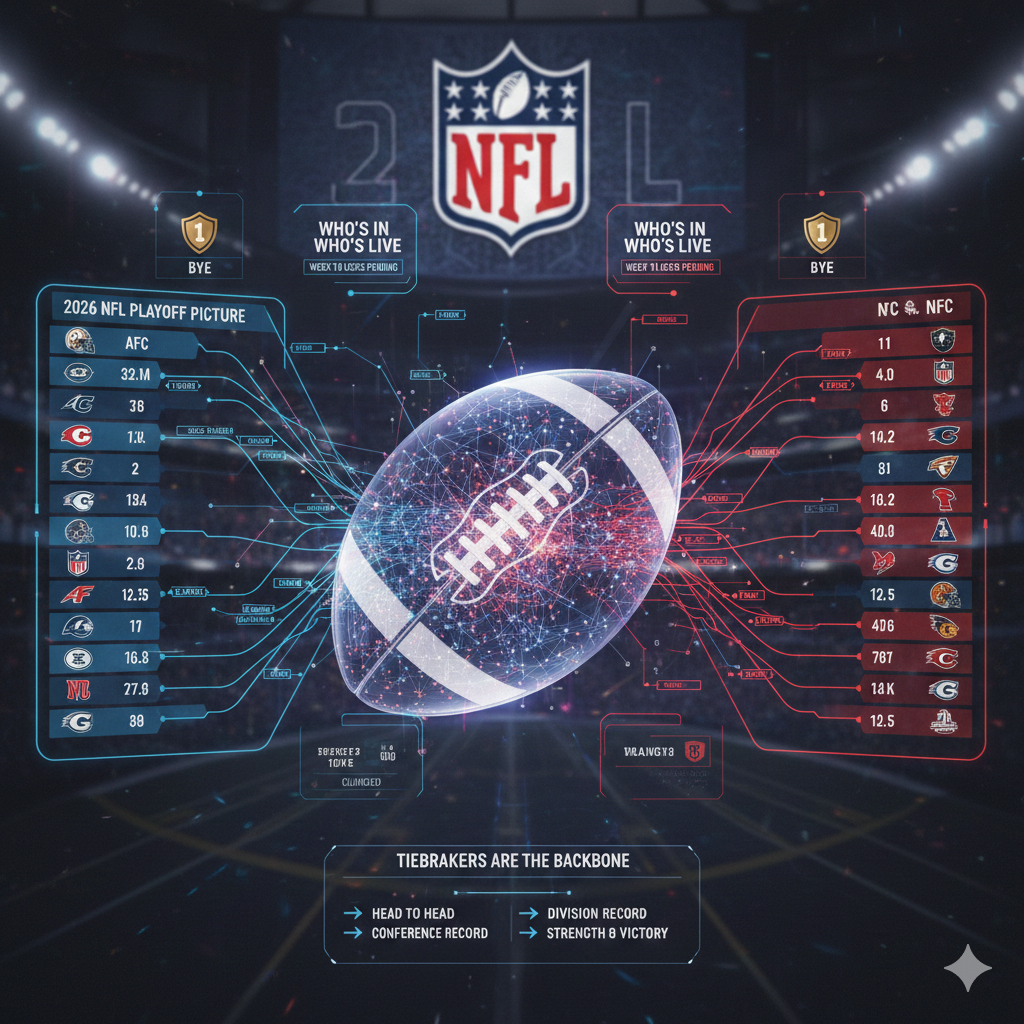
Playoff math gets very real once seeds one through seven start to take shape in the 2026 AFC and NFC playoff picture. This is the point in the season where everything feels loud and messy all at once. Fans are refreshing standings every five minutes, bettors are chasing half built scenarios, and social media is flooded with clinch graphics that look confident but quietly skip major tiebreak rules. If you have ever felt confused in late December, you are not alone.
I build sports outcome models for a living, and the goal of this guide is simple. Cut through the noise without turning this into a math lecture. No code talk, no guessing, and no viral graphics that fall apart the second you look deeper. Just clean explanations you can actually use in real time while games are being played.
This guide is built for the stretch run. It explains how the NFL playoff picture actually forms, what is locked versus what is still live, how tiebreakers really work when records match, and how to track everything without getting burned by bad information. If you are betting, modeling, or just trying to understand how your team can still sneak in, this walks through the process step by step using the same logic ATSwins uses when playoff chaos hits.
Table Of Contents
- 2026 NFL Playoff Picture: Who’s In, Who’s Live, and How the Seeds Will Lock
- 2026 AFC and NFC playoff picture pending until Week 18 locks
- Seeding and tiebreakers that decide who’s in
- Key dates and format for 2026
- Real time verification and tracking
- Seeding flows you will see on Wild Card Weekend
- ATSwins angle: how playoff picture chaos turns into bets
- Step by step building your Week 18 and playoff card with ATSwins
- Tools and templates you can use
- Practical examples without naming 2026 teams
- Key differences between division and wild card tiebreaks you should remember
- How to map No. 1 seed paths without guessing
- Flex scheduling quirks and their betting impact
- Injury reporting cutoffs and what actually matters
- How to avoid overreacting to playoff narratives
- What to do the moment the official bracket drops
- Sources to use and how we use them
- Final reminders for Week 18 and beyond
- Conclusion
- Frequently Asked Questions
2026 NFL Playoff Picture: Who’s In, Who’s Live, and How the Seeds Will Lock
By the time Week 18 arrives, the playoff picture usually feels both close to finished and completely unsettled at the same time. A few teams have already clinched and can breathe. A few are officially done even if the fan base refuses to admit it. Everyone else is stuck in that uncomfortable middle where one win changes everything or one loss ends the season.
The biggest mistake people make at this stage is assuming things are simpler than they actually are. A team being up one game in the standings does not mean they are safe. A team being down one game does not mean they are dead. Late season NFL math is rarely that clean.
The playoff format itself is not complicated. There are fourteen total teams. Seven from the AFC and seven from the NFC. Each conference sends four division winners and three wild cards. The number one seed in each conference gets a bye and home field advantage throughout the conference playoffs. Everyone else plays on Wild Card Weekend, and wild card teams always travel.
What makes everything feel chaotic is not the structure. It is the math underneath it. When multiple teams finish with the same record, the league does not guess. It follows strict tiebreak rules in a specific order. Ignore those rules and you will misread the playoff picture almost every year.
This is why you see clinch posts that are technically wrong. It is also why some teams that feel safe end up sliding into worse seeds or missing the playoffs entirely. Records matter, but context and tiebreakers matter just as much.
2026 AFC and NFC playoff picture pending until Week 18 locks
As of now, the 2026 NFL playoff field is not official. Until the final regular season games are played and the league posts the bracket, every seed should be treated as provisional. Even teams that look locked can still move based on final results.
The structure stays identical in both conferences. Four division winners qualify automatically. Three additional teams earn wild card spots based on record and tiebreakers. The top seed earns the only bye. There is no second bye anymore, which makes the race for the number one seed way more important than it used to be.
From a betting and modeling perspective, this is where discipline matters. You want to separate teams into three buckets. Locked teams have officially clinched either a playoff berth, a division, or the top seed. Live teams still control their own fate or need limited help. Eliminated teams are done regardless of what the narrative says.
In the AFC, late season races tend to be decided by conference record more often than people expect. You will see clusters of teams with similar win totals, and the difference comes down to how they performed against conference opponents. That detail flips wild card outcomes almost every year.
The NFC tends to produce more multi team ties, especially within divisions. That creates more scenario based chaos in the final week. This is where patience matters most. If a team has not been officially marked as clinched, it is still live no matter how confident social media sounds.
Seeding and tiebreakers that decide who’s in
Tiebreakers are not optional details. They are the backbone of the playoff picture. If you ignore them, you will misread standings and misprice games.
For two teams tied in record, the first thing checked is head to head results. If one team beat the other during the season, that usually ends the discussion. If they did not play or split games, the process moves forward.
If the teams are in the same division, division record becomes the next filter. If they are not in the same division, conference record is used instead. This is where many fans get lost. Conference games carry more weight in playoff math than non conference games.
If teams are still tied, the league looks at record in common games, assuming a minimum number of common opponents exists. After that, strength of victory and strength of schedule come into play. These metrics measure who you beat and who you played, not just how many games you won.
In rare cases, ties continue into net points or net touchdowns. A coin toss exists as a last resort, but it is extremely uncommon.
For three or more teams tied together, the process becomes more complex but stays structured. The league first looks for clean head to head sweeps. If none exist, it moves through division or conference record, common games, and strength metrics. Once a team is eliminated or advanced at any step, the tie is reduced and the process restarts from the top.
This reduction step is the part most people miss. It is also why simple comparison graphics are often wrong.
Key dates and format for 2026
The NFL postseason timeline stays consistent every year even if the calendar shifts slightly. Wild Card Weekend takes place in mid January. The Divisional Round follows one week later. Conference Championship games are played in late January. The Super Bowl happens in early February at a neutral site.
Wild Card Weekend features six games spread across Saturday, Sunday, and Monday. The second through fourth seeds host. Wild card teams travel. The second seed plays the seventh seed. The third hosts the sixth. The fourth hosts the fifth.
The Divisional Round brings the top seeds back in. Each number one seed hosts the lowest remaining seed in its conference. The remaining two teams face off with the higher seed hosting.
Conference Championship games are straightforward. Higher seed hosts. One game per conference.
From a betting perspective, timing matters as much as matchups. Travel, rest, and short weeks can quietly move numbers before the public notices.
Real time verification and tracking
When playoff spots are unsettled, misinformation spreads fast. The safest approach is trusting only official standings updates and confirmed clinch markers. Anything else should be treated as a scenario, not a fact.
Tracking the playoff picture correctly means refreshing after games end and checking again the next morning. Late stat corrections are rare but real. Flex scheduling decisions also matter, especially in Week 18 when kickoff windows can change motivation and betting markets.
A simple habit that helps is time stamping your notes. Write down when you checked the standings and what was official at that moment. That alone prevents confusion later.
Seeding flows you will see on Wild Card Weekend
Every postseason starts the same way. Three games per conference. The second seed plays the seventh. The third plays the sixth. The fourth plays the fifth. After that, the bracket reseeds so the top seed always faces the lowest remaining seed.
This matters for futures markets and lookahead pricing. When an upset happens early, the next round matchup becomes clear immediately and prices can move fast.
ATSwins angle: how playoff picture chaos turns into bets
At ATSwins, playoff betting is built around three pillars. Numbers, context, and confirmation.
Numbers come first. Power ratings adjust for health, rest, and recent performance without overreacting to one game. Context fills gaps models cannot fully capture, like motivation, coaching tendencies, and public bias. Confirmation comes last through injury reports, weather updates, and market movement.
January markets are sharp but not perfect. Public money still leans toward favorites, big name quarterbacks, and prime time overs. That creates small but repeatable edges for disciplined bettors.
Step by step building your Week 18 and playoff card with ATSwins
The process starts by mapping seed paths. Write out what each live team needs, who they need help from, and which games affect them. Then identify which tiebreakers are likely to matter.
Next comes pricing motivation. Teams locked into a seed may rest starters. Teams chasing slim tiebreak paths may push harder than expected. Those choices move spreads and totals.
After that, numbers get run and edges are tagged. Timing matters. Some bets are better early. Others are better late once information is complete.
Everything gets tracked. Closing line value and profit tracking keep the process honest.
Tools and templates you can use
Playoff weeks reward organization. Simple worksheets that track seed paths, injury status, weather risk, and model versus market differences go a long way. You do not need anything fancy. Consistency beats complexity.
Practical examples without naming 2026 teams
Imagine two teams tied for a wild card where one owns the head to head win. If both win in Week 18, the head to head decides it even if the other team looked better all season. Knowing that early can justify an early bet before the market adjusts.
In three team ties, division record often becomes the silent killer. One extra divisional loss can drop a team from first to out very quickly.
Key differences between division and wild card tiebreaks you should remember
Division ties prioritize division record earlier. Wild card ties prioritize conference record earlier. That difference changes how late season games should be weighted.
Multi team ties are reduced step by step. Ignoring that reduction leads to bad conclusions.
How to map No. 1 seed paths without guessing
Start with head to head results between contenders. Then track conference record. Then factor in opponent quality in the final weeks. Small edges add up when races are tight.
Flex scheduling quirks and their betting impact
Late window games are stacked to limit scoreboard watching, but edges still exist. Travel fatigue, short rest, and public bias toward prime time overs matter.
Injury reporting cutoffs and what actually matters
Focus on positions that move numbers. Quarterback, offensive line, primary receivers, and top corners matter more than depth changes. A star playing through injury with a weakened supporting cast can still be a downgrade.
How to avoid overreacting to playoff narratives
Cold weather does not automatically mean unders. Defense wins championships is not a betting model. Past playoff failures do not predict current outcomes. Price what exists now.
What to do the moment the official bracket drops
Save the official bracket. Lock matchup ratings. Watch openers in smaller markets. Build your plan and let the market come to you.
Sources to use and how we use them
Always verify playoff status using official league updates. Use historical data for context, not confirmation. Pair that with ATSwins modeling tools once the bracket is official.
Final reminders for Week 18 and beyond
Nothing is final until it is official. Tiebreakers matter. Wild cards travel. There is no reseeding mid week. Preparation beats speed.
Conclusion
The 2026 NFL playoff picture is built on structure, not vibes. Four division winners, three wild cards, one bye per conference. Tiebreakers decide everything when records match. Track the math correctly, verify information properly, and apply context without overreacting, and the chaos becomes manageable.
ATSwins brings that structure into betting with AI powered projections, betting splits, player props, and profit tracking across major leagues. Whether you are just trying to understand who is in or looking for betting edges, the process stays the same. Verify, model, confirm, then act.
Frequently Asked Questions
Who is in the NFL playoffs for 2026 right now and how do I check the seeds?
The playoff field is not official until the final regular season games finish. Always rely on current official standings and clinch indicators. Refresh after games and again the next morning.
How do tiebreakers decide who gets in when records match?
Head to head comes first. Division or conference record comes next. Common games, strength of victory, and strength of schedule follow. Multi team ties are reduced step by step.
What key dates affect the playoff picture?
Week 18 locks most outcomes. Wild Card Weekend follows in mid January. The Divisional Round comes next, then Conference Championships, then the Super Bowl in early February.
Can ATSwins help analyze playoff teams and bets?
Yes. ATSwins is an AI powered sports prediction platform that helps analyze matchups, betting splits, player props, and long term profitability. It complements official standings by helping determine whether the price is worth the risk.
What is the quickest way to check the playoff picture on mobile?
Open live standings, check clinch indicators, review conference records for tied teams, and refresh after prime time games. Doing this consistently prevents bad assumptions.
Related Posts
AI For Sports Prediction - Bet Smarter and Win More
AI Football Betting Tools - How They Make Winning Easier
Bet Like a Pro in 2025 with Sports AI Prediction Tools
Sources
The Game Changer: How AI Is Transforming The World Of Sports Gambling
AI and the Bookie: How Artificial Intelligence is Helping Transform Sports Betting
How to Use AI for Sports Betting
Keywords:
MLB AI predictions atswins
ai mlb predictions atswins
NBA AI predictions atswins
basketball ai prediction atswins
NFL ai prediction atswins
ai betting analysis