

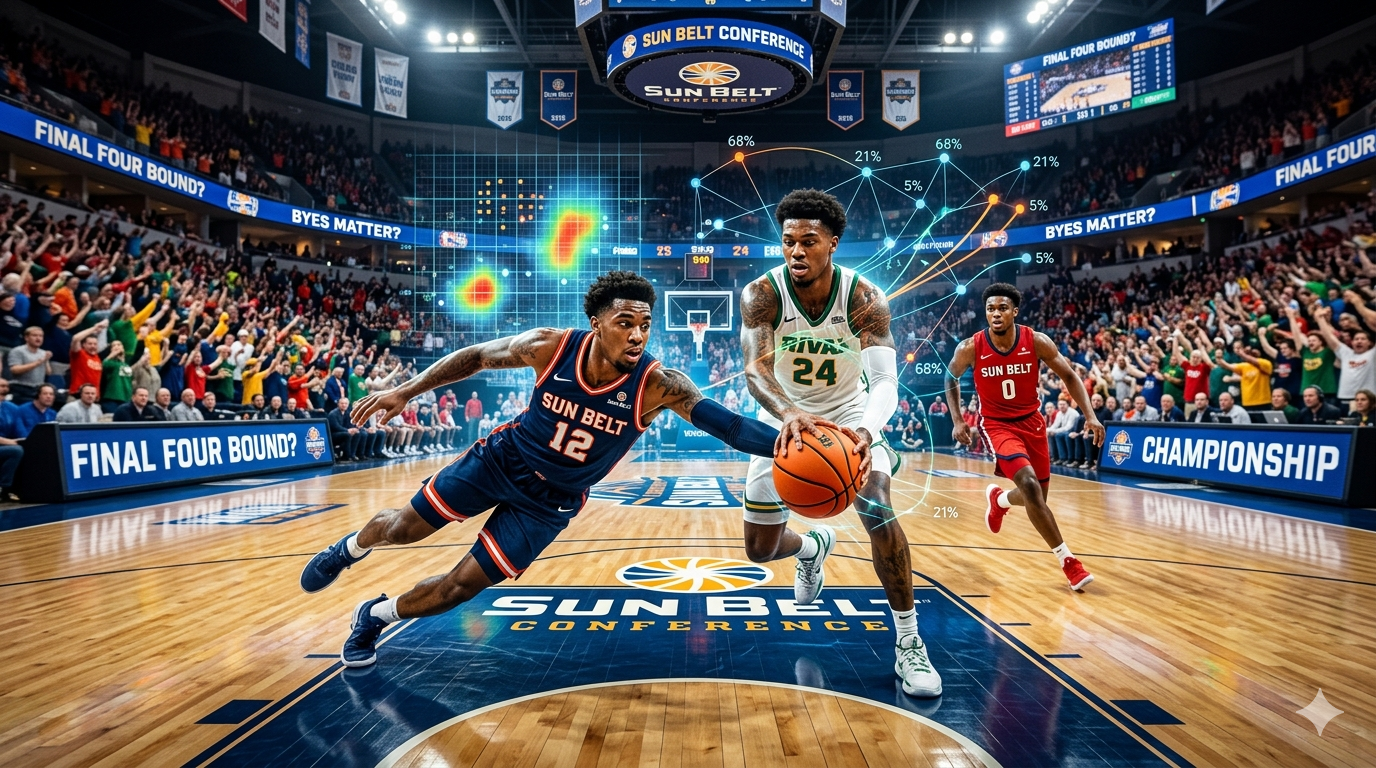
March in the Sun Belt Conference is chaotic in the best way possible. If you follow college basketball long enough you start to realize that conference tournaments rarely play out the way the standings suggest. Teams that looked average for months suddenly catch fire. Favorites stumble in back to back games. Role players hit shots they never hit all season. That randomness is exactly why modeling a tournament like this is interesting.
In this breakdown I’m going to walk through how an AI driven approach can estimate win probabilities for every team in the Sun Belt tournament played at a neutral site in Pensacola. Instead of relying on seed rankings or vibes, the model leans on pace, efficiency, matchup styles, foul risk, fatigue, and rotation stability. Once those inputs are built, the bracket gets simulated thousands of times so we can understand the full range of outcomes.
The goal is not to predict a single winner. That is not realistic in a single elimination format. The real goal is to convert messy matchups into clear probabilities. When you run enough simulations you start to see how likely each team is to reach the quarterfinals, the semifinals, and eventually cut down the nets.
This approach also keeps things transparent. Instead of a mysterious black box, every step of the modeling pipeline is visible and testable. That matters if you actually want to trust the numbers.
Table Of Contents
- Sun Belt Tournament Model That Thinks Like the Bracket
- Tournament Context and Data Foundation
- Data Collection and Cleaning
- Feature Engineering and Model Selection
- Bracket Aware Simulation and Scheduling Effects
- Backtesting, Calibration, and Interpretability
- Deployment, Reproducibility, and Reporting
- What Matters Most in Sun Belt Tournament Games
- Conclusion
- Frequently Asked Questions
Sun Belt Tournament Model That Thinks Like the Bracket
The biggest mistake people make when building tournament models is treating each game as if it exists in isolation. That approach works for regular season predictions but it falls apart in conference tournaments. Every result changes the path ahead.
A realistic model has to understand the bracket structure itself. Some teams receive byes. Some teams play multiple games in three days. Others get extra rest before the quarterfinals. All of those factors influence performance.
Instead of simply rating teams, the model treats the entire bracket as a system. Each game feeds into the next one. Every simulated outcome reshapes the remaining matchups.
When you run this type of bracket aware model enough times, patterns start to appear. Certain teams consistently reach later rounds because their playing style translates well in neutral environments. Others struggle once fatigue or foul trouble becomes a factor.
The entire point is to move from guessing to probability distributions.
Tournament Context and Data Foundation
The Sun Belt tournament takes place in Pensacola at a neutral site. That small detail actually matters quite a bit. Teams that dominate at home often lose some edge when crowd noise disappears. Meanwhile well disciplined teams that rely on structure instead of emotion tend to perform more consistently in quiet environments.
Because of this, the model treats neutral court performance as its own category rather than just averaging home and road results. Some teams historically travel well. Others depend heavily on their home arena.
Neutral games also introduce subtle shooting changes. Background depth behind the basket can alter how comfortable shooters feel. Instead of assuming shooting percentages stay identical, the model slightly increases shooting variance. The average may stay the same, but outcomes swing a little wider.
Seeding structure is another huge part of the equation. Higher seeds earn byes in the bracket. That means they play fewer games and usually get extra rest before entering the tournament.
Rest advantages can swing efficiency in small ways. Teams playing their second game in two days often see minor drops in defensive rebounding and late game shooting accuracy. Rotations tighten and bench players become more important.
Travel distance is another variable that quietly influences outcomes. Not every campus sits the same distance from Pensacola. While the differences are not extreme, travel fatigue can still accumulate during the final weeks of the season.
Because of these factors the model encodes several contextual variables. Rest days between games get recorded. Bye rounds are tagged. Travel distance is estimated. The round index is included so the model understands when a game happens in the bracket.
These small adjustments add realism that simple power ratings completely ignore.
Data Collection and Cleaning
Before any modeling begins the data itself has to be structured correctly. The most reliable way to do that is to build everything around possessions rather than raw scoring totals.
Possessions normalize pace differences. A fast team might score more points per game simply because they play more possessions. Efficiency statistics remove that distortion.
Each game record includes the date, opponent, location, final score, and overtime flags. From those numbers we estimate possessions using the classic basketball formula involving field goal attempts, offensive rebounds, turnovers, and free throws.
Once possessions are estimated, the four factors get calculated for both teams. These include effective field goal percentage, turnover rate, offensive rebounding rate, and free throw rate. Those four metrics capture the core mechanics of basketball performance.
The data then gets expanded using rolling windows. Instead of relying on a full season average, the model tracks recent performance across the last five games, the last ten games, and the entire season.
Opponent strength also needs adjustment. Playing well against weak defenses does not mean much if the competition is soft. To stabilize those signals, opponent adjustments shrink extreme values toward league averages.
Another useful signal is rotation stability. Teams with consistent minutes distribution tend to perform more predictably in tournaments. A simple continuity index measures how many minutes come from the top seven players over recent games.
Injuries and lineup disruptions reduce that number. If a key guard suddenly misses time, the continuity metric drops and the model recognizes increased uncertainty.
Seeds and bracket positions are also encoded directly into the dataset. Every potential matchup becomes a row containing feature differences between two teams.
Finally, travel estimates and fatigue indicators are added. Games played within short rest windows receive flags so the model can learn how performance shifts during heavy schedules.
After those steps the dataset becomes a structured representation of the entire season leading into the tournament.
Feature Engineering and Model Selection
Once the data is organized, feature engineering becomes the main focus. The most important variables remain possession based efficiency numbers.
Adjusted offensive efficiency measures how many points a team scores per 100 possessions after accounting for opponent strength. Defensive efficiency measures the opposite side.
Tempo metrics capture pace. Some teams thrive in fast games while others slow everything down. That stylistic difference often decides tournament matchups.
The four factors remain central features. Shooting efficiency usually drives the biggest differences, but rebounding and turnovers can swing outcomes dramatically during short tournaments.
Additional shot profile metrics help explain offensive structure. Teams that generate many rim attempts tend to produce stable scoring. Teams dependent on three point shooting carry more variance.
Late game performance metrics also get added. Possessions in the final four minutes of close games reveal how teams handle pressure. These situations occur frequently in tournament play.
Contextual variables like rest days, travel distance, and rotation continuity round out the dataset.
From a modeling perspective several methods can produce win probabilities. Logistic regression is a reliable baseline because it produces stable predictions and remains interpretable. It works well when sample sizes are limited.
Rating systems similar to Elo also help capture momentum throughout the season. These ratings update after each game and reflect team strength relative to opponents.
More complex models like gradient boosted trees capture non linear interactions between features. For example the effect of rest might change depending on pace or turnover pressure.
A practical system combines several of these approaches. A hierarchical logistic framework handles team level offense and defense ratings. A boosted model learns interaction patterns between engineered features. The final probabilities then get calibrated to ensure they match historical outcomes.
Calibration matters more than model complexity. A prediction of sixty percent should actually win around sixty percent of the time over the long run.
Bracket Aware Simulation and Scheduling Effects
Once the model produces single game probabilities, the next step is turning those into tournament outcomes. This is where Monte Carlo simulation comes into play.
First the system calculates the probability of every possible matchup in the bracket. Those numbers assume neutral court conditions and known rest situations.
Then the bracket state gets initialized. Seeds, byes, and scheduled game days all get defined. Each team also receives a baseline fatigue level.
From there the simulation runs thousands of tournaments. In each run the model randomly samples game outcomes based on predicted probabilities. Winners advance while fatigue and foul risk update slightly.
Fatigue grows when teams play multiple games in short periods. That fatigue can lower shooting efficiency or rebounding strength in later rounds.
Foul trouble introduces additional randomness. Teams that draw many fouls can occasionally remove key defenders from the floor. The model samples foul rates using distributions centered around season averages.
Close games receive additional variance. When margins are small, a handful of possessions determine the outcome. Instead of pretending the model knows exactly what will happen, the simulation slightly widens the distribution of final possessions.
After thousands of simulated tournaments, the results get aggregated. Each team receives advancement probabilities for every round.
You can see how often a specific team reaches the semifinals or how frequently two teams meet in the championship game. These distributions tell a far richer story than a single predicted bracket.
Backtesting, Calibration, and Interpretability
No model should be trusted without testing it against historical tournaments. Backtesting ensures that predictions remain realistic.
The best approach is to train the model only on regular season games from past seasons. Each year’s tournament then becomes a fresh test set.
Performance is measured using probability focused metrics. Log loss punishes predictions that are overly confident. Brier score measures average squared error between predicted probabilities and actual results.
Reliability curves help visualize calibration. Predictions get grouped into buckets and compared against real outcomes. If games predicted at seventy percent only win sixty percent of the time, the model is overconfident.
Baseline comparisons are also important. A simple seed based probability model serves as a reference point. If the advanced model cannot outperform that baseline, something is wrong.
Interpretability tools also reveal which features drive predictions. Feature attribution methods highlight how variables like offensive rebounding or rest days influence win probabilities in specific matchups.
These insights help analysts understand why the model prefers one team over another. That transparency builds trust in the numbers.
Deployment, Reproducibility, and Reporting
A good model is useless if it cannot be reproduced. Every run should use fixed data snapshots and recorded simulation seeds. That way analysts can recreate identical results later.
Data pipelines typically store raw inputs, processed features, trained models, and final outputs in separate folders. This structure keeps experiments organized.
Before the tournament begins the entire pipeline runs from start to finish. Regular season data gets locked, models train, matchup probabilities generate, and bracket simulations run.
The final outputs include round by round advancement odds, likely semifinal pairings, and overall championship probabilities.
A simple dashboard can display these numbers for quick viewing. Analysts can also compare updates if injuries or lineup changes occur before the tournament begins.
At ATSwins the focus is on making these insights easy to interpret. Instead of overwhelming users with raw model outputs, the results get packaged into readable probability summaries and scenario breakdowns.
That approach allows fans and analysts to quickly understand which teams carry the strongest paths through the bracket.
What Matters Most in Sun Belt Tournament Games
Certain patterns repeat themselves almost every year in the Sun Belt tournament. Offensive rebounding consistently proves valuable. Teams that control the glass create extra scoring opportunities even when shooting percentages drop.
Turnovers also play a major role. Underdogs often rely on aggressive defensive pressure, but if that pressure leads to foul trouble or defensive breakdowns the strategy can backfire quickly.
Pace control is another underrated factor. Slower teams with strong defenses tend to reduce upset volatility. By limiting possessions they shrink the window for underdogs to go on scoring runs.
Coaching tendencies also matter. Some coaches automatically bench players with two fouls early in games. That decision can change rotation depth and influence efficiency metrics.
Capturing these tendencies through data and simulation helps explain why certain teams consistently outperform their seed positions.
Conclusion
Building reliable Sun Belt tournament predictions is less about guessing winners and more about understanding probabilities. Clean possession based data forms the foundation. Smart feature engineering captures matchup dynamics. Bracket aware simulations translate single game predictions into tournament paths.
When all those pieces come together, analysts gain a much clearer picture of how the tournament might unfold.
ATSwins focuses on turning those modeling techniques into accessible insights. The platform uses data driven analysis to evaluate matchups, track performance trends, and generate probability based predictions across multiple sports leagues including college basketball.
Instead of relying on hype or narratives, the approach stays grounded in measurable information. That makes it easier to evaluate scenarios, understand risk, and follow the numbers as the tournament develops.
Frequently Asked Questions
What data is required to build a Sun Belt tournament prediction model?
The most important data includes possession based efficiency metrics. Offensive and defensive efficiency, shooting percentages, turnover rates, rebounding rates, and free throw rates form the core statistics. Additional context like rest days, rotation stability, injuries, and neutral court performance helps refine predictions. Combining those variables creates a balanced view of each team entering the tournament.
Why do neutral sites change predictions?
Neutral courts remove traditional home court advantages. Crowd energy disappears and shooting environments change slightly. Teams that rely heavily on home momentum often perform differently in neutral arenas. Modeling these conditions separately helps maintain realistic expectations.
Which models work best for tournament predictions?
Transparent models such as logistic regression paired with rating systems provide strong baselines. More advanced models like gradient boosted trees capture interactions between pace, turnovers, and rest factors. The most important step is calibrating probabilities so predictions align with historical outcomes.
How does ATSwins support tournament modeling?
ATSwins provides a platform focused on data driven sports insights. By combining statistical modeling, matchup analysis, and performance tracking, it helps analysts interpret probabilities and understand how team dynamics influence tournament outcomes.
Related Posts
AI For Sports Prediction - Bet Smarter and Win More
AI Football Betting Tools - How They Make Winning Easier
Bet Like a Pro in 2025 with Sports AI Prediction Tools
Sources
The Game Changer: How AI Is Transforming The World Of Sports Gambling
AI and the Bookie: How Artificial Intelligence is Helping Transform Sports Betting
How to Use AI for Sports Betting
Keywords:
MLB AI predictions atswins
ai mlb predictions atswins
NBA AI predictions atswins
basketball ai prediction atswins
NFL ai prediction atswins