

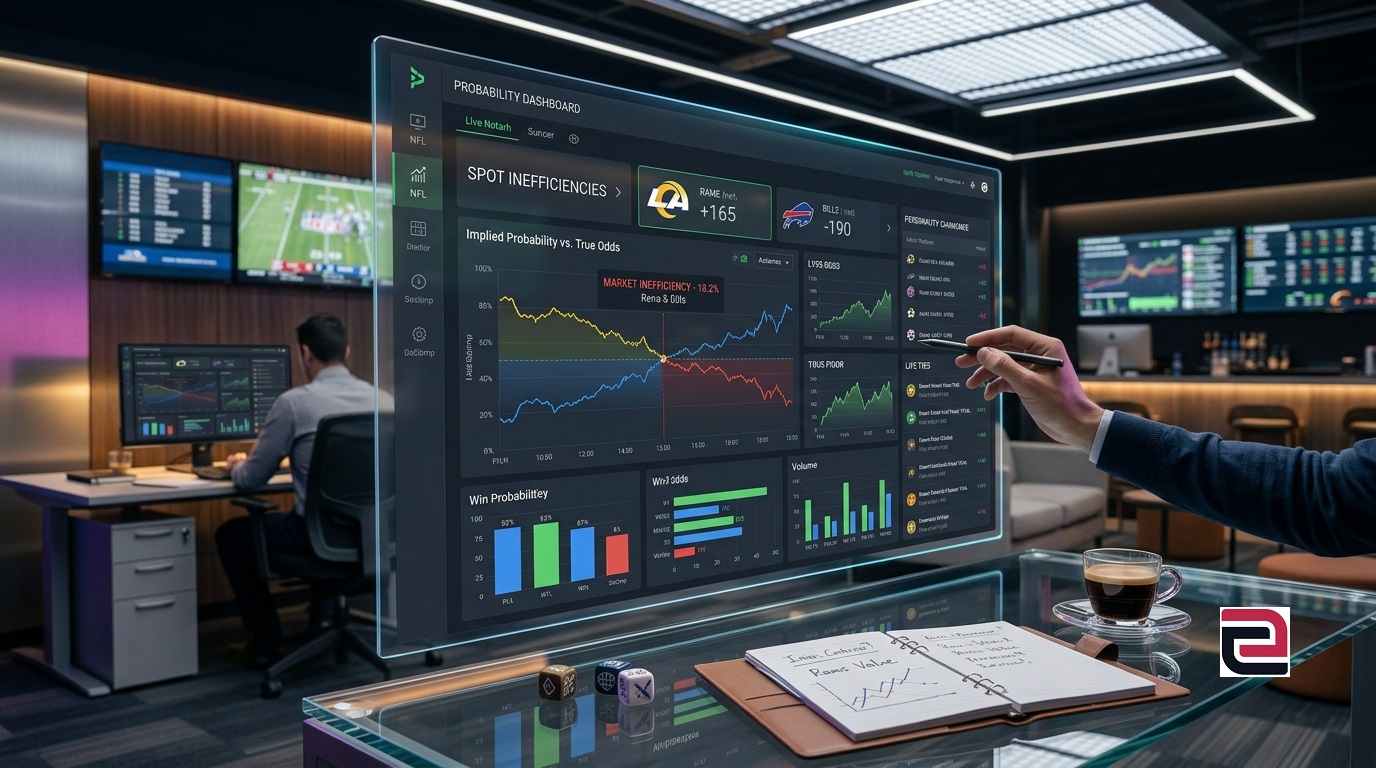
I built my sports betting probability dashboard to turn noisy odds into clear decisions. Using AI models I actually trust, I convert sportsbook lines into implied chances, strip out the vig, and size bets based on my bankroll instead of vibes. In this article, I’m walking through how I find edge, how I track closing line value, how I avoid the dumb mistakes that cost money, and how you can copy this whole setup faster than you probably think.
Table Of Contents
- What this dashboard is for and why it matters
- Data and modeling inputs that make the dashboard credible
- UI and decision metrics that reduce hesitation
- Validation and monitoring so your numbers stay honest
- Implementation sketch you can ship this month
- How this fits with an ATSwins workflow
- Practical, sport-specific notes that save you time
- Edge hygiene: steps before you press “bet”
- Common pitfalls and simple fixes
- Short list of tools that make this faster
- Responsible wagering and transparent assumptions
- Conclusion
- Frequently Asked Questions (FAQs)
What this dashboard is for and why it matters
A sports betting probability dashboard is basically your command center. It is where raw sportsbook odds get turned into something you can actually use to make decisions. Instead of guessing or chasing narratives, you’re looking at probabilities, fair prices, and whether the market is off.
The whole point is to standardize how you go from data to decision. Without that structure, you end up second guessing everything or worse, betting based on whatever feels right in the moment. This dashboard removes that friction. You see your model’s win probability, you see the market’s fair probability after removing vig, and you instantly know if there is edge or not.
If you already use ATSwins, this becomes even more powerful. You are not just building numbers in a vacuum. You are layering your model with proven projections, betting splits, and performance tracking. That combination makes your decisions faster and a lot more grounded.
At a glance, your dashboard should show you the model probability versus market probability, the fair line, your expected value, and how much you should actually bet based on your bankroll. It should also show how the line has moved so you can see if you are beating the market or just reacting to it.
Speed matters too. If your model shows value and it takes you five minutes to act, that edge might already be gone. The goal is to make decisions in seconds, not minutes.
Data and modeling inputs that make the dashboard credible
Everything starts with data. If your inputs are weak, your outputs are useless. That sounds obvious, but a lot of people skip this part and jump straight into modeling.
You need consistent odds data across multiple sportsbooks. That gives you a more accurate picture of the market instead of relying on a single number. Once you have that, you convert those odds into implied probabilities. From there, you remove the vig so you get the true market expectation.
That process alone already gives you a big edge over casual bettors. Most people never even think about removing vig. They just look at odds and guess.
After that, you layer in context. This is where things get interesting. You bring in team strength, pace, injuries, travel, weather, and player projections. These factors shift probabilities constantly, and if you ignore them, your model will always lag behind the market.
Your model itself does not need to be insanely complex to be useful. A clean logistic model for moneylines or a simple simulation for totals can go a long way if it is calibrated well. The key is consistency and accuracy, not complexity for the sake of it.
Once your model produces a probability, you compare it to the market. That difference is your edge. Then you calculate expected value based on the actual odds you can bet. This step is critical. You are not betting based on theory. You are betting based on real prices you can actually get.
UI and decision metrics that reduce hesitation
Your dashboard should feel simple, even though there is a lot going on under the hood. If it feels cluttered, you are going to hesitate, and hesitation kills good bets.
The main panel should clearly show your model probability, the market’s fair probability, and the difference between them. It should also show expected value and a suggested bet size based on a fractional Kelly approach.
Confidence matters too. You want to know not just what your model says, but how certain it is. If your edge disappears when you factor in uncertainty, it is probably not worth betting.
Line movement is another big one. If the market is moving toward your number, that is usually a good sign. If it is moving against you, you need to slow down and figure out why.
Filters help a lot here. You should be able to quickly narrow down to games starting soon, specific leagues, or bets that meet your minimum edge threshold. That way you are not scrolling through a bunch of noise.
Over time, you also want to track closing line value. That tells you whether your bets are actually beating the market. If you consistently get better prices than the closing line, you are doing something right, even if short term results are up and down.
Validation and monitoring so your numbers stay honest
Building a model is one thing. Keeping it honest is another.
You need to test your model on data it has never seen before. That means running backtests where you simulate real betting conditions. You only place bets when the edge is there and when the price is actually available.
Scoring your model properly is also important. Metrics like Brier score and log loss give you a better sense of accuracy than just looking at win rate. You also want to check calibration. If your model says something has a 60 percent chance, it should win around 60 percent of the time over a large sample. This aligns with concepts discussed in “Sports Betting Decision Support System: Analytics for Smarter Betting,” which emphasizes calibration and probabilistic accuracy as core components of smarter wagering systems.
Drift happens too. Markets change, teams change, and your model can slowly become less accurate. That is why you need regular checks. If performance drops or calibration shifts, you adjust.
Tracking everything is key. Every bet should be logged with the price, the time, the stake, and the outcome. That gives you a full picture of what is working and what is not.
Implementation sketch you can ship this month
You do not need a huge team to build this. You can get a solid version running in a few weeks if you stay focused.
Start with data collection. Pull odds, event data, and projections into a database. Clean everything and make sure it updates regularly.
Next, build a simple model. Do not overthink it. A baseline model that is calibrated properly is better than a complex one that is not.
Then build your dashboard. Focus on the core features first. Show probabilities, edge, expected value, and suggested stake. Make sure it updates quickly.
After that, add tracking. Log your bets and start measuring performance and closing line value.
Finally, add alerts. When a bet meets your criteria, you should know immediately. That is how you stay ahead of the market.
How this fits with an ATSwins workflow
If you are using ATSwins, your dashboard becomes a lot more powerful. Instead of relying on a single model, you are combining your own numbers with a proven system that already tracks performance across multiple sports.
You can use ATSwins projections as a benchmark. When both your model and ATSwins agree, those are usually your strongest plays. When they disagree, that is where you dig deeper.
This setup also helps with discipline. You are not just betting because something looks good. You are betting because multiple signals line up.
Over time, you can track where that agreement produces the best results. That lets you adjust your strategy and focus on what actually works.
Practical, sport-specific notes that save you time
Different sports behave differently, and your dashboard should reflect that.
Football markets react heavily to injuries and weather. You need to update quickly when those factors change. Basketball is more about pace and rotations. Minutes projections are huge for player props.
Baseball revolves around pitchers and matchups. Hockey depends a lot on goalies and travel. Soccer requires a different approach entirely, especially when accounting for draws.
You do not need to master everything at once. Start with one sport, get your process right, and then expand.
Edge hygiene: steps before you press “bet”
Before placing any bet, run through a quick checklist in your head.
Make sure the price you are seeing is still available. Check for any late injury or lineup news. Confirm your stake size fits your bankroll rules.
Take a second to think about why the edge exists. If you cannot explain it, that is a red flag.
Log the bet with a short note. That helps you learn over time and avoid repeating mistakes.
Common pitfalls and simple fixes
One of the biggest mistakes is overconfidence. If your model is not calibrated, you can end up betting too aggressively. The fix is simple. Use fractional Kelly and adjust based on performance.
Another issue is chasing prices you cannot actually get. Always base your calculations on real, available odds.
People also tend to double count information. If your model already accounts for an injury, do not manually adjust again.
Finally, avoid thin markets unless you have a clear edge. The variance is higher and limits are lower, which makes it harder to scale.
Short list of tools that make this faster
You can build everything with standard tools. A programming language for data and modeling, a database for storage, and a dashboard framework for visualization are enough to get started.
The key is not the tools themselves. It is how you use them. Keep your workflow clean, your data consistent, and your logic simple.
If you are using ATSwins, a lot of the heavy lifting is already done for you in terms of projections and tracking. That lets you focus more on decision making and less on building everything from scratch.
Responsible wagering and transparent assumptions
At the end of the day, this is still betting. There is risk involved no matter how good your model is.
You need to be clear about your assumptions. Models are not perfect. They are just tools to help you make better decisions.
Stick to your bankroll rules. Do not increase your stakes just because you feel confident. Over time, discipline matters more than any single bet.
Document your process and stay consistent. That is how you build something that actually works long term.
Conclusion
This whole setup is about turning information into action. You take odds, convert them into probabilities, compare them to your model, and make decisions based on expected value and proper sizing.
If you stay disciplined and keep your process clean, you can remove a lot of the randomness from betting. You will still have variance, but you will also have a system that gives you a real edge.
Using ATSwins alongside your dashboard makes everything smoother. You get reliable projections, tracking, and additional signals that help confirm your plays.
At the end of the day, it is not about winning every bet. It is about making good decisions consistently and letting the results play out over time.
Frequently Asked Questions (FAQs)
What is a sports betting probability dashboard and how does it help me find edges?
It is a tool that converts sportsbook odds into probabilities and compares them to your model. When your model shows a higher probability than the market, you have an edge. The dashboard helps you act on that quickly and consistently.
How do I convert odds to implied probabilities inside a sports betting probability dashboard?
You convert odds into probabilities using standard formulas and then remove the vig by normalizing the probabilities. This gives you a fair view of the market and makes it easier to spot value.
What metrics should a sports betting probability dashboard show for bankroll and bet sizing?
You should always see edge percentage, expected value, and a suggested bet size based on your bankroll. Tracking closing line value is also important for long term evaluation.
How does ATSwins fit into a sports betting probability dashboard workflow?
ATSwins provides data-driven picks, projections, and tracking that you can use alongside your own model. It helps confirm your decisions and improve consistency.
How do I know my sports betting probability dashboard is calibrated and not overfitting?
You check calibration by comparing predicted probabilities to actual outcomes over time. You also track scoring metrics and closing line value to make sure your model is performing as expected.