

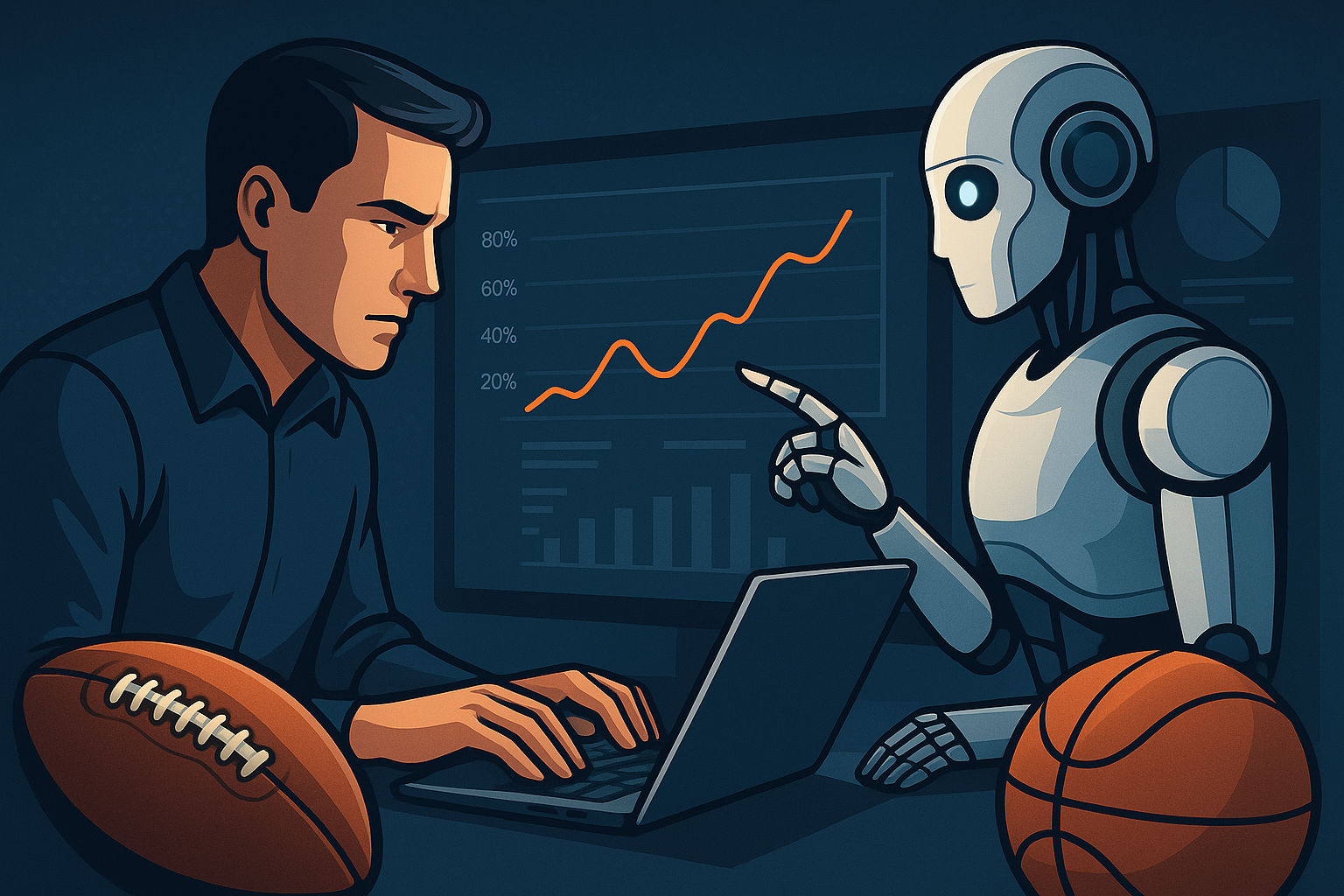
Sports gambling AI can be powerful when used with disciplined thinking, clean data, and a clear bankroll plan. As a pro analyst, I’ll show how to turn probabilities into edges, avoid common traps, and build repeatable processes from data pipelines and modeling to calibration and staking so your decisions are sharper, steadier, and accountable.
Table Of Contents
- What sports gambling AI actually is (and isn’t)
- Data pipelines and features that move the needle
- Modeling approaches that are practical
- Bankroll, execution, and day-to-day operations
- Ethics, compliance, and transparency
- Step-by-step to build your own system
- Practical examples, tools, and templates
- How ATSwins.ai fits into this framework (and why that matters)
- FAQs
- A simple, repeatable build plan
- Quick templates you can reuse
- Realistic expectations and the professional mindset
- Conclusion
- Frequently Asked Questions (FAQs)
What sports gambling AI actually is (and isn’t)
Sports gambling AI is basically a combination of structured data pipelines, smart feature engineering, model training, and disciplined decision making that tries to assign better probabilities to sports outcomes than the market. A lot of people hear the term AI and start imagining some magical machine that predicts every upset or knows advanced stuff like locker room drama or last second play calling. That is not what happens here. Real sports gambling AI just takes all the messy information floating around a league and organizes it into something you can actually use. It consumes odds history, injury reports, weather details, role changes, rotation patterns, travel situations, and recent form, then turns all of that into features a model can learn from. After that, you rely on calibrated probabilities rather than vibes or gut feelings.
It is definitely not perfect. AI is not going to give you guaranteed profit or anything close to that. All it does is increase your chance of having a long term edge if you build it the right way. If you want something that wins every night, there is no system in the world that can do that, especially in high variance sports like basketball, hockey, and baseball. The goal is not perfection. The goal is repeatable edges over thousands of bets. AI helps you track the edge, measure it, and keep yourself honest.
At ATSwins.ai, the whole idea is to bring these principles to real bettors. The platform provides model driven picks, props, betting splits, insights, and tracking tools across NFL, NBA, MLB, NHL, and NCAA. Everything is built around clarity instead of hype, and that’s part of what makes the system trustworthy. When you follow a model that is calibrated and structured, you can make decisions that are more consistent and easier to evaluate.
AI excels at speed. It can scan hundreds or even thousands of lines and update probabilities as news breaks. It does not get tired or emotional, and it does not panic or tilt after a losing streak. It just keeps following the rules you set. That stability is an underrated advantage when you are dealing with a market that changes constantly.
Where AI struggles is in nuance. There is a ton of context that never shows up in the data. A team might hate their coach, a player could be quietly dealing with something personal, or a locker room might be falling apart. Stuff like that barely shows up in the numbers. That is why the best setups combine human judgment and machine consistency. The model creates the baseline probabilities and alerts, then a human reviews injury context, evaluates market behavior, or handles late breaking news. This hybrid approach is exactly how most pro bettors work.
Probability calibration matters a lot. You can have two models with the same accuracy but wildly different bankroll outcomes because the poorly calibrated model exaggerates confidence and pushes you into oversized bets. If your model says 70 percent and the outcome actually hits 55 percent in the long run, that is a disaster for staking. Good calibration protects your bankroll and helps you stick to rational bet sizes.
There are several ways to calibrate. Platt scaling smooths out a model’s outputs by fitting a sigmoid. Isotonic regression gives a flexible non parametric mapping that adjusts predicted probabilities to match observed frequencies. Reliability plots show where your model is over or under confident. You can recalibrate over rolling windows because the market evolves across a season. Calibration is something people underestimate, but it is genuinely one of the most important parts of building betting AI.
There are also common myths that need to be cleared up. One myth says AI basically guarantees long term profit. That is false. Even the best models deal with variance, cold streaks, and unexpected news. Another myth says the more features you add, the better the model gets. In reality, too many features can introduce leaks or noise that drag performance down. Another myth says one model can handle every market. Props, spreads, moneylines, and totals all behave differently. They require different targets, distributions, and evaluation metrics. Backtests are not the ultimate truth either. Only live tracking, CLV, and continuous monitoring show if a model is actually beating the market.
|
Data pipelines and features that move the needle
A strong data pipeline matters more than most people think. If your data is messy, late, mislabeled, or inconsistent, your predictions suffer no matter how fancy your model is. Odds history is the backbone of most betting models. You want snapshots of opening lines, early moves, injury influenced moves, and most importantly the closing number. Closing line value, or CLV, is one of the clearest signals of long term edge. If you consistently beat the closing price, you are likely doing something right, even if short term results swing.
Capturing line movements with timestamps helps you study when the model is strongest. Maybe your model shines early in the day when the market is quiet. Or maybe it performs better closer to game time. You cannot know until you actually track it.
Injuries are massive. In the NBA, a single player can move a spread by multiple points. In the NFL, skill players, quarterbacks, cornerbacks, and key starters reshape the whole matchup. In MLB, pitchers completely change the run environment. Useful injury features include role stability, rotation changes, minutes or snap trends, and the difference between questionable and probable. You can include on off metrics like approximate estimated plus minus, adjusted EPA, or impact ratings. Lagged injury features are also important because you do not want your model accidentally looking into the future.
Weather matters most in NFL and MLB. Strong wind can push unders. Heat boosts baseball offense. Rain impacts ball travel and passing efficiency. Travel and schedule density matter across every major sport. Back to backs in NBA and NHL, long flights, short weeks in NFL, bullpen fatigue in MLB, and compressed schedules all influence performance.
Market liquidity windows change how you trade edges. Early markets can be soft but low volume. Later markets are sharper but more efficient. You want to understand which window suits your model. Overnight lines can be great for props, while totals often become better closer to kickoff or first pitch once weather clears up.
Each target type has different modeling needs. Spreads are classifications. Moneylines are straight probabilities. Totals often benefit from Poisson or negative binomial setups. Props might need distribution modeling with zero inflation or role based projections.
Preventing data leakage is a big part of keeping a model honest. Leakage happens when you use information your model should not have at decision time. You avoid this by training on strict time splits with walk forward validation. You freeze features using only data available at that timestamp. You document how each feed lags so you never give future knowledge to the model.
A minimal data stack can still work extremely well. You can use simple storage formats like Parquet for historical data and a small relational database for logs and metadata. You track bets with identifiers, timestamps, prices, market, and CLV. You do not need fancy cloud setups to start.
Modeling approaches that are practical
Some models just work better for betting because they are interpretable, stable, and easy to calibrate. Logistic regression is one of the best baselines for spreads and moneylines. It gives clear coefficients and maps well to probability. You can include home advantage, rest days, team dummies, and simple matchup features.
Poisson models are natural for totals or scoring props because they treat points, goals, or runs as count distributions. When there is over dispersion, negative binomial setups often work better. Elo systems create rolling strength ratings that adapt over time. They are great baseline tools and often outperform beginners who try to jump straight into neural nets.
Bayesian models help share information between teams, players, and seasons. If someone has limited data, partial pooling prevents the model from overreacting. If you do not want full Bayesian setups, you can approximate shrinkage with ridge or elastic net.
Gradient boosting machines like XGBoost or LightGBM capture non linear interactions like weather interacting with totals or rest interacting with travel. You just need to be careful about leaks and over complexity.
Ensembles reduce variance by combining multiple models. You can weight them based on recent log loss or Brier performance. You can track diversity because models that make different mistakes complement each other.
Once you have a probability, you compare it with the fair probability after removing vig. For example, a line at +150 implies 40 percent. A line at -120 implies around 54.5 percent. If you have a two way market where home and away add up to more than 100 percent, you normalize them so the sum is 100 percent. Your edge is simply model probability minus the implied probability after removing vig. Expected value per dollar is the edge times the payout profile.
You should bet only when EV is meaningfully positive and the confidence in the model version is stable. If you force bets because they look fun or because you want action, you break the entire structure and lose the edge the system gives you. Models only help when you stick to the math instead of drifting into emotional betting.
Bankroll, execution, and day-to-day operations
Bankroll management is the part everyone loves to skip but it is honestly the foundation of long term success. If your staking is chaotic, your results will be chaotic too. Flat betting is the safest way to start. Once you trust your model and have tracked it over hundreds of bets, you can shift into fractional Kelly. Full Kelly is way too aggressive for sports, so most pros stick to 25 to 50 percent Kelly. It helps you size bets proportional to edge without blowing up during variance spikes.
You should also cap exposure by day or sport. Recreational bettors underestimate how quickly variance stacks up across markets. A great model can lose for days or even weeks. That is normal. Consistency beats excitement in sports betting.
Execution is about timing your bets, understanding line movement patterns, and keeping logs. Even a strong model will lose money if you execute poorly. If your model finds soft openers but you only bet right before close, you are cutting your edge in half.
Daily operations include checking injury reports, verifying feed accuracy, running pre game checks, updating model versions, recalibrating probabilities, and reviewing market signals. You do not want to blindly fire bets without reviewing context. That is how edges die.
Ethics, compliance, and transparency
Sports betting is heavily regulated, and you want to make sure your system respects all legal boundaries. You should understand what data is allowed, what jurisdictions support betting, and how to keep transparency high. It is important to show users or teammates how the model works, what assumptions it makes, and where it might fail. Transparency builds trust and prevents misuse.
You also want ethical guidelines. Avoid promoting gambling to people who cannot afford it. Encourage responsible bankroll sizes. Stress the reality of variance. Do not oversell models as guaranteed winners. A transparent model is a healthy model.
Step-by-step to build your own system
You start by gathering data that is clean and consistent. Build a small pipeline that pulls odds, injuries, team stats, and rotation data. Engineer features like rest, travel, weather, roles, and line movement. Train baseline models first. Calibrate them. Track live performance. Add complexity slowly. Avoid huge jumps in architecture until you have proof that your base is solid.
The next steps involve executing small stakes live, logging results, reviewing CLV, refining timing, and gradually scaling. Never skip tracking because without logs you have no idea where the model is strong or weak.
Practical examples, tools, and templates
You can use Python with pandas, scikit-learn, LightGBM, and a notebook workflow. You can build a feature store as a simple dictionary or module. You can store model versions in JSON. You can track bets in a CSV or small database. Simple tools are enough to run serious systems.
Examples include predicting NBA spreads, MLB totals, NFL moneylines, or NHL props. Each requires different features and targets but uses the same general workflow.
How ATSwins.ai fits into this framework (and why that matters)
ATSwins.ai integrates structured data pipelines, calibrated models, player prop projections, betting splits, and transparent tracking into one platform. It is built around the exact workflow described above. The goal is to help bettors understand the reasoning behind picks instead of hiding behind vague statements.
Users can choose free or paid options depending on how deep they want to go. The platform emphasizes responsible strategy, clarity around probabilities, and tools that help people think like analysts, not gamblers chasing randomness.
FAQs
Many people ask whether they need coding experience. You do not. You can learn gradually or rely on prebuilt tools. Others ask if AI can beat the market long term. It can, but only with discipline, tracking, and constant iteration. Some people ask why models lose sometimes. Variance is part of the game. Losing streaks happen even with strong edges.
A simple, repeatable build plan
Start small. Build clean pipelines. Add features slowly. Train baseline models. Calibrate. Track. Improve timing. Expand. The repeatable plan is all about iteration and discipline rather than flashy complexity.
Quick templates you can reuse
You can reuse templates for data pulling, feature generation, model training, calibration, betting logs, and evaluation. Once you have them, you can adapt them to any league or sport.
Realistic expectations and the professional mindset
You should expect variance, ups and downs, and weeks where nothing goes your way. You should embrace tracking because it tells the truth. A professional mindset means sticking to process instead of chasing hot streaks or reacting emotionally. Models do not save you from bad habits. Good habits make models useful.
Conclusion
Sports gambling AI is powerful but only when built with discipline. Clean data, calibrated probabilities, careful feature design, and responsible staking are the core. You do not need a massive tech setup. You just need consistency. When you combine machine insight with human judgment, you get a system that helps you find edges without losing your mind to the chaos of sports.
Frequently Asked Questions (FAQs)
What is the main point of using AI in sports betting?
The goal is to make better probability estimates than the market. AI cannot predict every upset or nail every outcome. What it does well is stay consistent, avoid emotional swings, and process large amounts of data. Over time, that consistency gives you a better chance at generating small but real edges.
Does AI guarantee profit if I use it correctly?
No. Nothing in sports betting is guaranteed. AI just helps you stay disciplined and stick to probabilities instead of gut feelings. The market is sharp, variance is real, and even strong models lose in the short run. The value comes from long term repeatability, not instant results.
How do I know if my model is actually good?
Track everything. A good model consistently gets positive closing line value, stays calibrated, and performs well in walk forward tests. You want to look at log loss, Brier score, EV, and CLV. Backtests are helpful but never enough. Real edge shows up through live tracking.
What data should I start with if I am building my first system?
Start small. Odds history, injury reports, simple advanced metrics, weather, and basic team or player ratings are enough. You can always expand later. Clean, reliable data beats a massive messy dataset every time.
Do I need a complicated neural network to win?
Definitely not. Logistic regression, Elo based systems, Poisson models, and small gradient boosting models can outperform big neural nets when your data is limited. Simple models are easier to troubleshoot, calibrate, and trust.
Related Posts
AI For Sports Prediction - Bet Smarter and Win More
AI Football Betting Tools - How They Make Winning Easier
Bet Like a Pro in 2025 with Sports AI Prediction Tools
Sources
The Game Changer: How AI Is Transforming The World Of Sports Gambling
AI and the Bookie: How Artificial Intelligence is Helping Transform Sports Betting
How to Use AI for Sports Betting
Keywords:
MLB AI predictions atswins
ai mlb predictions atswins
NBA AI predictions atswins
basketball ai prediction atswins
NFL ai prediction atswins
ai betting analysis