

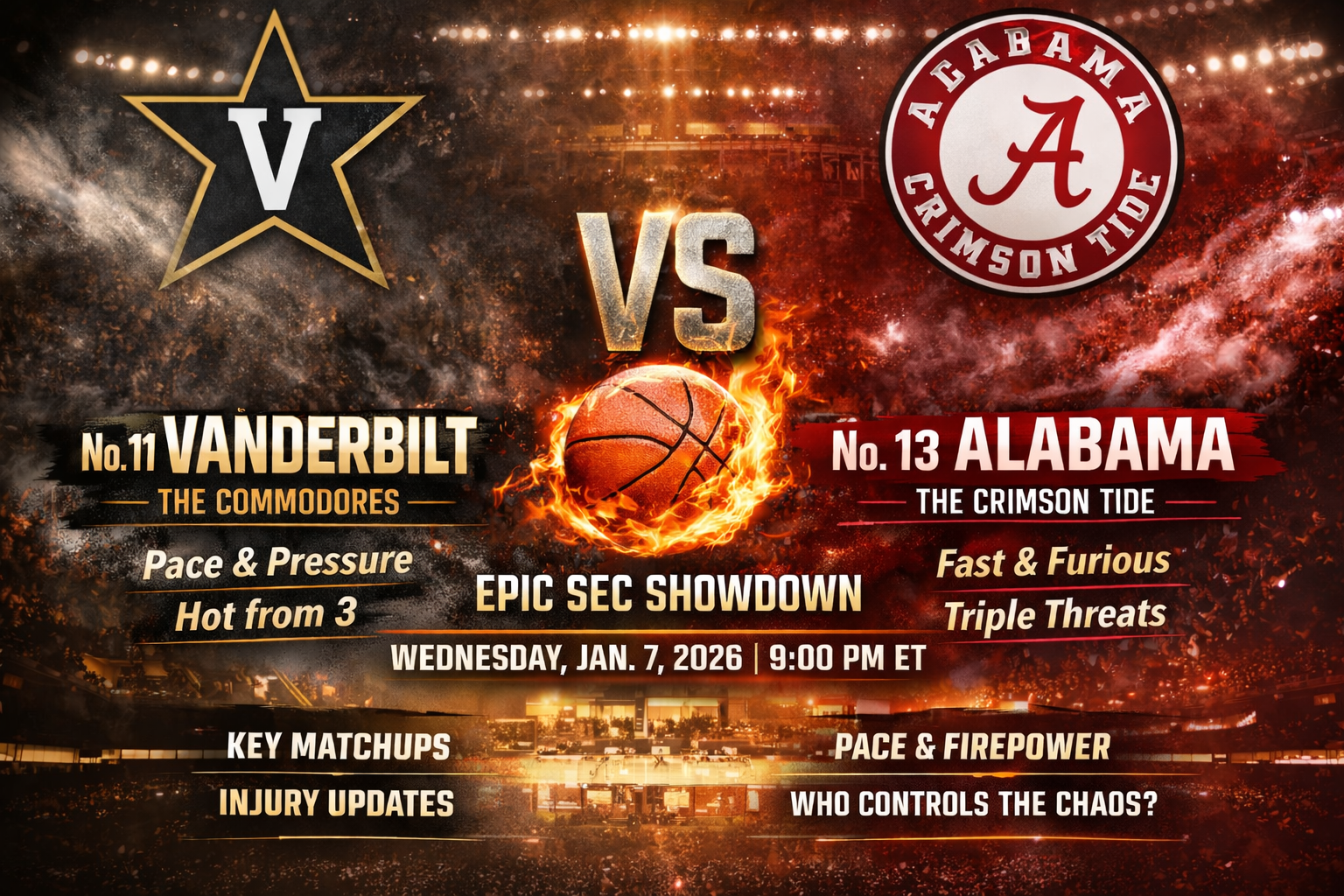
If you’re only watching one men’s college basketball game tonight, it’s this one because it’s basically a stress test for your TV’s scoreboard graphics. No. 11 Vanderbilt and No. 13 Alabama both play with pace, spacing, and the kind of shot diet that turns a normal Tuesday night into a 40-minute sprint. It’s also a rare early-January matchup where both teams look like they belong in the second weekend conversation, and the “who’s real?” questions get answered in real time.
Game context: what kind of game are we walking into?
Both teams play fast, but Alabama is a notch faster, and both are comfortable winning with offense. Alabama is around 75.8 possessions per game, Vanderbilt around 73.2.
That’s important because pace doesn’t just raise the total — it changes variance:
- More possessions = more shots = more runs
- More threes = bigger swings
- More transition chances = more foul pressure on bigs and more “oh no” turnovers
In other words: if either team has a sloppy stretch, it can turn into a 10–0 run before your group chat finishes typing “lol.”
Vanderbilt breakdown: identity, strengths, and where they can get got
Who Vanderbilt is right now
Vanderbilt is 14–0, already has a road SEC win, and they’re doing it with a blend that travels: shot-making + ball pressure + depth that can cover up one guy having a meh night.
They’re also scoring like a team that doesn’t care about your defensive reputation:
- 93.4 points per game (top-tier national scoring profile)
- 11.0 made threes per game and strong 3-point efficiency
What Vanderbilt does well
1) They have multiple creators (even when shorthanded)
Against South Carolina, Tyler Tanner went for 19 points and 14 assists while committing one turnover, and Vanderbilt stayed unbeaten even with key ball-handlers missing.
That matters because Alabama’s defense is often less about “stop you” and more about “can you keep up with the math?” Vanderbilt needs guards who can create clean possessions, not just run fast.
2) They can score in different ways
A lot of “fast teams” are secretly one-note. Vanderbilt isn’t.
They can:
- Bomb from three (they’ve hit 37.9% of their threes per CBS’s preview)
- Score efficiently inside (their bigs finish, and their wings cut)
- Get to the line (they shot 83% FT vs South Carolina)
3) Disruption is usually part of the plan
One of the most telling stats from the South Carolina game recap: Vanderbilt averages 14.8 forced turnovers, even though they only forced four in that particular win.
That’s a big “swing factor” tonight, because Alabama wants to play fast without being reckless. If Vanderbilt can turn Alabama’s early-clock possessions into giveaways (or even just rushed, non-rim attempts), that’s how you flip the game from track meet into your tempo.
Where Vanderbilt is vulnerable
1) Can they protect the rim without fouling?
Alabama attacks in waves and has legit size/athleticism across multiple lineup looks. If Vanderbilt’s bigs get into foul trouble early, it forces smaller lineups — and small lineups vs Alabama can turn into “we’re switching everything and praying.”
2) Live by the three, swing by the three
Vanderbilt is efficient from deep, but the bigger the three-point diet, the more your offense can yo-yo. That’s not a criticism — it’s just math.
If Vanderbilt has even a 3–4 minute cold stretch, Alabama is exactly the kind of team that can turn it into a margin.
3) Ball-handling depth
This is the “monitor it until tip” section.
Alabama breakdown: identity, strengths, and the most annoying things they do to opponents
Who Alabama is right now
Alabama is 11–3, coming off a statement win over Kentucky, and they’re heading into their first SEC road game with an offense that is basically built to stress modern defenses.
They’re also scoring at a silly rate:
- 94.1 points per game
- 13.2 made threes per game (elite volume and production)
What Alabama does well
1) Three-point volume that forces “pick your poison” defense
Against Kentucky, Alabama hit 15 threes; against Yale the game before, they hit 22 threes.
This isn’t just “they shoot a lot.” It’s that they shoot a lot and they do it in ways that are hard to scheme:
- Transition threes
- Drive-and-kick threes
- Early-clock trail threes
- Corner threes off quick paint touches
If Vanderbilt helps too much, the ball is already flying to a shooter. If Vanderbilt doesn’t help enough, Alabama gets downhill and pressures the rim (and fouls).
2) They can win the possession battle with defense events
Alabama’s profile is not just scoring. They also create “events”:
- 7.4 steals per game
- 6.6 blocks per game
Blocks matter extra in a high-tempo game because they can become instant runouts. (And nothing feels worse than playing good defense for 22 seconds, then getting your layup erased into a fast break three.)
3) The backcourt is in rhythm
In the Kentucky win:
- Aden Holloway scored 26 (six threes)
- Labaron Philon Jr. had 17 and three steals, returning from injury
When Alabama has multiple guards cooking, you can’t just load up on one creator. That’s how a “solid defensive plan” becomes “why are we down 11 already?”
Where Alabama is vulnerable
1) Road control (and Memorial Gym is weird on purpose)
This is Alabama’s first SEC road game.
And Memorial Gym isn’t your typical arena — the sightlines and raised floor aren’t excuses, but they do punish teams that start loose.
If Alabama comes out sloppy, Vanderbilt can turn that into momentum fast.
2) If the threes aren’t falling, can they stay patient?
Alabama’s offense is still efficient even when they don’t shoot lights out, but their whole identity is “we’re going to win the math battle.”
If Vanderbilt can run shooters off the line without giving up layups, Alabama has to live in the in-between game — midrange pull-ups, late-clock stuff, tougher finishes.
That’s a very different night.
Injury / rotation notes that actually matter
This is where the game can swing from “fun chaos” to “one team can’t run its stuff.”
Vanderbilt availability
- Duke Miles (leading scorer) has missed time recently (illness, then leg issue); Vanderbilt planned for him to practice Tuesday with hopes of playing.
- Frankie Collins (key ball-handler) has been out with a meniscus injury and was expected back later this month.
- An availability report listed Miles probable and Collins out.
Why it matters: If Miles is limited or out, Vanderbilt’s initiation leans harder on Tanner’s playmaking and on secondary creators not turning it over against Alabama pressure.
Alabama availability
- Alabama has dealt with multiple rotation questions: Taylor Bol Bowen (back spasms) and Davion Hannah (undisclosed) missed the Kentucky game.
- Aiden Sherrell left the Kentucky game with a knee injury; Nate Oats said they didn’t think it was serious, but tests would determine availability.
- An availability report listed Sherrell questionable, Hannah doubtful, and Onyejiaka out.
Why it matters: Sherrell impacts rim protection and defensive rebounding. If he’s limited, Alabama may have to play smaller more often — which can increase pace but can also open the door for Vanderbilt’s frontcourt to punish mismatches.
Key player matchups and the biggest swing factors
1) Tyler Tanner’s decision-making vs Alabama’s pressure
Tanner’s 14-assist game vs South Carolina wasn’t just a nice stat line — it was proof Vanderbilt can run offense clean even when short-handed.
Swing factor: Can Tanner keep Vanderbilt’s turnover number in check while still pushing tempo? If Vanderbilt plays fast but sloppy, Alabama’s transition threes show up like a jump scare.
2) Duke Miles (if active) as the “stability” scorer
Miles is Vanderbilt’s leading scorer and also a defensive playmaker (points + assists + steals profile).
Swing factor: Is he full-speed? In a pace game, “80% healthy” can show up quickly — especially laterally on defense and when finishing through contact.
3) Alabama’s shooting gravity vs Vanderbilt’s help rules
Alabama hit 15-of-38 from three vs Kentucky, and they’re comfortable taking 35+ threes if you let them.
Swing factor: Vanderbilt’s closeouts. Not just “run them off” — but run them off under control. Bad closeouts become fouls, and fouls become free points in a game with a high total.
4) Rebounding and second-chance math
In a high-tempo matchup, missed shots stack up. The team that turns misses into extra possessions often wins the “hidden” battle.
What to watch:
- Are Vanderbilt’s bigs staying on the floor (foul trouble)?
- Is Alabama generating runouts off long rebounds from threes?
5) Free throws: the sneaky late-game lever
Vanderbilt shot 83% at the line in the South Carolina win.
In a game where both teams want to run, whistles can slow the flow — and also decide who gets easy points when legs are tired.
Coaching and style clash: Byington vs Oats
This is a fascinating “same tempo, different goals” coaching duel.
Mark Byington’s Vanderbilt: pressure + spacing + confidence
Vanderbilt’s growth this season is how quickly they’ve become comfortable playing an aggressive brand without looking frantic. They’re undefeated, they’ve shown they can win on the road, and they’ve shown they can survive missing pieces.
The Byington plan tonight likely looks like:
- Be the more organized fast team
- Force Alabama into a few extra late-clock possessions
- Make Alabama defend multiple actions (not just one main ball screen look)
Nate Oats’ Alabama: maximize possessions, maximize threes
Alabama’s identity is consistent: play fast, hunt threes, pressure the rim, and use athleticism to create defense events.
The Oats plan tonight likely looks like:
- Keep pace high (even on the road)
- Turn Vanderbilt’s misses into transition shots
- Make Vanderbilt’s ball-handlers prove they can initiate under heat for 40 minutes
Venue and schedule spot notes
Memorial Gym factor
Games at Memorial Gym can get funky because:
- The environment is loud
- The court setup is unusual
- Momentum swings are real (and the crowd feeds off runs)
Alabama also comes in for its first SEC road game, which is a different kind of test than beating Kentucky at home.
Rest/travel
Both teams played Saturday (SEC openers) and have had several days to prepare. Vanderbilt is at home; Alabama travels into Nashville.
In high-tempo games, prep time matters because:
- Transition defense rules need to be sharp
- Matchups on shooters must be clean
- You need a plan for foul trouble and rotations
Market / line movement: what it says, and what typically drives it
You’ll see a lot of attention on this market because it’s the kind of game where tempo and shooting create public interest.
Current spread/total context
Consensus listings had Vanderbilt favored in the single-possession to two-possession range, and the total sitting in the high-170s.
Total movement: why it’s been pushed high
A key reference point: the total was listed around 176.5 at open in some market snapshots and has shown numbers up into the 177.5–178.5 range.
What drives that kind of move in games like this:
- Pace metrics (both top-50-ish in tempo by the preview’s numbers)
- Three-point volume (Alabama 513 attempts; Vanderbilt 406 attempts per the preview)
- Injury clarity (a healthy ball-handler often increases efficiency and pace; a missing rim protector can do the same)
Spread movement: what to watch for during the day
For the side, the biggest drivers are typically:
- Confirmation on Miles’ status (primary creation and defensive pressure)
- Confirmation on Sherrell/Bol Bowen/Hannah availability (rim protection + rotation depth)
- Market reaction to “road test” narratives (first SEC road game angles can attract opinions fast)
Practical note: In high-total games, each point of spread matters slightly less than in grind-it-out games — but turnovers and foul trouble matter more, because they create instant scoring chances.
What to watch live: a simple viewing guide (3–6 things)
If you want to follow the game like a sharp without turning it into homework, watch these:
- Can Vanderbilt’s guards get into offense cleanly by the 22-second mark?
If they’re burning clock just to initiate, Alabama’s athleticism is already winning.
- Alabama’s “quality threes” vs “heat-check threes.”
Early, in-rhythm threes are part of the plan. Off-balance, early-clock threes can keep Vanderbilt alive even if Alabama is “winning.”
- Turnovers in the first 8 minutes.
Vanderbilt typically forces turnovers at a high rate, but didn’t vs South Carolina. If the pressure shows up tonight, you’ll see it early.
- Foul trouble on the bigs.
If either team’s primary rim presence sits, the game can turn into a layup line + corner threes (aka the worst possible outcome for defenses).
- Who controls pace after makes?
The sneaky battle is whether Vanderbilt can slow Alabama just a beat after Alabama scores — not walk it up, but prevent instant runouts.
- Late-clock possessions: who has the better bailout option?
In a game this fast, both teams will have a few “nothing there” possessions. Watch who can still generate a good look with 6 seconds left.
How different game scripts could favor either side
Because we’re avoiding the “pick” language and staying analysis-first, think in scripts:
Script A: Vanderbilt wins the possession battle
This looks like:
- Alabama has a slightly higher turnover count than normal
- Vanderbilt gets a few extra transition chances off steals/deflections
- Vanderbilt’s half-court offense stays organized even if the pace is high
That’s how an underdog-ish home team keeps control without needing a perfect shooting night.
Script B: Alabama turns it into a 3-point math problem
This looks like:
- Alabama gets 35+ threes with a high share being clean catch-and-shoot looks
- Vanderbilt’s help defense gets stretched and closeouts get messy
- The game lives in the “trading threes for twos” zone
In that world, Vanderbilt needs either elite three-point matching or major rim pressure to keep up.
Script C: The injury/rotation game decides it
This looks like:
- One team’s questionable player is clearly limited
- That weakness shows up in either ball security (guards) or rim protection (bigs)
- The opponent hunts it possession after possession
With the availability notes on both sides, this isn’t a small possibility — it’s a real lever.
Series and “recent history” quick hit
Alabama leads the all-time series 77–68, has won four straight, and is 8–2 in the last 10 meetings per the official matchup history listing.
That’s not destiny — rosters and styles change — but it’s a reminder that Alabama has generally been comfortable in this matchup in recent years, including in Nashville.
Final thought
This is the kind of game where you don’t need a “who’s better?” answer — you need a “who can impose their version of fast?” answer. Vanderbilt wants pace with disruption and control; Alabama wants pace with volume threes and constant pressure. The cleanest early tell will be turnovers and foul trouble, and the loudest late tell will be which team still has legs to sprint back on defense after missed threes. Enjoy the fireworks — and if you want deeper context around how to think about games like this without forcing a one-line prediction, check ATSwins.ai.