

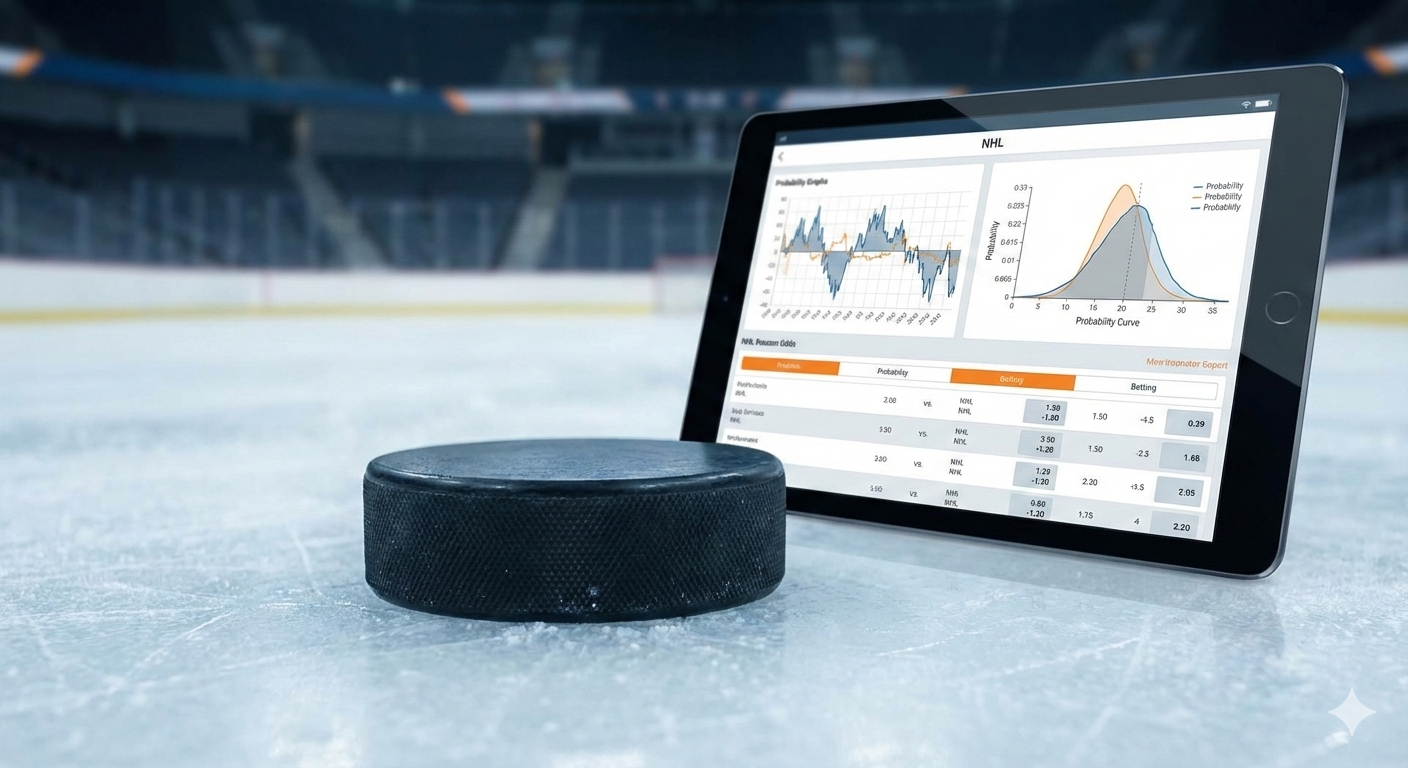
Beating the NHL puck line is not about picking the right team. It is about pricing margins better than the market. Anyone can look at a matchup and say who they think is better. That is not the edge. The edge comes from understanding how often a team actually wins by two goals or more, translating that probability into a fair price, stripping out the sportsbook’s margin, and only betting when the number is wrong enough to matter.
I approach the puck line the same way I approach any spread market. I treat it as a probability problem first and a betting decision second. The goal is not to predict scores. The goal is to estimate cover probability accurately, consistently, and with discipline. That means blending team strength, goalie impact, situational context, and game state dynamics into a repeatable model that can be applied night after night.
This article walks through how to build that process from the ground up. It is not about shortcuts or one-off angles. It is about creating a puck line projection model that can survive a full NHL season and still show an edge. Along the way, I will also show how this fits into the way ATSwins approaches NHL betting, focusing on probability, price, and long-term performance rather than vibes or hot streaks.
Table of Contents
• Core data and features
• Modeling and math stack
• Training, validation, and evaluation
• Pricing translation and bankroll
• Tools and workflow
• Step by step: from slate to stakes
• Practical tips that save money over a season
• Example: translating model output into a bet slip
• How ATSwins fits this into a bettor’s week
• Common mistakes and how to avoid them
• Optional enhancements when you have bandwidth
• Quick audit checklist
• FAQ lite: things pros ask each other
• Short build plan you can start this week
• What great looks like inside ATSwins
• Conclusion
• Frequently Asked Questions
Core Data and Features
Every puck line model starts with data, and bad data will quietly ruin everything. The goal here is not volume for the sake of volume. It is relevance, consistency, and timing. You want inputs that explain why teams score and allow goals, and you want them in a form that reflects what was actually known before the bet was placed.
At the base level, you need clean play by play and time on ice data to understand how teams perform at even strength and on special teams. From that, you can derive rate stats that normalize for pace and deployment. You also need shot quality information so that goals are not treated as random events detached from process.
At even strength, the most important drivers are expected goals for and against, shot quality distribution, and how teams generate offense. Some teams live off the rush. Others grind out cycles and rebound chances. Those styles matter because they interact differently with opponents and goalies. You also want to account for score effects, since teams change behavior depending on whether they are leading or trailing.
Special teams matter more for the puck line than many bettors realize. A single power play goal can flip a one goal game into a two goal margin. Penalty differentials, power play efficiency, and penalty kill suppression all directly affect cover probability. Ignoring special teams is one of the fastest ways to misprice the puck line.
Goalie impact deserves its own layer. Raw save percentage is not enough. You need context around shot quality, pre shot movement, rebound control, workload, and fatigue. Back to backs and travel hit goalies harder than skaters, especially when backups are involved. Early in the season, goalie samples are small and noisy, which is why shrinkage and priors matter.
Line combinations and defensive pairings also matter more than people think. Hockey is not five identical skaters rotating randomly. Matchups change when top lines are broken up, when a top four defenseman is out, or when a player is returning from injury. Home ice also matters because last change affects who plays against whom, which can swing goal differential outcomes.
Situational context rounds out the feature set. Rest days, travel distance, time zone changes, altitude, and scheduling density all influence pace and fatigue. Empty net tendencies late in games are especially important for the puck line, since many covers happen in the final minute. Some coaches pull the goalie aggressively. Others wait too long. That difference shows up in long term data.
All of these features should be stored with timestamps and versioning. If you are backtesting, you must be ruthless about only using information that would have been available at the time of the bet. Anything else is leakage, and leakage creates fake edges.
Modeling and Math Stack
Once you have features, the next step is turning them into a goal differential distribution. That distribution is the heart of a puck line model. You are not just asking who wins. You are asking how often a team wins by exactly one, by two, by three, or loses by one.
A simple and effective starting point is modeling goals scored by each team as Poisson processes. Even strength and special teams can be modeled separately and then combined. The difference between two Poisson variables gives you a Skellam distribution, which is a natural way to model goal differential.
The Skellam distribution gives you probabilities for every possible margin. From there, calculating puck line cover probability is straightforward. You just sum the probabilities where the differential meets your condition, such as winning by two or more.
However, pure independence assumptions break down in hockey. Penalties are not independent of game state. Leading teams play differently than trailing teams. Empty net situations dramatically change shot rates and variance. That is why a layered approach works best.
Hierarchical modeling helps stabilize noisy inputs, especially early in the season. Goalies benefit the most from this treatment. Backups and rookies should be regressed harder toward league average until they prove otherwise. Finishers can also be partially pooled so that short term shooting spikes do not get over-weighted.
Monte Carlo simulation is best reserved for the parts of the game where variance matters most. Overtime and empty net situations are prime examples. Three on three overtime is volatile and favors teams with elite puck carriers. Empty net play introduces asymmetry that simple Poisson models miss. Simulating those segments separately and then stitching them into the regulation distribution improves tail accuracy, which is exactly where puck line outcomes live.
Feature fusion can be handled with a mix of linear and nonlinear models. Linear models with shrinkage are stable and interpretable. Gradient boosted models can capture interactions, such as how rest interacts with travel or how rush heavy teams perform against slow defensive units. A stacked approach that blends a Skellam based distribution with a secondary classifier for cover outcomes can improve accuracy while maintaining transparency.
No matter the model, uncertainty matters. You should always output distributions and confidence intervals, not just point estimates. Those intervals help with stake sizing and risk control.
Training, Validation, and Evaluation
Validation is where most betting models fall apart. Random splits do not work in sports betting because time matters. You must validate in a way that mimics live betting.
Rolling origin validation is the standard. You train on games up to a certain date, test on the next block, then roll forward. This forces the model to operate under the same information constraints it would face in real life.
Calibration is just as important as accuracy. A model that says 55 percent and hits 55 percent is more valuable than one that says 65 percent and hits 55 percent. Calibration techniques like isotonic regression can correct systematic bias and make probabilities usable for pricing.
Evaluation should separate prediction quality from betting performance. Metrics like Brier score and log loss tell you whether your probabilities are well formed. Metrics like closing line value and return on investment tell you whether the market agrees with you over time. Both matter.
You also need stability checks. If the model performs well overall but collapses in specific scenarios, such as heavy underdogs on back to backs, that is a signal to revisit features or assumptions. Sensitivity testing helps identify which inputs drive outcomes and which ones might be over-weighted.
Pricing Translation and Bankroll
Once you have cover probability, the math of pricing is straightforward. Probability converts to fair odds by taking the inverse. From there, you compare your fair price to the market after removing vig.
Removing vig is not optional. If you compare your probability to raw sportsbook odds, you will consistently overestimate edge. Always normalize both sides of the puck line so that probabilities sum to one.
Empty net dynamics matter here more than most bettors realize. Underdogs plus one and a half benefit disproportionately from games landing on exactly one goal. Favorites minus one and a half benefit from aggressive goalie pulls and strong finishing ability. If your model does not handle this properly, your pricing will be biased.
Stake sizing should be conservative. Fractional Kelly works well in this market because variance is real. Full Kelly is too aggressive for most bettors. Capping per game and per day exposure prevents drawdowns from getting out of control.
Execution matters too. Markets move on goalie news and lineup confirmation. If your model already accounts for uncertainty, you can bet earlier. If not, you should wait and accept worse prices in exchange for clarity. Discipline here separates long term winners from gamblers chasing steam.
Tools and Workflow
A clean workflow matters as much as the model itself. Data ingestion should run nightly. Feature updates should be timestamped. Modeling should be repeatable. Pricing should be automated.
The final layer is presentation and tracking. At ATSwins, model outputs are turned into picks with transparent probabilities, fair prices, and recommended stakes. Betting splits provide context around market sentiment, and profit tracking keeps the focus on long term performance rather than short term noise.
Every bet should be logged with the model version, inputs used, time placed, and price taken. That is how you avoid hindsight bias and actually learn from results.
Step by Step: From Slate to Stakes
The daily process starts the night before with feature updates and preliminary projections. Games with high uncertainty are flagged. In the morning, goalie probabilities are updated and cover probabilities are recalculated. By midday, fair prices are compared to the market and potential edges are identified.
Bets are placed within defined risk limits, and every decision is documented. After the games, results are logged and notes are added for anything unusual, such as extended empty net time or special teams swings.
This process repeats every day. Consistency is the edge.
Practical Tips That Save Money Over a Season
Small samples lie. Priors keep you grounded early in the season. Empty net modeling matters more than people think. Special teams swing puck lines more than moneylines. Rink effects can trick you into chasing noise if you are not careful.
Do not oversize bets when goalie status is uncertain. Track rule trends and officiating changes. Avoid hardcoding reactions to last week’s results. Clear reporting beats clever narratives every time.
Example: Translating Model Output Into a Bet
Imagine your model gives a home favorite a roughly fifty percent chance to cover minus one and a half once goalie uncertainty is weighted in. That converts to a fair price near even money. If the market is offering plus money, you have a small but real edge.
The stake should reflect that. A quarter Kelly approach keeps risk manageable. Even if the game lands oddly, positive closing line value tells you the process is working.
How ATSwins Fits This Into a Bettor’s Week
ATSwins takes this modeling approach and turns it into actionable picks. Each selection shows the probability, fair price, market price, and stake suggestion. Betting splits add context, and profit tracking keeps everything honest.
The goal is not volume. It is quality, transparency, and repeatability.
Common Mistakes and How to Avoid Them
Treating goals as independent events without accounting for special teams and game state underestimates variance. Ignoring lineup confirmation leads to oversized bets. Failing to calibrate creates overconfidence. Optimizing purely on backtests without enforcing real time constraints produces fake edges.
Optional Enhancements When You Have Bandwidth
More granular lineup modeling, three on three specific ratings, and opponent interaction features can all improve accuracy if done carefully. These are refinements, not foundations.
Quick Audit Checklist
Before publishing a play, confirm data freshness, goalie assumptions, rink adjustments, calibration status, edge threshold, and stake limits. Document any assumptions clearly.
FAQ Lite: Things Pros Ask Each Other
You do not need Monte Carlo everywhere. Focus it where tails matter. Recalibrate regularly but do not chase noise. Alternate puck lines are easy once you have the full distribution, but demand higher edges. Closing line value still matters if you track it honestly.
Short Build Plan You Can Start This Week
Start with data ingestion and basic features. Add goalie context and shrinkage. Implement a Skellam differential. Calibrate probabilities. Add pricing and stake sizing. Backtest honestly. Improve one piece at a time.
What Great Looks Like Inside ATSwins
Great means transparent picks, real tracking, disciplined iteration, and bettor education. It means focusing on process health rather than last night’s result. That is how an ATS platform turns a solid NHL puck line model into sustainable value.
Conclusion
Price puck lines instead of picking winners. Build a model that understands goal differential, game state, and variance. Translate probability into fair odds. Manage risk with discipline. ATSwins brings that approach together with AI driven modeling, betting splits, and profit tracking to help bettors make smarter, more informed decisions across the NHL and beyond.
Frequently Asked Questions
An NHL puck line projection model estimates how often a team covers plus or minus one and a half goals. That probability becomes fair odds, which you compare to the market to find value.
To build a simple model, start with team strength, goalie impact, and situational context. Convert expected goals into a differential distribution. Translate cover probability into fair prices.
Goalies, shot quality, special teams, fatigue, and lineups matter most. These inputs directly shift cover probability.
When acting on edges, compare fair odds to the market, size responsibly, and track closing line value. Consistency matters more than aggression.
ATSwins helps by providing data driven picks, betting splits, and profit tracking so bettors can apply these principles with clarity and discipline.
Related Posts
AI For Sports Prediction - Bet Smarter and Win More
AI Football Betting Tools - How They Make Winning Easier
Bet Like a Pro in 2025 with Sports AI Prediction Tools
Sources
The Game Changer: How AI Is Transforming The World Of Sports Gambling
AI and the Bookie: How Artificial Intelligence is Helping Transform Sports Betting
How to Use AI for Sports Betting
Keywords:
MLB AI predictions atswins
ai mlb predictions atswins
NBA AI predictions atswins
basketball ai prediction atswins
NFL ai prediction atswins