

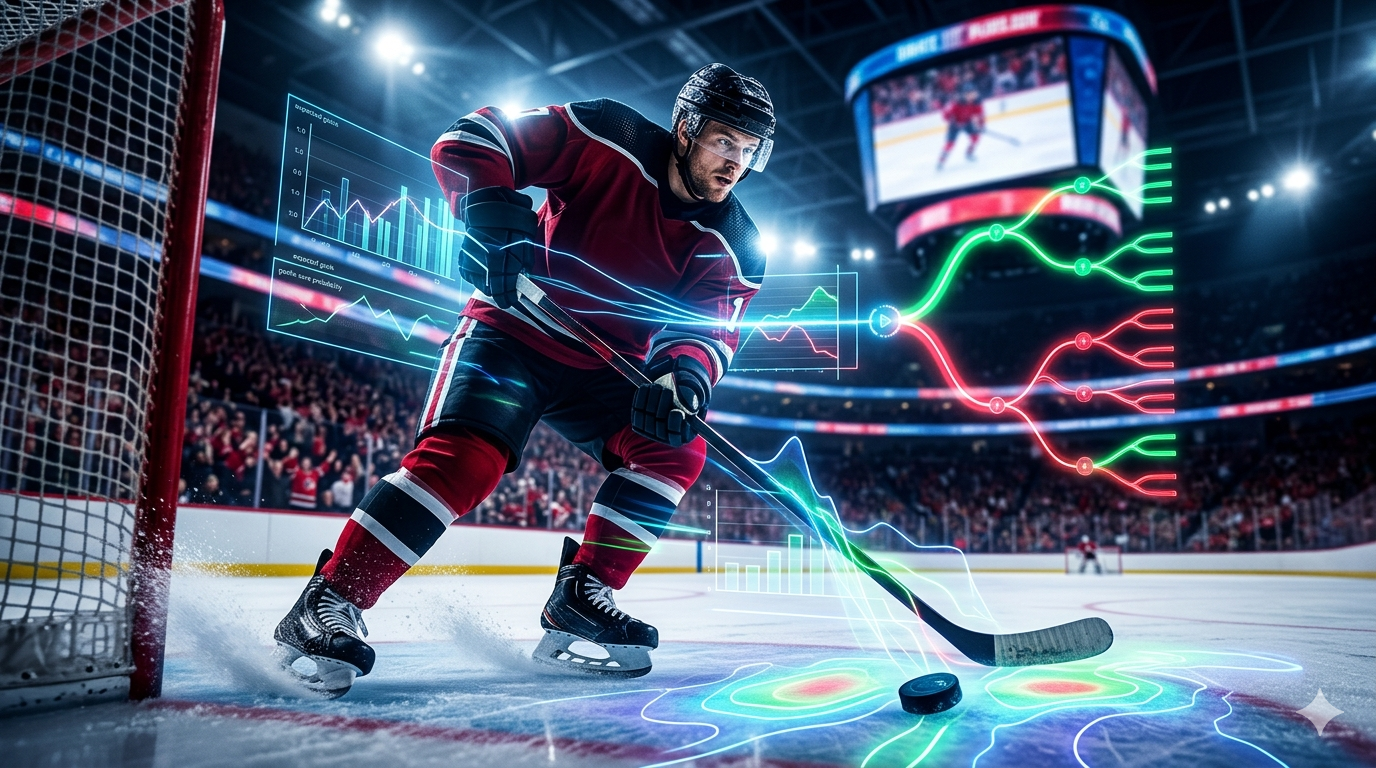
NHL playoff predictions aren’t a coin flip. As a professional analyst who builds AI models for the rink, I blend five-on-five shot quality, special-teams edges, goaltending form, and travel context to price series and games. This article turns that process into clear steps, practical checks, and repeatable predictions you can trust. Most people think the postseason is just about "who wants it more," but the numbers tell a much more specific story about puck possession and high-danger scoring chances. We are going to look at how to build a system that ignores the television talking heads and focuses strictly on the math that drives winning hockey.
Table of Contents
- Objective and constraints for playoff forecasting
- Data intake and feature engineering
- Modeling and validation
- Interpretability and deployment
- Workflow and deliverables
- Frequently Asked Questions (FAQs)
Objective and Constraints for Playoff Forecasting
Before you write a single line of code or touch a spreadsheet, you have to nail down what you are actually trying to solve. In the playoffs, you generally have two targets. The first is game-level edges, which is the probability that a team wins a specific game. This includes derivative markets like the puckline or period totals. The second is series-level probabilities, which is the chance a team wins a best-of-seven matchup. In my experience, you need both. You use the game-level probabilities to set the state in a series simulation, and then you aggregate those game states into series probabilities that respect travel days and fatigue. This is exactly how we align the logic used on ATSwins. If you are looking for daily player props, the game-level edges are your best friend. If you are trying to fill out a bracket, the series probabilities carry the heavy weight.
You have to realize that the NHL playoffs are a completely different animal than the regular season. Your model has to adapt to specific constraints that don't exist in November. First, you are dealing with a tiny sample size within a round. A single series only gives you up to seven games, which means randomness is massive. Second, rotations get much tighter. Top-pair defensemen and top-six forwards play way more minutes than they do in the regular season. This means bench depth matters less while your stars matter more. Third, goalie variance dominates everything. A hot or cold run from a netminder can move a series by 10 to 15 percentage points in a heartbeat. Finally, special teams swings are huge because whistle frequency and opponent penalty kill structures shift expected goals on both sides. We solve this by using multi-year data with playoff-specific flags and applying Bayesian shrinkage to volatile components like goalies and special teams.
Data Intake and Feature Engineering
To build a model that actually works, you need multiple data sources to capture the micro-stats that traditional box scores miss. I rely heavily on Natural Stat Trick for five-on-five expected goals, shot share, and high-danger chances. You also need to pull schedule data, goalie starts, and travel indicators from sites like Hockey-Reference. When you are looking at the ATSwins workflow, you should always use the games board to confirm matchup timing and current lines. This ensures your model is pricing the game based on the most current roster reality.
The features you build are the heart of the AI. You should focus on five-on-five performance, specifically score-adjusted and venue-adjusted metrics. Last-10 and last-25 game rolling averages are essential for capturing late-season form. For special teams, don't just look at percentages. Look at power play expected goals per 60 minutes and entry success rates. Goaltending is the hardest part to get right. I use a "GSAA" (Goals Saved Above Average) rolling window for 7, 14, and 30 games. You also need a rebound control proxy because goalies who spit out pucks in the playoffs get punished quickly. Lineup certainty is another big one. You need flags for the availability of top-six forwards and top-four defensemen. If a star center is out, your model needs to know that the replacement-level player is going to crater the team's transition numbers.
Cleaning this data is where most people fail. You have to handle rink adjustments because some home scorers are more generous with counting shots than others. You also need to winsorize extreme goalie stats. If a goalie has a .980 save percentage over three games, your model shouldn't assume he is a god; it should pull that number back toward a more realistic 99th percentile. When starters are unconfirmed, I create a blended feature based on the probability of who starts. If there is a 70% chance the starter plays, I blend his stats with the backup's stats accordingly. This prevents the model from being blindsided by a "late scratch" situation.
Modeling and Validation
I always tell people to start simple. Your first layer should be a logistic regression baseline. It is honest, stable, and explainable. You feed it about ten core features like expected goal percentage and goalie form, then use L2 regularization to keep it from getting too wild. From there, you can add an Elo-like rating system that updates based on expected goal differential rather than just wins and losses. Once those baselines are stable, then you can bring in the heavy hitters like XGBoost or LightGBM. These tree-based models are great at capturing interactions, like how an elite power play performs specifically against an undisciplined team that takes a lot of penalties.
To get series probabilities, you run a Monte Carlo engine. This is where you simulate the best-of-seven series 100,000 times or more. You have to make the simulation "state-aware," meaning it accounts for fatigue as the series goes on. Short rest between Games 5 and 7 usually compresses bench usage, so you tie that rest to top-pair minutes. You also have to account for in-series injuries. If a star player gets hurt in Game 2, the remaining simulations for that series need to reflect his absence. This creates a distribution of outcomes that tells you not just who will win, but the probability of the series going 5, 6, or 7 games.
Validation is the only way to know if you are actually good or just lucky. You have to backtest on the last five to ten playoff seasons using a strict rolling window. You only use data available up to Game N to predict Game N. If you use data from Game 4 to predict Game 2, you are cheating and your model will fail in the real world. I track the Brier score and log loss to penalize overconfidence. You want your model to be well-calibrated. If your model says a team has a 60% chance to win, those teams better actually win about 60% of the time over a large sample. If they only win 50% of the time, your model is biased and needs recalibration.
Interpretability and Deployment
A model is useless if you don't know why it is making a prediction. I use SHAP values to see what is driving the edge in each game. Usually, in the playoffs, you will see that goaltending form dominates the marginal edges, followed closely by the power play versus penalty kill matchup. Five-on-five expected goal share remains the floor; if that collapses, a team is usually toast over a seven-game stretch. We make sure to publish these drivers on ATSwins so subscribers can see the "why" behind the pick. For example, we might note that an edge exists because of a massive mismatch in high-danger chances created versus those allowed by the opponent's backup goalie.
You also have to monitor for "drift" as the rounds progress. As the field narrows, the opponents get stronger. A team that was a 55% favorite in the first round might only be a 51% favorite in the Conference Final even if their stats stay the same, simply because the quality of the opposition has spiked. You also have to watch the referees. Penalty thresholds often change as the series gets deeper, and your model needs to account for the fact that there might be fewer power play opportunities in a Game 7 than in a Game 1.
We never publish single-number "locks." That is a rookie mistake. Instead, we publish ranges. We might say a team has a 58% chance to win, with a range of 52% to 63% depending on who starts in net. This helps users manage their bankroll and understand the risk involved. The NHL playoffs are chaotic. There are empty-net goals, weird bounces off the glass, and controversial calls. Your job as an analyst is to price that risk honestly. If the edge is smaller than the transaction cost or if the uncertainty is too wide, the best move is often to pass.
Workflow and Deliverables
My daily workflow is a grind, but it has to be. Every morning, I rebuild the features with the latest roster updates and goalie confirmations. I rerun the series simulations if there was an injury the night before. All of this data is versioned, meaning I can go back and see exactly what my model predicted on April 18th even if it is already June. We store everything in parquet files with schema hashes to ensure the data stays clean.
We also run unit tests on our logic. We check to make sure the goalie blend always sums to 1.0 and that no future data has leaked into the training sets. This level of discipline is what separates professional analysts from hobbyists. When we push a pick to the ATSwins dashboard, it includes the game probability, the series probability, and the top SHAP features so the user has the full context. We then reconcile those results against the actual outcomes to track our profit and closing line value (CLV). If we aren't beating the closing line, we go back to the drawing board to see what we missed—usually, it’s a late-breaking injury or a tactical shift we didn't account for.
The goal is to provide a comprehensive guide that helps people make smarter decisions. By blending machine learning with hockey sense, we create a system that is robust enough to handle the volatility of the playoffs. Whether you are looking at the NHL games board or tracking your own performance, having a data-driven anchor is the only way to survive the two-month marathon that is the quest for the Stanley Cup.
Frequently Asked Questions (FAQs)
What is an NHL playoffs prediction model AI, in plain terms?
An NHL playoffs prediction model AI uses past and current hockey data to estimate win odds for each game and the full series. It mixes team strength at five-on-five, special teams, goaltending form, injuries, home-ice with last change, and travel quirks. Then it simulates best-of-seven outcomes thousands of times. The result isn’t a crystal ball; it’s a calibrated probability that updates as news and lineups shift. It essentially takes all the noise of a hockey game and filters it down into a percentage that represents the most likely outcome.
Which data should I feed an NHL playoffs prediction model AI for better accuracy?
You should start with consistent and clean inputs. This includes five-on-five shot share and expected goal share because quality and volume both matter. You also need power play and penalty kill rates, plus expected goals on special teams. Goaltending is crucial; look at recent form and longer-term numbers like GSAA, but always keep an eye on starter uncertainty. Injuries, line combinations, and usage are also massive factors. You have to know who is taking the defensive zone starts and who is driving zone entries. Finally, don't forget the logistical stuff like rest days and travel distance. When you feed all of this into an NHL playoffs prediction model AI, you should scale the features so the model learns the actual signal rather than just chasing noise.
How do you validate an NHL playoffs prediction model AI so it doesn’t overfit?
The most important thing is to backtest with strict time splits. You train on prior seasons and test on later ones, making sure you never peek at future injuries or goalie news. You should evaluate the model using Brier score and log loss rather than just a simple hit rate. Calibration is also key. If your NHL playoffs prediction model AI says a team has a 60% chance to win, you need to verify that those teams actually win around 60% of the time over a large sample. Reliability plots are a great way to visualize this. You can also nudge the inputs, like goalie value, to see if the outputs change in a way that actually makes sense.
Can ATSwins.ai enhance my NHL playoffs prediction model AI workflow?
Yes, it definitely can. ATSwins is an AI-powered sports prediction platform that offers data-driven picks, player props, betting splits, and profit tracking across the NHL and other major leagues. I personally use ATSwins to compare my model's edges against the public betting splits to see if I'm on a "sharp" side or a "square" side. It is also great for tracking profit and closing line value game-by-game, which helps me separate my actual skill from just being lucky. It’s a complementary tool where your model provides the probabilities and ATSwins helps you manage the actual execution of your strategy.
Why do probabilities from an NHL playoffs prediction model AI change so much during a series?
Probabilities change because the inputs are constantly moving. A surprise goalie start can shift a single-game line by 5% or more, and that impact compounds over the course of a series. You also have matchup adjustments. Since the home coach has the "last change," they can chase specific line combinations to neutralize the other team's stars. If those tactical shifts work, the NHL playoffs prediction model AI has to react to that new reality. Special teams streaks and officiating styles also alter expected goal rates. It is perfectly normal to see series odds jump by 10 to 20 points after an overtime win or a major injury. It isn't the model panicking; it is just the math updating to reflect the new state of the series.
Related Posts
AI For Sports Prediction - Bet Smarter and Win More
AI Football Betting Tools - How They Make Winning Easier
Bet Like a Pro in 2025 with Sports AI Prediction Tools
Sources
The Game Changer: How AI Is Transforming The World Of Sports Gambling
AI and the Bookie: How Artificial Intelligence is Helping Transform Sports Betting
How to Use AI for Sports Betting
Keywords:
MLB AI predictions atswins
AI MLB predictions atswins
NBA AI predictions atswins
basketball ai prediction atswins
NFL ai prediction atswins