

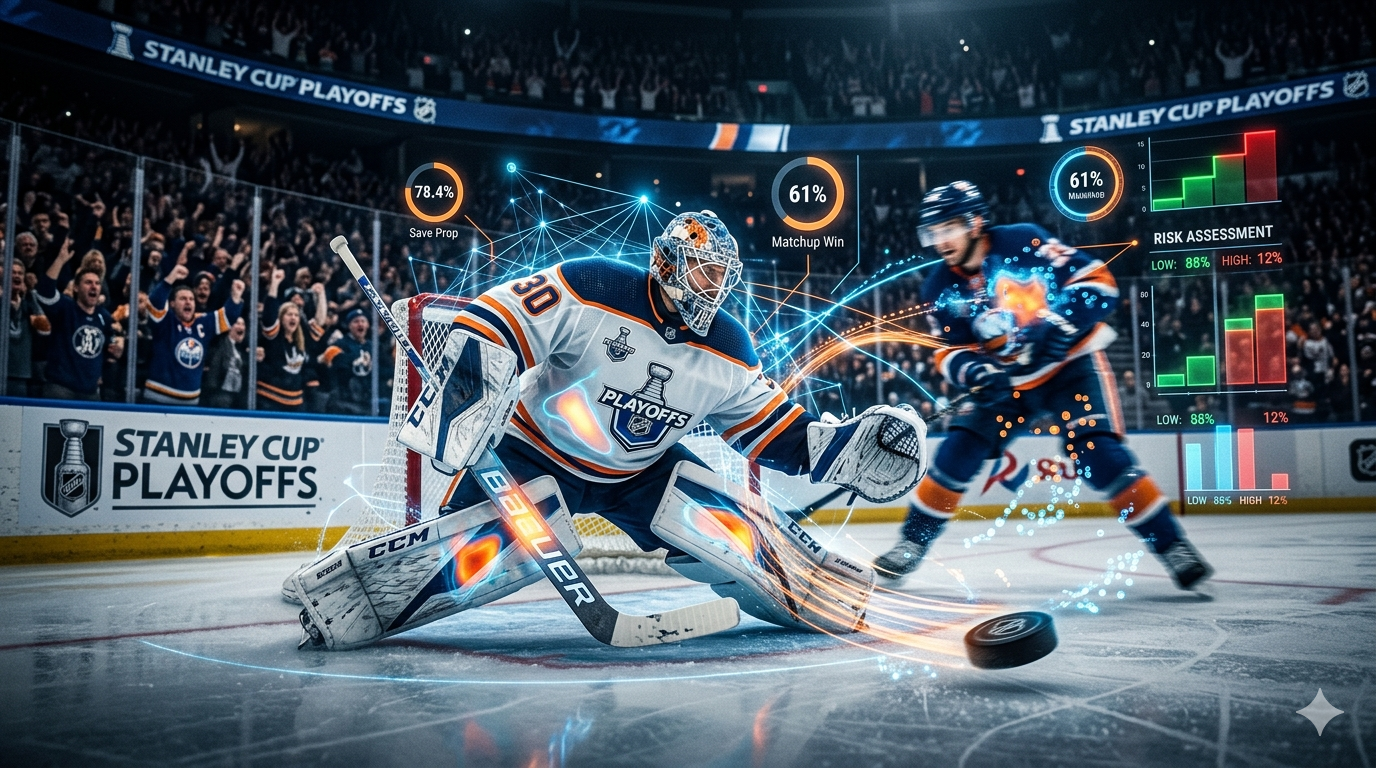
Playoff hockey tightens everything. Space disappears, mistakes get punished instantly, and the margin between winning and losing shrinks down to a few key moments. Naturally, the same thing happens with betting edges. As a sports analyst working with AI, my job is to take all that chaos and compress it into probabilities that actually make sense. That means blending 5 on 5 shot quality, goalie form, travel spots, and real matchup context into something actionable.
This is not about throwing a model together and hoping it spits out winners. This is about building a system that holds up under playoff pressure. It is also about understanding where models fail, because they absolutely do if you are not careful. The goal here is to walk through the full process in a way that feels real and usable, not overly academic. If you are tracking things like NHL scores today, building your own Trade tracker NHL, or just trying to interpret the NHL Playoff Bracket 2026, this is the kind of structure that actually helps.
Table Of Contents
- Playoff reality check and modeling targets
- Data intake and feature engineering
- Modeling stack and validation
- Betting execution and risk
- Workflow and compliance
- Data sources and how to use them, fast
- Practical examples and small how-tos
- Common failure modes and how to avoid them
- Quick reference: playoff-specific priors to set before Round 1
- Minimal ops plan for daily cards
- Final notes on aligning model output with hockey sense
- Primary references to ground the analysis
- Conclusion
- Frequently Asked Questions (FAQs)
Playoff Reality Check and Modeling Targets
Playoff hockey is not just the regular season with higher stakes. It is a completely different environment. If your model treats it like business as usual, it will get exposed pretty quickly.
First thing that changes is 5 on 5 scoring. It drops. Coaches shorten benches, defensive structure tightens, and neutral zone play becomes more conservative. You end up with more one goal games and fewer wide open stretches. That matters because it compresses win probabilities. Favorites become less dominant, and underdogs hang around longer.
Penalty rates are another weird one. They do not just drop evenly. Sometimes refs swallow the whistle late in games, sometimes certain series get chippy and spike. That inconsistency creates volatility in special teams impact. Your model needs to account for power play quality without assuming consistent volume.
Goalies are probably the biggest swing factor. In the regular season, you get rotation and rest. In the playoffs, you get heavy workloads and elite starters playing through fatigue. A hot goalie can completely flip a series, and your model needs to reflect that without overreacting to short-term noise.
Matchups matter more too. With last change, coaches actively hunt mismatches. A shutdown line can erase a top scoring unit if deployed correctly. That is not just theory, it shows up in expected goals data if you track it carefully.
Overtime adds another layer. Once a game hits OT, a lot of your edge disappears. It becomes much closer to a coin flip, especially between evenly matched teams. If your model does not adjust for that, you will overestimate your edge on favorites.
So your modeling targets need to reflect all of this. You are not just predicting winners. You are building:
Pregame win probabilities tied to confirmed goalie scenarios.
Score distributions that help with totals and alternate lines.
Series probabilities that update after every game.
Live betting triggers based on real in-game signals.
This is where ai sports betting prediction accuracy actually matters. It is not about being right in a vacuum. It is about being calibrated and consistent in a volatile environment.
Data Intake and Feature Engineering
Hockey data is messy. There is noise everywhere. The key is not collecting everything, it is collecting the right things and organizing them cleanly.
Start with a reproducible pipeline. You want consistent pulls for team stats, player metrics, goalie performance, and scheduling spots. Everything should be timestamped and versioned. If you cannot track when your data changed, you cannot trust your outputs. Rolling windows are essential. Ten to twenty game samples give you recent form, but they can be noisy. Longer windows give stability. The best approach is usually a blend, weighting recent games slightly more but not ignoring the larger sample.At 5 on 5, focus on expected goals for and against per 60 minutes. Add in rush chances and rebound opportunities if you can approximate them. Those tend to matter more in playoff-style hockey where space is limited.
Special teams need their own treatment. Power play expected goals and penalty kill suppression rates both matter, but remember that opportunity volume can swing game to game.
Goalie data deserves special attention. Metrics like goals saved above expected are useful, but you need to adjust for team defense. Otherwise, you double count defensive strength. You also need scenario modeling. If a starter is not confirmed, you should be running multiple versions of the game with different probabilities.
Rest and travel are underrated but still relevant. Even though playoff travel is structured, fatigue still accumulates, especially after overtime games. Tracking rest days and travel distance helps refine edges slightly.
Injuries are where things get tricky. You cannot just mark a player as out or in. You need to assign impact values and probabilities. A top defenseman missing is not the same as a depth forward missing. If someone is a game-time decision, you should be blending outcomes.
Finally, late-game tendencies like empty net pulls matter more than people think. Teams that pull early create more volatility in totals. That can be useful if you are betting alternate lines.
Modeling Stack and Validation
You do not need an overly complex stack, but you do need a reliable one.
A good baseline is a logistic regression model for win probability combined with a gradient boosting model. The regression gives you stability and interpretability. The boosting model captures nonlinear interactions.
The key is combining them into an ensemble. Weight each model based on recent performance. Do not just average blindly.
Calibration is critical. If your model says a team has a 60 percent chance to win, it should actually win around 60 percent of the time in similar spots. Use techniques like isotonic regression or Platt scaling to fix calibration issues.
Track metrics like Brier score and log loss. These tell you if your probabilities are meaningful, not just your picks.
For totals, use Poisson or similar distributions to model goal scoring. Adjust for playoff conditions by slightly lowering expected goal rates.
For series predictions, run Monte Carlo simulations. Update them after every game. This is especially useful when tracking something like the NHL Playoff Bracket 2026 because probabilities shift constantly based on results and injuries.
Validation should always be time-based. Train on past seasons, test on playoff games. Do not mix timelines or you risk data leakage.
Betting Execution and Risk
This is where most people mess up. Having a good model does not guarantee profit. Execution matters more.
Start by removing the vig from betting lines. Convert odds into implied probabilities and normalize them. That gives you a fair baseline to compare against your model.
Only bet when your edge clears a threshold. In playoff markets, that threshold should be higher because lines are sharper.
Use fractional Kelly for sizing. Something like 0.25 to 0.5 Kelly works well. Always cap your exposure per bet and per day. You are trying to survive variance, not beat it in one night.
Timing matters a lot. Goalie confirmations can move lines significantly. If you can act quickly after news breaks, you gain an edge.
Live betting should be structured, not emotional. Look for specific triggers like special teams advantages or clear mismatches in shot quality.
If you are tracking everything properly, including your Trade tracker NHL, you will start to see patterns in where your execution improves or fails.
Workflow and Compliance
A clean workflow keeps everything consistent.
You should have version control for your models and data. That way you can roll back if something breaks.
Daily checks for missing data or anomalies are important. One bad input can ruin an entire slate.
Responsible betting practices are not optional. Set limits, separate your bankroll, and stick to your plan.
Transparency matters too. If your model has limitations, acknowledge them. Playoff samples are small, and variance is real.
Data Sources and How to Use Them, Fast
Use official league data for accuracy. Supplement with advanced stats providers for deeper insights.
The key is not where the data comes from, it is how you use it. Build pipelines that update quickly and consistently.
If you are checking NHL scores today, your system should already be updating probabilities and tracking outcomes automatically.
Practical Examples and Small How-Tos
Let’s say your model gives a team a 54 percent chance to win. The market implies 51 percent after removing vig. That is a 3 percent edge.
That might not sound huge, but over time, that is where profit comes from.
For totals, if your model projects slightly lower scoring due to playoff conditions, you might find value on unders, especially with elite goalies.
For series bets, always update after each game. Do not anchor to your original projection.
Common Failure Modes and How to Avoid Them
Overreacting to recent games is a big one. A team having one strong game does not mean they are suddenly dominant.
Double counting goalie impact is another issue. Keep those effects separate and controlled.
Ignoring matchup adjustments can also hurt. Coaches change strategies mid-series, and your model needs to adapt.
Quick Reference: Playoff-Specific Priors to Set Before Round 1
Lower overall scoring expectations slightly.
Reduce penalty rate assumptions.
Increase overtime probability in close matchups.
Weight goalie performance more, but not excessively.
Be cautious with players returning from injury.
Minimal Ops Plan for Daily Cards
Morning starts with data updates and running models. Midday is for monitoring news. Evening is for execution.
After games, log everything. Compare your numbers to closing lines and actual results.
Final Notes on Aligning Model Output with Hockey Sense
If your model says a team improved after getting outplayed badly, question it. Numbers need context.
If special teams are driving outcomes without actual opportunities, reassess assumptions.
Models are tools, not answers. You still need to think.
Primary References to Ground the Analysis
Use a mix of official stats and advanced analytics. Combine them with your own tracking systems.
Conclusion
At the end of the day, playoff betting is about discipline. The edges are smaller, the variance is higher, and the margin for error is thin. The best approach is to stay consistent. Build clean data pipelines, use calibrated models, and execute with discipline.
If you are following the NHL Playoff Bracket 2026, checking NHL scores today, or logging everything in a Trade tracker NHL, the goal is the same. Stay structured and avoid emotional decisions.
Platforms like ATSwins help by providing a centralized way to track predictions, analyze performance, and refine strategy. That extra layer of organization can make a big difference when things get chaotic.
Frequently Asked Questions (FAQs)
What is ai sports betting prediction accuracy and why does it matter?
It refers to how well your model’s probabilities match real outcomes. In playoffs, accuracy is less about picking winners and more about being properly calibrated.
Which inputs matter most?
Focus on 5 on 5 expected goals, goalie performance, special teams, and matchup context.
How do I turn probabilities into bets?
Compare your model probability to the market’s implied probability. Bet only when you have a clear edge.
How should I approach live betting?
Keep it structured. Use clear triggers and reduce stake sizes compared to pregame bets.
How does ATSwins help?
It provides tracking, projections, and tools that complement your own modeling process.
Related Posts
AI For Sports Prediction - Bet Smarter and Win More
AI Football Betting Tools - How They Make Winning Easier
Bet Like a Pro in 2025 with Sports AI Prediction Tools
Sources
The Game Changer: How AI Is Transforming The World Of Sports Gambling
AI and the Bookie: How Artificial Intelligence is Helping Transform Sports Betting
How to Use AI for Sports Betting
Keywords:
MLB AI predictions atswins
AI MLB predictions atswins
NBA AI predictions atswins
basketball ai prediction atswins
NFL ai prediction atswins