

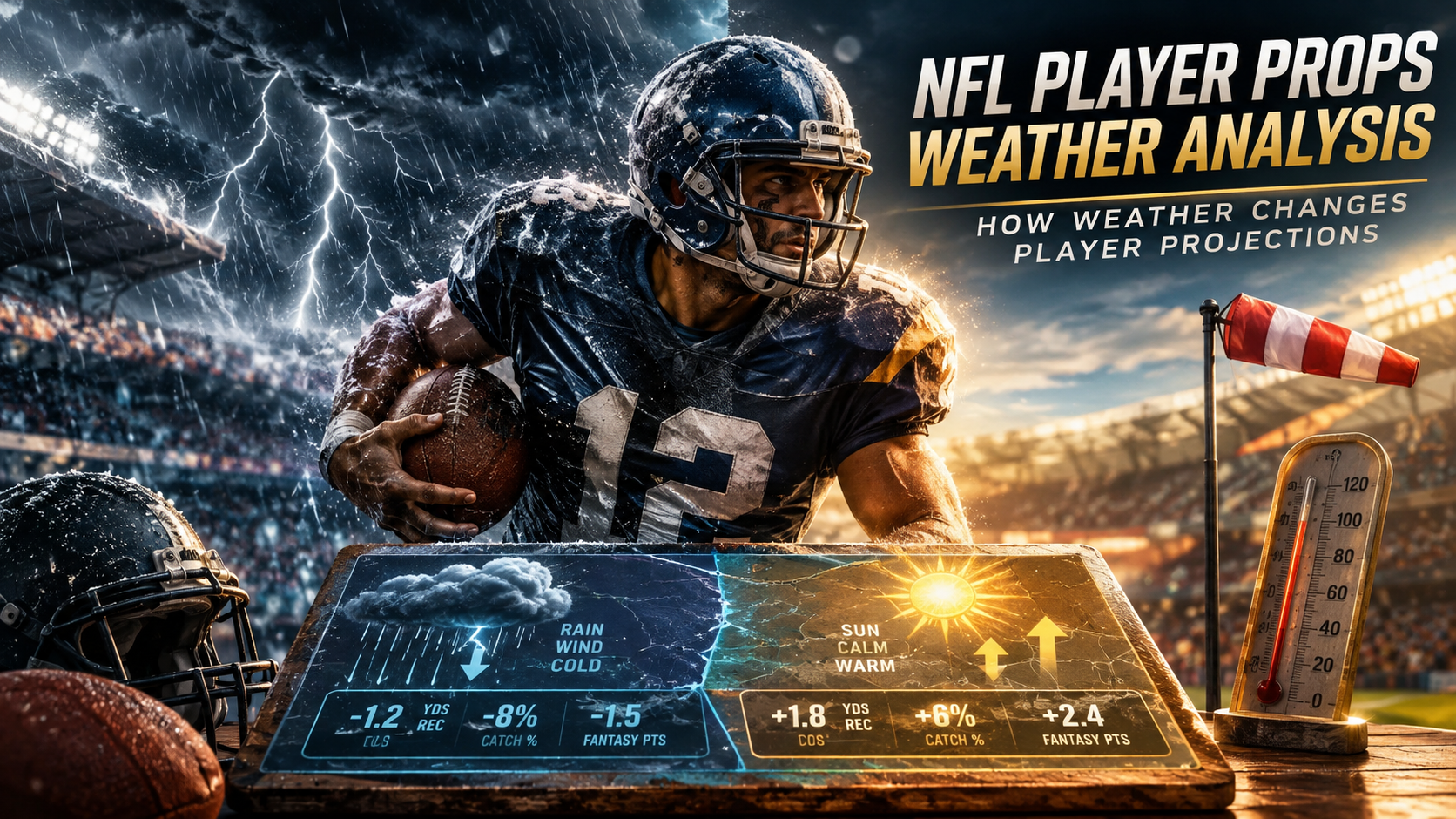
Weather is one of the most overlooked variables in NFL player prop analysis. A forecast does not automatically tell you whether a player will go over or under a betting line, but wind, rain, snow, temperature, and field conditions can change the expected environment in which that player performs.
For NFL player props, the key is not simply asking whether the weather is “bad.” The better question is how specific weather conditions affect expected volume, efficiency, play calling, and the distribution of possible outcomes. A quarterback playing in strong wind, a running back facing a wet field, and a wide receiver dealing with heavy rain may all be affected differently.
That makes weather analysis more useful when it is incorporated into a player projection model rather than treated as a last-minute betting narrative. ATSwins approaches sports forecasting through probabilities, player projections, statistical modeling, and market evaluation, which makes weather one of several inputs that can be considered when estimating a player's expected performance.
Table of Contents
- How Weather Affects NFL Player Props
- Wind Is Usually the Most Important Weather Variable
- Rain and Snow Require More Than a Simple Over or Under Adjustment
- How Weather Changes Quarterback and Passing Props
- How Weather Affects Running Back and Receiving Props
- Building Weather Into a Player Projection
- Why Weather Should Be Combined With Market and Player Data
- Common Mistakes in NFL Weather Prop Analysis
- How ATSwins Can Use Weather in Player Prop Analysis
- Frequently Asked Questions
- Using Weather as Part of a Better Prop Process
How Weather Affects NFL Player Props
Weather matters because NFL player props are based on expected statistical outcomes. If conditions change the expected number of passes, rushing attempts, yards per attempt, completion rate, field-goal attempts, or scoring opportunities, the probability distribution around a player's projection can change as well.
The mistake is treating weather as a universal adjustment.
A 20 mph wind does not mean every passing prop should automatically move downward. The impact depends on the direction and consistency of the wind, the stadium, the quarterback's tendencies, the team's offensive approach, the opponent, and the expected game script.
The same principle applies to rain. Light rain may have little meaningful effect on a professional offense, while heavy rain combined with strong wind can create a completely different environment.
A useful weather model therefore needs to connect conditions to football outcomes.
Consider a quarterback with a baseline projection of 250 passing yards. If the expected conditions are calm, the model may produce a relatively narrow distribution around that projection. If the game is expected to feature sustained strong wind, the mean projection might decline, but the uncertainty around the result could also increase.
That second part is important.
Weather does not always simply move the average. It can change the shape of the expected outcomes.
Wind Is Usually the Most Important Weather Variable
For NFL player props, wind deserves special attention because it can affect the passing game, kicking game, punt distance, and play-calling decisions.
Wind speed alone is not enough. Direction matters, and gusts can matter even more than average wind speed.
A steady wind creates one type of challenge. Strong, inconsistent gusts create another. A quarterback may be able to adjust to a predictable wind direction, while sudden gusts can create more uncertainty on deep throws and longer kicks.
This matters most for passing props involving downfield production.
Suppose a receiver has a normal projection of 72 receiving yards. If the expected game conditions make deep passing less attractive, the model should not necessarily assume that the receiver simply loses a fixed percentage of his projection. Instead, the model should consider how the offense is likely to respond.
The quarterback might throw fewer deep passes. The offense might shift toward shorter routes. The receiver could maintain his target volume but experience a lower average depth of target. A running back could receive additional carries because the coaching staff prefers a lower-variance offensive approach.
The result can be complicated.
A receiver's yardage projection could decline even if his target projection remains relatively stable. A running back's rushing attempts could increase while his yards per carry decline. A quarterback's passing yards could fall while his rushing attempts rise.
That is why weather should be connected to player role rather than applied as a blanket adjustment.
Rain and Snow Require More Than a Simple Over or Under Adjustment
Rain is another common weather variable in NFL prop analysis, but its effect depends heavily on intensity.
A light rain forecast does not necessarily create a major statistical adjustment. NFL players regularly perform in wet conditions, and teams have sophisticated equipment and preparation routines for those environments.
Heavy rain can be more significant because ball handling becomes more difficult and field conditions can change.
That can influence offensive efficiency and turnovers. It can also change how coaches distribute touches.
Snow presents another interesting situation. Snow does not automatically mean that passing production will collapse. Temperature, accumulation, wind, field maintenance, and the actual playing surface all matter.
A snow game with minimal wind may produce a very different environment from a game featuring heavy snow and strong gusts.
For player prop modeling, this distinction is critical. A model should use weather as a collection of measurable variables instead of turning an entire game into a simplistic “bad weather” label.
How Weather Changes Quarterback and Passing Props
Quarterback props are often among the most weather-sensitive markets because passing efficiency can be affected by wind, rain, snow, and field conditions.
Passing yards are an obvious example, but the effects can extend to completions, passing attempts, passing touchdowns, interceptions, and longest completion markets.
The first variable to examine is expected passing volume.
If weather is expected to reduce offensive efficiency, the team may run fewer plays overall. But it is also possible that a negative game script produces more passing attempts. These competing effects are why a weather adjustment should not simply subtract a predetermined number of passing yards.
A strong projection process might estimate expected plays first, then estimate the probability of a pass on each situation, then model expected efficiency under the forecast conditions.
For example, imagine an offense normally projects for 64 plays with a 59% pass rate. That creates roughly 38 expected pass attempts before accounting for game-specific factors.
If weather reduces expected offensive efficiency but the opponent is projected to lead, the final passing-attempt projection could remain relatively high. The quarterback might throw frequently but generate fewer yards per attempt.
That distinction is important when evaluating different quarterback props.
Passing yards may become less attractive while passing attempts remain relatively resilient. Completions may not move in exactly the same direction as passing yards because shorter throws could replace deeper attempts.
The best weather analysis therefore evaluates each market independently.
How Weather Affects Running Back and Receiving Props
Weather can create opportunities for running backs, but increased rushing volume does not automatically mean increased rushing efficiency.
If coaches expect difficult passing conditions, they may lean more heavily on the running game. That can increase rushing attempts for a lead back.
At the same time, defensive expectations can change. If both teams anticipate a run-heavy environment, defenses may commit additional resources to stopping the run.
A running back could therefore receive more carries while producing fewer yards per attempt.
This is one reason player prop analysis should separate volume from efficiency.
For receivers, weather can influence target depth, catch probability, yards after catch opportunities, and total receiving yards.
A receiver who normally generates a large percentage of his production on deep targets may be more sensitive to strong wind than a possession receiver whose role is concentrated around short and intermediate routes.
Two players on the same team can therefore experience very different weather adjustments.
That is much more useful than saying, “It is raining, so take the under on receiving yards.”
The same principle applies to tight ends and running backs who function as short-area receiving options. Their target volume may remain relatively stable if the quarterback continues using short throws as a way to maintain offensive efficiency.
Building Weather Into a Player Projection
A practical NFL player projection model can treat weather as one component of a larger forecasting system.
The first step is establishing a baseline projection without the weather adjustment. That baseline can incorporate player talent, expected snaps, historical usage, opponent strength, team tendencies, injuries, and recent role changes.
Weather is then introduced as a conditional variable.
Instead of asking whether rain historically affects wide receivers, a stronger approach asks questions such as whether receiving efficiency changes under specific combinations of precipitation, wind, temperature, and field conditions.
Historical data can be divided into comparable weather environments. The model can then estimate whether the observed differences are meaningful after controlling for opponent strength, player quality, offensive scheme, and game context.
This is where sample size becomes important.
There may not be enough observations for a single player to establish a reliable weather-specific trend. A receiver might have only a handful of career games in heavy rain. Treating that tiny sample as a definitive player-specific rule would create an unstable projection.
A better model can borrow information from league-wide results while allowing player and team characteristics to influence the final estimate.
The process might look conceptually like this:
Baseline player projection → expected role → opponent adjustment → weather adjustment → game-script adjustment → probability distribution → market comparison.
The output should not simply be a number such as 67.5 receiving yards.
A useful forecasting system can estimate the probability that the player finishes above or below the available line.
Why Weather Should Be Combined With Market and Player Data
Weather is only one piece of an NFL player prop forecast.
A common mistake is finding an interesting weather angle and assuming the betting market has not considered it. Sportsbooks and market participants have access to weather information too.
The real analytical question is whether the current market price properly reflects the expected impact.
Suppose a quarterback's passing-yard line is 239.5 yards. Your baseline model projects 248 yards in neutral conditions. After incorporating the expected wind and offensive adjustments, the projection falls to 237 yards.
The weather has changed the model's estimate, but that alone does not tell you whether the under is valuable.
You still need to estimate the probability of finishing below 239.5 and compare that probability with the implied probability of the market price.
This is the difference between prediction and betting analysis.
A model could correctly identify that weather reduces expected passing production while still producing no worthwhile betting opportunity if the market has already adjusted.
The same concept applies when weather information changes during the week.
An early forecast might show mild conditions. A later forecast could introduce stronger wind or heavier precipitation. If the player prop line and price have not fully reflected that information, the model's fair probability may change.
That creates a more interesting analytical situation than simply betting every weather-related under.
Common Mistakes in NFL Weather Prop Analysis
One of the biggest mistakes is treating all bad weather equally.
Rain, snow, cold temperatures, and wind have different mechanisms and different levels of impact. Even within the same category, severity matters.
Another mistake is focusing only on historical averages. If a study finds that passing yards are lower in games with strong wind, that does not mean every quarterback should receive the same adjustment.
Quarterback skill, offensive scheme, route distribution, offensive line performance, and opponent pressure rate all matter.
Another problem is ignoring stadium conditions. Some stadiums are open-air environments where wind and precipitation can directly affect play. Others provide substantially more protection from weather. A roof status change can also matter when a venue has retractable coverage.
Timing matters too.
A forecast several days before kickoff is not equivalent to the conditions expected at game time. Weather models change, and the confidence of the forecast generally depends on how far ahead it is being evaluated.
That means weather inputs should be timestamped.
A forecasting system should know what the weather forecast actually looked like when the projection was generated. Otherwise, historical testing can accidentally use information that would not have been available at the time of the prediction.
This is a form of data leakage that can make a model's backtest look better than its real-world performance.
How ATSwins Can Use Weather in Player Prop Analysis
ATSwins focuses on sports forecasting through player projections, probability analysis, statistical modeling, simulations, and market evaluation. Weather fits naturally into that framework when it has a measurable relationship with the player market being analyzed.
For an NFL player prop, the objective is not to produce a weather-based prediction in isolation.
The useful question is how the forecast conditions interact with the player's expected role.
A quarterback's projection can incorporate expected passing volume and efficiency. A running back's projection can account for expected rushing attempts and the potential change in offensive philosophy. A receiver's projection can consider target volume, target depth, catch probability, and expected yards per reception.
Weather can then modify those inputs based on the expected environment.
The resulting probability distribution can be compared with the market line.
For example, a model might project a receiver for 68 receiving yards with neutral conditions. A weather update could lower the mean projection to 64 yards while also increasing uncertainty. If the available line is 59.5, the weather adjustment may not be enough to create an attractive under despite lowering the projection.
If the line is 72.5, the same weather adjustment could have a much larger effect on the probability calculation.
This illustrates why projection and price must be evaluated together.
Frequently Asked Questions
Does weather affect NFL player props?
Yes, weather can affect NFL player props, particularly when strong wind, heavy precipitation, or difficult field conditions influence passing volume, passing efficiency, rushing usage, or offensive strategy. The size of the impact depends on the specific conditions and player role.
What weather matters most for NFL passing props?
Wind is often one of the most important variables because it can affect throwing conditions and deep passing efficiency. However, the actual impact depends on wind speed, gusts, direction, precipitation, quarterback tendencies, and offensive strategy.
Does rain automatically favor running backs?
No. Rain may increase the likelihood of a run-heavy game plan, but increased rushing volume does not guarantee higher rushing efficiency. Defensive adjustments, offensive line performance, game script, and field conditions still matter.
Should weather automatically mean betting the under?
No. The market may already account for the expected conditions. A weather adjustment becomes useful when it changes the model's probability relative to the available price, not simply because the forecast looks unfavorable.
How far ahead should weather be included in player prop models?
Weather can be included early as a provisional input, but forecasts should be updated as kickoff approaches. The closer the game gets, the more relevant the expected game-time conditions become. A model should also track when each weather forecast was available to avoid using future information in historical testing.