

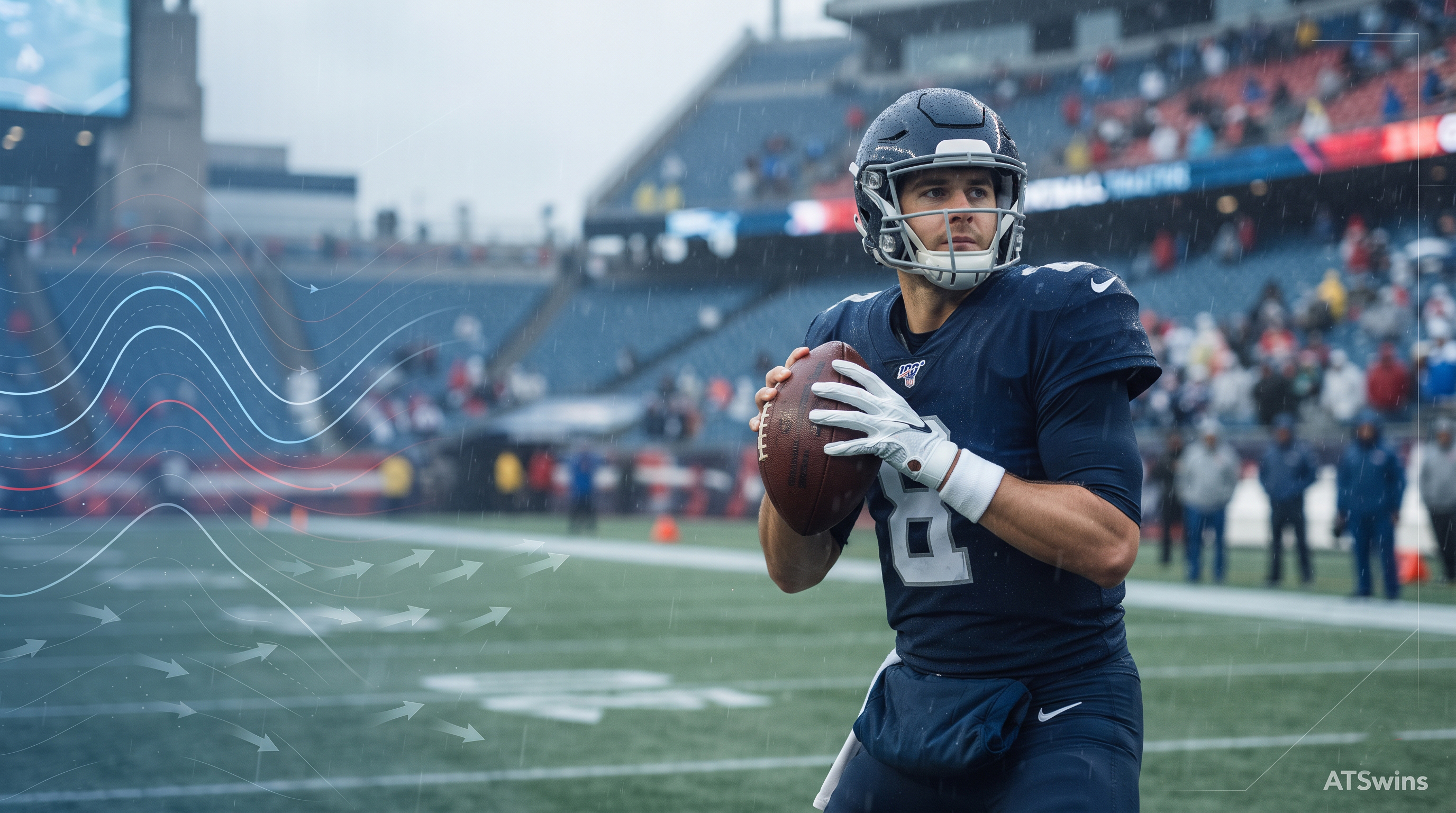
Navigating outdoor football games during late autumn and deep winter requires more than just evaluating a quarterback arm talent or a running back speed. Environmental factors introduce a layer of variance that can completely shift game scripts, alter passing efficiencies, and suppress or inflate individual statistics. When building projections for individual player performances, ignoring the forecast is equivalent to ignoring a major injury report. Wind speed, heavy precipitation, freezing temperatures, and high humidity each exert unique pressures on different positions, creating distinct challenges for anyone trying to model player outcomes. Understanding these meteorological nuances helps analysts separate surface level narratives from true statistical shifts.
Wind Speed and Passing Metrics
Wind is arguably the single most disruptive weather element for outdoor football games, particularly for passing attacks and deep field targets. Sustained breezes above fifteen miles per hour begin to alter the trajectory of a football, making intermediate and deep throws noticeably more difficult to execute with precision. Air resistance increases drag, which reduces the velocity of a pass and causes the ball to flutter or drift off target. Receivers running downfield routes often find that timing patterns are disrupted because the quarterback cannot deliver the ball with the usual zip.
When examining passing props under high wind conditions, volume often decreases while short passing efficiency changes in unexpected ways. Coaching staffs frequently pivot to quick screens, short slants, and rapid releases to mitigate the risk of a turnover caused by a misthrown ball. This shift can sometimes inflate the reception totals for pass catching running backs or slot receivers even as the overall team passing yardage drops. Conversely, deep threat wide receivers typically see a sharp decline in target share and completion probability. Predictive models account for these velocity shifts by lowering the expected air yards per attempt and adjusting completion percentages downward whenever sustained wind speeds cross specific environmental thresholds.
Stadium architecture also plays a significant role in how wind affects the field. Open air venues situated near bodies of water or in notoriously breezy regions create swirling vortexes that are far more disruptive than a steady directional breeze. Analysts must look beyond the standard city weather report and consider microclimates within specific stadiums. A gusting wind that remains trapped inside a bowl shaped venue can wreak havoc on kicker projections and deep passing props alike, making localized historical data a vital input for any robust forecasting system.
Precipitation and Offensive Execution
Rain, snow, and sleet introduce moisture to the playing surface and the equipment, fundamentally changing grip, footing, and ball security. Heavy rainfall makes catching a wet leather football significantly more difficult, leading to higher drop rates across the board for wide receivers and tight ends. Ball carriers must secure the ball with extra care to avoid fumbles, which occasionally prompts coaches to rely more heavily on conservative running plays or slower developing rushing schemes to maintain control of the contest.
The impact of precipitation on rushing props is nuanced rather than universally positive. While a slick field might seem to favor the running game, heavy mud or soaking rain can slow down offensive linemen trying to maintain their footing against rushing defensive linemen. This dynamic often neutralizes the speed advantage of elusive running backs while elevating the utility of powerful interior rushers who can push through muddy trenches. Furthermore, if a game turns into a sloppy defensive struggle, both teams may abandon complex passing playbooks, leading to compressed offensive efficiency and lower overall scoring across multiple prop categories.
Snow presents its own unique visual and physical challenges. Light flurries rarely disrupt play significantly, but heavy accumulating snow can slow down foot speed and obscure yardage markers for players and officials alike. Defensive players often have an inherent advantage in snowy conditions because they dictate the movement and react to the ball carrier, whereas offensive players must plant their feet and make cuts without knowing precisely where the traction will fail. Factoring these surface conditions into player props requires analyzing historical team performance under similar winter weather rather than relying solely on raw seasonal averages.
Temperature and Body Efficiency
Extreme cold and high heat both affect human physiology and athletic performance, though cold weather tends to dominate late season football discussions. When temperatures drop below freezing, muscles take longer to stay warm, grip strength diminishes, and minor impacts feel significantly more painful. Receivers wearing heavy cold weather gear or dealing with stiff hands may experience a drop in catch rates on fast moving passes. Kickers also face severe challenges in sub-zero temperatures, as the ball becomes dense and hard like a rock, drastically reducing field goal distances and altering kickoff touchback rates.
On the other end of the spectrum, early season games played in oppressive heat and humidity drain stamina much faster than normal. Players rotating onto the sideline need immediate hydration and cooling management to maintain peak output throughout four quarters. Fatigue tends to set in earlier for defensive units facing high tempo offenses in hot climates, which can lead to inflated offensive statistics in the second half of games. Analytical models incorporate temperature indexes by adjusting fatigue coefficients and stamina degradation curves, ensuring that player projections reflect the physical toll of extreme climate conditions rather than just standard fatigue assumptions.
Modeling Weather in Player Props
Translating raw weather forecasts into actionable adjustments for player props requires structured quantitative modeling. Simply noting that it might rain or snow is insufficient for setting accurate projections. Advanced sports analytics platforms ingest high resolution meteorological data, combining wind speeds, precipitation rates, barometric pressure, and temperature readings into unified environmental adjustment factors. These factors are then applied directly to baseline player simulations to see how probability distributions shift under specific game day conditions. As a premier sports forecasting platform, ATSwins relies on these sophisticated frameworks to parse external variables.
For example, if an analytical model projects a quarterback to throw for two hundred and eighty yards under normal dome conditions, a forecasted wind speed of twenty miles per hour with gusts up to thirty triggers a downward calibration. When building an advanced ai sports betting probability model, engineers must factor in how defensive matchups and wind penalties interact across thousands of simulation iterations. This disciplined approach ensures that evaluations are based on calculated variance rather than gut feelings about bad weather games.
Transparency regarding model uncertainty remains a cornerstone of professional sports analysis. Weather forecasts themselves change rapidly leading up kickoff, meaning environmental adjustments must be dynamic and updated in real time. A sudden shift in wind direction or a last minute rain shower can render an early morning projection obsolete. Maintaining an agile data pipeline powered by modern predictive sports analytics allows analysts to capture these fluctuations and adjust prop market evaluations before lines fully reflect the new environmental reality.
Practical Application Approach
Evaluating player props through an environmental lens ultimately comes down to understanding how coaching staffs historically react to adversity. Every head coach and offensive coordinator has a distinct philosophy when severe weather strikes. Some conservative play callers will immediately dial back the passing game at the first sign of rain, leaning heavily on a ground attack regardless of the opposing defense strength. Other aggressive play callers will continue airing the ball out, accepting higher turnover risks to maintain their preferred offensive identity.
At ATSwins, our analytical framework incorporates these situational tendencies alongside raw meteorological data, helping users evaluate how environmental factors ripple through player projection markets. By studying historical play calling tendencies during inclement weather, predictive models can better anticipate whether a windy afternoon will result in a drastic reduction of passing volume or merely a shift to shorter, high percentage throws. This level of granularity transforms basic weather reports into powerful forecasting insights.