

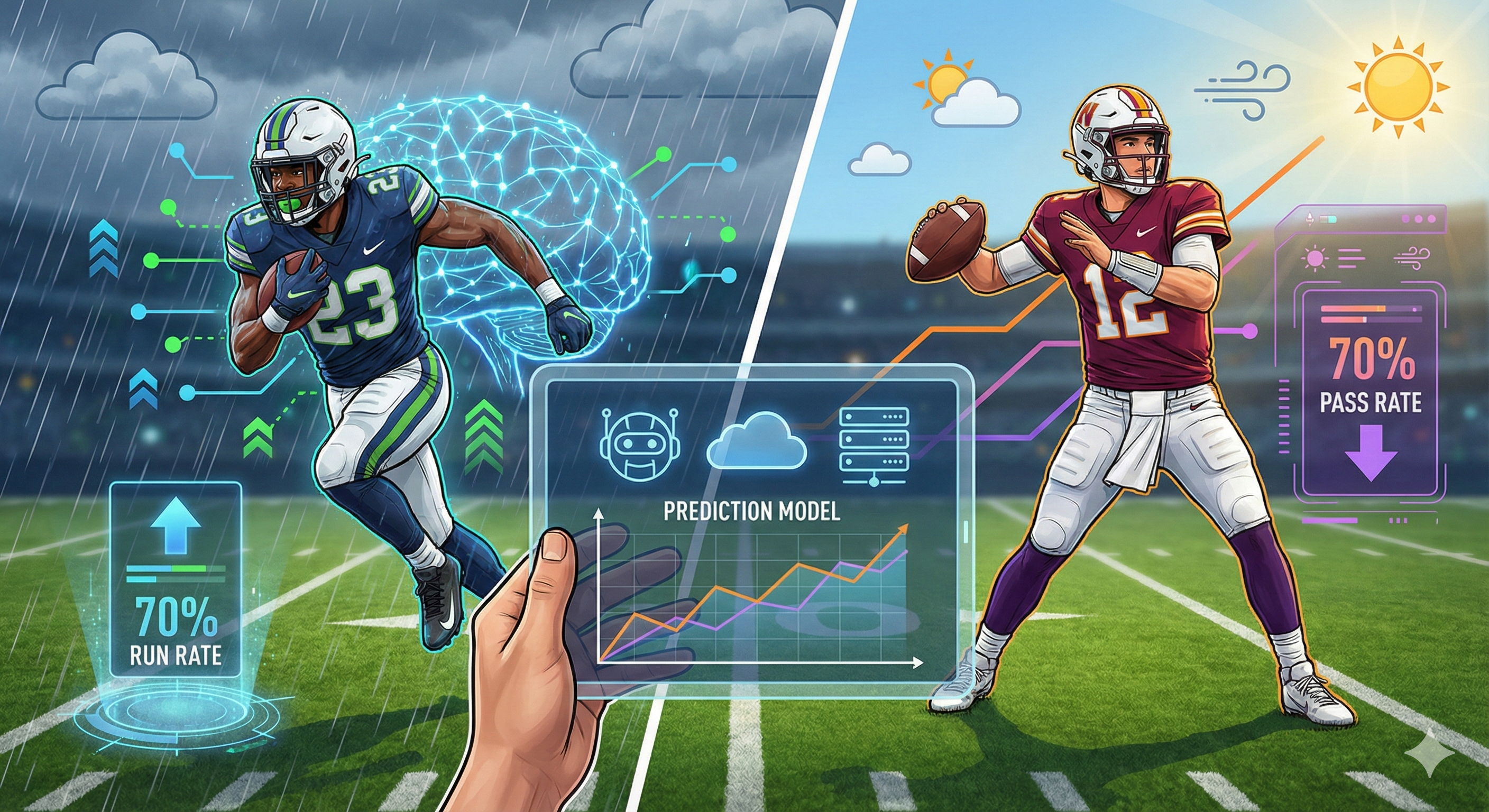
NCAAF run versus pass rate prediction sits at the intersection of strategy and data. Coaches make decisions every snap, but understanding tendencies requires more than just watching the game. AI models translate down, distance, score, and weather into clear probabilities for run and pass plays, creating actionable insights. By focusing on practical patterns and removing the noise, teams and bettors alike can anticipate how offenses are likely to behave in different situations. This approach helps to identify when teams lean on the run game, when they push the pass, and how external factors like wind or late-game situations influence play calling.
Table Of Contents
- Problem Framing and Target Definition
- Data Ingestion and Cleaning
- Feature Engineering and Leakage Control
- Modeling approach
- Evaluation, Interpretation, and Deployment
- Useful References
- Conclusion
- Frequently Asked Questions (FAQs)
Key Takeaways
Accurate prediction relies on using only information available at the time of the snap, including clean play-by-play data, score, clock, field position, weather, and pregame lines. Future outcomes must never be included. Modeling should start simple, expanding from logistic regression with team and opponent effects to gradient boosting, with calibration applied using isotonic regression or Platt scaling. Evaluations should reflect temporal reality, such as week-ahead splits, subgroup checks for weather and tempo, and post-training calibration. Predictions translate into actionable insights by flagging run-heavy scripts, identifying passing surges in two-minute drills, and aligning with totals, props, and correlated markets. ATSwins applies this methodology consistently, offering bettors data-driven insights, player props, betting splits, and profit tracking across NFL, NBA, MLB, NHL, and NCAA.
Problem Framing and Target Definition
The primary goal is predicting team-level run versus pass rates for a given situation rather than determining the outcome of a single play. Each prediction corresponds to a decision point defined by down, distance, time remaining, score margin, field position, and overall game context. The probability of a run or pass is calculated conditional on what the coaching staff and quarterback know at the moment.
Situation-aware run-pass predictions power multiple workflows. Betting splits reflect true offensive intent rather than being skewed by occasional explosive plays. Player prop analysis benefits from accurate exposure estimates for rushing attempts, passing attempts, and target shares under realistic game scripts. In-game alerts can identify deviations from projected tendencies, while profit tracking and model diagnostics attribute edges to consistent decision-making patterns rather than luck. Predicting rates instead of single-play outcomes improves aggregate calibration, which is critical for props, live totals, and derivative markets.
Predictions are produced across three horizons: drive-level forecasts for the next offensive series, quarter-level for the next 15 minutes, and game-level for the remaining full game. Each horizon aggregates situational predictions across likely future states, accounting for typical strategic adjustments, such as increased passing when trailing late.
Target probabilities are calculated for each offense versus defense in a given situation, where the probability of a run can be expressed directly or via log-odds models that include team and opponent effects. Aggregation to longer horizons uses simulation or integration over probable future game states to compute expected run and pass shares. Success metrics include mean absolute error on run and pass shares, Brier scores for predicted probabilities, calibration curves, and expected loss under betting constraints. Subgroup performance is tracked across tempo, scheme, and weather categories.
Existing public datasets do not provide direct, off-the-shelf NCAAF run/pass rate predictors at the team and situation level. Therefore, reliance is placed on authoritative, reproducible sources for play-by-play data, weather, and market context. Data is standardized from CollegeFootballData and cfbfastR, stadium weather from NOAA, and pregame lines and totals from market feeds, ensuring transparency and reproducibility in weekly updates.
Data Ingestion and Cleaning
Play-by-play data forms the backbone of predictions. It includes stable identifiers, downs, distances, yardlines, scores, drive information, and play type labels. Weather is merged from NOAA or local stadium feeds to capture temperature, wind, precipitation, and pressure. Closing spreads and totals serve as market priors for pace and scoring expectations.
A structured ETL pipeline ensures data consistency. The extraction step pulls games, plays, injury notes, and historical weather while collecting pregame spreads and totals. Transformation involves normalizing play types into run, pass, or other, computing game clock properties, constructing possession identifiers, and creating garbage-time masks to filter extreme late-game plays. The loading step stores harmonized features in an analytics warehouse with partitions by season and week to enable efficient filtering and splits.
Play-type normalization addresses sensitivity in run/pass rates. Sacks and scrambles are treated as passes unless signals are missing. Option plays retain original designations, penalties are assigned to underlying calls when possible, and spikes, kneels, and clock-management events are removed from modeling while optionally tracked for diagnostics.
Weather features are merged based on stadium latitude and longitude, scheduled kickoff times, and nearest station observations. Interpolation creates continuous variables for temperature, wind speed and direction, precipitation, gusts, and humidity, with quality control applied to remove implausible values. Odds are incorporated to estimate expected plays, script pressure, and scoring environment. Openers and line movements can be used for pregame modeling, while predictive evaluation relies on closing lines for consistency.
Game clocks, possessions, and garbage-time masks are crucial for modeling. Possession features include series identifiers, series success, and proxies for two-minute warnings. Garbage-time masks can follow cutoffs based on margin or smooth weighting functions, with diagnostic fields to maintain flexibility. Train and validation splits are based on calendar time to avoid leakage, ensuring that opponent and team features lag prior weeks.
Feature Engineering and Leakage Control
Feature engineering is all about turning raw game data into something that actually predicts what’s going to happen next. Situational features capture everything a coach sees in real time. This includes down and distance, yardline context, score margin, seconds remaining, quarter, timeouts left, hash mark, formation type, RB/TE counts, option play indicators, and field conditions like home or away, turf type, and stadium specifics. Each of these helps the model understand not just the “what” but the “why” behind playcalling. For example, teams in short-yardage situations with heavy personnel on a windy day behave differently than teams in open-field, late-game scenarios.
Opponent strength is encoded in a smart way to avoid future leakage while still reflecting real influence. Metrics like defensive efficiency against the run or pass, pass-rush pressure, and run stop rates are lagged so only past games influence predictions. Schematic tags such as odd/even fronts, quarters-heavy schemes, or tendencies on 3rd-and-long give the model more context. Recent performance is weighted heavier than early-season stats to reflect current form without overfitting to a single week.
Coaches and quarterbacks leave unique fingerprints on playcalling, so fixed effects for head coach, offensive coordinator, defensive coordinator, and QB1 identity are included. Interaction terms capture how combinations of coach and QB, or coach and down, influence choices. Weather features also play a role—temperature, wind, precipitation, and dome status interact with expected totals and yardline context to influence whether teams pass or run. For instance, high wind in a low-scoring game reduces pass attempts, while snow or rain changes the likelihood of explosive runs.
Early-season modeling relies heavily on priors because there isn’t much current data. Empirical Bayes smoothing blends last season’s data with conference-level baselines, gradually letting the current season dominate as more plays accumulate. Sparse data situations, like a triple-option offense playing a rarely seen defense, are supplemented through proxies inferred from formation, yardline, personnel counts, and play descriptions. Strict leakage control is enforced everywhere: final results, postgame stats, or actual weather after kickoff are never used in pregame predictions. All rolling statistics are carefully lagged so that each week’s prediction only uses information available up to that point, preventing contamination and overconfidence.
Modeling Approach
The modeling approach is designed to capture the right balance of simplicity, interpretability, and predictive power. The baseline model uses generalized linear models with a binomial likelihood, which is perfect for binary outcomes like run or pass. These models are quick to train, easy to interpret, and stable. Adding generalized linear mixed models (GLMMs) with random effects for teams and opponents stabilizes estimates for smaller sample sizes and allows the model to borrow strength from the broader population of teams.
To capture nonlinear behavior and threshold effects, gradient boosting methods like LightGBM and XGBoost are used. These models handle complex interactions that GLMMs might miss, such as how a QB’s tendencies change under pressure in the red zone or how wind combined with a short yardage situation affects pass attempts. Hierarchical Bayesian models take it a step further, pooling data across similar situations to stabilize estimates for rare scenarios. Partial pooling provides robust uncertainty estimates, which is crucial for bettors trying to weigh risk in prop bets or game scripts.
Multitask setups improve predictions by separating early and late downs while sharing learned patterns across these tasks. Early downs (1st and 2nd) generally follow predictable patterns, while late downs (3rd and 4th) are more reactive to field position, score, and tempo. Sharing representations allows the model to leverage common signals while still specializing for different decision points. Calibration is key: boosted models are often miscalibrated out of the box, so isotonic regression or Platt scaling ensures probabilities reflect reality. Uncertainty estimates are derived from Bayesian posterior draws or bootstrapped predictions across games or weeks. Ensemble approaches combine GLMMs, boosted trees, and Bayesian outputs into a single meta-learner, ensuring monotonic relationships remain sensible for key features. Model selection always prioritizes a balance of accuracy, interpretability, and reliability for analysts and bettors.
Evaluation, Interpretation, and Deployment
Evaluation is a weekly ritual with a rolling protocol. The model trains on past weeks and predicts the next, with metrics like mean absolute error for run share, Brier scores, log loss, and calibration curves to measure reliability. Horizon aggregation simulates drives, quarters, or full games using predicted rates and compares them to actual sequences, excluding garbage-time plays. Subgroup analyses break down performance by pace, offensive scheme, weather conditions, and margin to highlight where the model excels and where it might need adjustment.
Explainability is built into the process. SHAP values for boosted models show which features drive predictions globally and locally, and GLMM coefficients provide a stable baseline for interpretation. This combination creates a human-readable story that bettors and analysts can follow. For example, a windy 3rd-and-long with heavy personnel might push the model toward run, and the SHAP values explain why that prediction makes sense.
Deployment is designed for real-world use, with predictions packaged as an API for ATSwins products. This feeds pregame and live dashboards, player prop projections, betting splits, and real-time alerts. Drift monitoring uses population stability indexes and residual diagnostics to detect when recalibration or adjustment of priors is necessary. Reproducibility is maintained with versioned data snapshots, model metadata, and continuous integration checks to prevent future leakage.
The end-to-end pipeline is highly structured. It begins with selecting base data sources, normalizing play types, constructing situational features, and merging odds and weather. Lagged opponent strength features are built, team priors are smoothed, and data is split by week for training. Baseline GLM/GLMM and boosted models are trained, outputs are calibrated, hierarchical Bayesian models stabilize sparse cells, and all models are stacked with a meta-learner. Evaluation includes horizon simulation, subgroup analysis, and explainability checks. Templates for feature matrices, model reports, SHAP visualizations, and drift flags standardize the workflow. Popular Python and R libraries are used for data handling, modeling, explainability, and scheduling, ensuring the entire process is repeatable and efficient.
Useful References
Core datasets include play-by-play and metadata from CollegeFootballData and cfbfastR, both of which provide reproducible examples, consistent identifiers, and detailed variable definitions. Historical stadium weather is sourced from NOAA, providing temperature, wind, precipitation, and station metadata. Market priors such as closing spreads and totals help contextualize expected pace and scoring, serving as an additional layer of information that improves prediction accuracy. These references form a solid foundation for modeling run versus pass tendencies at a high level of fidelity.
Conclusion
Run versus pass predictions combine situational awareness, opponent strength, weather, and priors into calibrated forecasts. Key lessons include preventing leakage, evaluating out-of-sample, recalibrating weekly, and explaining results through SHAP rather than intuition. Operationalizing pipelines and tracking drift is critical for ongoing accuracy. ATSwins provides an AI-powered platform for data-driven picks, player props, betting splits, and profit tracking across NFL, NBA, MLB, NHL, and NCAA, helping bettors make smarter decisions with both free and paid plans.
Frequently Asked Questions (FAQs)
What is an NCAAF run vs pass rate prediction model?
An NCAAF run versus pass rate prediction model estimates how often a college football offense will run or pass in a given situation. It uses inputs such as down, distance, score margin, time remaining, field position, timeouts, opponent strength, and weather to predict a team’s play mix. Probabilities can be averaged across drives, quarters, or full games to understand tendencies and likely playcalling in specific scenarios, for example, second-and-seven at midfield with a three-point lead and eight minutes remaining.
What data do I need to build an NCAAF run vs pass rate prediction model?
Building this type of model requires clean play-by-play data with clear labels for runs, passes, and sacks, along with down, distance, yard line, score, game clock, quarter, and possession information. Additional features include team identifiers, opponent, home/away status, timeouts, hash mark, and proxies for personnel or formation. Weather information, such as temperature, wind, and precipitation, can improve predictions, and incorporating market context, like closing spreads and totals, helps capture expected pace. The most important rule is to use only information known at the decision time to prevent leakage.
How accurate can an NCAAF run vs pass rate prediction model be?
With well-engineered features and careful validation, mean absolute error typically ranges from four to seven percentage points across weeks. Brier scores and log loss are used to evaluate the quality of binary predictions, and calibration checks ensure that predicted probabilities align with observed outcomes. Accuracy can also be assessed across subgroups, such as weather conditions, tempo, early versus late downs, and field position. Regular recalibration is essential, as coaching adjustments, injuries, and other game factors influence team tendencies throughout the season.
How do I use an NCAAF run vs pass rate prediction model to make better decisions?
These models can inform betting strategies, game scripting, live monitoring, and scouting. In betting, run-heavy scripts affect pace, live totals, rushing props, and first-half unders, while pass-heavy scripts in trailing situations influence attempts, receptions, and air-yard props. For game scripting, coaches and analysts can identify when a staff adjusts tendencies, for instance, passing more on first-and-ten against top run defenses. Live monitoring allows for comparison between actual play mix and the pregame baseline, helping spot temporary mispricings due to injuries, weather shifts, or other anomalies. Scouting benefits from understanding subtle tendencies that may not be obvious from watching highlights alone.
How does ATSwins use an NCAAF run vs pass rate prediction model, and what makes it different?
ATSwins integrates run versus pass rate predictions into its AI-powered platform, which offers data-driven picks, player props, betting splits, and profit tracking across NFL, NBA, MLB, NHL, and NCAA. The model shapes pregame and in-game expectations, highlights correlated markets, and flags shifts in pace. The platform provides transparent reasoning, simple dashboards, and weekly tracking so users can see patterns, deviations, and potential edges with clarity. By combining calibrated predictions with real-time monitoring, ATSwins helps bettors make informed decisions rather than relying on guesswork or anecdotal observations.
Related Posts
AI For Sports Prediction - Bet Smarter and Win More
AI Football Betting Tools - How They Make Winning Easier
Bet Like a Pro in 2025 with Sports AI Prediction Tools
Sources
The Game Changer: How AI Is Transforming The World Of Sports Gambling
AI and the Bookie: How Artificial Intelligence is Helping Transform Sports Betting
How to Use AI for Sports Betting
Keywords:
MLB AI predictions atswins
AI MLB predictions atswins
NBA AI predictions atswins
basketball ai prediction atswins
NFL ai prediction atswins