

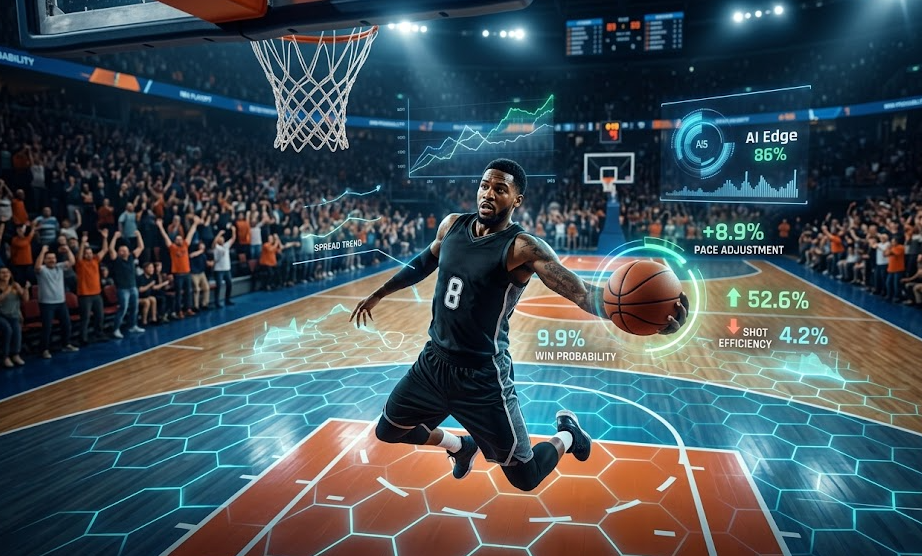
Playoff basketball introduces a completely different environment for modeling, pricing, and betting compared to the regular season. This is where slower tempo, tighter rotations, and sharper coaching adjustments reshape everything that standard season-long models assume. The focus of nba playoff betting trends ai analysis is to translate those structural changes into measurable signals that can be tested, validated, and used for decision-making rather than narrative guessing.
ATSwins is an AI-powered sports prediction platform designed to support this exact kind of analysis. It provides data-driven picks, player prop insights, betting splits, and performance tracking across major sports including the NBA. Its playoff modeling framework emphasizes matchup-based reasoning, rotation tracking, travel fatigue, and market movement detection. Instead of relying on surface-level trends, ATSwins focuses on structured inputs that reflect how playoff games are actually played and priced.
This approach matters because playoff markets behave differently. Lines are sharper, information moves faster, and small edges become more meaningful over a long series. The goal of nba playoff betting trends ai analysis is not to predict everything perfectly, but to consistently identify situations where the model probability differs from the market enough to justify action.
Table Of Contents
- NBA Playoff Betting Trends AI Analysis That Actually Moves The Needle
- Key Takeaways
- Playoffs Versus Regular Season What Changes For Bettors And Models
- Data Pipeline And Feature Design For AI Analysis
- Modeling Approach And Evaluation Framework
- Validating Trends Versus Myths In Playoff Betting
- Practical Workflow And Risk Management System
- How ATSwins Uses NBA Playoff Betting Trends AI Analysis
- Feature Engineering Deep Dive For Playoff Modeling
- Iteration And Evaluation During The Playoffs
- Backtesting Key Playoff Betting Angles
- Practical Playoff Betting Checklist
- Totals And Endgame Behavior Adjustments
- Common Mistakes In Playoff Modeling
- Example Feature Set For NBA Playoff Models
- Where ATSwins Fits Into The Workflow
- Final Execution Principles
- Conclusion
- Frequently Asked Questions
- Key Takeaways
NBA playoff betting trends AI analysis focuses on turning playoff-specific basketball changes into structured model inputs rather than relying on regular season assumptions. One of the most important shifts is tempo compression. Games slow down significantly as teams move from transition-heavy possessions to half-court sets. This reduces volatility in some areas while increasing the importance of matchup execution and coaching decisions.
Another major change is rotation tightening. Most playoff teams shorten their rotation to around seven or eight reliable players. This increases the value of starters and reduces bench randomness. In many cases, late-game performance becomes heavily dependent on fatigue resistance and foul management rather than overall roster depth.
Home court impact also shifts depending on the round. Early rounds tend to be more neutral due to inconsistent travel spacing, while later rounds often show stronger home advantage, especially in high-pressure elimination games. Game 7 environments in particular show measurable behavioral changes in shooting efficiency and foul rates.
Injury timing becomes more impactful in playoff settings compared to the regular season. Updates between games can move lines sharply because teams adjust rotations immediately based on availability. This creates short windows where information edges exist before markets fully stabilize.
Market behavior itself becomes more efficient during the playoffs. Public biases, such as overvaluing higher seeds still exist but are priced more aggressively. This means nba playoff betting trends AI analysis must focus on deeper inefficiencies like scheme mismatches, rotation fatigue, and foul volatility rather than surface-level win-loss expectations.
Finally, ATSwins integrates these insights into structured probability models that track expected value, closing line value, and simulation-based outcomes. The key is consistency in validation rather than chasing isolated winning streaks.
NBA Playoff Betting Trends AI Analysis That Actually Moves The Needle
Playoff betting requires a shift in mindset from general season modeling to context-heavy situational analysis. The phrase nba playoff betting trends AI analysis refers to identifying repeatable, testable patterns that appear specifically in postseason environments and not in regular-season averages.
The most important idea is that playoff basketball is slower, more physical, and more strategic. This impacts totals, spreads, and player usage in ways that can be measured directly using play-by-play data and lineup tracking.
Playoffs Versus Regular Season What Changes For Bettors And Models
The biggest modeling mistake in playoff betting is treating regular-season averages as stable inputs. In reality, playoff basketball alters almost every major statistical category.
Tempo decreases as teams prioritize half-court execution. Transition opportunities shrink because opponents are more prepared defensively. This leads to fewer easy baskets and more structured offensive possessions. As a result, totals often behave differently early in series compared to later games where adjustments accumulate.
Rotations tighten significantly. Coaches reduce bench usage and increase minutes for core players. This leads to more predictable lineup combinations but also higher fatigue levels late in games. Bench scoring becomes less relevant, while star efficiency becomes more important.
Home court advantage becomes more situational. In early rounds, travel schedules can be inconsistent and reduce its impact. In later rounds, particularly elimination scenarios, home court influence becomes more pronounced due to familiarity, crowd pressure, and officiating environment shifts.
Foul rates and free throw volume also become more important. Physicality increases in playoff settings, and referees often allow more contact. This can suppress scoring early but create volatility in late-game scenarios where intentional fouling occurs.
All of these shifts are essential inputs for nba playoff betting trends AI analysis because they directly affect expected value calculations across spreads and totals.
Data Pipeline And Feature Design For AI Analysis
Effective playoff modeling starts with structured data collection. The most important inputs include play-by-play data, lineup configurations, injury updates, scheduling context, and market pricing movement.
Play-by-play data allows tracking of possession-level behavior, including pace, shot selection, and foul frequency. Lineup data is used to measure how teams adjust rotations across a series. Injury updates provide real-time changes in expected performance, especially when star players are upgraded or downgraded between games.
Market data plays a key role because it reflects collective betting behavior. Differences between opening and closing lines can reveal where information is being absorbed faster than expected.
Scheduling data captures rest days, travel distance, and time zone shifts. These factors become more important in playoff series where games are played in rapid succession.
Feature design focuses on converting this raw data into stable signals such as rolling offensive and defensive efficiency, matchup shot profile differences, rotation continuity, and fatigue indicators.
Modeling Approach And Evaluation Framework
Playoff modeling requires careful separation between prediction accuracy and betting value. A model can be directionally correct but still unprofitable if it is not calibrated properly.
Most effective approaches combine logistic regression for baseline probability estimation with gradient boosted models for nonlinear interactions. This allows the system to capture both stable trends and complex matchup dynamics.
Calibration is essential. Probabilities must reflect true expected outcomes rather than raw model outputs. Techniques such as isotonic calibration help align predictions with real-world results.
Evaluation must be structured by series rather than random game splits. Mixing games from the same series across training and testing can lead to data leakage and overly optimistic results. Group-based validation ensures realistic performance measurement.
Key evaluation metrics include expected value, calibration accuracy, and closing line value. Closing line value is particularly important because it measures whether the model consistently beats market pricing, even if short-term results fluctuate.
Validating Trends Versus Myths In Playoff Betting
Many widely discussed playoff betting angles do not hold up under structured testing. nba playoff betting trends AI analysis focuses on validating these patterns using historical data and controlled comparisons.
For example, early game unders are often discussed due to slower adjustments and conservative coaching. While this can appear true in certain seasons, it is not universally reliable unless controlled for team style and matchup context.
Game 7 home advantage is another frequently cited trend. While home teams often perform better, the edge is heavily influenced by underlying team strength and series dynamics rather than crowd impact alone.
Zig-zag patterns after blowouts are also commonly referenced. These occur in some series but are not consistent enough to rely on without conditioning on lineup changes, fatigue, and tactical adjustments.
Travel and altitude effects can influence performance, especially in short rest situations, but they must be modeled with caution to avoid overfitting small sample noise.
Practical Workflow And Risk Management System
A structured workflow is essential for applying nba playoff betting trends AI analysis in real-time environments.
The process begins with updating game results, injury statuses, and market lines. This is followed by feature recalculation including rolling performance metrics, lineup continuity, and fatigue indicators.
Next, model predictions are generated for moneyline, spread, and totals markets. These outputs are compared against market pricing to identify expected value opportunities.
Before any action is taken, correlation risk is evaluated. Multiple bets within the same game or series can unintentionally increase exposure to the same outcome.
Finally, all decisions are logged with timestamps, expected value estimates, and closing line outcomes. This creates a feedback loop that improves model calibration over time.
Risk management focuses on limiting exposure per game, using fractional staking strategies, and avoiding overreaction to short-term variance.
How ATSwins Uses NBA Playoff Betting Trends AI Analysis
ATSwins integrates nba playoff betting trends AI analysis into a structured prediction system that prioritizes consistency and transparency.
The platform generates model-based picks across spreads, totals, and moneylines using a combination of matchup data, rotation tracking, and situational context. It also monitors betting market movement to identify when model signals align or diverge from public pricing.
Player prop models are built separately and focus on usage rate changes, injury status shifts, and playoff-specific rotation tightening. This helps identify opportunities where star players may have increased or reduced roles depending on series context.
Performance tracking is used to evaluate long-term accuracy through expected value and closing line value rather than isolated win rates. This ensures that model quality is judged on consistency rather than short-term variance.
Feature Engineering Deep Dive For Playoff Modeling
Feature engineering is the foundation of nba playoff betting trends AI analysis. Key inputs include rolling offensive and defensive efficiency, matchup shot profile differences, and scheme-based defensive classifications.
Rotation structure is another critical feature. Tracking top player minutes and bench compression helps measure fatigue and predict late-game performance stability.
Contextual variables such as series game number, elimination status, and home or away designation also play a major role. These factors often influence coaching strategy and player usage more than raw statistical averages.
Market features are included to capture how quickly information is being priced in. Large differences between model output and market movement often signal either strong edge or model miscalibration.
Iteration And Evaluation During The Playoffs
Playoff environments require continuous recalibration. After each series, models should be reassessed to ensure stability across different matchup types.
Calibration adjustments are often necessary because playoff intensity changes variance patterns. Shot selection becomes more conservative, and defensive effort increases, which affects scoring distribution.
Feature importance should also be reviewed regularly to ensure that no single variable is dominating predictions without justification. If certain features become unstable, they should be regularized or adjusted.
Backtesting Key Playoff Betting Angles
Backtesting is essential for separating real edges from noise. Common angles such as Game 1 unders, Game 7 home advantage, and travel spot effects must be tested using controlled historical samples.
The most reliable approach is to measure both raw win rate and closing line value. Even if win rate is inconsistent, persistent positive closing line value suggests a meaningful predictive edge.
Testing should always be playoff-specific rather than mixing regular season data. This ensures that results reflect actual postseason conditions.
Practical Playoff Betting Checklist
A structured checklist ensures consistency in decision-making. This includes updating injury reports, recalculating rolling metrics, reviewing lineup continuity, and checking market movement.
Model outputs should be compared against market lines to identify expected value. Only bets that meet a minimum threshold of edge should be considered, while others should be passed.
All decisions should be logged for later review to improve future model iterations.
Totals And Endgame Behavior Adjustments
Totals behavior changes significantly in playoff games. Early series often lean lower due to defensive adjustments, while late-game scenarios introduce volatility through intentional fouling.
Close spreads increase the likelihood of free throw sequences in the final minutes, which can shift totals unexpectedly.
Three-point shooting remains a dominant source of variance, and models should avoid overfitting midrange efficiency changes that are less stable.
Common Mistakes In Playoff Modeling
One common mistake is over-relying on regular season pace without adjusting for playoff context. Another is treating referee data as highly predictive without sufficient sample size.
Mixing live betting data with pregame models can also create contamination issues. Each system should remain separate to preserve accuracy.
Narrative-driven betting without statistical backing often leads to inconsistent results and poor long-term performance.
Example Feature Set For NBA Playoff Models
A complete feature set includes rolling team performance metrics, matchup shot profiles, scheme classifications, rotation structure, contextual game variables, market movement indicators, referee tendencies, and injury status encoding.
Each feature should be tested for stability and contribution to predictive performance before being fully integrated into the model.
Where ATSwins Fits Into The Workflow
ATSwins serves as a centralized platform for applying nba playoff betting trends AI analysis in practice. It connects model outputs with actionable insights, tracks performance over time, and provides structured evaluations of betting decisions.
The focus remains on transparency, consistency, and measurable improvement rather than isolated predictions.
Final Execution Principles
Successful playoff betting depends on discipline, calibration, and structured decision-making. Small edges accumulate over time when risk is managed correctly and models are continuously validated.
Consistency in tracking, evaluation, and adjustment is more important than chasing high variance outcomes.
Conclusion
NBA playoff betting trends AI analysis focuses on identifying structural changes in postseason basketball and converting them into measurable betting edges. Slower pace, tighter rotations, injury timing, and market efficiency all play critical roles in shaping outcomes.
ATSwins supports this process by providing structured AI-driven insights that combine matchup analysis, rotation tracking, and market behavior into a single framework. When used consistently, this approach helps identify value-driven opportunities while maintaining strong risk control.
Frequently Asked Questions
What is NBA playoff betting trends AI analysis
NBA playoff betting trends AI analysis is the process of using structured data models to evaluate how playoff basketball differs from the regular season and identify betting value based on those differences. It focuses on tempo, rotations, injuries, and market behavior.
Why is playoff basketball different for betting models
Playoff basketball is slower, more physical, and more strategic. Rotations tighten, coaching adjustments increase, and games become more matchup dependent, which changes how models should interpret data.
How does ATSwins use AI in playoff betting
ATSwins uses AI models that combine matchup data, rotation tracking, injury updates, and market movement to generate probability-based insights and betting evaluations.
What are the most important features in playoff betting models
Key features include pace adjustments, lineup continuity, shot profile differences, injury status, travel and rest data, and market line movement.
How can betting risk be managed in playoffs
Risk is managed through small edge thresholds, controlled staking, correlation limits, and consistent tracking of closing line value and expected value.
Related Posts
AI For Sports Prediction - Bet Smarter and Win More
AI Football Betting Tools - How They Make Winning Easier
Bet Like a Pro in 2025 with Sports AI Prediction Tools
Sources
The Game Changer: How AI Is Transforming The World Of Sports Gambling
AI and the Bookie: How Artificial Intelligence is Helping Transform Sports Betting
How to Use AI for Sports Betting
Keywords:
MLB AI predictions atswins
AI MLB predictions atswins
NBA AI predictions atswins
basketball ai prediction atswins
NFL ai prediction atswins