

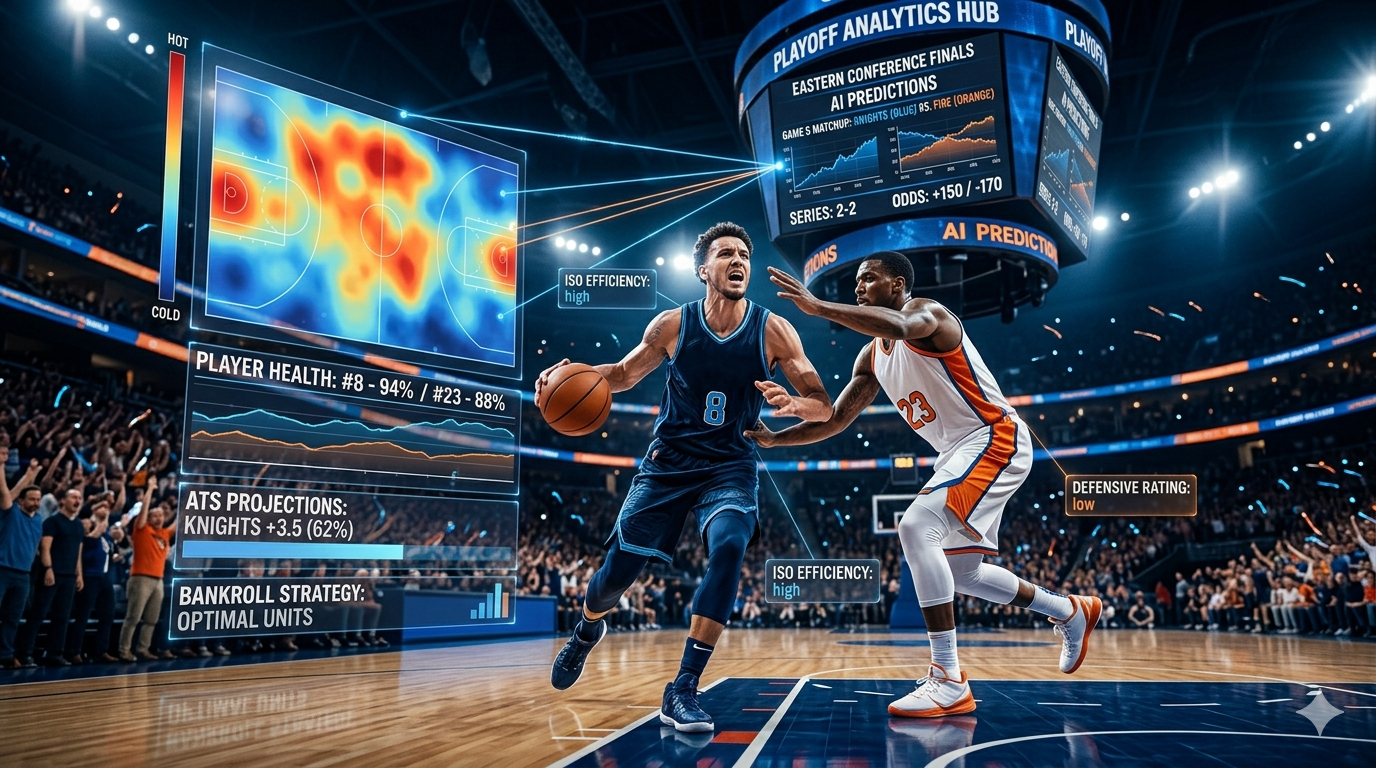
Every morning during the NBA playoffs, I’m doing the same routine. Coffee, laptop open, models running, injury reports refreshing every few minutes. It’s not glamorous, but this is where the edge actually comes from. You’re not guessing. You’re not riding vibes. You’re building a repeatable process that turns chaos into structure. That’s the whole point of an AI-driven approach to betting.
This post is all about how I build and run a daily system that can simulate game outcomes NBA betting predictions in a way that actually holds up over time. It blends film, data, and machine learning into something practical. Not theory. Not hype. Real decisions you can make before tipoff. If you’re into ai basketball picks, or you’ve been experimenting with ai nba prediction models and want something more structured, this is going to give you a full framework.
The goal here is simple. Build something that produces consistent, explainable outputs every single day of the playoffs. Not just winners, but edges. Not just edges, but properly sized bets. And not just bets, but a system you can track, improve, and trust over a full postseason run. This is basically how I approach nba ai latest workflows when the games actually matter.
Table Of Contents
- Building an NBA Playoff AI Daily Picks System That Traders Can Use
- Data pipeline and features
- Modeling and validation
- Daily operations and deployment
- Ethics, limits, and practical edges
- Tools, templates, and resources
- Conclusion
- Frequently Asked Questions (FAQs)
Building an NBA Playoff AI Daily Picks System That Traders Can Use
The system runs like a machine once it’s set up properly. Every day it pulls matchup data, odds, injuries, travel info, and rest days. Then it builds opponent-adjusted features that actually reflect playoff basketball, not regular season noise. From there, it estimates probabilities for ATS, moneyline, and totals. Those probabilities get calibrated, compared to the market, and converted into real betting edges.
What matters here is that everything is structured. You’re not just getting a pick. You’re getting context. You’re seeing confidence levels, edge percentages, and suggested unit sizes based on risk. That’s what separates a real system from random ai basketball picks floating around online.
The outputs are clean. You might see something like a team projected to win 63 percent of the time on the moneyline, cover a -4 spread at 55 percent, and lean under at 52 percent. Then it shows you how that compares to the market price, whether there’s actual value, and how much of your bankroll should be exposed.
And the explanation always matters. If a pick shows up, there’s a reason. Maybe pace is projected to slow down. Maybe rotations are tightening. Maybe a starter is limited to 16 minutes. Maybe travel across time zones is impacting performance. This is where ai nba prediction becomes useful instead of just theoretical.
Playoff basketball is different. Pace slows down. Teams rely more on half-court sets. Rotations shrink, which makes player-level impact way more important. Shot quality matters more than volume. Late-game situations matter more than anything, especially for totals and spreads. And series context changes everything. A team down 0-2 plays differently than a team up 3-1.
The daily workflow is consistent. Morning is data ingestion. Midday is feature updates and injury adjustments. Afternoon is modeling and edge calculation. Pre-lock is verification. After games, everything gets logged and reviewed. That consistency is what allows the system to simulate game outcomes NBA betting predictions in a way that actually improves over time.
Data pipeline and features
The data pipeline is where most people mess up. If your inputs are bad, your outputs don’t matter. You need clean, structured data from multiple sources. League data, market data, and contextual data all come together here.
League data includes play-by-play, box scores, lineup combinations, and on/off splits. Market data includes moneylines, spreads, totals, and closing lines across books. Contextual data includes injuries, travel distance, time zones, and even referee tendencies.
Everything gets normalized. Team names, player names, timestamps. You store raw data and curated data separately so you can always go back and reproduce results. That reproducibility is a huge part of making ai basketball picks reliable instead of random.
The feature set is where things get interesting. You’re building adjusted team strength ratings, player impact metrics, lineup continuity scores, pace trends, and shot profile matchups. You’re looking at how teams generate offense and how opponents defend it. You’re modeling interactions like how a drop coverage defense affects a team that relies on pull-up threes.
Rebounding and free throws matter more than people think. Offensive rebound rate can swing both totals and spreads. Free throw rate becomes huge in playoff games where whistles tighten or loosen depending on officiating crews.
Clutch performance also becomes more relevant. Late-game turnovers, timeout usage, and after-timeout efficiency all impact outcomes. These are small edges individually, but they stack.
Injury handling is critical. You’re not just marking players as in or out. You’re assigning probabilities. You’re adjusting minutes. You’re redistributing usage. If a high-usage guard is out, that usage doesn’t get split evenly. It shifts to primary creators.
All of this feeds into a system that can simulate game outcomes NBA betting predictions with multiple scenarios baked in. That’s how you handle uncertainty without guessing.
Modeling and validation
The modeling layer is where everything comes together. You’re typically running a mix of gradient boosted trees, logistic regression, and sometimes a small neural network for interaction effects. Nothing too crazy. The key is balance between power and stability.
Tree models handle nonlinear relationships well. Logistic models provide clean probability outputs. Neural nets can capture interactions but need to stay simple because playoff samples are small.
Everything gets calibrated. That’s non-negotiable. A model saying 60 percent needs to actually hit 60 percent over time. Otherwise your edges are fake. Calibration methods like isotonic regression help fix that.
Validation is done through rolling time-based testing. You train on past data, validate on future games, and repeat across seasons. No shortcuts. No random splits. This is about simulating real-world conditions.
You track metrics like Brier score, log loss, and closing line value. CLV is huge. If your picks consistently beat the closing line, you’re doing something right even if short-term results are noisy.
Uncertainty also needs to be quantified. You can use bootstrap methods or Bayesian approaches to create probability ranges. Then you adjust betting thresholds based on how confident those probabilities are.
This is where ai nba prediction becomes actionable. You’re not just generating numbers. You’re understanding how reliable those numbers are.
Daily operations and deployment
Running the system daily is about discipline. Everything is automated where possible. Data pulls happen at scheduled times. Models run at specific checkpoints. Picks are generated, reviewed, and either placed or passed.
Cutoffs matter. You don’t want to bet stale lines. You don’t want to chase moves after value is gone. Timing is part of the edge.
Everything is logged. Every pick, every line, every timestamp. That’s how you build a track record and improve. Tools like experiment tracking platforms help keep everything organized.
You also monitor for drift. If pace trends change across series or officiating patterns shift, your model needs to adapt. If your edges stop beating closing lines, something is wrong.
Bankroll management is baked in. Fractional Kelly is a common approach, but it’s always capped. You’re never overexposing on one game or one series. Survival comes first.
A typical day ends with logging results, reviewing performance, and updating notes. Then it repeats. That consistency is what turns ai basketball picks into something sustainable.
Ethics, limits, and practical edges
There are limits to everything. Playoff samples are small. You can’t overreact to one series. You can’t overfit matchup narratives. Film study helps, but it should guide features, not override data.
You also need to stay honest about results. Track what you knew at the time. Don’t rewrite history after the fact. If a pick loses, figure out why. Was it bad logic or just variance?
Responsible betting matters too. Set limits. Take breaks after bad days. Stick to your system. This isn’t about chasing wins. It’s about long-term edge.
Practical edges still exist. Pace mispricing in Game 1. Offensive rebounding mismatches. Referee tendencies. Lineup continuity. Coaching adjustments. These are small but repeatable signals.
When you combine those with a solid nba ai latest system, you get something that can actually compete with the market.
Tools, templates, and resources
You don’t need anything crazy to build this. Basic tools for data, modeling, and tracking are enough. The key is how you use them.
Your data structure should include game-level info, team stats, player projections, and market lines. Everything should be versioned and reproducible.
Model templates should stay simple. Start with baseline models and improve gradually. Don’t jump straight into complex architectures.
Validation templates should focus on time-based splits and real-world simulation. Track metrics that actually matter like CLV and calibration.
Position sizing templates should define units clearly and enforce caps. Scaling rules should be based on performance, not emotion.
All of this reduces friction and keeps your workflow clean.
Conclusion
At the end of the day, this is what an AI-driven playoff betting system really looks like. It’s structured, repeatable, and grounded in data. You’re not guessing. You’re building probabilities, comparing them to the market, and making disciplined decisions.
The combination of matchup context, injuries, pace, and calibrated models is what drives real edges. Add in proper bankroll management and consistent tracking, and you have something that can last beyond one playoff run.
There’s no magic here. Just process. If you stay consistent, track your results, and keep improving your model, you put yourself in a position to win long-term. That’s the whole point of using ai nba prediction systems in the first place.
Frequently Asked Questions (FAQs)
What is an NBA Playoff AI daily picks system, and how does it actually work?
An NBA Playoff AI daily picks system turns playoff data into structured betting decisions every day. It processes injuries, odds, matchup stats, and context to estimate probabilities for ATS, moneyline, and totals. Then it compares those probabilities to market prices to find edges and outputs picks with confidence and sizing.
Which data points matter most in an NBA Playoff AI daily picks system?
Rotation minutes, half-court efficiency, shot quality, on/off splits, pace trends, and market context are all key. Playoffs amplify these factors, so they matter more than regular season stats.
How do I use an NBA Playoff AI daily picks system with bankroll management?
Use small, consistent units. Apply fractional Kelly or flat betting. Limit exposure to correlated outcomes. Track closing line value and long-term results instead of short-term wins.
How does ATSwins.ai support an NBA Playoff AI daily picks system?
ATSwins.ai provides AI-driven picks, player props, betting splits, and tracking tools. It helps validate your model outputs and maintain discipline throughout the playoffs.
Why do lines move in the playoffs, and how should timing work?
Lines move due to injuries, coaching adjustments, and sharp money. The system should account for timing by identifying early value or waiting for better prices depending on the situation.
Related Posts
AI For Sports Prediction - Bet Smarter and Win More
AI Football Betting Tools - How They Make Winning Easier
Bet Like a Pro in 2025 with Sports AI Prediction Tools
Sources
The Game Changer: How AI Is Transforming The World Of Sports Gambling
AI and the Bookie: How Artificial Intelligence is Helping Transform Sports Betting
How to Use AI for Sports Betting
Keywords:
MLB AI predictions atswins
AI MLB predictions atswins
NBA AI predictions atswins
basketball ai prediction atswins
NFL ai prediction atswins