

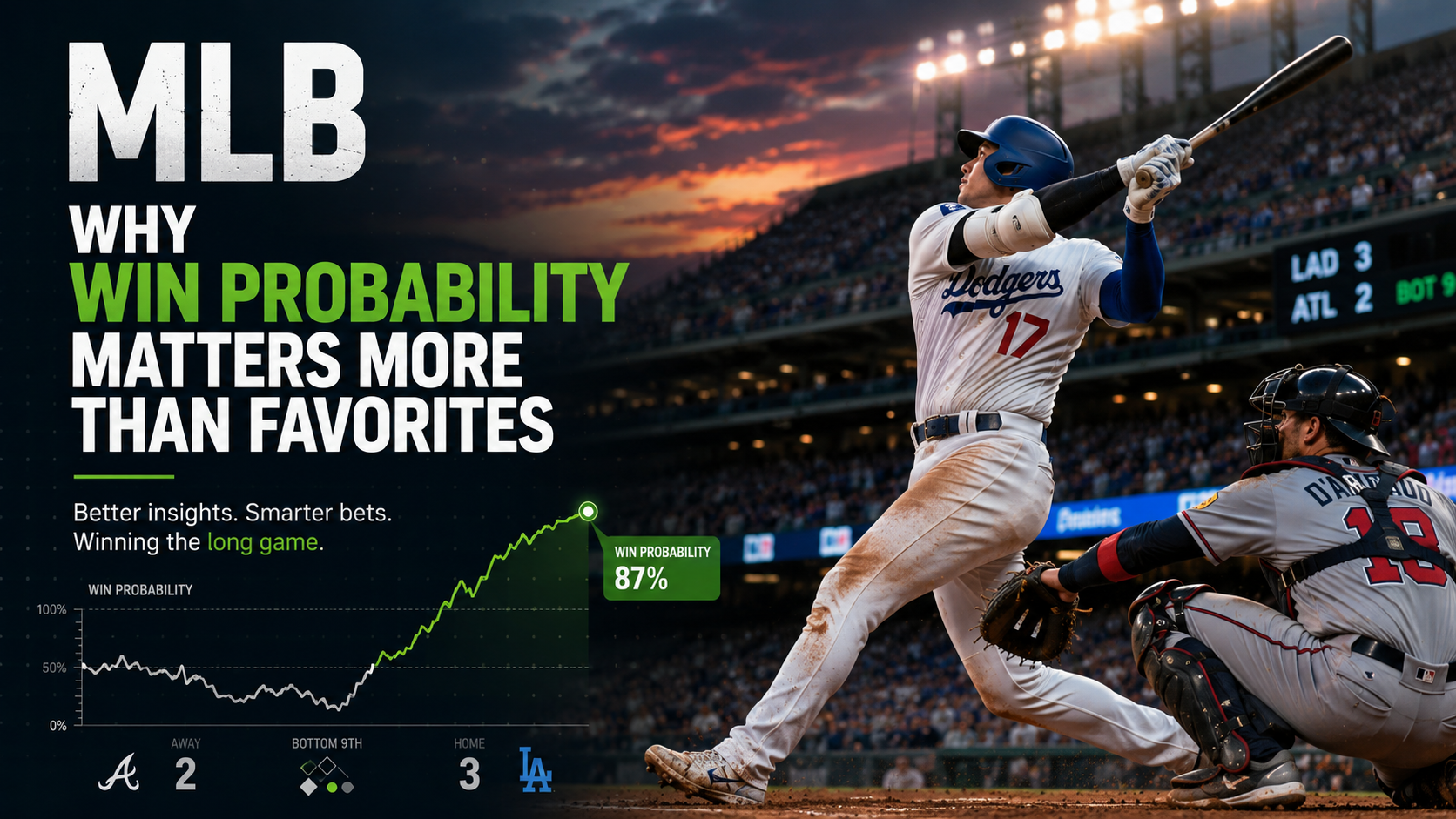
Most bettors naturally gravitate toward favorites because they seem like the safer choice, but successful sports betting is built on finding value rather than simply picking the team most likely to win. This guide explains why moneylines tell only part of the story and how understanding true probabilities can help you identify opportunities the betting market may have overlooked. Instead of relying on intuition, you'll learn to evaluate wagers through a data-driven lens.
The article explores how AI-powered win probability models estimate outcomes by combining factors such as starting pitching, bullpen strength, offensive production, park effects, weather, and recent team performance. It also shows how to convert betting odds into implied probabilities and compare them with model projections to determine whether a wager offers positive expected value instead of simply backing the favorite.
Beyond identifying value, you'll discover practical bankroll management strategies that help protect your capital over the long run. By sizing bets appropriately and making decisions based on probability rather than emotion, you can approach MLB betting with greater discipline and consistency. Whether you're new to analytics or looking to refine your strategy, this guide provides a straightforward framework for making smarter betting decisions.
Table Of Contents
- Win Probability Beats Favorites in MLB Betting
- Thesis: Price the Game, Not the Label
- Favorites vs. Implied Odds: Why Labels Mislead
- Quick Framework: Turn Lines into Probabilities
- Live Win Probability: State, Leverage, and Stale Prices
- Pricing the Edge, Not the Favorite
- Case Workups: Where WP Outperforms Favorites Thinking
- Tooling, Data Sources, and a Lightweight Workflow
- QA Your Model: Backtest and Calibrate
- How ATSwins Puts WP into Practice
- Quick How-To: Fast WP Model You Can Run Daily
- Practical Heuristics: When to Fade Big Favorites
- A Compact Checklist You Can Reuse
- Two Fast Worked Examples
- Small but Meaningful Model Upgrades
- What to Measure Weekly
- Bringing It Back to ATSwins
- Conclusion
- Frequently Asked Questions (FAQs)
Key Takeaways
The fundamental rule of this game is to bet value, not labels. You must compare your own calculated win probability to the no-vig implied odds set by the market. It is a harsh reality that even a massive favorite can be a negative expected value play if the price is too steep. To get this right, you first convert moneylines into implied odds and strip away the house edge, known as the vig. You only pull the trigger when your win probability beats that number by a clear margin of at least two or three percent.
When you are building your model, focus on the factors that actually move the needle for an MLB team like the Los Angeles Dodgers. This includes starting pitcher quality, bullpen freshness, park effects, weather conditions, and platoon splits. In a live betting environment, you need to use the base-out state and leverage indices to catch fast shifts in value. Finally, manage your risk with disciplined staking and always track your closing line value to keep your records honest. At ATSwins, we use AI-powered projections and player props to help bettors focus on price rather than vibes.
Win Probability Beats Favorites in MLB Betting
Thesis: Price the Game, Not the Label
The word favorite is nothing more than a label, whereas win probability is a specific price. Most bettors find themselves in deep water because they buy the label and completely ignore the price. Favorites often look safe because they win more often on a raw percentage basis, but the problem is that the market price and the subsequent payout already account for that frequency.
The betting market is also subject to significant bias. Recreational money tends to push the chalk even higher, and sportsbooks add juice to protect their bottom line. Your entire edge as a bettor comes from estimating the true win probability of a game and then comparing it to the implied odds. If the difference is positive, you have a bet. This is the backbone of how serious analysts approach the official stats provided by MLB.com to find gaps in the market.
Favorites vs. Implied Odds: Why Labels Mislead
American odds are a translation of the market's belief into an implied probability. For instance, a -150 line means the market believes that team wins about 60 percent of the time before you even consider the vig. If your calculated fair win probability is equal to the market's fair win probability, the bet is a break-even proposition regardless of whether you are taking the favorite or the dog.
Bias and juice are the two primary reasons why these labels lead people astray. Because so many casual bettors love favorites and parlays, books will often shade the lines toward that demand. Furthermore, the vig ensures that the two-way market total exceeds 100 percent. If you do not remove that vig, your comparison will always be skewed. Narratives about an ace being on the mound or a team being in a must-win situation can cause prices to drift far away from the actual run environment or bullpen reality.
Quick Framework: Turn Lines into Probabilities
Step 1: Convert Moneylines to Implied Probability and Remove Vig
To calculate the implied probability for negative odds, you take the absolute value of the odds and divide it by the sum of that value plus 100. For positive odds, you divide 100 by the sum of the odds plus 100. Once you have both probabilities, you sum them up to find the total market percentage. To find the fair probability, you divide the individual team’s implied percentage by that total sum. This gives you a neutral baseline that is free from the house edge, allowing you to see what the market actually thinks about the performance of a player like Shohei Ohtani and his impact on the game.
Step 2: Build a Pregame WP Baseline
The job of your model is to move from the roster and environmental data to an expected distribution of runs. You should focus on starting pitcher quality by looking at both recent and long-term trends while checking pitch shapes on Baseball Savant. Bullpen freshness is equally vital; you need to know the workload from the last three days. Other factors like park dimensions, weather sensitivities, and confirmed lineup changes can swing your win probability by several percentage points in a matter of minutes.
Step 3: Synthesize into Team Win Probability
Once you have your offensive and pitching distributions, you can compute the probability of one team outscoring the other. This needs to account for the nine innings of regulation plus the specific rules of extra innings, where home-field advantage can shift the win probability by one or two percent. Running a Monte Carlo simulation with 10,000 to 50,000 iterations is a great way to sample these outcomes quickly and get a post-lineup sanity check on your numbers.
Live Win Probability: State, Leverage, and Stale Prices
The Base-Out State and Run Expectancy
Live win probability is anchored in run expectancy. This is determined by the specific base-out state, the inning, the current score, and the park environment. There are 24 possible base-out states depending on which bases are occupied and how many outs have been recorded. For every state, there is a historical run expectancy that tells you how many runs are likely to score by the end of that half-inning. Successful live models combine this state with the specific quality of the relievers currently in the game.
Score, Inning, and Leverage Index
The Leverage Index is a measurement of how much the very next play will swing the win probability of the game. It tends to spike in late-inning, close-score situations with runners on base. These high-leverage spots magnify tiny edges, such as a pinch-hitter’s platoon advantage or the availability of a fresh closer. You must adjust your live model for real-time bullpen usage rather than just relying on nominal depth charts.
Using Live Data with ATSwins
The market often lags when it comes to live inputs like unstated bullpen fatigue or a bench bat that can flip a platoon advantage. That lag is your window of opportunity. By monitoring ATSwins live updates and watching for sudden weather shifts, you can catch lines that have gone stale. If you want to see how these games are trending in real-time, you can always check the today’s MLB odds board on the ATSwins platform to see where the value is hiding.
Pricing the Edge, Not the Favorite
EV Math: The Only Scorecard That Matters
Your edge is simply the difference between your calculated fair win probability and the fair win probability offered by the market. Expected Value (EV) multiplies that difference by the potential payout to determine if a bet is worth the risk. Whether you are betting a dog or a favorite, the math remains the same: you are looking for an ROI that justifies the variance. A favorite that wins 60 percent of the time is a losing bet if you are paying for it as if it wins 65 percent of the time.
Sizing Stakes: Fractional Kelly or Flat Stakes
There are two primary ways to handle your bankroll. Fractional Kelly staking allows you to grow your bankroll efficiently by betting a percentage of your edge, but it can be volatile if your estimates are noisy. Flat staking, usually between half a percent and one percent of your bankroll, offers more stability and is often better for those who are still refining their models. I personally utilize a mix of both, moving to fractional Kelly only when my backtested signal is exceptionally stable.
Track CLV and Error Bars
Closing Line Value is a crucial metric for any serious bettor. While beating the closing line does not guarantee a win on any single game, it is the strongest signal of long-term quality. You should also build error bars for your win probability. An estimate of 58 percent with a three percent margin of error is much less certain than one with a one percent margin. Tracking your misses by category will help you identify where your model needs adjustment.
Case Workups: Where WP Outperforms Favorites Thinking
Case 1: Ace vs. Elite Offense
Imagine a scenario where a star starter is listed as a heavy favorite at home against an elite road lineup. The public usually piles on the ace, causing the line to move even further. However, if the home bullpen’s top arms are unavailable due to heavy usage in the previous two days, the late-inning win probability shifts toward the road team. While the favorite looks safe on the surface, the price becomes inflated, and the true value often lies with the underdog or a pass on the chalk.
Case 2: The Wrigley Field Factor
When the wind is blowing out at 20 mph at Wrigley Field, the market usually overcorrects by bumping the total and shading the line toward the better starter. However, high-run environments actually increase volatility. In these situations, the edge of a better team is often eroded by the randomness of fly balls turning into home runs. This is a classic spot where big favorites become overpriced because the increased variance favors the underdog.
Case 3: Catcher Rest and Travel Spots
A visiting team arriving on a late cross-country flight for an early day game is a prime candidate for a fade, especially if their primary catcher is sitting out. If the home pitcher relies on framing and hitting the edges of the zone, a backup catcher with poor framing stats can cause the called-strike rate to drop. Even a one percent drop in strikes can lead to higher pitch counts and shorter outings, meaning a favorite at -155 might actually be a negative EV play.
Tooling, Data Sources, and a Lightweight Workflow
To build a professional-grade model, you need to bookmark reputable sources like the FanGraphs WPA library and Baseball Savant for Statcast data. You can also utilize Retrosheet to download historical event files and build your own base-out run expectancy tables. These neutral sources provide the raw data without the noise of the mainstream media.
A repeatable workflow is the key to consistency. Start your morning by pulling opener lines and converting them to implied probabilities. Once lineups are confirmed, run your full simulation to account for platoons and substitutions. After the game, log your bet, the closing price, and your calculated win probability to ensure you are constantly calibrating your approach. For a more structured approach, the ATSwins MLB playbook offers a great frame for your daily routine.
QA Your Model: Backtest and Calibrate
Calibration is the process of ensuring that your 55 percent picks actually win about 55 percent of the time over a large sample. You should use Brier scores to measure the accuracy of your probabilities and log loss to ensure you aren't being overconfident. If your model starts to drift, it may be due to seasonal changes in ball composition or shifts in how managers are utilizing their bullpens. Updating your priors monthly rather than annually will help keep your win probability aligned with the current reality of the league.
How ATSwins Puts WP into Practice
At ATSwins, we focus on providing the data-driven inputs you need to make repeatable decisions. We offer player props and betting splits that help you understand where the retail money is moving and where the sharp edges are located. By using our profit tracking tools, you can filter your results by market type and identify exactly which parts of your model are performing the best. Our goal is to provide clarity so that you can stop chasing favorites and start pricing games like a professional.
Quick How-To: Fast WP Model You Can Run Daily
You can build a functional model by scraping lines, pulling starter projections, and adjusting for bullpen availability. Make sure to integrate park factors and weather heuristics while also accounting for lineup multipliers like platoon splits. Whether you use a full simulation or an analytic approximation, the goal is to convert those runs into a win probability that can be compared against the market. In-game, you should constantly update your numbers based on the base-out state and reliever warm-ups.
Practical Heuristics: When to Fade Big Favorites
There are several red flags that should make you wary of a heavy favorite. Shorthanded bullpens, high-volatility weather, and travel compression are all factors that the market often fails to price correctly. Additionally, if you see an overreaction to a first-inning error or a couple of early runs, the live market may offer a better entry point on the underdog. Favorites can certainly be profitable plays, but only when your fair win probability cushion is large enough to overcome the vig.
A Compact Checklist You Can Reuse
Before you place your next bet, ask yourself if you have removed the vig and worked with fair implied probabilities. Ensure your pregame numbers incorporate bullpen availability and likely late-game substitutions. Double-check that you have adjusted for park and weather factors in a meaningful way. Most importantly, make sure you are logging your closing line value and hit rates so that you can prove you have a real edge over the long haul.
Two Fast Worked Examples
In Example A, a home favorite is listed at -200 with a market fair win probability of 66 percent. However, if your model shows the top leverage arms are down and the umpire has a tight zone that hurts the starter, your fair win probability might only be 61 percent. In this case, the math tells you to pass. In Example B, a road dog at +140 has a market fair win probability of 41.5 percent. If your model likes the rested bullpen and the park environment, and gives them a 45 percent chance to win, you have a clear positive EV bet.
Small but Meaningful Model Upgrades
If you want to take your model to the next level, start integrating catcher framing deltas for specific pitcher pairings. You can also model pinch-run equity for the late innings, as a fast runner on the bench changes the run expectancy of a single. Adding interaction terms for weather and park geometry or tracking umpire handedness splits can give you the tiny nudges in win probability that turn a break-even season into a profitable one.
What to Measure Weekly
Every week, you should look at your edge distribution and your realized ROI by edge bucket. Check your median closing line value and ensure that your mix of favorites and dogs isn't heavily biased in one direction. If your performance in low-run environments is significantly different from high-run environments, your model may be overestimating the impact of certain variables like bullpen depth.
Bringing It Back to ATSwins
I keep my own process boring and repeatable because that is what works. I start each day by scanning the ATSwins board for news on the New York Yankees and other major teams to see where the lines are moving. I review the betting splits to see if the favorites are being pushed by public sentiment and log every decision to compare it against the closing prices. When the market falls in love with a favorite, I ignore the hype and focus on the fair win probability. If the math doesn't work, I don't bet.
Conclusion
Winning in MLB betting is about the discipline of pricing games rather than the emotional lure of chasing favorites. By converting lines to true odds and modeling the specific context of each matchup, you can find the edges that others miss. ATSwins's expertise is grounded in being an AI-powered sports prediction platform that offers data-driven picks, player props, betting splits, and profit tracking across the NFL, NBA, MLB, NHL, and NCAA. Whether you are using our free or paid plans, we provide the insights and guides necessary to help bettors make smarter, more informed decisions in a volatile market.
Frequently Asked Questions (FAQs)
What does it mean that in MLB win probability matters more than favorites?
It means that your primary goal is to price the true mathematical chance of a team winning rather than simply following the market's designation of a favorite. Favorites often carry extra vig and are influenced by public bias, which inflates their price. The smarter approach is to compare your calculated win probability to the market’s implied odds. If your model predicts a 54 percent chance of winning while the market price implies only 50 percent, you have found value. Conversely, if a popular team like the Yankees is priced at -180 but your model shows they only win 58 percent of the time, there is no edge to be found despite their status as the favorite.
How do I turn MLB moneylines into win probability and spot value vs. favorites?
The process begins by converting the moneyline into an implied probability. For a favorite at -150, you divide 150 by 250 to get 60 percent. For an underdog at +140, you divide 100 by 240 to get approximately 41.7 percent. You then remove the vig by normalizing these two numbers so they sum to exactly 100 percent. Once you have the fair implied probability, you compare it to your own model's win probability. You should only place a bet when your win probability exceeds the market's implied probability by a comfortable margin, typically two to three percent. This prevents you from chasing favorites just because their name or roster looks superior on paper.
When will betting MLB favorites underperform a win probability approach?
Betting on favorites often underperforms in high-run environments, such as a hot day at a hitter-friendly park, because the increased scoring variance naturally helps the underdog. Additionally, a mismatch in bullpen availability can flip the win probability in the late innings even if the favorite has a superior starting pitcher. Factors like a stingier umpire's strike zone or a backup catcher's poor framing can also erode a favorite's edge in ways the market doesn't always account for. Travel schedules and late lineup scratches also impact win probability more accurately than they do the static favorite price. Essentially, win probability reveals the hidden risks that make favorites less safe than they appear.
How do I use live MLB win probability during games instead of riding pregame favorites?
To effectively use live win probability, you must track the base-out state and the specific inning. For example, a lead-off runner reaching base spikes the live win probability significantly more than most casual observers realize. You should utilize run expectancy tables to update your calculations after every single plate appearance. It is also vital to watch for bullpen usage and any dips in pitcher velocity, as your live win probability should react to these physical signals faster than the sportsbooks' automated algorithms. By looking for stale lines during high-leverage moments, such as a late-inning pitching change or a crucial defensive replacement, you can find profitable entries that pregame bettors completely miss.