

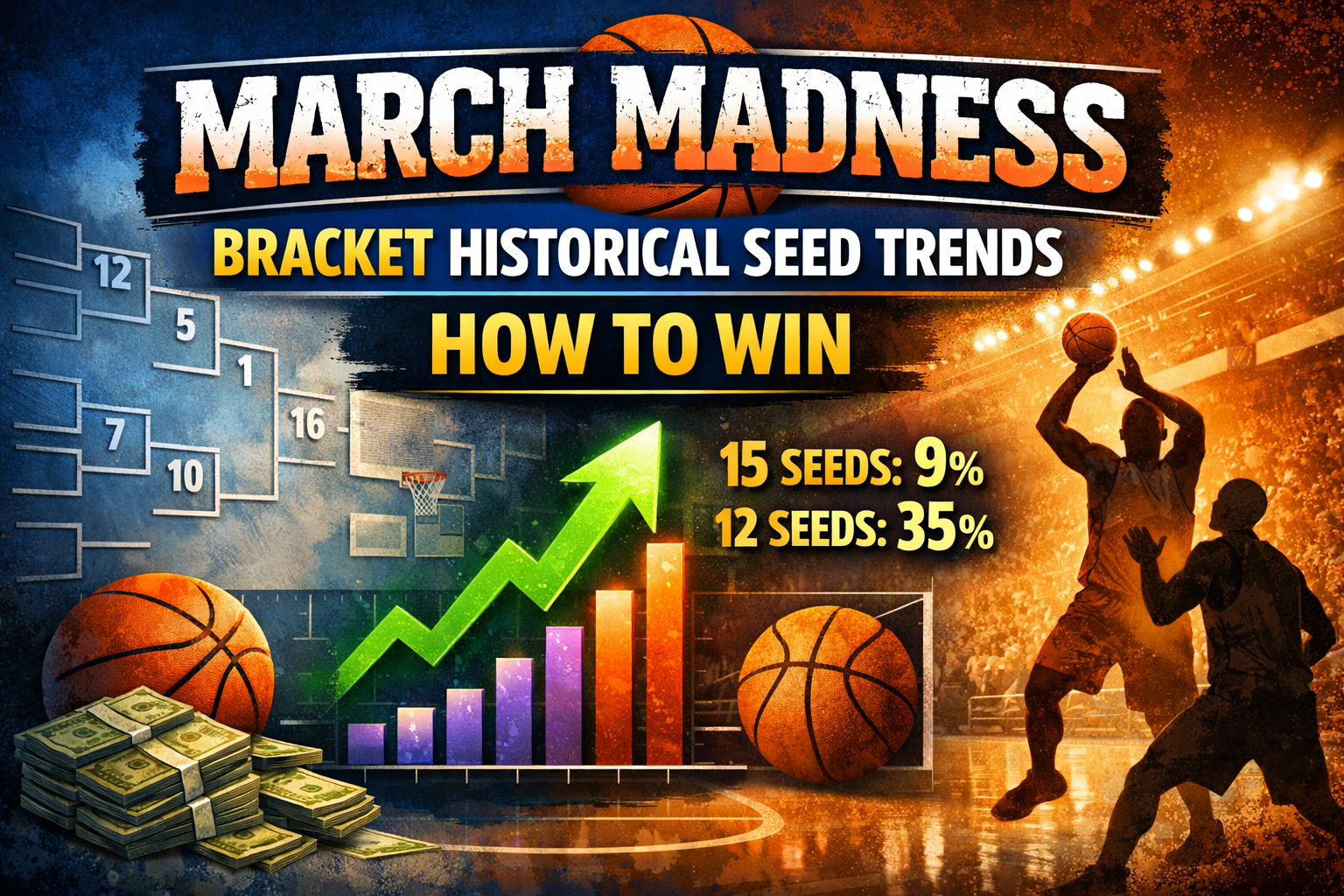
Every March, I lock in for the tournament like it is a second holiday season. My phone is blowing up, group chats are debating 12 over 5 picks, and everyone suddenly becomes a college hoops expert for three weeks. The difference for me is I do not guess. I lean on years of historical data, matchup metrics, and AI modeling through ATSwins to turn chaos into structure. March is wild, but it is not random. There are patterns baked into the bracket. If you understand march madness bracket historical seed trends and how to win using them, you instantly put yourself ahead of most pools.
The goal is not to predict every upset. That is impossible. The goal is to understand where upsets actually happen, where chalk usually holds, and how to balance risk based on your pool size. Seeds are not perfect, but they are powerful priors. When you combine long run seed performance with tempo splits, turnover margins, efficiency ratings, and market signals, you get something way more reliable than vibes.
In this guide, we are going deep. We are breaking down seed performance by round, identifying upset hotspots, looking at Final Four and champion seed distributions, and then building a practical bracket strategy that you can actually use. This is not theory. This is about how to win your bracket more often over time.
Table Of Contents
- Seed performance by round
- Upset hotspots by seed matchup
- Final Four and champion seed distributions
- How to apply trends to build smarter brackets
- Caveats, eras and data hygiene
- Conclusion
- Related Posts
- Frequently Asked Questions (FAQs)
Seed performance by round
When people talk about march madness bracket historical seed trends, they usually throw out one or two fun facts. Like how a 12 seed upsets a 5 seed all the time. Or how a 16 seed finally beat a 1 seed. That stuff is cool, but if you want to win, you need the full picture by round.
Since the field expanded in 1985, we have decades of clean data. That is enough to create strong baseline probabilities. These are not guarantees. They are starting points.
In the Round of 64, 1 seeds win roughly 99 percent of the time. That number is real. Only two 16 seeds have ever pulled it off, and that includes the historic 2018 shocker and the 2023 follow up. That means if you are picking a 16 over a 1, you are basically buying a lottery ticket. Fun? Maybe. Smart in most pools? No.
2 seeds win around 93 percent of their first round games. That means about 7 percent of the time, a 15 seed sneaks through. That is rare but not impossible. In fact, we have seen 15 over 2 upsets pop up more frequently in the last decade than earlier eras. Still, you should not be loading your bracket with them.
3 seeds win roughly 85 percent of the time against 14 seeds. 4 seeds beat 13 seeds around 79 percent of the time. Already you can see the risk rising as you move down the line.
Then we hit the real chaos lanes.
5 seeds only win about 64 to 65 percent of the time against 12 seeds. That means 12 seeds win roughly 35 percent of those matchups. That is not a fluke. That is a pattern. Same thing with 6 seeds versus 11 seeds. The 11 seed wins in the high 30 percent range and has been closer to 40 percent in recent years.
7 versus 10 is basically coin flip territory. 8 versus 9 is also nearly even, with 9 seeds actually having a slight edge historically.
If you only remember one thing from this section, it is this. Protect your 1 seeds early. Be cautious but mostly respectful of 2 and 3 seeds. And allocate your upset picks where history says the door is open, mainly 12 over 5, 11 over 6, and sometimes 10 over 7.
Now let us talk about the second round, because this is where brackets really start to die.
One of the most dangerous spots historically is the 8 or 9 seed facing a 1 seed in the Round of 32. After surviving a coin flip type game, that 8 or 9 comes in battle tested. The 1 seed is often seeing a style they did not want to face. We have seen this play out multiple times over the years. It is not common, but it is common enough that you should at least evaluate one region for a possible 8 or 9 run to the Sweet 16.
Another subtle choke point is the 7 or 10 seed versus the 2 seed in the Round of 32. If the 2 seed is turnover prone or lacks depth, that game can get uncomfortable quickly. Historical seed trends tell us that 2 seeds are strong, but they are not invincible.
Then there is the 11 seed phenomenon. 11 seeds making the Sweet 16 is not shocking anymore. In many cases, these teams are under seeded power conference programs that had uneven regular seasons but still grade highly in efficiency metrics. When you understand march madness bracket historical seed trends and how to win, you stop seeing 11 seeds as cute stories and start seeing them as legitimate threats in the right matchups.
Over the last decade, parity has increased. The transfer portal, veteran guards, and fifth year seniors have made lower seeded teams more dangerous. That does not mean chaos reigns everywhere. It just means the middle of the bracket is more volatile than it used to be.
At ATSwins, I track rolling five year windows for upset frequencies. If 11 over 6 has been hitting at 42 percent over the last five tournaments compared to 37 percent long term, I slightly nudge my priors. Not dramatically. Just enough to reflect the modern game. That is how you respect history without being trapped by outdated assumptions.
Upset hotspots by seed matchup
Now we zoom in on the fun stuff. The upset lanes that actually matter.
The 12 over 5 matchup is legendary for a reason. A 35 percent upset rate is massive in tournament terms. Why does this happen? Because 5 seeds are often flawed power conference teams. They might have an elite defense but inconsistent offense. Or they might rely heavily on one shot type that disappears on neutral floors. Meanwhile, 12 seeds are usually strong mid major champions with elite continuity, veteran guards, and clear identities.
When I evaluate a 12 over 5 upset, I am looking at tempo control, turnover rate, and shot profile. If the 12 seed protects the ball, shoots above average from three, and can defend the glass decently, that is a real green light. If the betting spread is short, like plus three or plus four, that adds even more confidence.
The 11 over 6 lane is almost as strong. Historically high 30 percent upset rates and sometimes pushing 40 percent in recent years. Many 11 seeds are at large teams from strong conferences that slipped to the wrong side of the bubble narrative. Efficiency wise, they might be top 25 or top 30 teams. When they face a 6 seed that struggles with ball pressure or lacks shot creation, it becomes a very real problem.
10 over 7 is less dramatic but still important. These games are often within a possession or two in spread terms. Here is where matchup metrics break ties. Turnover margin, free throw rate, and defensive rebounding percentage matter more than the seed number printed next to the team name.
What about the big shockers? 15 over 2 happens around 7 percent of the time. That is rare but not mythical. If a 2 seed is sloppy with the ball and facing a 15 that can shoot and apply pressure, it becomes at least discussable. Still, this is not where you want to load up.
16 over 1 is museum level rare. Two times ever. Enough said.
When we talk about march madness bracket historical seed trends and how to win, it is about controlled aggression. Take 1 or 2 shots in the 12 and 11 lanes. Sprinkle a couple 10 seeds if the metrics align. Be very selective beyond that.
Second weekend chaos is where people get carried away. Yes, 8 and 9 seeds have knocked out 1 seeds before. Yes, double digit seeds have reached the Elite Eight and even the Final Four. But title equity collapses fast for those teams. If you are sending multiple double digit seeds to your Final Four, you are not playing the percentages.
Final Four and champion seed distributions
Let us zoom out and look at who actually makes the Final Four and wins the championship.
Historically, 1 seeds dominate Final Four appearances. It is common to see one or two 1 seeds in the Final Four. Seeing all four 1 seeds make it is extremely rare. It happened once in 2008. That should tell you something. Chalk can hold, but total chalk is unlikely.
2 and 3 seeds also make consistent runs. When you combine 1, 2, and 3 seeds, you account for the vast majority of champions in tournament history. The median champion seed sits around 2 or 3.
Lower seeds have made magical runs. A 7 seed has won before. An 8 seed has won before. But those are exceptions. They are not the baseline.
If your goal is to understand march madness bracket historical seed trends and how to win, you have to respect where title equity lives. It lives mostly with 1 to 3 seeds. That does not mean you cannot push a 4 seed to the Final Four. It just means crowning a 10 seed champion is almost always lighting expected value on fire.
One thing I do every year is track rolling five year seed distributions for Final Four and champions. If mid seeds are making deeper runs at slightly elevated rates in recent tournaments, I allow a bit more flexibility. But I never abandon the reality that elite efficiency profiles win titles.
Most champions are top 10 in adjusted offense and top 20 in adjusted defense at minimum. When you see a lower seed that actually fits that profile, that is where you can get sharp leverage. Not because of the seed number, but because the underlying metrics say they are mis seeded relative to true strength.
How to apply trends to build smarter brackets
This is where theory becomes action.
Step one is setting your baseline. Use historical seed win rates as priors. That means protecting 1 seeds in the first round. Being cautious with 2 and 3 seeds. Planning for 1 to 2 upsets in the 12 and 11 lanes.
Step two is layering matchup context. I look at adjusted offensive and defensive efficiency, turnover rates, rebounding splits, and shot profile. If a 12 seed is elite from three and the 5 seed struggles to defend the arc, that is not random. That is actionable.
Step three is allocating an upset budget. I literally think of it as a budget. You do not get unlimited chaos. In most standard brackets, 2 to 4 early round upsets in the 10 to 12 seed range is reasonable. More than that and you are fighting history.
Step four is engineering one region for leverage. Identify a vulnerable 1 or 2 seed and allow a 3 to 5 seed to make a deeper run there. That gives you differentiation without relying on miracles.
Step five is choosing your champion wisely. In small pools, staying closer to chalk is usually optimal. In medium and large pools, you might pivot from the most popular 1 seed to a slightly less hyped 2 or 3 seed with similar efficiency metrics.
Step six is using market signals. If a 6 seed is only favored by two points over an 11 seed, that game is closer to a coin flip than the seed numbers suggest. Betting spreads and moneylines are powerful sanity checks.
At ATSwins, the platform blends historical seed baselines, team level efficiency, and real time context like injuries and line movement. That helps you see where your bracket might be too aggressive or too conservative. It also helps you avoid emotional picks that feel good but are not supported by the data.
Another key factor is pool size. In a small office pool with 20 entries, you do not need five bold Final Four picks. You need to avoid disaster and differentiate slightly. In a pool with hundreds of entries, you need more leverage. That might mean one mid seed Final Four team and a non consensus champion among the 1 to 3 seeds.
Scoring rules matter too. If later rounds are weighted heavily, protecting your champion is critical. Most of your expected points come from getting the last three rounds correct. Early round chaos can feel exciting, but it often contributes fewer total points.
The biggest mistake people make is overplaying Cinderellas deep into the bracket. Sweet 16 runs are doable. Elite Eight is rare but possible. Final Four and titles from double digit seeds are extreme outliers. Respect the run, but do not over project it.
Caveats, eras and data hygiene
March has evolved. The transfer portal changed roster continuity. NIL deals changed player movement. Veteran heavy mid majors are more dangerous now than they were twenty years ago. That means you cannot blindly apply 1990s data to 2026 without context.
Late season form matters. A team that struggled in November but surged in February with a healthy roster is different from its early season profile. Still, small sample hot streaks can regress quickly on neutral floors.
Conference strength fluctuates year to year. A 4 seed from a weak conference year might be less impressive than a 5 seed from a stacked league. That is why efficiency metrics matter more than logos.
Data hygiene matters too. Make sure you are using clean historical datasets. Track injuries. Track line movement. Document your assumptions. The difference between guessing and modeling is discipline.
At ATSwins, I use seed trends as the baseline, then adjust using efficiency and market context. That keeps the process grounded. It avoids chasing narratives. It also avoids ignoring history.
The final checklist before submitting a bracket is simple. Do you have at least one 1 seed in your Final Four. Are your 12 and 11 upsets limited to high quality spots. Did you avoid sending multiple double digit seeds to the Final Four. Did you consider pool size. Did you sanity check coin flip games with turnover and tempo metrics. If the answer is yes across the board, you are in strong shape.
Understanding march madness bracket historical seed trends and how to win is not about predicting every buzzer beater. It is about playing probabilities over time. It is about knowing where chaos lives and where structure dominates.
Conclusion
March will always feel unpredictable. That is why we love it. But beneath the madness, there are patterns. 1 to 3 seeds carry most title equity. 12 over 5 and 11 over 6 are real upset lanes. 10 over 7 is matchup driven. Double digit seeds rarely win it all.
If you build your bracket with historical seed baselines, adjust with matchup metrics, and calibrate with market signals, you give yourself a repeatable edge. That is the real goal. Not one lucky year. Consistent advantage over time.
ATSwins helps layer AI driven projections, efficiency modeling, and betting market context so your bracket decisions are informed, not emotional. Free and paid plans offer tools, insights, and tracking to sharpen your strategy every March and beyond.
Frequently Asked Questions (FAQs)
What do march madness bracket historical seed trends say about how to win the early rounds?
Historical seed trends are clear about one thing. Most high seeds win early. 1 seeds almost never lose in the Round of 64. 2 and 3 seeds are heavy favorites. That means the foundation of a winning bracket is protecting chalk in the spots where history strongly favors it.
The real opportunity comes in selective aggression. 12 over 5 and 11 over 6 have upset rates high enough to justify 1 or 2 picks. 10 over 7 games are often close to coin flips. If you combine these historical baselines with matchup metrics like turnover margin, three point rate, and free throw percentage, you can choose smarter upsets instead of random ones. Winning early rounds is about discipline, not chaos.
Which upset spots do march madness bracket historical seed trends suggest if I want to win without getting reckless?
The safest upset lanes historically are 12 over 5 and 11 over 6. Those matchups consistently produce underdog wins at meaningful rates. 10 over 7 is another reasonable spot, especially when efficiency ratings show the 10 seed is undervalued.
Beyond that, caution is key. 13 over 4 happens but less often. 15 over 2 is rare. 16 over 1 is almost mythical. If you want to win without blowing up your bracket, concentrate your risk where the numbers actually support it. One or two thoughtful picks in those lanes is smart. Filling your bracket with double digit upsets is not.
How do I balance chalk and risk using march madness bracket historical seed trends to win different pool sizes?
In small pools, lean more toward chalk. Protect your 1 to 3 seeds and sprinkle a couple early upsets. You do not need extreme leverage to win 20 person brackets.
In medium pools, add a bit more creativity. Maybe push one 4 to 7 seed into the Elite Eight. Consider pivoting from the most popular 1 seed champion to a strong 2 or 3 seed if efficiency metrics are close.
In large pools, you need differentiation. Keep at least one 1 seed deep because most champions come from that range, but open a realistic path for a mid seed run in one region. The key is calculated risk, not reckless guessing.
How does ATSwins use march madness bracket historical seed trends to help me win?
ATSwins blends historical seed performance by round with advanced team metrics like adjusted efficiency, tempo, turnover rates, and shooting profiles. On top of that, it layers real time context such as injuries, travel spots, and betting market movement.
Instead of staring at seed numbers alone, you get a structured view of probability. The platform helps you see where your bracket aligns with long term trends and where you are taking on extra risk. Over time, that feedback loop sharpens decision making and improves outcomes. It is about building smarter brackets consistently, not chasing one lucky Cinderella.
What mistakes should I avoid when using march madness bracket historical seed trends to win my bracket?
One mistake is picking every trendy upset you see on social media. Historical seed trends do not say all 12 seeds win. They say some do. Choose carefully.
Another mistake is pushing Cinderellas too far. Sweet 16 runs are common enough. Final Four and title runs from double digit seeds are extremely rare.
Fading all 1 seeds is also a trap. Most champions come from 1 to 3 seeds. Removing them entirely from your Final Four usually hurts more than it helps.
Finally, ignoring matchups is dangerous. Seeds are starting points. Tempo, turnovers, rebounding, and shooting efficiency decide games. When you combine those factors with historical seed trends, you build a bracket strategy that actually gives you a chance to win year after year.
Related Posts
AI For Sports Prediction - Bet Smarter and Win More
AI Football Betting Tools - How They Make Winning Easier
Bet Like a Pro in 2025 with Sports AI Prediction Tools
Sources
The Game Changer: How AI Is Transforming The World Of Sports Gambling
AI and the Bookie: How Artificial Intelligence is Helping Transform Sports Betting
How to Use AI for Sports Betting
Keywords:
MLB AI predictions atswins
ai mlb predictions atswins
NBA AI predictions atswins
basketball ai prediction atswins
NFL ai prediction atswins