

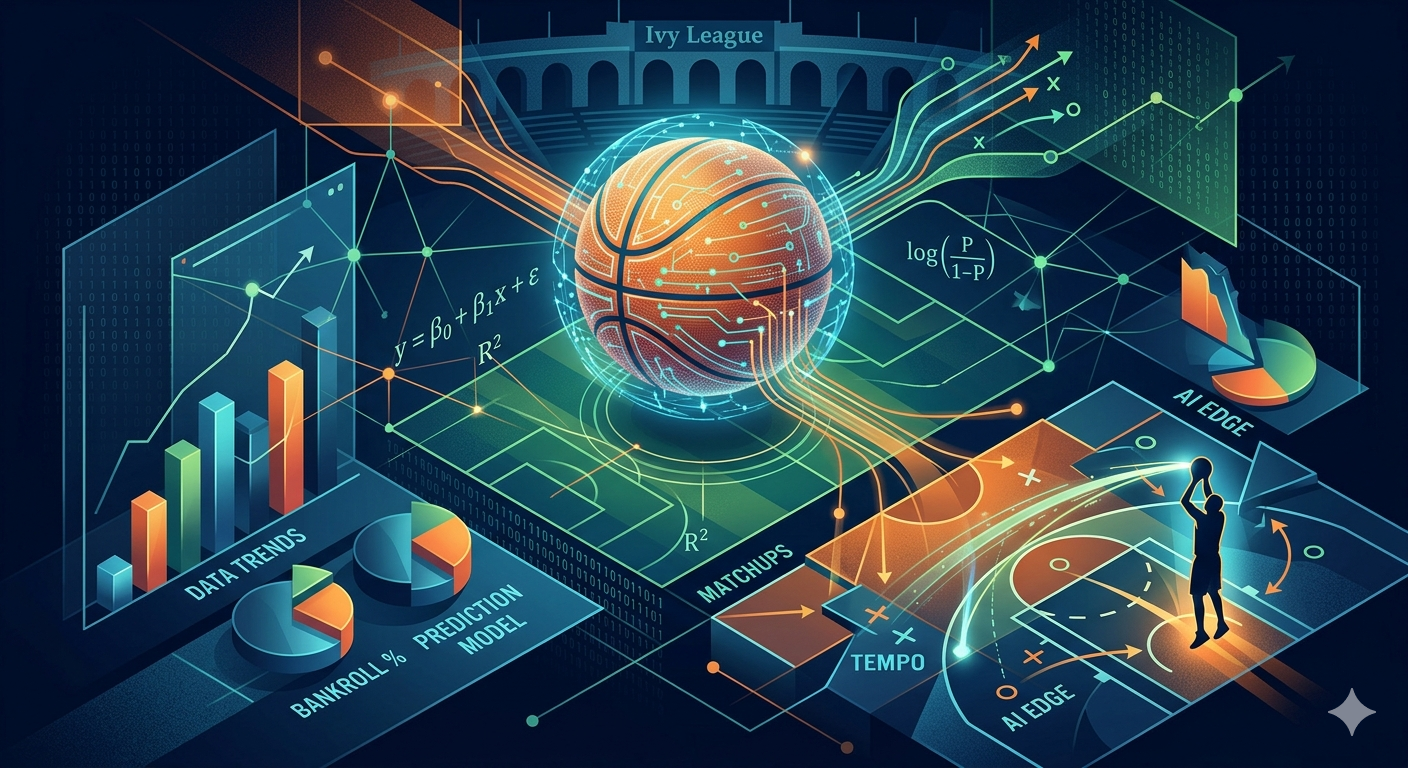
March in the Ivy League is a special kind of basketball chaos. The games are compact, the spreads are tight, and the tournament itself is a two-day sprint that rewards precision over hype. Unlike other conferences where upsets are more frequent or pace is extreme, Ivy Madness often comes down to small edges in shot selection, tempo management, and bench depth. A single misstep by a star player or a subtle rotation adjustment can swing a game. For bettors, it is less about flashy stats and more about the details: how teams handle back-to-back games, the timing of free throws, and whether defenses can secure critical rebounds when possessions are limited.
As someone who builds AI models for sports betting, I approach Ivy Madness like a laboratory experiment. Every shot, pass, and possession carries weight, and trends can be quantified. You need to translate tempo, matchup tendencies, and shot quality into actionable edges. It is not about blindly following historical winners or seeding. It is about understanding how the context of the tournament interacts with team-specific styles, player fatigue, and venue dynamics. When the stakes are small but tight, even a 1-point mispricing can be the difference between a winning weekend and a frustrating run.
This guide will break down the Ivy League tournament from every angle a bettor needs. From historical trends to live in-game adjustments, from modeling frameworks to practical bet execution, we will cover it all. You will see how to structure your bets, size them correctly, and track results without getting lost in noise. The goal is simple: turn the noise of Ivy Madness into repeatable, profitable edges while keeping the process manageable and grounded in real data.
Table of Contents
- Tournament context, format and what it means for betting
- Historical betting tendencies to watch
- Data and modeling workflow built for Ivy
- Market behavior and bankroll
- Live betting framework for a two-day sprint
- Templates you can copy
- Comparative look: semifinal vs. final dynamics
- Practical how‑to: building bets for this year’s Ivy Madness
- Data sources and tooling that actually help
- Building a compact Ivy-specific model in practice
- Semi-specific notes you can apply
- Final-specific notes you can apply
- Quick note on search and resources
- Conclusion
- Frequently Asked Questions (FAQs)
Tournament context, format and what it means for betting
The Ivy League tournament is compact, featuring only four teams, with semifinals on Saturday and the championship game on Sunday. The games rotate between Ivy campuses, which gives a neutral-ish feel but not full neutrality. Local fans, bands, and traveling students can create small boosts for the host team, particularly in bench energy and late-game communication. A modest bump exists, but overestimating or ignoring it can misprice a game. The best approach is a middle path: start neutral, add a small host-site variance if the host plays, a tiny adjustment if a geographic rival is present, and zero otherwise. Shooting variance is more affected than mean expectation because Ivy gyms differ in background depth, sightlines, and floor bounce.
Back-to-back scheduling makes depth a crucial factor. Semifinals are on Saturday, finals on Sunday, which means legs, foul discipline, and bench minutes matter. Teams with 36+ minute stars are fragile in the final, especially if the semi is a high-pace, whistle-heavy affair. In contrast, teams with deeper rotations or compact half-court systems often perform better with short turnarounds.
Ivy teams are methodical and space-aware. They value half-court execution over raw speed, which amplifies the importance of shot identity, defensive rebounding fundamentals, and continuity in offensive sets. Totals often skew under in the semifinals due to nerves and prep limitations, while finals see slower second halves as fatigue sets in. Favorites like Princeton and Yale often carry a small expectations tax: public money may push spreads slightly beyond rational levels. Short travel windows and limited prep time favor simple, repeatable schemes with high basketball IQ. The team that conserves energy on Saturday gains hidden equity in Sunday’s market.
Historical betting tendencies to watch
Spreads are typically small in Ivy semis. Numbers often hover between -1.5 to -4.5, magnifying the importance of Closing Line Value (CLV). Capturing a -2.5 that closes at -3.5 can significantly increase win probability. Semifinal favorites are efficient but not automatic; small micro-edges such as defensive rebounding deltas and low turnover rates allow underdogs to compete. Patience is key. If your edge is marginal at open, waiting for public action on recognizable programs often improves value, especially as broader college basketball markets evolve alongside insights from ESPN’s Ivy League BPI rankings
.
Tournament halves are not independent. A slow first half gives coaches permission to grind late, which can favor unders. Bonus and double-bonus timing affects totals: early bonus with tired legs can lead to free points, but if refs let contact go in the second half, the under benefits. Separate first-half and second-half pace priors help model this correctly. Shot mix deterioration in the final minutes and foul elasticity based on referees also need consideration, particularly when studying how pace and efficiency trends show up across team stat dashboards like Fox Sports Ivy League stats page
.
Seeds provide context, not price. In small-sample tournaments, defensive rebounding, turnover differential, and three-point rate matchups often trump the 1-seed vs. 4-seed narrative. Live markets react quickly to early foul trouble and pace shifts. Early fouls on primary creators or unusual possession rates can create live betting opportunities. Being prepared with precomputed base rates allows for quick, disciplined in-game adjustments.
Data and modeling workflow built for Ivy
Core inputs include schedule-adjusted offense/defense and tempo. Raw margins fail to capture Ivy-specific nuances. Building home/away splits and neutral compression allows accurate tournament modeling. Pace comparisons against similar teams help calibrate expectations.
Shot profile matters: rim attempts, three-point distribution, free-throw rate, and defensive allowances. Assign possession probabilities for rim, non-rim two, three, and turnover, adjusted for opponent tendencies. Model shooting quality with venue-specific variance. Back-to-back penalties are player-weighted, with heavy minutes reducing efficiency in the following game. Ref tendencies—high-foul vs low-foul crews—affect bonus timing and totals.
Simulating possessions instead of only scores is crucial in low-possession games. Monte Carlo simulations with randomized foul and substitution events give actionable outputs for sides and totals. Track market movement with priors to validate against your model. Back-test priors, adjust for noise, and maintain discipline with CLV.
Step-by-step: building an Ivy Madness betting model
Collect data: adjusted offense/defense, tempo, shot profiles, lineup usage, refs, and venue specifics.
Create matchup baselines: neutral strength ratings, shot probabilities, opponent adjustments.
Add context modifiers: host-site variance, back-to-back fatigue, foul environment.
Simulate: possession-level Monte Carlo, conditional for finals, track distributions.
Price and bet: convert outputs to fair numbers, hit openers if edge exceeds threshold.
Live prep: pre-program triggers for pace deviations and foul trouble.
Postmortem: log CLV, results, update priors for Sunday.
ATSwins users can compare model outputs to consensus, track CLV, and pressure-test angles. Logs are essential for iterative improvement, particularly when analyzing rotation, fatigue, and live triggers.
Market behavior and bankroll
Openers should be taken when your edge is clear and market movement is favorable. Wait when public favorites are likely to attract recreational money. Monitor Friday night line moves; early signs of sharp action can help identify value. Avoid correlated parlays and stick to straight bets with Kelly-lite sizing. Record bets with CLV, rotation adjustments, and injuries. Small edges compounded over multiple tournaments can outperform chasing large, speculative plays.
Live betting framework for a two-day sprint
Pre-game, track player foul baselines, pace bands, shot-quality read, and timeout patterns. During the first 8–10 minutes, monitor pace relative to expectations, foul asymmetry, and bench performance. Halftime adjustments should consider fatigue and rotation. Late-game dynamics involve foul-stall management and side exposure control. Predefine live triggers to minimize emotional reaction and maximize data-driven adjustments.
Templates, checklists, and practical tips
Side-checklist: offensive rim vs opponent rim defense, three-point attempt rate vs closeout, turnover creation vs security, defensive rebounding gap, foul and whistle tendencies, rotation and bench reliability, venue and travel considerations.
Totals-checklist: pace levers, substitution patterns, shot mix, fatigue, and whistle/bonus timing. Adjust for semi-to-final differences and live game indicators.
Rotation tracker: expected minutes, bench stints, emergency minutes, conditioning notes. Update after semis to adjust Sunday strategy. Logging CLV, market movement, and injuries is critical for refining future bets.
Comparative look: semifinal vs. final dynamics
Semifinals often align with season norms, with unders favored in second halves. Finals see more fatigue, slower possessions, and tighter rotations. Market responses vary, with openers fragile on Saturday and Sunday prices incorporating semi results. Modeling both games separately avoids mispricing caused by Saturday shooting variance.
Building a compact Ivy-specific model in practice
Layer your model with ratings, matchups, context, simulation, and market tracking. Avoid overfitting last-year data, treating seeds as ratings, ignoring foul environments, or assuming Saturday pace carries into Sunday. Focus on CLV, opponent-specific shot diet, realistic minutes allocation, and preprogrammed live triggers. Semi- and final-specific notes guide micro-adjustments in betting strategy.
Quick note on search and resources
Use official Ivy brackets and venues, KenPom, Bart Torvik T-Rank, Sports-Reference CBB, and ATSwins for tracking, pressure-testing, and edge comparison. Logging every bet, rotation, and adjustment ensures compounding value across seasons.
Conclusion
Ivy Madness is about small, repeatable edges in a compressed format. Model matchups, monitor live fouls, size stakes with discipline, and track results. ATSwins offers AI-powered data-driven tools for picks, player props, and profit tracking across NCAA, NFL, NBA, MLB, and NHL, providing actionable insight for bettors who treat this tournament like a process, not a guess.
Frequently Asked Questions (FAQs)
What are the most reliable Ivy League basketball tournament betting trends?
Tight spreads, slower pace, unders late on back-to-backs, and defensive rebounding/turnover gaps are key. Early numbers can be soft; timing is critical.
How does back-to-back format change trends?
Short rotations favor deeper benches, slightly slower pace, and fatigue impacts totals. Track minutes and foul rates after semis.
Which stats predict outcomes fastest?
Schedule-adjusted offense/defense, defensive rebounding, turnover margin, rim/3-point rates, and free-throw rate. Efficiency and matchup quirks matter most.
How can ATSwins help?
Compare model edges with market splits, track CLV, and log results efficiently. Dashboards simplify spotting opportunities on sides or totals.
Common mistakes?
Chasing seeding, brand names, or live hype. Favor teams with good glass, ball security, and clean shot profiles. Avoid mistimed entries and unplanned live reactions.
Related Posts
AI For Sports Prediction - Bet Smarter and Win More
AI Football Betting Tools - How They Make Winning Easier
Bet Like a Pro in 2025 with Sports AI Prediction Tools
Sources
The Game Changer: How AI Is Transforming The World Of Sports Gambling
AI and the Bookie: How Artificial Intelligence is Helping Transform Sports Betting
How to Use AI for Sports Betting
Keywords:
MLB AI predictions atswins
ai mlb predictions atswins
NBA AI predictions atswins
basketball ai prediction atswins
NFL ai prediction atswins