

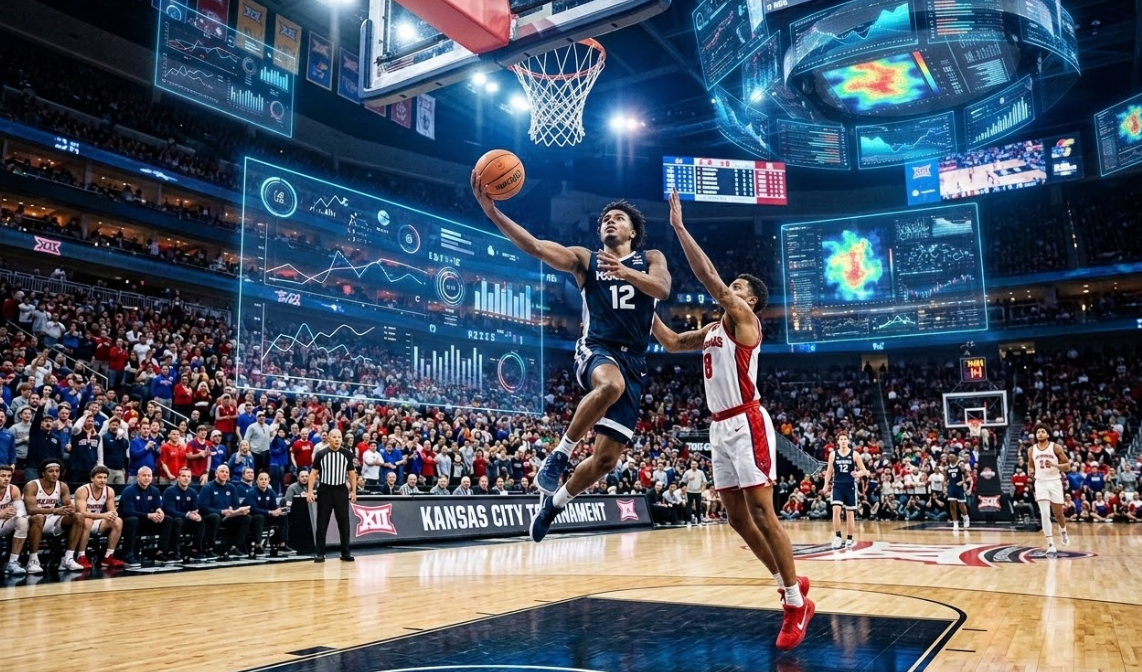
March hoops in Kansas City brings volatility, short rest, and tight rims, making it a prime opportunity for bettors who are prepared. The Big 12 tournament is notorious for compressed schedules, neutral-site games, and rugged defenses, all of which change the pace and impact how teams perform. Smart analysis focuses on tempo swings, shot quality, rotations, and live-market cues. These factors, combined with practical tools and data-backed edges, allow bettors to find actionable opportunities before tip-off. By applying a disciplined approach, you can exploit inefficiencies in both spreads and totals while staying ahead of public narratives.
Table Of Contents
- Tournament Context and Why Big 12 Betting Trends Matter
- Historical Patterns to Track (ATS and Totals)
- Modeling Edges: Build and Test with ATSwins
- Market Timing and Bet Types
- Data Workflow and References
- Putting the Trends to Work in Kansas City
- Conclusion
- Frequently Asked Questions (FAQs)
- Key Takeaways
Neutral-site games and back-to-back schedules change pace and shooting, meaning early rounds often lean toward underdogs and lower totals. It is important not to overrate the “home” vibes even for programs like Kansas or Iowa State in Kansas City. Effective models focus on tempo splits, effective field goal percentage allowed, three-point volume in a new arena, turnover pressure on tired guards, offensive rebounding, whistle rates, and bench depth on back-to-back games. Timing is critical; openers should be attacked when your number disagrees with the market, live totals should be considered after the first media timeout if pace or shot quality diverges from expectations, and second-half lines are useful when fouls swing the dynamics. Maintaining a clean workflow that confirms injuries, travel quirks, and referees while tracking every wager ensures your edge compounds over the tournament. ATSwins provides AI-powered sports predictions, including data-driven picks, player props, betting splits, and profit tracking across major leagues, which helps bettors make smarter, more informed decisions.
Tournament Context and Why Big 12 Betting Trends Matter
The Big 12 tournament takes place at the T-Mobile Center in Kansas City, which has several implications. Teams lose their typical home-court advantages and routines. Crowd support is present but usually split across multiple sessions, and shooting sightlines differ from campus gyms, which can impact depth perception and early shot quality. Floor and rim stiffness can also change rebound patterns, so monitoring early offensive rebound rates is essential. Travel distances vary across the league, benefiting some fan bases while fatigue can become apparent by the quarterfinals and semifinals. The best approach is to start each matchup with roughly zero home-court points, avoid assuming programs carry their campus dominance into Kansas City, shade early-game shooting slightly down, particularly from three, and modestly upgrade defensive rebounding rates for the first round. As sessions progress, adjust totals if shooting improves or rims play differently.
Short-rest back-to-back games compress rotations and alter minutes curves. Coaches with shallow benches are particularly vulnerable, as guards on heavy usage show fatigue through turnovers, short jumpers, and lapses in transition defense. Star bigs playing 35 or more minutes may lose lift and commit frustration fouls. Opponents with deeper rotations often gain an advantage that markets sometimes underprice. Bettors should tag teams by bench size before the tournament, adjust projected pace based on the previous day's performance, and give a slight boost to underdog cover probability for deeper teams facing top-heavy favorites.
Big 12 basketball is physical, leading to per-possession battles and limited transition opportunities. Teams that rely on rim attempts or drawn fouls need referee cooperation, which is not guaranteed on neutral courts. For early rounds, it is wise to default pace slightly slower than the season average unless a clear transition-focused team faces a permissive opponent, and to lean toward unders when rotations tighten and sightlines are fresh. Neutral-site games also introduce variability in officiating and travel effects, particularly in the first halves. Foul counts and free-throw rates should be monitored, adjusting live totals based on referee tendencies. When in doubt, betting second halves instead of full games can reduce risk from pregame variables.
Seed numbers reflect months of performance, but in a one-day, neutral-site setting, gaps narrow. Middle seeds that have recently improved or stabilized lineups often perform better than their bracket number, while top seeds sometimes manage minutes if NCAA qualification is secure. Bettors should price matchups based on efficiency and form rather than anchor on seeds. Small sample sizes in conference tournaments mean trends should be treated as hypotheses and validated over multiple seasons, using live data and second-half edges where noise is lower.
Historical Patterns to Track (ATS and Totals)
Mid-seed underdogs, particularly 4–7 seeds, often cover against favorites in early rounds. Favorites with NCAA security may conserve minutes, while mid-seed dogs usually have balanced scoring and enough depth to handle short runs. Tagging 4–7 seeds with veteran guard play and sufficient rotation depth can highlight actionable opportunities. Avoid favorites with recent injuries or public statements about saving energy for future games.
First-round and quarterfinal unders are common due to fresh sightlines and tight rotations. Unfamiliar rims, trimmed rotations, and focused defenses tend to slow pace. Pricing first-half unders conservatively is advised if teams have recently shown under trends against top defenses. Fading automatic unders is warranted if opener totals are already low and the matchup features elite pace injectors.
By the semifinals, elite offenses adjust as teams learn sightlines and implement their preferred sets. Fatigue may widen talent gaps in the final minutes, favoring second-half plays on favorites who underperformed early but dominated shot quality metrics. Dogs that survived early rounds on unsustainable shooting are at risk of regression. Endgame foul frequency can also shift totals, and building a foul propensity tag for each coach helps guide live adjustments. Neutral-site games also diminish the influence of crowd support from historically strong programs, so any implied campus-like advantage is often a mispriced factor.
Openers versus closers reveal whether early market steam is predictive or noise. Early steam that aligns with matchup edges tends to hold, while late-session steam may follow herd behavior or public seed biases. Tracking steam against clear on-court realities allows for informed follow-through or fading of the market.
Modeling Edges: Build and Test with ATSwins
ATSwins combines market information with team- and player-level priors to identify edges. Tempo splits and opponent-adjusted effective field goal percentages are prioritized, with slight reversion to half-court frequency in Kansas City. Three-point attempt rates can vary on neutral floors, particularly early in games, and adjustments account for defensive pressure and player experience. Turnover pressure against fatigued guards is critical in back-to-back scenarios, as fresh legs often create second-half opportunities. Offensive rebounding versus whistle tendencies can affect live overs, and bench minute sustainability is factored to downgrade top-heavy favorites while upgrading balanced underdogs.
Late-season form is incorporated with a rolling weighted approach that emphasizes the last ten games but retains season-long context. Schedule-adjusted efficiencies and matchup matrices capture shot profile clashes and adjusted ratings, while categorical flags account for injuries, travel, and minute caps. This approach ensures pre-tournament simulations reflect adjusted tempo, efficiency, turnover clashes, rebounding deltas, bench sustainability, form, and injury impacts. Betting decisions are informed by fair line comparisons against market openers and exposure is capped to protect bankrolls in volatile tournament conditions.
Market Timing and Bet Types
Opening numbers are best attacked when your feature set diverges from market priors, particularly when identifying pressure mismatches or bench depth advantages. Live totals should be assessed after the first media timeout, using rim attempts, transition plays, and free-throw activity to gauge pace and shot quality. Second-half sides become relevant when key players accumulate fouls, as defensive rotation and rebounding may shift. Alternate spreads can be useful when pace edges align with mismatch opportunities, but bets should remain conservative relative to main stakes. Player props, particularly for rebounds and defensive stats, should factor in rotation depth, small-ball matchups, and back-to-back fatigue. Bankroll management is crucial, with stake sizes and correlations carefully controlled to avoid overexposure.
Data Workflow and References
Maintaining a clean and reproducible workflow is essential. Data is pulled from official Big 12 rosters, NCAA statistics, and historical logs with neutral-site tags. Daily ingestion tracks team efficiencies, pace, and Four Factors, overlaid with player-level minutes and injury adjustments. Games are labeled by site, rest, and referee crew when possible. A neutral-site prior is built using both season-long and last-10-game windows. Trend claims are validated over multiple seasons, accounting for conference expansion and rule changes. ATSwins models in Kansas City utilize Monte Carlo simulations of bracket paths and matchup features to produce fair moneylines, spreads, and totals with uncertainty bounds. Live tracking captures pace, shot quality, fouls, and rotation shifts, while each bet is logged with its edge type and reasoning.
Handicapping follows a step-by-step workflow using adjusted efficiencies, pace priors, shot profile adjustments, turnover risks, rebounding assumptions, and bench depth analysis. Fair lines are compared to market openers, and live adjustments are made for deviations in shooting, fouls, and substitutions. Templates include pregame and live trackers for neutral-site penalties, bench stamina, foul propensity, and second-half adjustments. ATSwins provides additional data-driven model outputs, bet splits, and performance tracking for those following the platform.
Putting the Trends to Work in Kansas City
On day one, unders are emphasized when teams defend well and pace is controlled. Mid-seed underdogs with depth and experienced guards often provide value. Quarterfinals and semifinals reward attention to depth, foul management, and stars’ heavy minutes, while round-one unders should not be chased if shooting normalizes. Across all rounds, monitoring whistle patterns, live totals, steam alignment with matchups, and fatigue markers is essential. Common mistakes include trusting seeds over numbers, reacting to first-half shooting luck without shot quality context, overexposing to correlated outcomes, and ignoring neutral-site and short-rest impacts. A compact process includes building neutral priors, tagging benches, pricing sides and totals with uncertainty, attacking openers with clear mismatches, adjusting at media timeouts, reassessing at halftime, and logging outcomes to refine priors rather than narratives.
Conclusion
Big 12 tournament betting rewards sharp, read-and-react strategies that account for neutral floors, pace pressure, and foul math. Early unders, mid-seed underdog value, and live totals when tempo or shot quality shifts provide actionable edges. ATSwins offers AI-powered sports predictions with data-driven picks, player props, betting splits, and profit tracking across major leagues, helping bettors make more informed decisions. Leveraging data, models, and disciplined workflows enables bettors to exploit inefficiencies in Kansas City effectively.
Frequently Asked Questions (FAQs)
What are Big 12 basketball conference tournament betting trends, and why do they matter?
Big 12 basketball conference tournament betting trends are recurring patterns in spreads, totals, and seed performance on neutral floors. They matter because back-to-back schedules, short rotations, and physical defenses often reduce pace and scoring, which can mislead the public. Recognizing trends helps bettors find value and avoid common pitfalls.
Which Big 12 basketball conference tournament betting trends should I watch for ATS and totals?
Key trends include mid-seed underdogs covering in early rounds, first-day and quarterfinal unders due to slow pace, late-round overs driven by elite offenses or endgame fouls, and neutral-site quirks affecting rebound rates and three-point variance. Comparing closing lines to openers helps identify actionable divergences.
How can I use Big 12 basketball conference tournament betting trends for live wagering without overreacting?
Live wagering benefits from observing pace and shot quality after the first media timeout, adjusting totals if possessions vary significantly. Foul trouble on key defenders affects scoring and over/under considerations. Fatigue in guard-heavy teams may also signal second-half unders. Confirm changes over multiple possessions before acting.
Do travel and rest really change Big 12 basketball conference tournament betting trends?
Yes, back-to-back games can stress shallow benches, giving an edge to teams with reliable rotations. Travel may slightly favor nearby fan bases, but neutral rims and referee tendencies often have a greater effect than travel alone.
How does ATSwins help with Big 12 basketball conference tournament betting trends?
ATSwins provides AI-powered predictions with data-driven picks, player props, betting splits, and profit tracking. For Big 12 basketball, it highlights pace shifts, matchup edges, and flag metrics that often decide neutral-floor games. Users can access dashboards and alerts to act before the market fully adjusts.
Related Posts
AI For Sports Prediction - Bet Smarter and Win More
AI Football Betting Tools - How They Make Winning Easier
Bet Like a Pro in 2025 with Sports AI Prediction Tools
Sources
The Game Changer: How AI Is Transforming The World Of Sports Gambling
AI and the Bookie: How Artificial Intelligence is Helping Transform Sports Betting
How to Use AI for Sports Betting
Keywords:
MLB AI predictions atswins
AI MLB predictions atswins
NBA AI predictions atswins
basketball ai prediction atswins
NFL ai prediction atswins