

If you’ve ever opened up a sportsbook and looked at UFC odds, you know how overwhelming it can be at first. All those numbers, different formats, plus and minus signs everywhere—it feels like you need to be a math major just to figure out what’s going on. But the truth is, betting odds aren’t nearly as complicated as they look. Once you understand the basics, you’ll be able to read them quickly, find value, and make way more confident bets.
This blog is going to walk you through everything you need to know about UFC betting odds. We’re going to talk about the different odds formats (American, decimal, and fractional), how to convert those odds into implied probability, what betting markets actually matter for UFC, how line movement works, and why bankroll management is a bigger deal than most beginners realize. We’ll also cover weigh-ins, line timing, and some practical betting steps you can use every fight week. By the end, you’ll have a system in place so you’re not just guessing—you’re betting smarter.
Table Of Contents
- How Do I Read and Interpret UFC Betting Odds?
- Converting odds to implied probability and break-even
- Key UFC markets you will actually bet
- Line movement, timing, and context
- Bankroll, risk control, and responsibility
- Handy references and tools
- Putting it all together: quick steps you can follow
- Related Posts
- Frequently Asked Questions (FAQs)
How Do I Read and Interpret UFC Betting Odds?
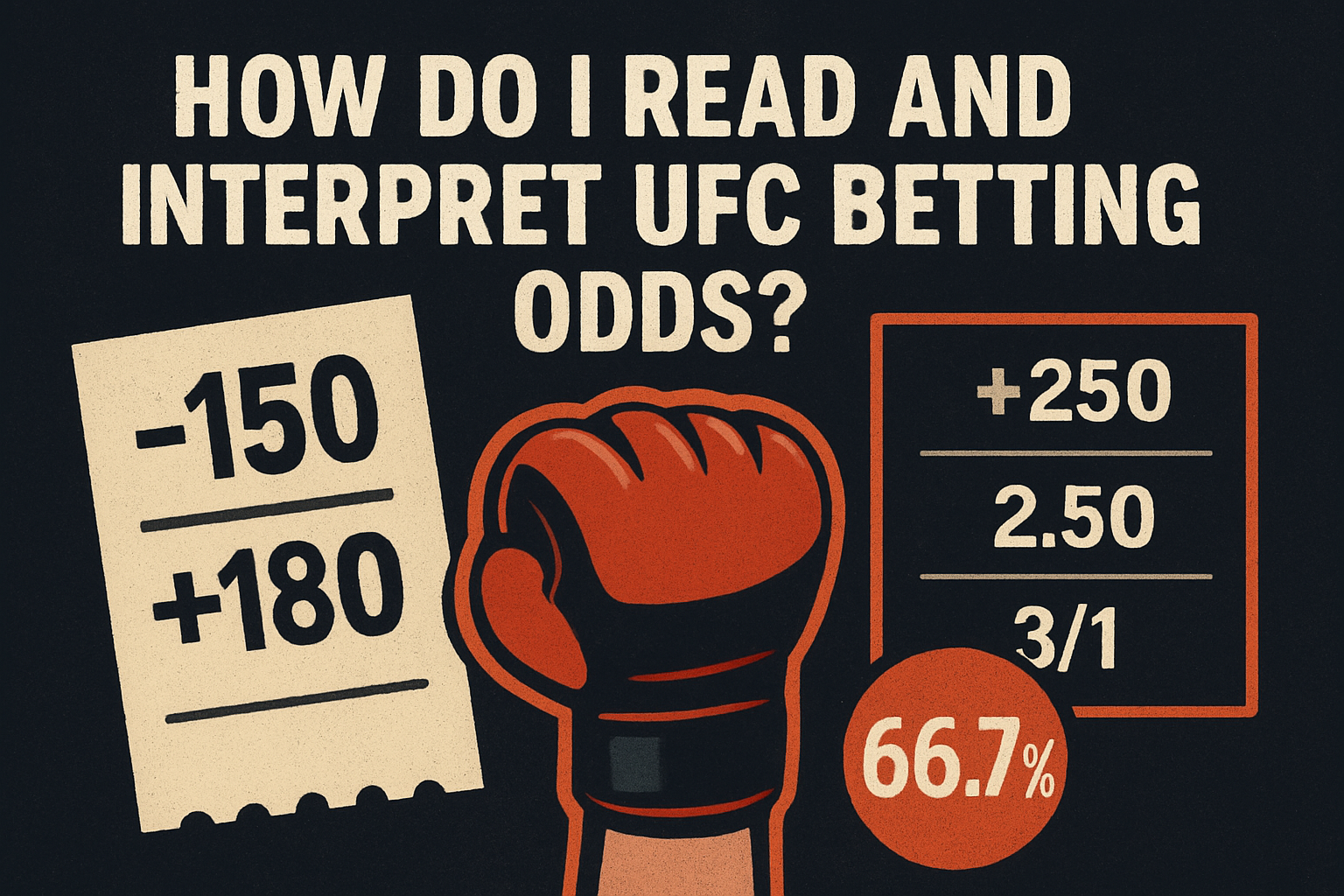
Odds are just the way sportsbooks communicate how much you can win compared to how much you risk. Once you get used to them, it’s second nature. The easiest way to start is with American odds. If the number is negative, that fighter is the favorite. If the number is positive, they’re the underdog. So -150 means you risk $150 to win $100, while +180 means risk $100 to win $180.
Decimal odds work differently. They’re more common outside the U.S. and already include your stake. So if you see 1.50, your return is your stake multiplied by 1.5. Fractional odds are old-school and show profit relative to stake, like 3/2 meaning you win $3 for every $2 you risk.
But beyond payouts, odds also carry implied probability, which is the real backbone of betting. That percentage is basically saying, “This is how often this fighter would need to win for this price to be fair.” And it’s not just about who’s better in the cage. Odds also reflect public perception, hype, injuries, and even rumors. That’s why sharp bettors don’t just look at odds—they look for edges between their own numbers and the market’s.
Converting Odds to Implied Probability and Break-Even
Here’s where we take those numbers and turn them into something useful. If you see odds of -200, you can convert them into a break-even percentage. The formula is simple: take the absolute value divided by the absolute value plus 100. So for -200, that’s 200 divided by 300, which comes out to 66.67%. That means if you want to break even betting -200 lines, the fighter has to win two out of three times.
For positive odds like +150, the formula flips. It’s 100 divided by the odds plus 100. So 100 divided by 250 equals 40%. That means if you’re betting +150 underdogs, you only need them to win 4 out of 10 times to break even. That’s why dogs can be valuable even if they lose more often.
Decimal odds are straightforward. Just do 1 divided by the decimal number. So if the odds are 1.50, divide 1 by 1.50 and you get 66.67%. Fractional odds work similarly once you convert them into decimal.
Here’s the kicker: sportsbooks build in vig, which means the implied probabilities for both fighters will add up to more than 100%. If Fighter A is -150 and Fighter B is +130, you might see 60% plus 43.48%, which equals 103.48%. That extra 3.48% is the book’s margin. To win long term, you need to beat that margin.
Once you’ve got implied probability down, you can start looking for value. Say you find a fighter at +150 with a 40% implied chance, but your research makes you believe they actually win 44% of the time. That’s value. On the flip side, if a fighter is -200 (66.67% implied) but you only cap them at 62%, that’s no value. This is the math behind sharp betting.
Key UFC Markets You Will Actually Bet
There are a bunch of different ways to bet UFC fights, but a few markets really stand out.
The moneyline is the bread and butter. You’re simply betting who wins. It doesn’t matter if it’s by knockout, submission, or decision. If your fighter gets the W, you cash. Sometimes sportsbooks will offer a three-way moneyline that includes a draw option, but the standard is usually two-way.
Method of victory bets are where you pick both the fighter and how they win. This can mean betting on a knockout, a submission, or a decision. These bets are all about style matchups. For example, if a heavy hitter is fighting someone with weak striking defense, a KO/TKO prop might be worth it.
Round totals are another fun market. Sportsbooks set lines like 1.5, 2.5, or 3.5 rounds, and you bet over or under. If you’re betting the over 2.5 in a three-round fight, you need it to last past 12 minutes and 30 seconds. Round props can also get specific, like predicting a fighter to win in Round 1, 2, or 3.
Then you’ve got things like winning margin or double chance bets, which combine outcomes. For example, you could bet on a fighter to win by KO/TKO or submission. These reduce variance but pay less.
Parlays are super popular, but you need to be careful. UFC has so much variance that one bad beat can ruin a ticket. Correlated parlays, like betting a fighter’s moneyline and also betting them to win by knockout, are often restricted by books anyway.
The big takeaway is this: match your bets to the matchup. If you think a wrestler dominates with control, maybe a decision prop makes sense. If two brawlers with weak defense are going at it, the under on rounds might be worth a shot.
Line Movement, Timing, and Context
Odds don’t stay still. They move based on news, money coming in, and even fighter perception. Injuries, camp changes, or whispers about a bad weight cut can all shift lines before the public even knows.
Weigh-ins are a big deal. If a fighter misses weight badly or looks drained, the market often reacts fast. Same with short-notice replacements. If someone steps in late, bettors usually lean toward the opponent who had a full camp.
Public money and sharp money also shape lines differently. The public tends to back big names or highlight reel knockout artists. Sharps bet numbers and styles. If you see a line moving in a way that doesn’t match public hype, chances are sharp bettors are on it.
When should you bet? Openers often have lower limits but softer numbers. If you’ve done your homework, betting early can pay off. Midweek, things settle a bit, and you’ll see more news come in. Weigh-in day is crucial—watch how fighters look. Closers, right before the fight, are often the most efficient lines.
A practical rule of thumb is to bet favorites earlier if you think the public will pile on, and bet underdogs later if you think the line will move in your favor. But don’t force it. If news is pending, sometimes it’s smarter to wait.
Bankroll, Risk Control, and Responsibility
Bankroll management is the boring part nobody wants to talk about, but it’s honestly the most important thing. Without it, even good picks can’t save you.
A lot of bettors use units. Think of a unit as 0.5% to 2% of your bankroll. So if your bankroll is $1,000, a 1% unit is $10. Bet consistently with units instead of throwing random amounts at different fights.
Flat betting is the simplest system. You bet the same unit size on every pick. It’s boring, but it keeps variance under control. Some bettors use a fractional Kelly strategy, which sizes bets based on your edge. But MMA is super volatile, so going full Kelly is risky. Most stick with 25–50% of what Kelly suggests, if they use it at all.
The key is to stay conservative. UFC fights are unpredictable. Chasing losses is the fastest way to burn your bankroll. Set limits for how much you’re willing to risk per day or per event. Once you hit it, stop.
Tracking results is a huge part of bankroll management. Keep records of your bets, your closing line value (whether you beat the market), and your ROI. ATSwins makes this easy with built-in profit tracking and data-driven insights. Keeping a record helps you figure out what’s working and what’s leaking.
Most importantly, know when to pass. You don’t need to bet every fight on the card. If you don’t see an edge, skip it. Watching markets, making notes, and waiting for better opportunities is part of the game.
Handy References and Tools
At this point, you’ve probably realized betting UFC is as much about process as it is about picks. The good news is, you don’t need to reinvent the wheel. Keep formulas for American odds conversions memorized, and practice with them until they’re second nature.
Use trackers to log your bets and compare them to closing lines. Over time, this will show you if you’re beating the market. That’s a sign you’re on the right path.
For a central hub of data-driven picks, profit tracking, and betting guides, ATSwins is the place to start. Even though it covers major sports like NFL, NBA, MLB, NHL, and NCAA, the same math and strategies apply to UFC once you learn the basics.
Putting It All Together: Quick Steps You Can Follow
Here’s a simple workflow you can use for every UFC card. First, build your own number for each fighter. This could be based on ratings, stats, or style matchups. Then, convert your number into a fair price and implied probability.
Next, compare your number to the market price. If your estimate is better than the odds, you’ve got value. Then, check weigh-ins and late news. Adjust if something significant happens. Decide your bet size using flat units or light fractional Kelly.
Place the bet, log it, and note both the line when you placed it and the closing line. After the fight, review not just whether you won, but whether your handicap was right. Over time, this builds consistency.
Example Walkthroughs
Let’s say Fighter A is -180, which has an implied probability of around 64.29%. If you think they only win 61% of the time, there’s no value. That’s a pass.
Now, imagine Fighter B is +150, with a 40% implied probability. Your model says they win 44% of the time. That’s value. Betting $50 here would mean risking $50 to win $75.
Or take a total at 2.5 rounds with odds of -130. That’s an implied 56.52%. If your projection is 60%, that edge might be worth a bet. Track results and see if your edges actually pay off over time.
Fight-Week Checklist
On Monday and Tuesday, start building your numbers and identifying edges. By Wednesday, check training notes and injury news. Friday weigh-ins are critical. Look at body language, weight misses, and hydration.
From Friday evening to Saturday, make your final decisions. If the line moved away from your number, don’t chase. Stick to your process.
Quick Reminders You’ll Use Often
Minus means risk, plus means profit. Implied probability is your break-even. Don’t forget about vig. Match your bet type to the matchup. And always record everything. Data makes you sharper every card.
When to Trust and When to Question the Market
Trust the market when you see big moves backed by legit news like injuries or brutal weight cuts. Sharper markets near close in big fights are usually efficient too.
Question the market when hype pushes lines in crazy directions without new info. If something doesn’t make sense, trust your work. And if you’re unsure, reduce your stake or just pass. There’s always another card coming.
Conclusion
Reading UFC odds, turning them into implied probability, and choosing the right markets are the foundation of betting smarter. The biggest lessons here are to understand plus and minus math, watch news and weigh-ins closely, and stick to consistent unit sizing. Don’t rush. Take your time, compare prices, and track your results.
For sharper decisions, ATSwins is a great resource. It’s an AI-powered sports prediction platform that gives you data-driven picks, player props, betting splits, and profit tracking across all the major sports. Even though your action might be on UFC, the same principles apply. Learning to bet with math and discipline is what keeps you in the game long term.
Related Posts
ATSwins.ai Archive Page 478
ATSwins.ai Archive Page 477
ATSwins.ai Archive Page 476
Frequently Asked Questions (FAQs)
What do the plus and minus signs mean in UFC betting odds?
The plus and minus signs tell you who’s the underdog and who’s the favorite. Minus odds like -150 mean the favorite—you’d have to risk $150 to win $100. Plus odds like +150 mean the underdog—risk $100 to win $150.
How do I turn UFC betting odds into implied probability and payouts?
For American odds, positive odds use the formula 100 divided by odds plus 100. Negative odds use the absolute value divided by the absolute value plus 100. For payouts, just apply the odds to your stake. Remember, sportsbooks include vig, so the implied chances won’t add to exactly 100%.
Which UFC betting odds markets should beginners focus on first?
Start with moneylines because they’re the simplest. After that, try method of victory, round totals, or double chance bets. Avoid stacking correlated parlays since variance in MMA is so high.
Why do UFC betting odds move before fight night, and when should I place my bet?
Odds move because of new info like injuries, camp changes, replacements, or weight cuts. They also move based on money flow from sharps and the public. Timing your bet depends on whether you’re backing a favorite or a dog and how you expect the line to shift.
How can ATSwins.ai help me read UFC betting odds and make smarter decisions?
ATSwins is an AI-powered sports prediction platform with tools for profit tracking, betting splits, and data-driven insights. Even though it covers major sports, the same math applies to UFC. Using ATSwins helps you manage bankroll units, track line movement, and think in probabilities instead of hunches.
Related Posts
AI For Sports Prediction - Bet Smarter and Win More
AI Football Betting Tools - How They Make Winning Easier
Bet Like a Pro in 2025 with Sports AI Prediction Tools
Sources
The Game Changer: How AI Is Transforming The World Of Sports Gambling
AI and the Bookie: How Artificial Intelligence is Helping Transform Sports Betting
How to Use AI for Sports Betting
Keywords:
MLB AI predictions atswins
ai mlb predictions atswins
NBA AI predictions atswins
basketball ai prediction atswins
NFL ai prediction atswins