

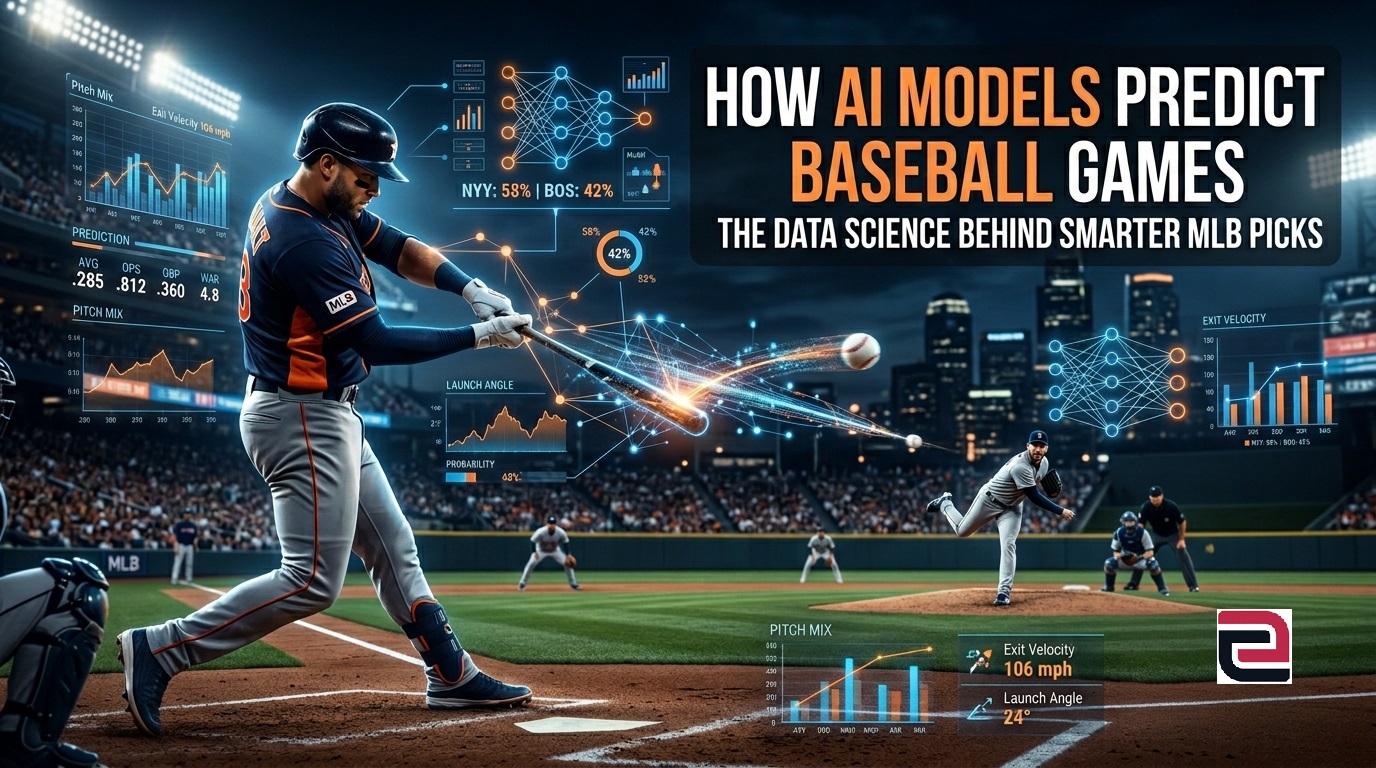
As someone who builds sports prediction systems with machine learning, I’ll walk through how baseball game prediction actually works when you strip away hype and focus on structured data, careful feature design, and honest probability thinking. This is not about magic formulas or “locks.” It is about turning messy game information into signals that can be used consistently across a season.
The goal is simple. Understand how AI models estimate win probabilities using pitching, hitting, bullpen usage, park context, weather, travel, and lineup information. If you follow the logic step by step, you can see how raw numbers turn into predictions that are useful without pretending anything is guaranteed.
Table Of Contents
- Data sources and collection
- Feature engineering and labeling
- Modeling approaches
- Validation, backtesting, and calibration
- Deployment and responsible use
- Step-by-step build process
- Practical betting perspective
- Calibration workflow
- Common pitfalls
- Quick-start prediction workflow
- Conclusion
- Frequently asked questions
Key Takeaways
Before getting into the technical layers, it helps to ground the entire idea in what actually matters.
The first thing people usually underestimate is how important clean data is. Not “more data,” but clean, aligned, correctly timed data. MLB prediction breaks fast when timestamps are wrong or when lineup information leaks into training data. Once you fix those issues, even simple models start behaving surprisingly well.
The second idea is that context always beats raw season stats. A pitcher’s full season ERA matters less than what he has done in the last few starts, how his velocity is trending, and whether his pitch mix is holding up against today’s opponent. The same goes for hitters. A team’s identity changes depending on who is actually in the lineup that day, not what their preseason projection said.
Third, calibration is everything. A model can look accurate on paper but still be useless if its probabilities are not honest. If the model says 60 percent, that should mean something very close to 60 percent over time. If it does not, then everything built on top of it becomes shaky.
Fourth, uncertainty is not a flaw in the system. It is part of the output. Good models do not hide it. They show when games are tight and when they are volatile due to bullpen fatigue, weather swings, or lineup uncertainty.
Finally, this is where ATSwins fits into the real world application layer. ATSwins is an AI-powered sports prediction platform that provides data-driven picks, player props, betting splits, and tracking tools across major sports. You can explore it here: ATSwins. The important part is not just the picks, but how probabilities are structured, tracked, and reviewed over time so users can see performance instead of guessing blindly.
Data sources and collection
Everything starts with data, but not all data is equally useful. In baseball modeling, the biggest mistake beginners make is thinking more variables automatically means better predictions. That is not how it works. What actually matters is whether each piece of data reflects something real about performance or environment.
The core of the system usually starts with pitch-level tracking data. This includes velocity, spin, movement, pitch selection, strike zone behavior, swing decisions, and contact quality. These signals tell you what is happening at the most granular level of the game. For example, a pitcher might have a good ERA but declining velocity or worse swing-and-miss rates. That is a warning sign that season averages will not capture.
Then you have historical game logs. These are used to understand long-term tendencies, matchup history, and team-level behavior over time. They help stabilize the model so it does not overreact to short-term noise.
The third layer is contextual team information. This includes bullpen workload, lineup strength, defensive performance, and park conditions. This layer often creates the biggest edge because it reflects real-time conditions that change daily.
A critical concept is freeze time. This is the cutoff point where data is locked for prediction. Everything before freeze time is allowed into the model. Everything after is treated as future information and must never leak into training. This is one of the most important safeguards in any real system.
Once everything is collected, the data is structured into a single row per game. Each row contains pitchers, lineups, bullpen status, park factors, weather, travel fatigue, and recent performance windows. This structure makes it possible to run models consistently across an entire season without breaking logic.
Missing data is handled carefully. Instead of guessing randomly, the system uses historical averages adjusted for similar contexts. This keeps predictions stable without overreacting to incomplete inputs.
Feature engineering and labeling
Feature engineering is where raw data becomes something the model can actually learn from. This is also where most predictive edge is created or lost.
The most important idea here is that baseball is not static. A team in June is not the same as that team in April. That is why rolling windows are used. Instead of looking at season-long stats, the model looks at recent performance over different time ranges. This captures momentum, fatigue, and adjustments.
For hitters, features focus on contact quality, swing decisions, and matchup splits. Things like barrel rate, hard hit rate, and chase rate matter more than traditional batting average. These metrics are more stable and more predictive of future performance.
For pitchers, the model tracks strikeout ability, walk control, ground ball rate, and how performance changes with pitch count. A key insight is that pitchers do not behave the same way in the first inning versus the sixth inning. Times through the order effects are important because fatigue and familiarity change outcomes.
Bullpen modeling is often overlooked but extremely important. A tired bullpen can completely change late game outcomes. So the system tracks recent usage, leverage situations, and availability of key relievers.
Defense is included through simplified run prevention estimates. It does not need to be overly complex, but it should reflect whether a team converts batted balls into outs better than average.
Weather and park conditions are also part of feature engineering. Temperature, wind direction, humidity, and stadium characteristics all affect scoring environments. Some parks amplify offense while others suppress it, and weather can shift that dramatically.
Travel and rest are often ignored in casual models but matter in practice. Long travel across time zones or lack of rest can subtly reduce performance across both pitching and hitting.
Labels are usually simple. The main target is game outcome, meaning win or loss. Additional targets like runs scored help the model understand scoring distribution.
The biggest rule in this entire stage is avoiding leakage. No feature is allowed to include information that would not have been known before the game started.
Modeling approaches
Modeling begins with simple baselines. This is intentional. If a simple model does not work, a complex one will not save it.
Logistic regression is often the first step. It is stable, interpretable, and surprisingly strong when features are well designed. It gives a clean probability output and is easy to calibrate.
After that, gradient boosted models are introduced. These are more flexible and can capture nonlinear interactions. For example, a specific pitcher might perform differently in windy conditions against high contact teams. Boosted models can learn these patterns automatically.
Hierarchical models add another layer. These models allow shared learning across teams and players. A new pitcher with limited data can still be estimated based on similar pitchers while gradually developing their own profile as more data arrives.
Ensembling is another key concept. Instead of relying on one model, multiple models are combined. Each one captures different parts of the signal. When averaged, the result is more stable and less sensitive to noise.
Regularization is used to prevent overfitting. Baseball data is extremely noisy, and without constraints, models tend to chase patterns that do not repeat.
Validation, backtesting, and calibration
Validation is where models prove whether they actually work. This is done using time-based splits rather than random splits. The model trains on past seasons and tests on future games in chronological order.
This is critical because baseball is time dependent. Player performance, rules, and even league-wide environments change over time.
Backtesting is used to simulate real-world conditions. The model makes predictions on past games as if it were operating in real time. These predictions are then compared to actual outcomes.
Calibration is the most important part of this stage. A well calibrated model means probabilities reflect reality. If the model predicts 70 percent outcomes, those outcomes should happen about 70 percent of the time over many samples.
Evaluation is not just about accuracy. It is about probability quality. Metrics like log loss and Brier score are used to measure how honest the probabilities are.
Another important step is slicing errors by context. The system checks whether it performs worse in certain parks, against certain pitching styles, or in extreme weather. If patterns appear, features are adjusted.
This is also where benchmarking matters. A simple baseline like home field advantage or basic team strength is used as a reference point. The model must consistently outperform these baselines to be considered useful.
Deployment and responsible use
Once validated, the model is deployed into a daily system. This system runs continuously and updates predictions as new information arrives.
Early predictions are generated before lineups are confirmed. Later updates refine probabilities after lineup announcements and weather updates. Final outputs are produced close to game time.
Monitoring is important because models degrade over time. If performance suddenly shifts, it could mean roster changes, data issues, or league-wide shifts in play style.
Responsible use is a major part of the system. Predictions are not guarantees. Even strong edges lose often in baseball because randomness plays a large role.
ATSwins presents these probabilities in a structured format so users can track performance over time instead of reacting to individual games.
Step-by-step build process
The build process starts with setting up clean data storage. Every game must be structured consistently.
Next, features are defined and versioned. This ensures consistency between training and prediction.
Rolling windows are implemented carefully to avoid future leakage.
Baseline models are built first before adding complexity.
Calibration is applied after modeling to ensure probabilities are meaningful.
Finally, the system is deployed with scheduled updates and monitoring.
Practical betting perspective
From a practical standpoint, the goal is not to predict winners perfectly. The goal is to find mispriced probabilities.
If a model estimates 55 percent but the market implies 50 percent, that difference is the edge. Over time, those small edges matter more than trying to pick every game correctly.
Baseball is high variance. Even good models lose frequently in the short term. That is why consistency matters more than excitement.
This idea connects directly to broader betting research, including articles like “How AI Identifies Mispriced MLB Odds and Outsmarts Sportsbooks” which explains how probability gaps between models and markets are created and exploited in structured systems.
Calibration workflow
Calibration is updated regularly using recent results. The system checks whether predicted probabilities match real outcomes in small probability bands.
If the model becomes overconfident or underconfident, adjustments are applied. This keeps predictions stable across the season.
Common pitfalls
One of the biggest mistakes is accidental data leakage. Another is overreacting to small samples like one or two hot weeks.
Ignoring bullpen fatigue is another common issue. So is underestimating weather and park interactions.
Quick-start prediction workflow
Each day starts with data collection, followed by early predictions. After lineups are released, the model updates inputs. Final probabilities are generated before first pitch.
After games finish, results are stored and used for future retraining and calibration.
Conclusion
AI baseball prediction works because it organizes real-world complexity into structured probabilities. It does not remove uncertainty, it measures it.
ATSwins provides a platform for this type of modeling in a practical environment where users can track predictions over time: ATSwins.
Frequently Asked Questions
AI models predict baseball games by combining pitching, hitting, bullpen usage, and environmental conditions into probability estimates.
Accuracy depends on calibration rather than perfect prediction. The goal is long-term reliability.
Key factors include starting pitching, bullpen fatigue, lineup strength, park effects, and weather.
Models update when new information like lineups or weather becomes available.
ATSwins uses structured data and calibrated models to produce predictions, props, and tracking tools across sports.
Final reflection on how probability actually behaves in baseball
One thing that takes a while to fully accept is that probability in baseball never feels clean in the short term. Even when the model is correct, outcomes can look wrong for long stretches. That is just how random variation shows up in a sport with so many independent events.
A well built system is not trying to eliminate that randomness. It is trying to survive it. That means staying calibrated, staying consistent with features, and not overreacting to short streaks.
Over enough games, the structure reveals itself. Good pitching matchups, tired bullpens, and favorable conditions start to show up in results in a way that aligns with the model. That alignment is what matters, not any single night of games.
This is also why long-term tracking and transparency are so important in platforms like ATSwins. The value is not in claiming certainty, but in showing how probability behaves over time in a real environment.